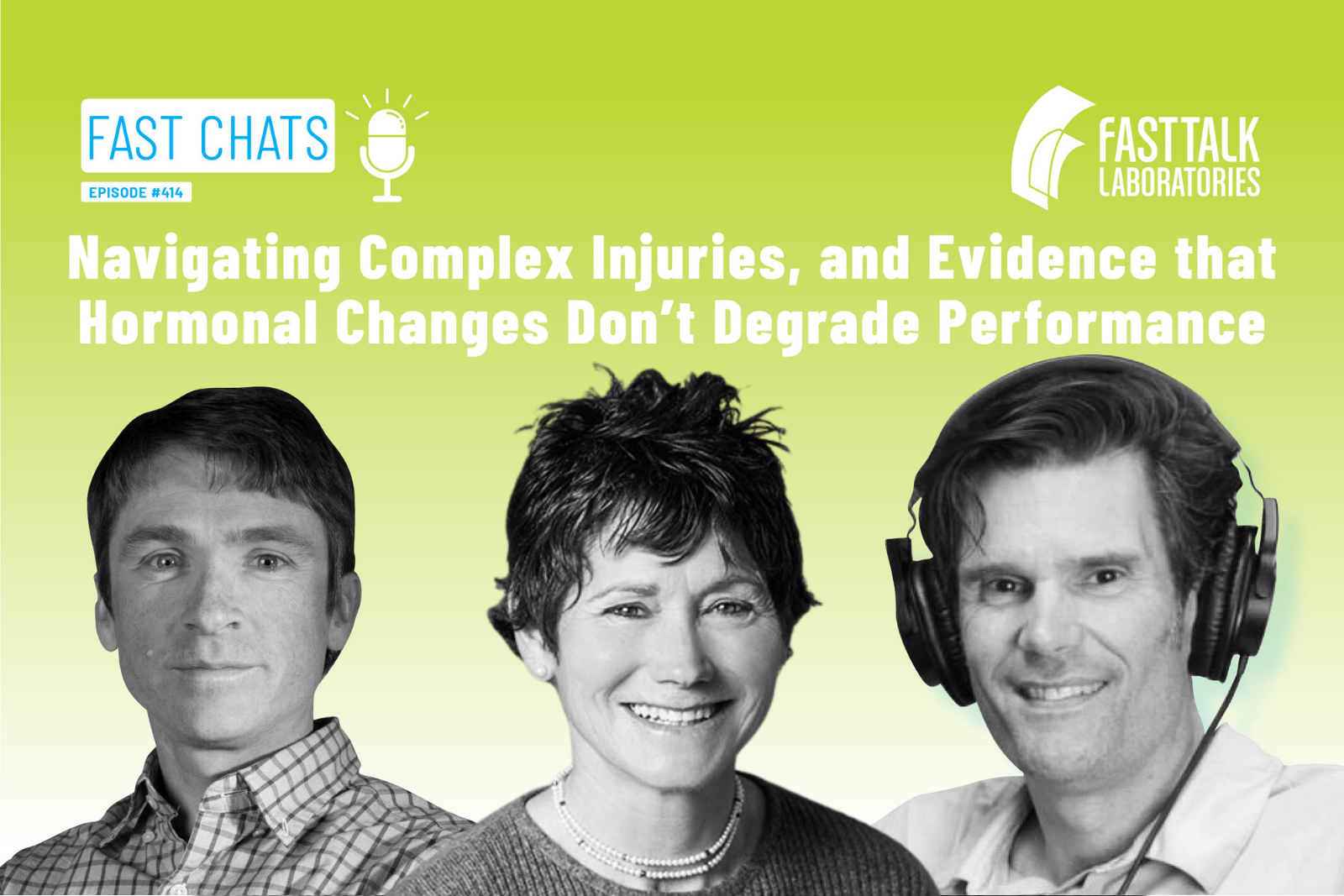






We discuss how to find solutions when you’re dealing with injuries without an obvious cause, then we review new research that demonstrates that changes in progesterone, estrogen, and testosterone do not negatively impact performance in males or females.
Episode Transcript
[00:00:00] Chris Case: Hey everyone. Welcome to another episode of Fast Talk, Trevor Connor. Julie Young, how are you today?
[00:00:10] Trevor Connor: Good. You didn’t do the tagline.
[00:00:12] Chris Case: I know,
[00:00:12] Trevor Connor: because I’m sure you were worried you’d get around too.
[00:00:15] Chris Case: No. This is your source for the Science of Endurance perform. So what are we thinking about? Today’s episode, we’re talking about injuries and we’re talking about those types of injuries where it’s a little bit hard to tell what the heck is going on.
It’s not obvious. It’s not a broken bone, it’s not a sprained ankle. It’s not something where you go to your GP or the emergency room and they stitch you up and you’re back on the road to recovery. It’s this that doesn’t feel right. Mm. Maybe I can ignore it for a little bit and it’ll go away. Nah, it’s not going away.
I don’t know who to see. I don’t know if it’s a PT issue. I don’t know if it’s a bike fit issue. I don’t know if it’s an overuse. I put in too many miles this week and I’m just feeling something that’s a little bit off. So that’s. How this came about. I’m dealing with something like that. Trevor, you are dealing with something like that.
Julie, you have dealt with stuff like that, and so we wanted to talk about that. Give people a bit of, I don’t know if it’s wisdom or not, but we’ve all been through it, so let’s talk about that experience and try to guide people. If you’re dealing with this type of scenario or this situation, here are some things to consider.
Here’s what you might wanna do. Here’s what you might not want to do at all. Hey listeners, come ride with us now through March. Trevor Conner and I are hosting Zift rides every Tuesday with special guests like Neil Henderson, Brent Buckwalter, Dr. Steven Seiler, and more. Each workout will be an easy no drop ride, so you can chat your cycling training questions to our experts and get instant answers, all while enjoying a one hour workout.
For Fast Talk Labs rides onw.com or see our guest list and register on Fast Talk labs.com/.
[00:02:07] Trevor Connor: Julie, you pointed out before we started recording that we could do a whole episode, if not a series of episodes on addressing injuries. So this is really just some guidelines, general guidelines on do you have an injury?
What do you do? What are the steps?
[00:02:21] Chris Case: Yeah.
[00:02:22] Trevor Connor: So Julie, why don’t you start us out. So if somebody has some pain or something’s bothering them, what are the first steps?
[00:02:29] Julie Young: I mean, I guess for me it is trying to narrow down like what could be the contributors to try to obviously resolve that. But you know, I think first and foremost it’s avoiding anything that triggers that pain.
And as Chris mentioned this, these are hard, these naggy little. Issues because it’s not like a broken bone or something that you can address and get that immediate help. These naggy little issues typically take avoiding the particular movement or whatever it is that’s creating that issue and then just giving it time.
It’s been my experience and I think for endurance athletes, that’s like one of the hardest things is it’s just gonna take time. But I definitely do think it is important to understand like what are the contributors to this? As Chris said, is it bike fit? Is it too much too soon? Is it poor flexibility on the bike?
Those sorts of things so that you could address that first and resolve the contributing issue.
[00:03:25] Trevor Connor: So I’m going to actually. I give a slightly different take on this. I don’t think the first step is figuring out the contributors. ’cause I think often as the athlete you don’t know what they are. So my first step is you need to find the support, the right people to help you.
’cause they’re the ones who are gonna identify it. I can’t tell you often you have an injury. When you go and see somebody about it who’s an expert on it, they tell you, here’s the source, here’s the cause, and it’s not at all what you expect. So point I wanna make is don’t try to diagnose yourself and say, oh, I know what’s causing this.
You might be surprised unless you are a medical expert yourself. Mm-hmm.
[00:04:04] Chris Case: So there’s an abundance of specialists in your network and in mine, and probably in Julie’s because we’ve been doing this a long time, and you and I in particular, we live in a place like Boulder. There’s so many experts around.
There’s so many people we come in contact with who. Have either dealt with it or know other people who’ve dealt with it, or that they are experts in whatever we’re talking about and addressing that injury or issue. For those people that don’t have that network, are you suggesting that wherever they live, kind of have a, or try to build up a network of specialists so that they know who to turn to?
Before an issue even arises, so that when it does arise, they can turn to that person as opposed to waiting and reacting, oh, I have pain now I need to find somebody. And it takes a little bit of time.
[00:04:57] Trevor Connor: Yeah. I’ll give you my take, which is everywhere I lived. I’ve moved a bunch of times. First thing I do is look for somebody, look for that network of experts that I can go to, and I spent a lot of time asking around who’s a good bike fitter, who’s a good pt, that sort of thing.
So when I do have an issue, I know who to go to. But Julie, what’s your experience? What do you think?
[00:05:18] Julie Young: My experience is that people don’t start looking until they’re in pain.
[00:05:24] Trevor Connor: Yeah.
[00:05:24] Julie Young: Yeah. As I’d mentioned to you guys, I think pain is the motivator, but I also agree like your first point, Trevor, that you do want those experts guiding the process, and I’m a big fan of not waiting things out and not guessing my way through a pain or injury, but like really going to those experts.
Typically in these situation PTs are my go-to people. But again, as we were discussing offline, like any industry PT expert and their practice runs the gamut. And so I think for me it’s finding that PT that is a real problem solver, not just a STEM and ICER that really. It’s going to get to the root of the issue and help you navigate avoiding those contributors or resolving those contributors.
But I definitely think you wanna build up that network. But I think for a lot of people, it’s once they’re in pain that they go seeking those experts.
[00:06:16] Chris Case: One of the other things I think that’s worth mentioning, probably pretty obvious, is that. Athletes are a little bit different. So it’s helpful if you can see a PT or anybody that’s helping you with a problem that they are familiar with athletes, and a lot of times, particularly if it’s a cycling related issue, that maybe it’s saddle related or fit related, that they understand the repetitive motions and what that can cause.
And not every PT really understands that. Not every doctor understands that. This is getting a little outside of this, but you talk about heart issues. You go to a cardiologist who sees the general population and they see an athlete and they’re like, holy, what’s going on? You’re, there’s something really wrong here.
And you’re like, no, you just don’t know what athletes look like when you do ECG or whatever.
[00:07:09] Trevor Connor: I always love telling the story about the heart specialist that I saw many years ago, and I, I told him I wear a heart rate strap. And he just went, what’s that? And when I told him, athletes use heart rate straps, he’s like, no, they don’t.
And then he gave me a whole lecture on being a hypochondriac.
[00:07:27] Chris Case: Mm.
[00:07:28] Trevor Connor: And to stop wearing a heart rate strap. And you just go, okay, you don’t know athletes at all, right. To you.
[00:07:32] Chris Case: Yeah. Move on. You move on from that person at that point. Yeah.
[00:07:36] Trevor Connor: Definitely seen things like that. I mean, so what think I always recommend is if you’re new to an area or you don’t have your network of people, the group rides, you know, look for the people who have lived there a long time or lived there their whole life, and ask ’em who the experts are.
Often they’ll have good recommendations. Mm-hmm. You’re absolutely right. Somebody who knows Sports
[00:07:55] Chris Case: Trevor. How much do you use chat GPT to diagnose all of your issues?
[00:08:01] Trevor Connor: Not at all. And I could see Julie nodding her head.
[00:08:07] Chris Case: Yeah, it’s funny. AI is everywhere. We’ve talked about it a lot here. It’s taking over the world in some ways.
For better or worse, there are companies now that are releasing products that are labeled like Chat, GPT Medicine or whatever. I don’t know that they’re any really any better or any different. Maybe they will be someday. I think that the reason I ask that question is. For those people. Maybe they don’t live in an area where there’s a lot of resources and maybe they’re new to the area and they don’t have the friends to ask, they, they would turn to digital resources and try to have a conversation with chat DBT.
I think that you could certainly try it and challenge it, but be careful. It can lead people astray. I think at this point it’s not good enough. It’s not robust enough. It’s not sophisticated enough. It ain’t a doctor, so be careful if you do use it. And Trevor, you might, I don’t know, you might say, just don’t try it whatsoever.
[00:09:05] Trevor Connor: Well, the thing I’ve got to say to this is, and this is why you need an expert, often the cause of an injury is more subtle than you think or not what you think. So I’ll give you the example. I have an injury in my arm right now, so I was doing a lot of bicep curls this fall just to change things up. I was getting a lot of pain in my right bicep, so I thought, okay, I’m just doing bad form, and I aggravated the bicep and so I, I have a group of massage therapists, a pt, a chiropractor that I work with, and they all gave me the same answer, which is interesting.
So they got into my arm, they palpated a little bit and discovered, actually the issue was in my forearm. And then, and I forget the name of the muscle, but the muscle that was actually aggravated is the one that gets really aggravated by using a mouse.
[00:09:58] Chris Case: Mm-hmm.
[00:09:59] Trevor Connor: And what’s going on with me is it wasn’t I was doing bad form, it’s that I already had some aggravation there because I’m using a bad mouse when I’m working on my computer.
And when I started doing bicep curls, it just aggravated what was already there.
[00:10:13] Chris Case: Mm-hmm.
[00:10:14] Trevor Connor: And that’s not something I would have guessed.
[00:10:16] Chris Case: Everybody’s telling you, you work too much, Trevor. You’re just not listening to the message.
[00:10:20] Trevor Connor: No, they’re saying I’m using the wrong mouse. Work smarter,
[00:10:25] Chris Case: work smarter. Sure.
That’s when you use ai, right?
[00:10:30] Trevor Connor: Yes.
[00:10:31] Chris Case: Just don’t admit to it
[00:10:32] Trevor Connor: because it’s a lot smarter than me. I agree to that. So Julie, as you said, it really important to figure out what’s contributing, but you need support for that. What else is really important here in terms of figuring out the contributors?
[00:10:47] Julie Young: I think it’s finding that expert.
And then I also think what Chris pointed out is also very important. Someone that’s familiar with your lifestyle or familiar with your sport of choice, and then really creating a partnership with that expert describing your life particulars of what you do, and hopefully like as in your case, you can really dig deep and find that root cause.
Then of course I would expect that expert to then provide some sort of treatment plan as well.
[00:11:18] Chris Case: I think going in sometimes it, it helps to have a bit of an open mind. A lot of athletes are driven to solve problems.
[00:11:26] Trevor Connor: Yes.
[00:11:27] Chris Case: And so they want, they’re like, I’m convinced it’s this, but I need the PT to do this or the this, or I need this certain exercise to quote unquote treat it.
And they go in thinking they know what’s wrong. They’re told something else and they might resist that. For instance, in your case, not that you were like this, but you’re like, oh, it’s definitely something in my bicep. They told you something different and you actually accepted that. So I think there’s a onus on the patient slash athlete in this case to have an open mind and not go in thinking you’ve solved it.
Even though what we’re talking about is tricky
[00:12:01] Trevor Connor: though, I will say I have not acted on the recommendation because the mouse they recommended to me.
[00:12:07] Chris Case: Yeah.
[00:12:08] Trevor Connor: Expensive is the same. No, it’s the same mouse that Dave our head of marketing uses.
[00:12:12] Chris Case: Yes.
[00:12:13] Trevor Connor: And whatever I see him use that. I’m like, that is the silliest looking mouse I’ve ever seen.
So I’m having a hard time convincing myself to buy
[00:12:20] Chris Case: one. You’re saying. Stubborn.
[00:12:22] Trevor Connor: Yes. That is what I’m saying.
[00:12:26] Chris Case: So you’re not the perfect patient.
[00:12:28] Trevor Connor: No,
[00:12:30] Chris Case: not all. You keep an open mind to a point. Yes.
[00:12:33] Trevor Connor: But Julie, I agree with you a hundred percent that in my personal opinion, when you are having an injury or an issue and you go and see an expert.
They need to be giving you homework. There needs to be exercises, things you need to be doing. It doesn’t need to all hurt. It doesn’t need to be really hard.
[00:12:50] Chris Case: No,
[00:12:50] Trevor Connor: a lot of it is, it can be massage work, stability work, flexibility work, but they should be giving you exercises to do at home. And I would even say if you go and see somebody and they’re not giving you that work, I’d be a little hesitant about is this the right person or not?
Mm-hmm.
[00:13:06] Chris Case: Yeah.
[00:13:07] Julie Young: I always feel that pain is the greatest motivator, and when we are in these situations and we’re given that homework, like to me, that’s the work we should always be doing, like every single day in most cases. And it’s just the stuff that slips through the cracks because we all are like, as endurance athletes, like you said, it shouldn’t.
But you know, we want it to hurt. And so we love that activity that hurts. And so like all the like foundational PT work or stability, mobility, that’s the stuff that goes first in, in lieu of getting out on your bike. So I think, like I said, pain is a motivator, but to me this is the kind of work in most cases we should be doing all the time.
[00:13:48] Chris Case: Last question for you. From my point of view, Trevor. We’re talking about a population of individuals. You included me, included, Julie, included, that doesn’t wanna stop. We don’t want to de train, we don’t wanna lose fitness. So sometimes it’s hard to back off, which is sometimes exactly what we need to do.
Right? Question to you is sometimes people take that mentality overboard and they think, oh my God, if I have to take three days off, I’m gonna de train. So if they’re, you’re asking me to take two weeks off the bike or two weeks from exercising at all, I’m gonna be in such a hole. I’ll never be what I used to be, but that’s not really true.
[00:14:26] Trevor Connor: No, I’m gonna give you a nuanced answer again that I, I really want to hear Julie’s response to this. Yeah. If they tell you to stop using something because it’s injured, you should stop using it. And as you said, losing a few days isn’t that big a deal. I have known so many athletes that had a knee issue that had they addressed it right away the proper way.
It would’ve gone away instantly, but they didn’t address it, that it became chronic and then they were off the bike for a season or had knee pain for the rest of their career.
[00:15:01] Chris Case: Right?
[00:15:02] Trevor Connor: And that’s what you wanna avoid. But I will say my personal belief in terms of addressing issues is there is a point where rest is counterproductive because our bodies heal.
To what you throw at them. So if all you are doing is resting, that’s what the body’s going to heal towards. And, and I personally see people not healing as well, so it’s, you wanna start doing movement, you wanna start doing activity as soon as possible. You just wanna be doing the right activity so that the body can heal.
Right. Julie, what’s your feeling?
[00:15:39] Julie Young: I mean, whenever I’m helping athletes return to sport from injury, and it’s always thinking about like what are the things we can be doing? Not fixate on that one thing we can’t do, so maybe we can’t ride the bike for a bit, but there’s other things we can do that. Aren’t gonna be jeopardizing the healing process, but that are also probably super beneficial.
Kind of back to this idea of these foundational things like stability, mobility that tend to slip through the cracks. So I truly believe sometimes injury is this great opportunity to come back even better and stronger, just be more functional.
[00:16:15] Trevor Connor: Mm-hmm.
[00:16:15] Julie Young: So that’s kind of how I approach it. Like they say motion is lotion.
So I think that’s, you know, in terms of healing the body,
[00:16:22] Trevor Connor: it is necessary. The last thing I need to say is. Hopefully that expert has given you a good routine. My experience is often you have to experiment a little with the routine. You might have to see a couple experts who will each give you their thoughts and the exercises.
You try all of them, and you find the ones that really work. I have a binder with all my exercises, and I have a couple sheets in there of all the exercises. I’ve been given over the years to avoid overuse injuries and pain and all this sort of stuff, and it’s something you keep up. You know, I have a couple days a week go down into my basement and just spend 15 minutes doing those exercises that don’t make me any stronger on the bike, but prevent me from having back pain or knee pain or all those other issues.
[00:17:09] Chris Case: Do you still hang upside down sometimes like a bat?
[00:17:12] Trevor Connor: Never hung upside down.
[00:17:13] Chris Case: You didn’t?
[00:17:14] Trevor Connor: No. I’d hang from my arms.
[00:17:15] Chris Case: Oh darn.
[00:17:16] Trevor Connor: I’ve not skilled enough to hang upside down.
[00:17:19] Chris Case: That would lead to more injuries if you tried that.
[00:17:22] Trevor Connor: Yes. Fall in my head.
[00:17:23] Chris Case: That’s right.
[00:17:24] Trevor Connor: My back is great, but now I can’t do
[00:17:26] Chris Case: that. Now my head hurts.
Why?
[00:17:31] Suzy Sanchez: Hey coaches. This is Susie Sanchez from USA Cycling. We’ve partnered with Fast Talk Laboratories to upgrade our coach education program. By the end of this year, USA Cycling will have over 50 new CEU courses for coaches produced by experts from Fast Talk labs. Visit usa cycling.org/coaches to learn more.
[00:17:50] Chris Case: All right. Let’s move on to a paper that Julie, you found very interesting. Why don’t you tell us a little bit more about that?
[00:17:57] Julie Young: Yeah. I was really excited about this paper actually. Trevor found it and shared it with me, and the title is The Impact of Biological Sex. Female sex hormone concentration on the maximal metabolic study state.
And the conclusion, this is a recent paper, I think 2025 if I’m not mistaken. And so what they concluded was the lean body mass normalized work rate at maximal. Metabolic steady state was similar between men and women. Fluctuations in sex hormone profile in women were not associated with differences in the heavy to severe exercise domain boundary, nor were there any observed sex differences across distinct hormone profiles.
The thing I think’s interesting about it is they haven’t found differences in terms of like when they normalize for lean body mass. In work rate between men and women, and they, they were focused more on fluctuations of, of the sex hormones through the month. Not necessarily focused on the menstrual cycle per se, in terms of the different stages, but for me personally as a coach, I think this is really encouraging and empowering for female athletes or are sometimes told that.
They’re compromised, they’re kind of resigned to like if a race falls at a certain part of their menstrual cycle, you know they’re gonna suck and they just kind of have to deal with it. So I think this is really encouraging in that they don’t see any sort of performance changes with. The hormone. They did see like the rate of perceived exertion may be higher, but that’s not associated with like increase in heart rate or ventilation.
And that’s I guess to also say, not to discount or marginalize how women feel through the menstrual cycle, but I think, again, for me personally as a coach, this is an encouraging and empowering paper for female athletes. I was excited to be able to share this with athletes that I work with because I think there’s been two camps in this emerging interest in female physiology and research, and there’s one camp that basically is telling women that the menstrual cycle has a definite effect on their performance in that they should be.
Training to their menstrual cycle. And then what do you do when you get to a race that doesn’t fall in that optimal time in your menstrual cycle? And for me, this paper basically says there aren’t changes or there are no deficits for female performance based on the time of their cycle. So throughout their cycle, they’re able to perform at a high level.
And Trevor, you pointed out that they actually. Discovered that the females were able to perform at a higher work rate per watt, per kilogram in this study, and then also were able to operate or to perform at like a higher percentage of VO two max, so there were no detriments to their performance across their menstrual cycle or across different variations of the hormone profile.
[00:21:13] Trevor Connor: I did find that really interesting. They normalized watts per kilogram to lean body mass. And when they did that at the this mean max steady state, and by the way, we haven’t used that term before. And we could spend the whole episode talking about the nuances of what that means, but that’s not the purpose of this conversation.
So just think of that as threshold kind of FTP ish. Power. So what do you a time trial at? Uh, we will save the conversations for its nuances another time.
[00:21:44] Chris Case: Mm-hmm.
[00:21:45] Trevor Connor: But what they showed was women normalize to lean body mass, average 4.13 watts per kilogram, and men average 3.92. It does make some intuitive sense because at that sort of intensity you’re still gonna be heavily reliant on oxidative fibers, particularly type one fibers.
And women tend to have a higher percent of type one fibers.
[00:22:11] Chris Case: The one thing that rose, or maybe at least one of the things that Rose was RPE, is that correct, Julie?
[00:22:18] Julie Young: Yes. Again, they didn’t use menstrual cycle. They were more focused on the fluctuations in the hormone levels, but they did see. That the rate of perceived exertion for the effort was higher, but that wasn’t associated with a higher heart rate or higher ventilation
[00:22:37] Trevor Connor: or a drop in power.
Mm-hmm.
[00:22:38] Julie Young: Right. So this is really encouraging. I’m excited to share this paper with athletes who I coach. Because again, athletes don’t have control over their race schedule, and they’re told that, gosh, during this part of your menstrual cycle, you’re basically gonna suck. And that lines up with a really important race.
We all know how important the mental and psychological component of performance is, and if you’re towing the start line. I think every athlete tows the start line with some doubt. But if you’re again told like at this particular point in your menstrual cycle, you’re really at a deficit, how do you overcome that?
And so again, to me this is incredibly like empowering for these athletes to know like they’re good every single day. They’re at their best.
[00:23:31] Trevor Connor: I agree with you. I like the message, and I was actually thinking about this last night because right now we’re in the middle of the Winter Olympics and I was watching some of the events and realized there’s hundreds of women at the Olympics.
[00:23:45] Chris Case: Mm-hmm.
[00:23:46] Trevor Connor: How many of them are waking up? The day of their event and going, oh God,
[00:23:52] Chris Case: yeah,
[00:23:52] Trevor Connor: timing is wrong. The effect that can have on them mentally to just say, oh, I can’t perform now. And really what this study is saying is, yeah, RPE might be a little bit higher. You might not feel quite as good, but you can go just as hard.
It’s not gonna affect performance.
[00:24:09] Chris Case: Julie, at the elite level, are elite female athletes more apt to use hormone treatments to stabilize things? Or do you see the fluctuations?
[00:24:23] Julie Young: You mean like a contraceptive
[00:24:24] Chris Case: Yeah.
[00:24:25] Julie Young: Kind of thing. No, it’s really out of favor now because of like for example, reds. So if they’re using that, they would mask whether they truly have.
A menstrual cycle or not. So that’s, at least my circle’s, not a favorable recommendation.
[00:24:42] Chris Case: Mm-hmm.
[00:24:43] Julie Young: Like usually people are doing like non-hormonal IUDs.
[00:24:47] Trevor Connor: Yeah.
[00:24:47] Chris Case: Right.
[00:24:48] Trevor Connor: And that was actually why they chose to do this study the way they did. And I think it’s really important. They pointed out that about 70% of women.
Are either using or have used a contraceptive, as you said, it was mostly IUDs.
[00:25:03] Chris Case: Mm-hmm.
[00:25:04] Trevor Connor: And that’s why they didn’t wanna look at the phase of your cycle, because if you’re using an IUD, you can’t really look at the phase of the cycle, but. They still have the hormone fluctuations.
[00:25:15] Chris Case: Mm-hmm.
[00:25:16] Trevor Connor: So they could, in this study, look at what’s the impact when progesterone is high, what’s the impact when progesterone is low?
So they’re looking at estrogen and progesterone and testosterone in this study and just saw higher, low in all three of those hormones. And they also, there were 15 women, 15 men. ’cause I also wanted to see if there was an impact in, in men. Mm-hmm. And just said changes in all three of those hormones had no impact on performance.
[00:25:42] Chris Case: Mm-hmm.
[00:25:42] Trevor Connor: Like I said, that is important because so many women are gonna be competing on contraceptives, so they still wanna know. What’s the impact?
[00:25:51] Chris Case: Yeah.
[00:25:51] Trevor Connor: Julie, I know you also wanted to talk about some of the things that they saw specifically with estrogen.
[00:25:57] Julie Young: Yeah, so estrogen is interesting. I mean, I think some women feel like negative with all this hormone fluctuations because on one side it can make you feel lousy, but there are a lot of benefits.
So like for example, estrogen stimulates the production of nitric oxide, which then. Stimulates the vasodilation, which helps our ability to take in, not necessarily take in more oxygen, but really deliver and utilize that oxygen. And that’s a huge part I think, of this study and seeing that women can perform that work rate at a higher percentage of their VO two.
[00:26:35] Trevor Connor: Julie, I wanna go back to where you started at the beginning of this paper. ’cause you know, some of my thoughts on this, and like you, I thought this was a very encouraging paper, but as you said, there, there are two camps. There’s the one camp that says that the menstrual cycle has. A huge impact on women and at certain times of the month, training is next to ineffective, where there are other camps that say, yeah, it’s gonna have some effects, but don’t overrate it and just keep training.
I’m interested in where you stand on that spectrum and what impact this study has had on your opinion.
[00:27:14] Julie Young: You know, Trevor, when we were doing Fast Talk fem for example, that was largely based on trying to shed light on the differences between. Men and women, and I know it’s still early days in, in terms of the attention and the money that is being invested in research to try to make research more pertinent to women or replace that research on female athletes or focus that research on female athletes so we can have more definitive information on female athletes.
But seems to me like the more I learn and studies start coming out and it is high quality. Research, which I think again, has been an issue. It seems to me that we’re discovering that there may not be that many differences. And again, I know it is early days and I feel like when this conversation first started, there was that camp that really.
Placed the stake in the ground and built an industry around proving that. As I say, women aren’t little men. Now we’re scrambling to find the science to back it up. But it seems to me, again, as these high quality studies do come out, we’re not seeing that there’s this significant. Difference. And I guess for me personally, like I don’t want women to feel, or the women that I coach to feel that their menstrual cycle controls them.
I want them to feel that they’re in control. And again, as we discussed, like an athlete doesn’t decide they’re not. In control of that race schedule. So that menstrual cycle isn’t lining up perfectly to what they think is like that perfect performance time of their menstrual cycle there. Is that a mental, psychological component to it?
So I guess for me, I just really wanna encourage the athletes that I work with to, yeah, of course. We need to understand them individually and understand individually how they respond to their menstrual cycle. And so we can be proactive with that. And if they are. Experiencing some of these less favorable things, uh, with their menstrual cycle.
There’s definitely strategies that we can implement to help mitigate those less favorable things, whether that’s nutrition, hydration, maybe upping branch chain amino acids. But again, the reason I love the study is again, that it really. Puts the female athlete in control as opposed to like at the mercy of their menstrual cycle.
And like I said, this other camp, it’s really rotating everything around the menstrual cycle in terms of how females are training, whether they’re, rather than being on a three week build in their training, maybe they’re on a two week around that menstrual cycle. So I just feel like some of these strategies that are really.
Allowing the menstrual cycle to take center stage are in some ways chipping the female athlete of their potential.
[00:30:07] Trevor Connor: No, I’m really glad to hear you say that because I, I feel very similarly. I think it’s been a real positive thing. That we’re now doing that research and say it was a mistake that we were only ever doing research on men and then applying it to women.
And I do think there are definite differences. And this study actually, I mean I thought it was great at the very end when they talked about how this study can contribute to, to the research, they talked less about the actual result, which was you didn’t see a change in that power, uh, threshold.
Essentially they said it’s more. We took a different approach of studying women where we looked at hormone level versus stage in their cycle and why that’s important. So you’re seeing this continuation of how do we do effective research on women to see how hormones have the cycle affects their training.
But Julia, I agree with you a hundred percent that you’re seeing the menstrual cycle. This is one study. I’ve seen other studies that similar things, that the menstrual cycle just doesn’t have as enormous an impact as I think we feared. And I think that’s a positive thing, not a negative thing.
[00:31:13] Julie Young: I do too.
And I do agree with you, Trevor. I think it’s absolutely a positive that this conversation has started and there is more attention being brought to female specific research. Again, I just do think it is interesting as this higher quality research comes out, it appears that there aren’t these major differences or detriments due to the menstrual cycle.
[00:31:35] Trevor Connor: It’s a great message.
[00:31:36] Chris Case: Thanks Julie. Thanks, Trevor. That was a great conversation. That was another episode of Fast Talk. Subscribe to Fast Talk wherever you prefer to find your favorite podcast. Be sure to leave us a rating and a review. Hey, don’t forget Trevor, we’re now on YouTube. Give us a like, subscribe there.
Help us reach new audiences. As always, remember that the thoughts and opinions expressed on Fast Talk, especially Trevors, are those of the individual
[00:32:01] Trevor Connor: and
[00:32:02] Chris Case: kind, and we love your feedback. So join the conversation@forums.fast talk labs.com or join us on social media at. Fast talk labs for Julie Young and Trevor Connor.
I’m Chris Case. Thanks for listening.