
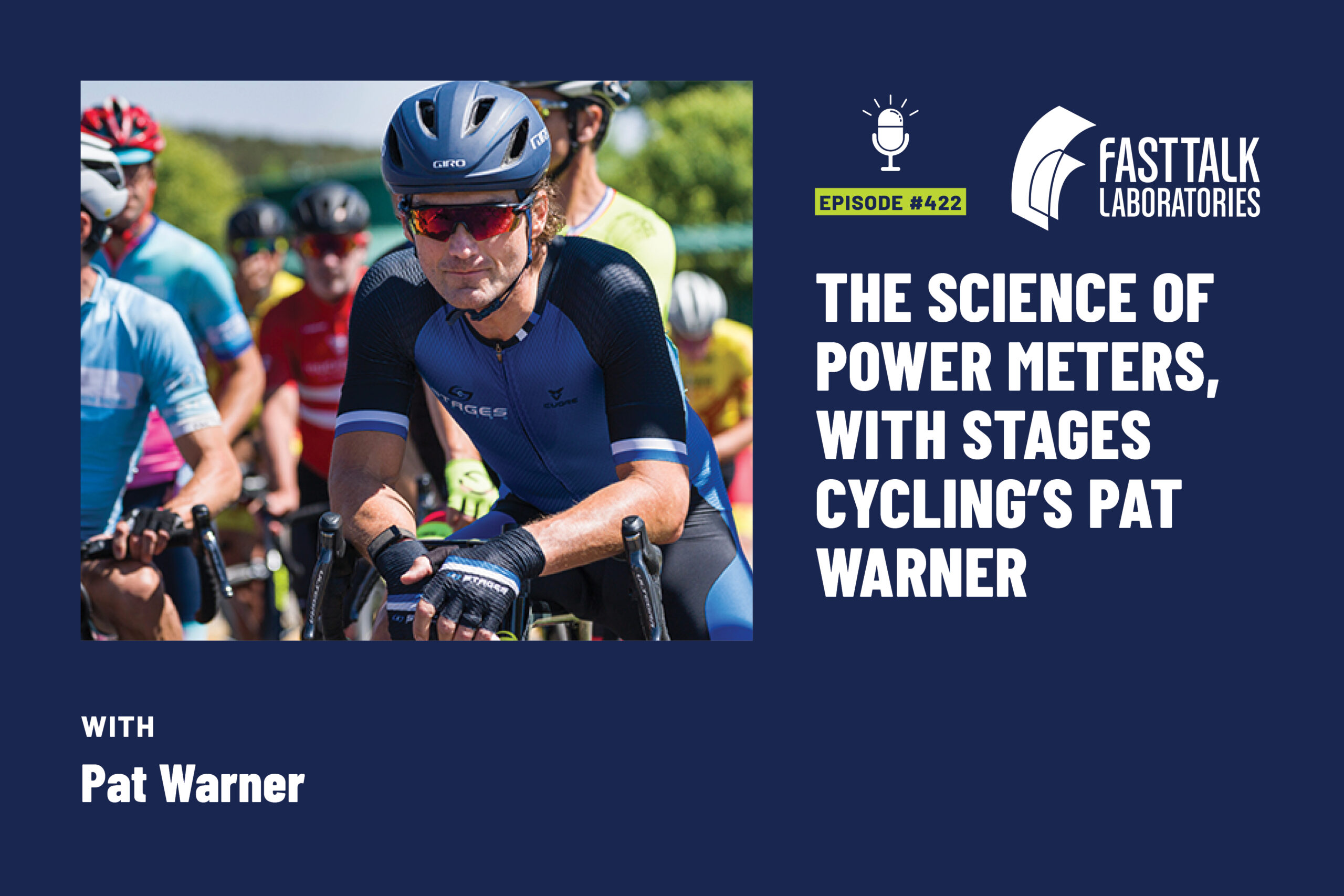
The Science of Power Meters, with Stages Cycling’s Pat Warner

You probably own a power meter, but do you know how it measures power or how these devices have evolved over 20 years? We were joined by Stages Cycling’s head of product development Pat Warner to pull back the curtain on the technology of power measurement.
Please login or join at a higher membership level to view this content.

Fast Talk Episode 422 with Pat Warner

You probably own a power meter, but do you know how it measures power or how these devices have evolved over 20 years? We were joined by Stages Cycling’s head of product development Pat Warner to pull back the curtain on the technology of power measurement.

Please login or join at a higher membership level to view this content.

Episode Transcript

[00:00:00] Trevor Connor: Hello, and welcome to Fast Talk, your source for the science of endurance performance. I’m your host Trevor Connor, here with Chris Case. It is not an exaggeration to say that power meters have revolutionized the sport of cycling in the last 20 years. But in many ways, they have also revolutionized the scientific study of endurance sport.

In the ’80s and ’90s, almost all endurance sports research was on runners. But with the advent of the power meter and the data it offered, cycling studies have become the default for understanding the effect of training on our bodies. Today, power meters are ubiquitous, yet the way in which these devices measure or calculate power is not well understood.

If you’re like most cyclists, you probably look to see how big a one-minute or 20-minute power number you can put out in a big race or hard ride. Those numbers are exciting to see, but they have more meaning when you understand how they are generated and just how sophisticated the gear must be to give us the eye-popping wattage.

In fact, calculating power is relatively easy. The difficulty is all the factors that make that simple calculation less accurate, such as temperature, body position, vibrations from the road, recording rates, pedaling technique, and even the head unit. Here to help us understand the science of power meters is someone who has geeked out on their engineering for over two decades.

Pat Warner is the vice president of product at Stages Cycling, where he has led innovation of the Stages power meter since its inception. Notably, he’s not just an engineer. He’s also a very accomplished cyclist, is a 23-time USAC Master National Champion, four-time world champion, and two-time Masters Hour World Record holder.

Much of his personal success comes from his data-driven approach to training that he applies to his work developing power meters. Pat talks with us about the history of power meters and how power is measured. Then we do a deep dive into all those factors that influence the quality of a power meter.

Then we’ll dive into just how accurate power meters really are and how that’s determined. Next, we’ll discuss power measurement on trainers, since accurate power becomes increasingly important for platforms like Zwift. Finally, we discuss how to ensure that you get the best numbers from your power meter.

So get ready for a high-torque conversation, and let’s make you fast. Well, Pat, first time we’ve had you on the show. Excited for this. Thanks for having me. I’m excited as well. Thank you, Pat. So definitely not first time talking with you, hanging out with you. We do that weekly time trial where you embarrass me.

‘Cause you do the 50-plus category and destroy everybody, and then you go and do the pro category and destroy everybody. But I actually do wanna share a story that’s related to that time trial because the first time I ever went to it, I went on, like, a 15-year-old time trial bike and got absolutely destroyed.

And Andy Pruitt was like, “Trevor- Don’t ever show up with that time trial bike again. So I looked on eBay for a new bike and saw this- There’s problem number two. Or was it, uh- Craigslist? Prob- probably Craigslist. Or, or… We don’t know. Sorry. Even worse. Probably Craigslist, and saw this Trek bike with a power meter, with a disc wheel- Wow, the whole shebang

up front, like 808, $1,000. I’m like, “This can’t be real, but I gotta check it out.” So I reply and immediately get a response of, “Oh, you’re in Boulder. Come on by. Come check it out.” Still no name attached to it, so I go to the address and walk into your garage. Too funny. And you’re, you’re like, “Hi, Trevor.” And I’m sitting there going- I thought you were going to say it was some stolen bike that you- No.

Nope, it was mine. So you, you were selling your, your time trial bike. I’m like, “This can’t be for real with all this stuff on it.” The other thing was, like, you were asking me, like, “What crank length do you have?” And I’m like, “Beggars can’t be choosers.” And you’re like, “No, no, no- … what crank length do you use?”

And I go, “Well, it’s whatever’s on the bike.” And then you just point to the wall. And you probably had 20 power meters on the wall of your garage. Well, you gotta have them all so you can test appropriately, right? Which was very impressive, and you were just like, “Pick one.” Yeah. “Which one do you want?” Yeah. No, I mean, that is a luxury for sure, having the power meters to choose from.

That is a really nice part of the job, for sure. Which is cool. But yeah, I wrote you a check for $1,000 and felt bad and almost called you up and like, “I want to pay you more.” No, it’s- So Canadian of you. Yeah. “I want to pay you more for this screaming deal.” No, I always feel like if you work in the industry and you, you get good deals on stuff, I try to- Mm-hmm

I really try to pass it on, so. Well, appreciate it, and I definitely benefited from it. And I have told the story about how on my crappy 15-year-old time trial bike, I went on a day when, like, everybody was setting PRs and got dead last. And then I showed up on this time trial bike that you sold me, and showed up, and it was snowing and windy, and everybody was substantially slower, and I was like a minute and a half faster.

I do remember that day. Unfortunately, we do get those days with snow here. Yes, we do. Yes. Time trialing in the snow is never fun. But today, we are talking about power meters, so power meters on the bike, which is, you know, we have seen the evolution of this technology from when it was an $8,000 device that only the elite could afford and have and took huge amounts of calibration and all sorts of issues with it, to now this is affordable technology that it’s rare to see a cyclist that doesn’t have this on their bike.

So we wanna talk about the evolution, talk about how power meters work, and I think we really wanted to start with the basics. How do they measure power? What do they actually measure? Yeah. Pull back the curtain a little bit and tell everybody how sophisticated or not sophisticated these things are. Well, I mean, they are sophisticated and, and, you know, a lot of people look at them as simple.

In concept they’re simple, but what the real trick is to be able to make a power meter that works every single time if you’re making one or 100,000 or a couple hundred thousand meters, to make them work in all condition is the other part. If it’s cold, if it’s wet, where your, you know, chain rings don’t matter and what gears you have on and all that type of stuff doesn’t matter.

That’s where it gets complicated to make it work in all scenarios. But in theory, it’s pretty simple. You’re taking a part of the bike, it could be a crank or a hub or a BB or whatever, and you are putting a force in and you’re measuring the displacement of that part. And I’ll talk about crank arms ’cause it’s the most easy for most people to visualize, but people don’t really think about it.

We’re measuring power by how much that crank is bending. People don’t think about their cranks bending when they’re pedaling. Microscopic bending. Yes. Very small amounts of, of bending. But so if it’s in a crank arm, you’re measuring how much it’s bending. If it’s in a spider, there’s little arms that bend, or you can measure the torsion as well, and same as a BB or back power tap days, it was in the hub.

There’s a tube in there that you’re twisting, and it’s all measuring how much it’s moving and if it’s carbon or aluminum or whatever it is, but it’s measuring how much you’re moving that. So the concept’s simple. The application is a lot harder. Most power meters, I can’t think of anything right now and today, there’s been attempts in the past without strain gauges, but they use strain gauges for measuring the amount that something moves.

And strain gauges are a mystery to a lot of people, but I can try my best to explain how they work. It’s a Very, very thin, tiny wire that goes back and forth, back and forth, back and forth in a, in a, like a five millimeter by five millimeter size for most people, but there’ll be hundreds of wires on there.

And if you think of that wire as a garden hose, if you stretch it really tight, it will get smaller- Mm-hmm … and not as much water will come through, but it’ll be a higher pressure. Mm-hmm. And if you go the other way, it’ll allow more to go through. So when you put a strain gauge on a product and bend it, you’re changing the size of it, and we can measure that resistance change by sending a current through it.

So it’s really you’re just changing that is where you’re getting the measurement of deflection. And then when you have the deflection, I should have taken one step back. Power is, you know, it’s your force times your speed. And so when- Right. So we’re not measuring power. No. We’re measuring force and cadence, basically.

Correct. Correct. You’re measuring your velocity, and really a power meter, if you don’t move it, is a scale, is really what it is. And so you’re measuring the amount of, uh, force that’s going into it at all times. It gets more complicated because it’s moving, and the angles are changing and all that type of stuff, but essentially it’s a scale.

And so with those strain gauges, then we can see how much force you’re putting into it, and then you know how fast it’s going. So that’s how they all basically work on principle. Now, in a pedal and on a spider and a crank and a hub or in a bottom bracket, there’s some variations in, in how it works, but they all fundamentally work under that philosophy.

So the other side of this, though, as you said, is velocity. So when you think about the cranks, how quickly are the cranks turning or your cadence, that can be a, a factor as well. So this is something I wasn’t even thinking about. But, you know, you think about a sprint, which is a real hard effort really quickly A lot of cranks are only gonna measure the cadence each time the crank arm comes around, so once per revolution.

But you’re gonna see much more variation in the cadence during that revolution. So I understand some power meters are gonna measure the cadence a lot more frequently, and that’s gonna help give a much more accurate measurement than others, correct? Yes. That’s a loaded question. With current communication standards, most power meters transmit at four hertz or four times a second, but you don’t usually have a new calculation that fast because it would drive the user crazy.

So in the background, most people are only getting, you know, cadence update once a second, maybe twice a second. But in the background, the power meters are usually measuring cadence a lot faster than that. But we don’t display it or share it because it would be changing constantly. You know, a lot of people ride with three-second averaging as power.

Imagine if your cadence moved all over the place like your power did when you’re just looking down, it was jumping, because it really does throughout the pedal stroke. It’s really, the cadence is really the average that most people are seeing for that pedal stroke because it does ac- accelerate and decelerate throughout the pedal stroke.

I believe you’ve also experimented at Stages with using an accelerometer as opposed to cadence, correct? Yeah, I mean, there’s a lot of ways measuring cadence, and you can use magnets, you can use accelerometers, you can use gyros. You can do a lot of different ways, and one of the things that, you know, you think about power meters is you want it to be simple, right?

You want it to be no maintenance and simple. And so there’s been a lot of people that have done them now, but when Stages made their first power meter, it didn’t have any magnets, and it used accelerometers plus some other technology that I won’t disclose completely, but it just makes it easier, and we could get just as accurate.

But accuracy in cadence becomes a very important thing. So it’s one of those things that people don’t talk about, but if your cadence isn’t right, then your power’s not right. And, uh, if your magnet’s not in the right place on some meters that use magnets, you know, you might miss some data and, you know, and it’s just one more thing to deal with.

But in today’s world, most people are not using magnets, but some people still do. Before we dive completely into the differences between crank-based, spider-based, pedal-based, et cetera, is there, in the validity sense or in the application sense in terms of how easy it is to make, is there a reason why being closer to the hub, for instance, is an advantage when measuring power?

Well, I think the closer you are to the person, the better it is, because you don’t have any changes. So for example, PowerTap was a great power meter. I mean, there’s no question, and it kinda changed the price point originally when, uh, when it was on the market and very popular. But I’m sure that you guys have talked about it endlessly like everybody else.

I mean, chain efficiency now is a big deal, but if you have a clean chain and a dirty chain, you might see a difference of, you know, everybody uses different numbers, but it’s, you know, three to eight watts, let’s say. And if you’re measuring power eight watts down the chain- Mm-hmm … it’s gonna be different than you have a clean chain the da- next day it might be.

So when you get into pedals, cranks, spiders, you’re getting much more connected to the user, and there’s no other variables in between the rider and the rear wheel. Right. Right. So generally, my understanding is you’re always gonna have a little bit of a loss of power. So if you had a perfectly accurate crank-based power meter and a perfectly accurate PowerTap in the rear hub, the PowerTap’s always gonna read slightly lower.

In theory, it should, if everything was exact. But there is no — Yeah. There’s no such thing. Yeah, I mean, uh, I don’t think anybody makes an exact power meter. But yes, in theory, that would be true. I mean, if we can sit here today and come out with a frictionless chain and do that, then we might not be talking about power meters any longer.

There you go. That is fair. All right, so, so far you’ve made this sound pretty easy. You got a little wire that you connect to the power meter. You measure cadence, which isn’t the hardest thing in the world to measure. So theoretically, power meters should be incredibly accurate. And of course, I’m setting that up because this is the huge challenge.

And Chris and I are getting ready for this, and we know this means we have about, one one-thousandth of the knowledge you have about all this, but we’re, we’ll start here. We read this whole review called Caveats and Recommendations To Assess the Validity and Reliability of Cycling Power Meters, a systematic scoping review, and it was very interesting.

But what I got out of it is, yeah, measurement, somewhat easy, but then there are so many factors that make this difficult, from temperature has an effect on the validity, accuracy, repeatability. So they said basically, validity is a factor of accuracy, sensitivity, repeatability, reproducibility, and robustness, which we can cover, but I admit I started getting bored about reading about all those-

and skimmed through it. So maybe we skip those. But there’s a lot of factors. But basically, they had a list of… Sprints can actually make it difficult, because a sprint is very short And can you collect enough data to get a really good, accurate picture of a sprint? Lower cadence versus high cadence can have an impact.

Rider position makes a difference. Rider position. Vibrations- Standing versus seated … make a difference, yeah. Riding on cobbles. Yeah, all of those things. And temperature. I was shocked when they said basically, without a correction, every one degree Celsius temperature change can be a two-watt difference.

So you can have a 30-degree difference between a cold day and a hot day- Mm-hmm … which could potentially be 60 watts if you’re not correcting for that. Let me tell you a story about temperature. Yeah, please. Go for it. So here we are, startup company in Boulder, Colorado, and there’s six employees I think at the time.

We had just launched our power meter. Team Sky calls, and we’re like, “Uh, hello?” Not sure what they were calling us for, but, uh, they had read about our new power meter, and the reason they were calling us, there was a couple reasons, but one of the main driving factors was temperature. Mm-hmm. So they explained to us the process of getting the pro peloton’s bikes ready in the morning before a stage race, right?

You think about it. What time do mechanics work on the bikes? They’re out there at 6:00 AM. Super early. They’ve got them set out by 8:00 or 9:00. Stage starts is at noon or 1:00. They did a zero reset at 8:00 AM. They ride. They’re racing four hours, five hours. They finish the top of a mountain stage. They basically threw the data away because of all the temperature changes.

And so when they saw that our meter compensated for the temperature automatically, that was the main driving factor for the first communication from Team Sky. So your point is very valid. That’s the trick, is in all conditions, the temperature, and people don’t talk about it, but cross-chaining and where you pedal on a pedal, all those factors make a huge difference.

And so the real trick to making a good power meter is making a good torque sensor. So there should be, mechanically, when you apply a force, you should be measuring that force in the way that rotates the cranks, chainrings, and bottom bracket. So if you make a torque sensor, that’s really the only influence, then you have something.

Then you have to correct for the temperatures. And to your point about 60 watts, some of them could be. What’s even crazier is some power meters, the same brands, some go up with temperature and some go down with temperature. Because it’s not just the strain gauges and materials, it’s all the electronics have to be.

So, you know, good or bad, Stages was the first to have temperature compensation, and then lots of people copied after that, so it’s more commonplace. But that makes it a much more viable product to make it consistent and repeatable day after day in all conditions. But there’s a lot that goes into that. I mean, I keep saying cross-chaining here and there, but that’s another one, is people think about, like, some meters, if you change your chainring, then it affects it.

So how do you deal with that? So if you make a good torque sensor where none of that influences the torque sensor, then it’s much easier to have a consistent, accurate, and repeatable power meter. And, and there’s a lot that goes into doing that, so you have to kinda pick where you’re gonna fight those battles.

So how do you compensate for temperature? Is there literally a temperature gauge in there? Yeah, we measure the temperature all the time, and we update it every four seconds. So we know, you know, we compensate, we calibrate it hot and cold, so we know exactly what happens both in the strain measurement and all the electronics, and every four seconds it updates for the temperature it currently is.

Wow. Yeah, so it’s invisible to the person. And you hear so much about zero resetting power meters, and that’s the, one of the number one reasons why. And a good power meter, you really shouldn’t have to zero reset hardly ever. I mean, it’s good. It’s a good practice, and it makes you feel better that you’re getting a response back that it’s doing what it’s supposed to be doing.

But if everything else works, if you have to do a zero reset each day, then it’s probably not gonna work during your whole ride. Right. Mm-hmm. We’ll talk more about this a little later, but I remember the early days of power meters where We were taught when you’re out on a ride, if there’s a change in temperature, like you start in the morning and it warms up, like you need to be calibrating multiple times on a single ride.

Correct. And some owner’s manuals still say that to this day. Yeah. And to be fair, PowerTap had one of the best solutions early on. Every time you coasted, there’s a reset, ’cause it knew you were coasting. Right. There was no force applied to the torque tube at that point in time, where the cranks, chain rings…

It’s really hard, ’cause you still have feet on the pedal, so you don’t really know- Mm-hmm … you know? Where- And then Quarq came out with one where you pedal backwards four times, and it would do a zero reset. But that’s great in training, but race day, I’m descending down after a mou- … mountain climb, I’m gonna- I gotta think about this backwards.

Yeah, I’m gonna pedal backwards four times. I mean, it was innovation at the time- Sure, sure … but we saw that as all limiting to your repeatability, and that’s why we always were innovating to make it easier to use, and then more consistent to use day in and day out. But what about these other factors? Are these just a reality, you know, the standing versus seated?

It goes back to if you design the torque sensor right, it doesn’t matter. Like, you can stand up on a good power meter or sit down. If you’re measuring the force that’s rotating the cranks properly, then it do- we don’t care w- how you’re applying that pressure, seated. And you can accelerate a whole bunch in your pedal stroke every…

and it doesn’t make a bit of difference. Now, when I say that, there are a lot of companies out there that don’t do it properly, and you see variation. So there’s some unknowns how everybody does it, other than that their data changes when you’re doing it. But if the torque sensor is designed properly, it will work in those situations.

So you’re not helping me here. I’m looking for ways that I can get my power looking higher It actually is. All right. How does vibration affect? Can you correct for vibration with a good torque gauge? The answer is that some people struggle with vibration when you’re not pedaling. Mm. But you know you’re not pedaling.

Mm-hmm. If you have good firmware and good cadence detection, you know you’re not pedaling, so that force is not rotating y- your components to drive you forward. Mm-hmm. So if you get vibration while you’re pedaling, you’re still, the amount of bend in that crank is driving you forward. Mm-hmm. So if a bump hits you really hard and your leg is still pushing down with a force, because it’s increased force, that’s still rotating the crank.

So I found it interesting that they were saying that this was a challenge for mountain bike power meters in the early days, because there was so much vibration. It was hard to get accurate power readings out on the trails. 100%. I mean, we have better technology in today’s world, and better components that we can detect a lot better than we used to be able to, at lower voltage.

I shouldn’t say it’s new technology. It’s the matter of we can run it on smaller batteries and have more powerful equipment inside the power meters that help us make it better. One thing, just to clarify for people who are not maybe familiar with, I don’t know if metallurgy is even the right word, but you know you’ve got a aluminum crank arm.

You’ve seen how much it bends given the temperature. You compensate for that. That’s put into- A chip or something that detects and calculates based around those parameters. Same thing for carbon. There’s a degree of flex that you expect to see. Is that… Do I have that right? It’s like that is all taken into consideration when you’re designing these products.

It is. It’s, it’s, it’s both taken into consideration when you’re designing the product, so the components you choose to measure the power, the strain gauges are made for whatever material. In our case, we design a strain gauge for every application. Doesn’t, you know, i- if it’s a left crank or a right crank, or if it’s stainless steel, uh, aluminum, steel, or carbon, we may have a different base layer because it moves differently- Mm

with the materials. But the second part of that is what you said, and I guess I should be very clear on this, good power meters are actually every single one of them is calibrated. So each unit, it’s not how much does that aluminum crank arm bend, it’s how much does that particular one bend. Mm-hmm. And so that is stored within the memory of that power meter for life.

So we should clarify a couple things. Calibration is one thing. Most power meters are calibrated at the factory. Right, right. That calibration usually doesn’t change, and if it does change, that means you have very scientific weights and all that type of stuff. Some companies allow you to recalibrate, but in my opinion, if it needs a new calibration after it’s been made, then something else is- Off, yeah

not designed properly in that system. So a lot of people intermix calibration and zero offset- Mm … or zero reset, whatever you- I was gonna say- Yeah … what people think of as calibration is not calibration. Yes, correct. There are some meters that allow it, but yes. So the more common thing is zero offset.

Mm-hmm. And that is no different than when you turn on a digital scale, you tap it, and it goes to zero. Right. That’s a zero offset. It’s saying, “I have no load on me.” And that’s common. But anyway, going back to your question is each individual power meter has its factory calibrations for how much it bends for force and how much it moves with temperature.

Mm. So every single one. Mm-hmm. Healthy eating can be a challenge. Sports nutrition is all about knowing what to eat, when, how much, and avoiding temptations that can derail your plans. I’m Jared Berg, and I’m a registered dietician and exercise physiologist with Fast Talk Labs. I’ve created a new eight-week sports nutrition course to help you break old habits and establish healthier, high-performance fueling practices for years to come.

Learn more and get started on fasttalklabs.com. Look for athlete services and sports nutrition. So something that we’ve kind of gotten into that I was really interested in talking about is this evolution of power meters, which, you know, best way I would describe it is they’ve just become more bulletproof.

So, like, I remember I, I had, way back in the day, going back 20 years ago now, one of the early SRMs And it was things like you had to use a particular chainring with it. If you didn’t, I think it was the Dura-Ace chainring. If you didn’t use a Dura-Ace chainring, or if the Dura-Ace chainring got old, you wouldn’t get accurate measurements.

As you said, temperature was an issue. There were all these things that would affect it. And I can remember back in those days, I would say 10, 15% of rides, you’d load into WKO and go, “That’s way off,” and delete the power channel and hope it gives you a better measurement next time. And you were constantly doing zero offsets.

It seems like now they’re pretty self-sustaining. Like, you can use any chainring. You can use any chain with it. As you said, you now have a temperature compensation, so you don’t have to worry about that and sit there and zero offset constantly during your rides. What are some of the big innovations that have gotten us from what…

it’s almost kind of a fragile device to much more bulletproof? There’s a lot, but, I mean, it’s really no different than if you go back 10 years ago, and you had an iPhone 3 in your hand, and you had an iPhone, whatever the current one- 7, 18 maybe … 18 maybe. You know, there’s so much innovation in the components and the technology that it just progresses, and part of it is battery.

Like, there’s stuff you could have done in the past, but you couldn’t power it on your bike in a feasible way. So that’s a lot of it. And the quantity and the volume one. When we first started making Stages meters, the goal was to make a meter that worked for everybody, right? And it was both price and ease of use and all that type of stuff.

And that, that really helped it become more mainstream in other companies as well. But the idea of making it stable, and people ask us all the time, “Why did you guys start with cranks?” The reason we did cranks is they never wear out. There’s no moving parts on the cranks themselves, and they’re completely protected.

And quite honestly, it’s one of the simpler places to do it because there are no moving parts. And to exactly what you’re sa- stating is they’ve become more robust, and we wanted to start that process of making it more robust because we want everybody to have a power meter on every bike and not worry about it.

I mean, that’s the end goal, right? Is so they have data for everything. And A lot of it is technology development, and some of it’s just pure volume. I mean, some of the costs are, you know, when you start manufacturing the volumes that we manufacture and compared to what you’re talking about, your twenty-year-old SRM, I don’t know the numbers, but if they’re making ten a month versus thousands a day, I mean, it just the, the scale changes a lot as well.

And I think it was the chicken and the egg. You had to get the price to a point where consumers bought a lot of them, which helped you bring your cost down. The other thing is automation. Like, how do you automate the process of making it so it has less labor? They used to be super labor-intensive, and the more of that you can take out, the price comes down, which, which helps.

And then when you have all the technology changing in other industries, helping you by making millions and millions of phones and that type of stuff, and battery powered, you get all that put together, and then you get a robust product that costs less. And so that’s where we are today. That’s a good point.

But as a, you know… You’re an engineer who’s been involved in power meter technology for a long time. Are there any trends or innovations that you look back on and just go, “That was cool”? Yeah, Stages was really cool. No. Yeah, I mean, I think the… I mean, you can look at all aspects of power meter. I mean, when SRM came out, it was great, right?

It was innovative, and it was great. And then when PowerTap came out, it was great because… And then, you know, all the wheels became systems, and then their technology wasn’t so good because it didn’t work on anybody’s wheels anymore. Yeah. So, I think it depends on the, which time you, you look at. And good or bad, I’ve been doing this for a long time and riding for a long time, so I’ve been through it all.

But, I mean, the beauty is, if you’re new to cycling, you have a lot of options, and you have a lot of great options. So it’s been, uh, fun to watch. There’s not one particular innovation, I think, other than that we’ve all worked together to make it better for everybody’s experience, and I’m sure that coaches really appreciate that they’re not cleaning up near as much data as they used to.

Is the crank arm, that’s where you started. Mm-hmm. You- That was a deliberate choice to start there. Very deliberate, yes. Is that the best place to have a power meter? The answer is there’s a lot of places that work as a power meter. It’s still a very good option, and it depends what you want out of a power meter.

I mean, there, there’s a lot of caveats here, so that’s why- Mm-hmm … I didn’t say it’s the only option. It’s really good. First of all, you have to ask the question, do you want true left or right? Mm-hmm. ‘Cause if you want true left or right, you only have two options. Right. You have pedals, and you have cranks.

Mm-hmm. And so, you know, the pedal conversation, pedals are great, but they have their own issues. Cranks are not as portable as pedals. But one of the thing about crank-based power meters, it’s always on your bike. There’s room to have enough battery capacity that you’re not charging your batteries, you know, once a month or whatever, and they’re just super consistent.

And they have no moving parts, no wear parts, no durability. They don’t… Nothing happens when you crash. So I think that the cranks is still a very good place if you truly want left/right power. It’s a great place to have a power meter. And, uh, everybody’s gonna ask me, pedals. Yes, pedals, it’s, it’s not a, it’s not a bad place.

We looked at everything when we started, and we just kept going back to what can we make durable, reliable, repeatable, and consistent the most at a price that could get, you know, the average consumer using a power meter. And so we just kept going back to the crank. We prototyped all kinds of power meters.

Pedals are good. They’re way more complicated. They also have a lot of moving parts, and they cost, they still cost a lot of money. I mean, you know, you gotta get a- They also wear out. Uh, well, they do. They have bearings, and they hit the ground, and, you know, companies have made it feasible where the pedal bodies and bearings aren’t that much money.

But it still goes to if you need to replace them, then they’re still more expensive. When’s the last time you replaced a crank arm because it was bent, broken, or… It just doesn’t wear out. So there, there are good places. If you have- Sadly, I have. I’m not- But that’s me. Leave it to you and Fred Dryer to, um…

Well, I’m glad you’re not injured. No. Yeah. One last thing I wanted to touch upon Was this ability to, quote unquote, “adjust power meters.” Some brands allow you to do that. Is that a good thing? That’s a great question. Is it a good thing or a bad thing? It’s a very interesting thing. A lot of the stated reason is so you can match power meters.

Mm. I would rather believe that every company should make accurate, consistent power meters so you don’t have to do it. The one case that you could possibly justify for adjusting a power meter is if you have some systems that are left and right, and some systems are left only or right only, and you know for a fact that, you know, the percentage of the time your balance is off by a certain percentage Can you give me an example of what you mean by that?

So for example, if you have a, your road bike and you ride every day and your balance is 45/55- Mm-hmm … on average always, and then you have a time trial bike that’s left only- I see … you may want to turn your left meter up to match what you are used to, so you don’t have to do the mental math or- Gotcha

adjust anything for pacing or strategy. And I can buy into that. But there’s also a lot of risk with adjusting power meters, because what is right then? You might also put out different power on your time trial bike, right? Correct. So you might be correcting for and adding inaccuracy, in effect. Yeah, and you can also do a Zwift race and turn into whatever you want.

That’s right. And so it’s, uh, it’s an interesting… You know, we’ve gone round and round about it, and, uh, yeah, it’s an interesting thing. I don’t know if it’s good or bad, but it is, uh, it’s something that people should, uh, definitely be aware of if they, A, buy used power meters. It’s something that they should check.

Hmm. And B, when you get talking with your buddies and they show you their power number, you may not always need to believe it. Sure. So you brought up something. There is one other type of power meter to talk about that I think deserves just a quick mention. Because of the number of people that are now in their basements- Mm-hmm

on trainers, trainers also have power meters built in. They do. Most of them are not strain gauge based, which is fine. There’s another way of doing it. But yeah, most of those are done at the brake level of the trainer or the smart bike or whatever product they’re on. And, uh, they can be very accurate, but they also can be very inaccurate.

It’s a much more complicated way of measuring power. It’s still a good way, but it’s much more complicated because you have so many variables. You have belts, and you have pulleys, and you have tensioners, and you have belt tension, and you have… You know, you just keep going down the list, and it’s pretty far down the train from your pedals and cranks.

However, they can measure power way faster because of gear ratios and that type of stuff. So maybe have to have a pod cast over that because there’s so many variables on that one. But, but yes, it is. And then, and that’s where you have to make the decision of do you want to use your… If you’re putting your own bike on a trainer, which power meter do you wanna use?

I can tell you which people usually pick. They usually go with simplicity and just use the trainer. Or they use the highest one. And is that the trainer? Or is it- It doesn’t matter. It doesn’t matter. Whatever’s highest. Yeah, whatever’s highest is the one that they like the most. We joke, but it’s true. We never get a warranty claim for my power meter being too high Never.

I’m guessing you get a warranty claim from their power meter being too low. Correct. Yes, yes. So no, the trainer is a completely viable way of measuring power, and, uh, in today’s platforms and virtual partners, it’s easier to use the trainer. But it is good to check if you have another power meter and see, see where it falls compared to your power meter.

A, I’m not gonna tell you which one’s right, and B, you get to choose. But the important part is you understand that if there’s a difference when you’re training off the trainer, that you know what you’re looking at. Mm-hmm. Now, I do find it interesting. This is a complete tangent, and you can argue me to death on this, but when I studied power in my biomechanics class, they pointed out that power is a calculation.

You don’t actually measure it. So there is no such a thing, or we can’t say this power meter is 100% accurate, that one isn’t. We can just say this one matches up with the calculations best. Yeah. I mean, yeah, I mean, when you start trying to measure it, you have… I mean, we have very accurate dynamometers, but there’s still an error, right?

Right. And our error might be slightly different than the competitor’s error or a third party’s error. They’re still more accurate than a power meter, but they still have error. You know? Yeah. It’s a, it’s an interesting, it’s an interesting game. So I agree with your previous assessment. Whichever one gives me a higher wattage-

that’s the more accurate one. That’s right. That is the general consensus. For sure. The only problem- So why don’t you just make yours 20% higher than the competition, and then everybody will buy your product? Yeah. Well, I think that happens in Zwift quite a lot, so. Oh, I will tell you, the trainer that I use at home, I have put my bike on it and compared- Mm

my trainer to my power meter, and my trainer is a good 15 watts higher. And which one do you pair it to? I pair to my trainer. Of course, of course. Why don’t we make one that’s high? For obvious reasons, I mean. Yeah. Yeah, I mean. I’m kidding. Yeah. But there is a disadvantage to that ’cause I spend all winter going, “Oh, my numbers look pretty good.”

Yeah. And then when I go and do my first interval workout outside, I’m like, “What happened?” Deflated. What happened to all that great power I had? So you’re opposite of most people. Most people get off the trainer and go outside and they’re like, “Wow, look at all this power I can make.” Yeah. No, I’m the exact…

So I, I do need to flip that and be like all winter going, “Oh, I’m so weak.” Yeah. And then get out on the bike and go, “Oh, that’s better.” Yeah. So I’m actually going somewhere a little bit with this, which is we keep talking about accuracy. How do you measure that? I know in the past there was kind of… They said the SRM was the gold standard.

I don’t know if that’s the case anymore. And so you compare it to an SRM, but that’s an issue if you got two crank-based power meters, you can’t really ride both at the same time and compare them. So how do you test accuracy of a power meter? There’s two answers. One, as a company, you usually have tools internally that allow you to do it statically and dynamically, so you can see how accurate it is with known forces.

And dynamically, you usually have dynos or another device where you can actually put a known force into it and see how it handles the different conditions. Now, when it comes to the general population or editors or people reviewing products, really you need three power meters. It’s great to have four, but to your point, you can’t really take an SRM and put it on every power meter because they go in the same place.

Right. So really the only way to do it is to have multiple power meters on a bike. If you have two power meters and they disagree, people always are gonna default to the one that they think is best, and that might be by price point or they might be by reputation or whatever, but it doesn’t mean that. But if you have three power meters and two line up and the other one doesn’t, there’s a much better chance that those two that line up are more accurate.

I mean, it, it would be odd- Mm-hmm … for two different brands to line up really well and a third brand to be accurate and not line up with the other two. That would be kind of a coincidence. So it is a tough challenge, and as a manufacturer, it’s hard because we have the internal tools to do it independently per power meter.

But people that review these products and people that test these products externally usually don’t have those tools, so they’re relying on another power meter that’s, you know, accuracy is plus or minus one and a half percent, and then you’re testing one that’s one and a half percent. That’s a 3% window.

So I mean, right there it gets to be a pretty big window. So if it’s one and a half percent, it’s three watts at 100, and then at 200 you’re at six watts, and at 400 you’re double that again, you know? So it just keeps going up in how many actual watts are different. And so it gets tough to really figure out which one is working accurately under all conditions unless you have lab space to do it.

Yeah. And part of the reason, again, that I brought up the trainer is, you know, I think out on the road you obviously want an accurate power meter. But if you’re in a race, you know you won the race by being the first one across the line. But as virtual racing is getting more and more important, it is a power test And what happens if somebody’s not on a very accurate power meter?

How do you know? Yeah, I mean, you know, and that’s why you see all the challenges with, uh, virtual racing at the very highest level. Multiple meters, weighing in that day, that type of stuff. That’s even hard. There are some groups working on trying to come up with a standard protocol and test for, uh, trainers for virtual racing, but the hard part about that is it’s gonna be impo- I mean, just ’cause you make one pass, probably anybody can make one pass, but if you make thousands or millions of ’em, how do you guarantee that they all pass that same te- in third-party test?

And so that’s where it gets really tricky for virtual racing. It’s a tough one, and we’ve seen it and read it, and we’ve heard it. People are cheating all over the place on- Mm-hmm … there’s lots of different ways to do it, and then some of it’s just literally intercepting the signal and changing the value, you know?

So there’s so many things that go to r- you know, into what we call virtual doping. But yeah, the trainer part is hard, but really, the best-case scenario w- would be th- three data sources. If you had three data sources, they would all need to line up. And there are, just for the people that are listening, there are some things in the background that are happening that manufacturers can detect and send virtual partners things that have been modified.

So there are things that, that the industry is doing in the background that, that might help a little bit. Yeah. And just to throw in a little more complexity, I just read this study, and there were issues in this study, so I didn’t put a ton of weight into it, but where they used 10 different, uh, recording devices, so the computer on the bike, connected all to the same power meter to see if they matched up, and it was actually surprising the difference in the average power, peak power, all that that you saw across different- Head units

head units- Yeah … getting the s- exact same signal. Yeah, ’cause the power meter’s sending it four times a second. The head unit’s recording it once a second. Right. And so you said something there that I think is very important. You said peak power. Getting your peak power one second- On a sprint for power meters is very challenging, not because the power meter can’t measure it, because the head unit doesn’t record every piece of information that’s sent.

And you don’t really need it to, but if you’re comparing two power meters and you get a sprint and one has 50 watts more than the other power meter, it’s likely just the timing of the receiving and recording. But yeah, you can see a substantial difference on head unit from the same power meter. It’s crazy.

It depends on which signal it, it receives and records. Yeah, that was one of my issues with the study is the, I think they were just sitting there and trying to hit start at the same time. I know, yeah. And as you said, it’s recording every one second, so that’s, they’re gonna be slightly off when they’re measuring that one second.

And one of those power head units is gonna get it right spot on at the highest power. Yep. The other one’s gonna miss it. Yeah. It’s a challenge when the… I mean, most people in most situations it doesn’t make a big difference. If you are a BMX racer in the start, and those guys are amazing, but they pedal, like, eight times out of the gate at 2,000 watts.

If you missed that first half pedal stroke, it’s a big deal to them because they can go from zero to 2,000 watts in one pedal stroke, from zero to 100 RPM in one pedal stroke. You gotta get that data. If you missed it, it’s a big deal to them. But for the average person, it doesn’t make a bit of difference if you miss, uh, you know, the peak of a sprint.

Yeah. Chris, this is why I’ve never seen 1,600 watts. It’s just your timing’s off. Yeah, your, yeah. Timing’s been off every single time. Yeah. So you’re blaming Garmin for your bad power numbers now. Wow. A new low for Trevor. It is sh- that quarter of a second just makes a difference between 900 watts and 1,600 watts.

It’s huge. That’s right. That’s right. Mm-hmm. Sure. Hey, listeners. I’m Suzy Sanchez from USA Cycling. If you like what you hear on Fast Talk podcast, you’re the kind of coach we want as part of our certified coach program. Fast Talk Labs is producing 50 courses on physiology, training, athlete management, and the business of coaching, all for USA Cycling coaches.

Visit usacycling.org/coaches to learn more. So let’s shift gears here. You know, the sort of things I remember doing 20 years ago to get accurate numbers out of power meters, you don’t need to do that anymore. They’re much more bomb-proof. But I would still say there are good practices for, you know, good hygiene practices for power meters.

So what are some of the recommendations you have for our listeners of things you should be doing so that you can make sure day in, day out you’re getting the best numbers out of your power meter? Is this a, is this an industry term, power meter hygiene? Or did Trevor make this up? I just made it up. You made it up.

He made it up. Okay. I’m going, I’m going with it. Best practices. Yeah. Is that what you would call this? Yeah, yeah. Best practice is fine. Hygiene, I can deal with. Hygiene, you keep it clean. No, I think that not all companies do this, but I think one of the, the things is watching trends. So a lot of companies give you some feedback when you do a zero reset Or zero offset.

And watching that trend a lot of times can teach you if there’s a problem with your power meter. There’s one other thing that people miss, that if you watch closely, it will indicate if you’re gonna have a problem, is your balance. Like, if your balance is pretty consistent and then it starts fading one way or the other, it will tell you something’s happening with your power meter.

And I think that’s probably actually one of the most beneficial things about having a left-right is you know for sure what’s happening. Because if you’re, let’s just say you’re 50/50 basically every day and something changes. Either, either it’s you, which is not that common unless you have an injury, or you can start trending to see what’s wrong with the power meter.

The thing that’s important is you wanna know that when you’re training, you’re getting consistent data. And, uh, when you have a left-right power meter, I, I say sometimes that the best part about it is on that day that you just y- I mean, you just have record numbers and you just come home and you have this high of like, “Man, I killed it today.”

Then you go look at your balance and it’s 50/50, and you’re like, “Yes.” It’s true because not, there’s no way both power meters are wrong today. That number’s real. Mm-hmm. Right. But then you go home and you have that record day, and you look at your balance and you’re like, “Crap, 70/30. Something happened.”

Yeah. And it just is an ego killer. But really what it is is, to your point, is pay attention. Like, monitor what’s happening so you know ahead of time if you’re gonna have something, and that, that’s really it. I would… It depends on the brand. I’d follow their, I’d follow their instructions, but doing a zero offset and a zero reset, especially if you get something feedback, is just, it’s really more confidence inspiring, but it does help make sure that the power meter’s working like you would expect it to.

So for example, in a Garmin, when you do that, it gives you a number like negative 56 or negative 100. So are you just looking for big changes in that? That’s, would be the concern? Yeah. I mean, everybody’s slightly different. Uh, actually in some Garmins they tell you the torque. It depends on what meter and what head unit and what variation, but it tells you the torque.

So in good or bad, on some meters when you do a zero reset, it’ll give you a torque, and it might be five Newton meters. That’s, you’re not even pedaling, so that’s not good. So, like, on some pedals, if it, you want it to always be zero. Like, ’cause it’s just sitting there. It has no torque on it. It should actually say zero or somewhere near there.

So those are the kind of things to watch for. A lot of people just ride their bike and don’t even think about it, and their nu- You know, if it changes daily by 20 or 30 watts, they would never know. They just have good days and bad days . And so I think watching the trend, yeah. If it’s a number, like ours, ours is in the 890 range when you’re, when you zero reset it.

If you got on your bike and it was, you know, 600, you’d be like, “Something’s wrong here,” and it gives you an indication that you need to look at it or, you know, contact support or change a battery or whatever else it might be. So really it’s about paying attention because now they’re so good and so reliable, as you mentioned, that because they work, people don’t know if the data’s good.

So take every action you can to understand and review something to make sure that it’s still working the way it’s supposed to. And when you do zero offset- Crank’s horizontal or straight up and down? Well, the good news is ours will not let you do them horizontal. It’ll only let you do it straight up and down.

You know why? Yes. The pedals bend the cranks. Yes. Yeah. You get a little bit of weight. Yeah, so I mean, th- that’s how sensitive power meters are is the pedals bend the cranks. Now, to be completely honest, the pedals would bend them opposite direction, so your total power would be right, but your balance would be slightly off.

Oh, okay. So yes. I thought you got a slightly higher power number if you did horizontal. No, ’cause it’s gonna take it off the other side. Ah, that’s a good point. Yeah. Okay, so you’re gonna get your- Yeah. That makes sense. It’s- You’re gonna get your balance out of whack … it’s very small, but it is there, so yes.

Oh, interesting. Yeah, yeah. Any other things you should be… And what about do chainrings matter now? Chain, should they be clean? Should they be newer? Should you wash your bike? Is that what you’re asking, Trevor? Yes, you should, more often. That’s a different conversation. Have you washed the bike you bought from Pat?

Do you still own the bike that you bought from Pat? It’s in my car. Oh, wow. Right now, ’cause we’re going to the time trial after this. Ooh. Pat, does he wash his bike enough? Uh, no. No. You have a reputation around town- I feel a little bad that Pat sold me this absolutely beautiful bike, perfectly set up, and I know when I show up to the time trial and he looks at it, he’s just like, “Why’d I sell it to him?”

I’m just happy- “Why’d I sell it to him?” … I’m just happy somebody’s riding and racing it, to be honest. To answer your question, if the power meter’s designed properly, chainrings should not matter. But that is not true in all, all brands. Okay, good to know. What about wear and tear on the chainrings? Does that eventually affect it, or do- if you do regular offsets?

Same answer. If it’s designed properly, the wear and tear should not make a bit of difference on the, uh, chainrings. Okay. Yeah, I mean, for example, you should be able to, in my opinion, you should be able to put on, and I do this all the time depending on course. Am I running a 52/36 or a 54 or a 55 or a 56, whatever, a one-by or a two-by, I should be able to bolt that on to a zero offset and go.

I should not, uh, you know, I should not be thinking about recalibration or some offset because I went to a one-by instead of a two-by, and you’ve probably heard the stories over the years that people amazingly can climb with, like, 20 watts more than they can do on the flats. A lot of times that’s just the power meter, because it’s, doesn’t, it, it affects the power meter by being in the wrong chainring.

And so yeah, a d- properly designed one, no, you should not have to worry about it, but there are some out there that you do. Interesting. I didn’t know that about climbing. Yeah. It’s still there on some brands, but it’s gotten way better, but it used to be that way. Okay. So I spent a while looking into the research for why people can put out a little more power climbing.

There is some biomechanics behind it. Oh, yeah. You have a, you have a much bigger area of making power and high torque. Mm-hmm. Yeah, I mean, it’s, uh… You’re moving slower, you have less inertia. You can apply torque in a broader range of the pedal stroke, for sure. And that’s exactly what you see. Yes, exactly.

Yep. Mm-hmm. I wanna ask a really big question. Is that all right? Please. I think it’s gonna take us in a new direction. Let’s go. What is the holy grail of power meters? Design it, if you haven’t already, in your head right now. What are you seeking? The holy grail of power meters, one that doesn’t weigh anything, doesn’t cost anything.

And is invisible to the, the, the eye. Ah, I see. Yeah, no. I think really, I think there’s a couple of things. We haven’t talked about battery life, and, and I think that that’s one thing that people are getting a little bit tired of. I mean, how many devices do you have to charge, and how often on your bike? I mean, ooh, I mean, you got a head unit, a headlight, and a taillight.

And if you have two power meters and shifting and front derailleur and rear derailleur, I mean… So the one thing that, for me, is part of it is battery life. I don’t know about you guys, but I, I, I, I’m overcharging everything- Mm-hmm … every day or every week or every month. So I think that really the holy grail is you never have to think about your power meter.

Mm-hmm. Like, if you didn’t ever have to do a zero reset, never think about it, charged it once a year, or replaced a battery once a year and never thought twice about it, that’s the power meter. Yeah. Like, and it was accurate and consistent. I mean, that’s the answer. And they’re not quite there yet, but they are getting closer and closer, and there’s some stuff we’re working on for sure that will help us get closer there, but that’s it.

Like, we don’t want… It should not be a distraction. You should not have to think about your power meter when you get on and go for a ride. You should just be able to get on and know you have accurate data and not question it You mentioned in there you’re working on some things. What can you tell us about what you’re working on?

Well, I’d have to kill you. No. Um, of course, we’re working on new innovations, and new technologies, and different ways of measuring power, and, uh, and continuing to innovate. And, and the goal really is what you just asked, is, like, what makes it better for the consumer? What makes it better for the rider? I mean, we didn’t talk too much about it, but, I mean, at heart, we are riders, and that’s…

I mean, if we go, if we took this all the way back, why did we ever make a power meter? It’s all those reasons. We all wanted power on our bikes, and we wanted it to work consistently, but we want it to be affordable. And so how do we take that next step to make it even more viable, more affordable, and, uh, you know, where you just don’t think about it?

I mean, that, that’s… Yeah. So there’s lots of answers to that, and I can’t obviously tell you the specifics, but yeah. I mean, it’s just making it available to more people in a, in a way that makes it… You know, I don’t really wanna just focus on price, but if you have eight bikes and you want power meters, you don’t wanna spend 2,000 or $1,500 on a power meter, or even $1,000 on a power meter, you know?

So- Times eight, yeah. Yeah, times eight, yeah. It, it adds up. And so- Why would you have eight bikes, Pat? That’s silly. I probably don’t, but others do. I say that I probably have eight. Yeah, I was gonna say, I was gonna say, how many do you have, Mitch? He has a lot of power meters on his wall. Too many. Too many He does have a lot of power meters as well Yeah, yeah.

So it’s a very fair question, and we’re continuing to develop and trying to continue to make it so the consumer has a better experience is really the, is the goal. Correct me on this- Yeah … but I know Stages when it started, the focus was affordability. So you had to make a few sacrifices, but make an, a power meter that everybody could afford.

It seems like now you’re innovating in a lot of directions. I’m assuming affordability is still a key factor to you. Yeah, but I’m gonna fight you on that one a little bit. We wanted- Mm … it to be affordable, but we innovated a ton more than anybody had in a long time. Temperature compensation, no magnets, you know, and I’m gonna say left side was an innovation, and you guys can push back on that, uh, ’cause we’ve been round and round on that with people.

But, so the affordability part was important, but we also want it to be easy to use and consistent. I mean, and, and that’s what we achieved. So affordability is always part of the conversation, but if we came, if we had a 5,000 power meter that made every person in the world faster and made their FTP went up 10%, we would make the damn thing.

But, you know, so it’s really about features and function and trying to figure out what makes the cycling experience better. Fantastic. I just wanna pick on you. I know this has nothing to do with this conversation. Don’t you have those things called power cr- what are they called? Power cranks? Power cranks.

Where you can- I love my power cranks. Yeah. I’m sorry. It’s also the reason I still have a 20-year-old PowerTap. And PowerTap products were good. Yeah. They had their, they served their purpose, that’s for sure. I just, my favorite thing is being on the bike path, passing a commuter with both feet pedaling for, like, two strokes- Do you know what power cranks even are?

and then back to normal. Yeah, yeah. So then you should ask the question about torque effectiveness. Ooh. That’s what you should ask, what you’re describing, and I’ve not got anybody to study it yet, but so you can measure, like, one of the metrics is torque effectiveness, is how much positive- Mm … torque you make.

So 100 is 100% torque. You have no negative torque, and our power meters and most pedals report that. You know, if it’s on a spider, you don’t know that. The question is what’s the right answer? I mean, like, so is it 70 when you’re just riding along because you don’t wanna fatigue your hip flexors? Is it 100 when you’re going hard?

I can tell you, I trained this way for a long time and tried to figure it out, but, like, on a three to five minute effort Like if I was attacking a solo or something, I would ride at 100% torque effectiveness, efficiency or effectiveness, because you could just see your power come up, but you would fatigue.

So like when you’re riding along, is it better to be 60 or 80 in the pack? Do you save it for those times? And I’ve never seen a study on it. It’s an interesting, it’s an interesting metric out there. That’s exactly what you’re talking about is like, where does it, how do you use it and when do you use it?

So last thing that wanna ask you about, I know there was some fear that Stages had gone away, but great to see you are now part of Giant’s group, if I have that right. You do have that correct. Yeah, no, it’s exciting. And, you know, with COVID, it, it affected a lot of people in the industry, and Stages was, uh, struck with that, like a lot of people.

But now under– we’re part of the Giant group. We– The, our official company name is SPEA Cycling, and our brand is Stages, and we operate here, and our headquarters are in Boulder, Colorado. So, but it’s good, and now we have the backing behind Giant to continue to innovate and do things in the power meter category and the smart bike category.

And some people know it, but we also make a lot of bikes for health clubs as well with direct power measurement. So Giant, I know, is a very large company with a lot of money. I know they wouldn’t bring you in just to keep doing what you’re doing. I’m sure there’s a lot of innovation involved. Are you willing to tell us– I know you can’t go into specifics, but what are some of the directions that you’re thinking about with the company?

Yeah. One part that’s not a big secret with Giant is we’re very focused on doing some more indoor stuff, right? And if you think about Giant, they make a lot of bicycles, but they don’t make a lot of indoor bicycles. And, uh, we’ve done a lot of that in the past, so we will focus on that. But the important part is it doesn’t change where Stages has been and where it’s going from a technology and power measurement and, uh, training, and that’s where we’re innovating.

Uh, I won’t tell you what specific products, but yes, we have a lot of products in the works right now, and we just got through our first year really of being back and get-getting everything up and running and, uh, operational and producing the quality meters and quality bikes that we’ve made in the past.

So now, over the last year and a half, we’ve been innovating, and you’ll start to see that stuff come to fruition here real soon. Pat, you’re, you’re new here. We do the take homes every episode. You get a minute. You’re on the clock. You can choose to start or you could go last, depends on what you’re feeling.

Oh, I gotta go first. You gotta go first. Yeah, because you guys- Set the record straight here … ’cause then you- then I’ll have to rethink what I’m gonna say- I know, I know … a couple of times, right? So, so somebody who gets it. He gets it. First is the best. Yeah, ’cause- Yes … I don’t have to change what I was gonna say.

No, I think the important part about if you take anything away from this is power is very powerful tool, but you need to pay attention to what you have, and you need to pay attention to how you’re using it. So don’t be afraid to experiment and look at your data and make sure that it’s working right, but follow your data and make sure that it’s consistent.

And I think that’s, I think that’s the part that you can’t go wrong with power meters if it’s working consistently, and I think that’s the important part is you to understand that you’re getting consistent data and your, the data that you have isn’t junk. Mm-hmm. I’m just purely excited that people like yourself, other companies out there have made better products so that they are easier to use for brainless people that don’t really want to pay…

I’m not saying I’m brainless. I guess maybe I am, ’cause I don’t wanna call other people brainless out there. You know what I’m saying. It’s something that, like the Holy Grail is get on your bike and ride it, ’cause that’s all I really wanna do. I don’t wanna be thinking about all these other things I need to charge and calibrate and all that sort of stuff.

So we’ve come a long way. So my first take home, you were talking about, you know, what you would love to see ideal power meter, and in two hours you and I are gonna be actually racing at that time trial. It’s a 20-minute time trial, and he beats me by two minutes. I wish I had selected the power meter on your wall that took a minute out of my time.

But picked the wrong one. So we’ll go with that. But to me, the message of this, uh, you know, both the conversation with you and reading the research, is just all the things you have to contend with, you have to deal with to get that accurate, consistent, valid measurement again and again. And so I don’t think there’s any major oh-my-God innovation.

There’s no new place they’re gonna put a strain gauge that’s better than any of the others. What I got out of this is all the little innovations, that you really need to know all the factors that you’re dealing with that allow you to get on the bike and more and more just go for a ride- Regardless of what happens with temperature, whether you’re going up a hill, whether you’re standing up or sitting down, you can rely on that number.

And I always knew that was challenging, but until I read this and talked with you, didn’t really realize just how challenging that is for those of you making power meters. Do I get a 30-second follow-up? Do you have a point? Please follow up to what I hear. You said something I think is very important. If it looks the same as everybody else’s power meter, it doesn’t mean it acts the same as everybody else’s power meter.

To your point exactly, they’re harder to make. They look like they’re easy to copy, and then when people make them, there’s some really bad ones on the market. So if it looks the same as some other brand name, doesn’t mean it acts the same. Good final point. Well, Pat, it’s a pleasure. Thanks for having me.

Yeah, it won’t be a pleasure in two hours. But right now, it’s a pleasure. That was another episode of Fast Talk. Subscribe to Fast Talk wherever you prefer to find your favorite podcasts. Be sure to leave us a rating and a review. Don’t forget, we’re now on YouTube. Give us a like and subscribe there too, and help us reach new audiences.

As always, remember that the thoughts and opinions expressed on Fast Talk are those of the individual. We love your feedback. Join the conversation at forums.fasttalklabs.com, or join us on social media at @fasttalklabs. For access to our endurance sports knowledge base, continuing education for coaches, as well as our in-person or remote athlete services, head to fasttalklabs.com.

For Pat Warner and Chris Case, I’m Trevor Connor. Thanks for listening.