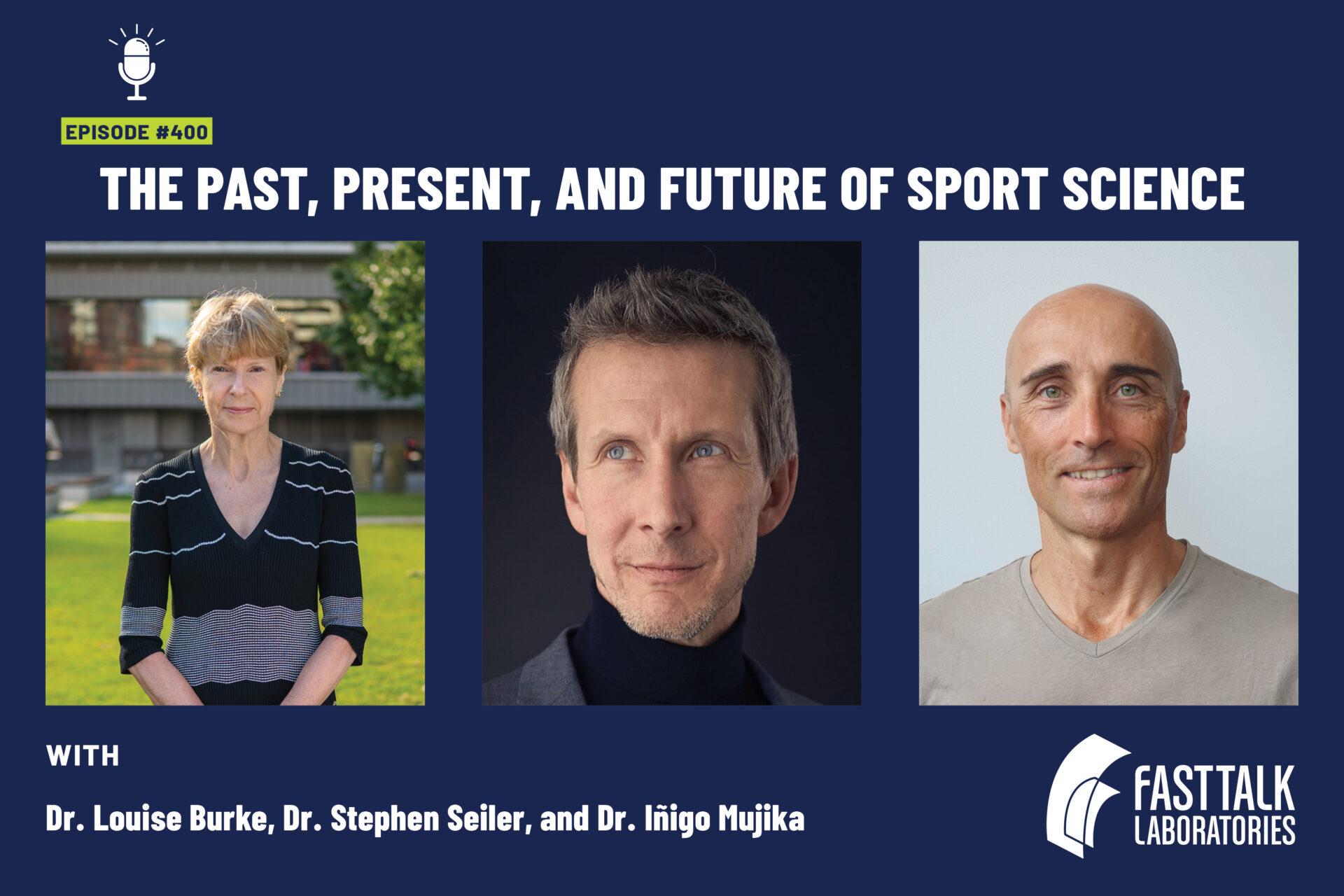






For our 400th episode we invited three of the most prominent names in exercise physiology to discuss where we are and where we’re going in endurance sports science.
Episode Transcript
[00:00:00] Trevor Connor: Hello and welcome to Fast Talk your source for the science of endurance performance. I’m your host, Trevor Connor, here with Chris Ks hitting a milestone like our 400th episode is the perfect time to reflect where we’ve been and where endurance sports science will go from here. So to celebrate Fast Talks 400th episode, we invited several of the most prominent names in exercise science to join us and reflect on the field.
We invited Dr. Steven Seiler, who’s involved in so many innovative and important projects right now. We can’t list them all. Dr. In Nigo Ika, who recently published a second edition of his book, endurance Training Science and Practice, which includes contributions from many of the top names in exercise physiology.
And finally, Dr. Louise Burke, who has led the field of sports nutrition for decades. Our conversation included four big questions, which cover the entire scope of sports science research. The first was, what has been the biggest changes of the last 25 years in exercise science? Since that time includes most of the lifespan of the internet, it was impossible for them not to look at the impact of technology on sport.
Our second question focused on the best metrics to use in scientific research. Interestingly, they all described the need for researchers to get out of the lab and measure performance in the field. Next, we ask them to look forward with the question. In 25 years, what will we look back on and say? I think we had that wrong.
Ironically, for a forward-looking question, they agreed that only looking at current research and not learning the full history of exercise science was a critical concern. Finally we finished out the episode by asking them who they think is the greatest endurance athlete of all time. Their answers will undoubtedly surprise you, especially since George Clooney gets a mention.
But before we get into the
[00:01:43] Chris Case: episode, Trevor, a few weeks ago we recorded with Angelo Poey of Met Pro. They were so pleased with Episode, they came on board as a sponsor of Fast Talk, and I know you have had many good interactions with Met Pro, so tell us a little bit about that.
[00:02:00] Trevor Connor: Yeah, excited to have them a sponsor because as I said, I’ve been trying to get them on the show for a while and really like their product.
I tried it, I wrote an article about it and I think it’s a great tool and I think it’s a great tool. For one really big reason, I don’t think counting calories really works because that’s an after the fact thing. You eat whatever you’re going to eat through the day, and then at the end of the day, you count your calories and go, oh, that was bad, and you beat up on yourself.
Met Pro completely flips it around and treats nutrition like it’s training where you build a training plant. And you see the same sorts of things. If you build a training plan and say, I’m gonna do two hours on Tuesday, you find that time. If you don’t build a plan and you get to Tuesday, you get caught up in work and next thing you know you’re doing 30 minutes ’cause that’s all you have time for before you need to go to bed.
That planning, it just works for us. And they do the same thing with nutrition. They map out the week, they help you figure out how to make it work with your training, how to make it healthy, how to help you lose weight if you need to lose weight. Then you do your prep, then you prepare your food ahead of time, and then you start eating the way you want to eat.
And even as somebody who has a degree in nutrition and feel, I eat pretty healthy. When I was on their program for four months, I got right down to my race weight. I felt really good because that planning element really, really helped. Excellent.
[00:03:23] Chris Case: And right now, fast Talk listeners can get a complimentary metabolic profiling assessment and a one-on-one consultation with a Met Pro coach.
To design their personal strategy for performance, just go to met pro.co/fast Talk. That’s met pro.co/a TT A LK, and start training smarter today.
[00:03:46] Trevor Connor: And with that, get ready for an interesting reflection on exercise science and let’s make it fast. Well, Chris, hard to believe we are at episode 400. Amazing.
[00:03:58] Chris Case: We made it
[00:03:59] Trevor Connor: kind of a unique episode ’cause it’s almost midnight
[00:04:02] Chris Case: for us.
[00:04:02] Trevor Connor: You and I just ate very large pizza in C pizza, so we’re being like college kids here. That’s
[00:04:08] Chris Case: right.
[00:04:08] Trevor Connor: But that is because we have some absolutely amazing names on the show and they are located in Europe, Australia. We’re here. Yes. So big thanks to all of you for joining us for the show. I think we’ve got just about every time of day covered.
[00:04:23] Chris Case: That’s right. Thank you guys. It’s a real honor to have you guys on the show. Can I talk now? We can talk. Absolutely. Absolutely. Okay, good. Oh, asking, asking, do you want say something? This, to say something? I can’t believe it. Well that’s, that’s you’ve this Dr. S before.
[00:04:40] Stephen Seiler: No, it’s good to be here. 400th episode.
That’s well done. 400 of anything is an accomplishment. I think. Anything legal.
[00:04:49] Trevor Connor: So this is actually strangely probably gonna be the easiest episode ever for Chris and myself because we have, don’t jinx
[00:04:56] Chris Case: us. Don’t jinx us. Yeah. Fair
[00:04:57] Trevor Connor: enough. We have three people like you. Just top names in the exercise science field.
As I said, it’s not for Chris and I to be talking. So the format here, we have some questions that we put together. We’re gonna hit you with the questions and then we’re really just gonna let the three of you run with it. So I’m going to start with the first question, and Dr. Seiler, I’m gonna throw this to you.
What have been the biggest developments or changes in endurance exercise science of the last 25 years? And just as importantly, are they good changes?
[00:05:33] Stephen Seiler: It starts for me with the development of the internet, and that coincided with my move to Norway. I can still remember 1993, I’m a PhD student and there’s like one computer in the huge University of Texas library where we can get on something called the internet.
And I began to pursue it a little bit. And from there, so what has the internet done if we go straight to the hardcore deal? It’s enabled training diaries. It’s enabled a tool for a digital process around this idea of recording my workouts. And we’ve gone from the wonderful old training diaries, handwritten to digitization, and then digitization has facilitated a lot of other things.
And then what the three ingredients, I would say that it really added up to something on top of that layer of internet infrastructure is number one. Wearable technologies, biosensors of different kinds that are able to take, whether it’s temperature or glucose concentration or heart rate, and generate an electrical signal that then can be properly smoothed and edited and so forth to give us this data, this information.
And then what makes that come together is Bluetooth that was developed in by a company called Ericsson in Sweden, and it’s now nobody owns it. And it continues to develop as a kind of a personal area network device for connecting all of our devices. And then the final ingredient is something that most of us don’t know anything about, but we’re using them constantly, is APIs application program interfaces, which allow information from different data sources, databases, and so forth to be integrated, to be aggregated and time synchronized.
So that’s the kind of the ecosystem or the cyborg ish kind of world that are. Our athletes live in, and that’s an answer to your question. Is it good? Is it bad? Yeah. It is both good and problematic. Like many inventions through the ages, they can be misused and used. And they are, and I would just say almost everything else, all the wonderful nutrition work, all the issues around psychology, a lot of that is enabled that we can be more holistic.
We can connect things in part due to that environment that we’ve created.
[00:07:53] Iñigo Mujika: It’s interesting that you mentioned the internet because last night I was having a conversation with my partner and I, out of the blue, I suddenly said. It’s incredible what the internet has done for us. I’m updating one of my presentations that I have to give in Barcelona next week, and I remember when you wanted to put together a lecture, and for every single slide you have to go to the library, you have to pick a figure photo, copy it, and then draw it yourself into PowerPoint.
And now just in a click, you can access the paper, you can copy paste the figure into your PowerPoint presentation, and everything is so much easier. Thanks to that. I know putting together presentations is not endurance training or endurance sport, but all I can do is agree with what Stephen said. But that said, from my point of view, one of the things that has improved a lot.
Is in terms of individualizing the entire training process. Nowadays, we don’t worry so much about the group we are working with. We can really focus and target the individual. In part, thanks of all the technological advances that Stephen has mentioned, because now we have individualized access to everything that’s going on during training, and we can adjust and modify our training program according to the individual data.
Dr. Burke, what are your thoughts?
[00:09:17] Louise Burke: I had both those thoughts, but if I have to think of something original, I think one of the big changes in nutrition as being not just personalization of the way we work, but also the periodization now recognize that. There’s not the athlete’s diet, but there’s not the diet that the same athlete eats every day once they’ve got it right.
We now follow the model of training, the understanding that there’s been different phases to the season, different types of training sessions that athletes do, and that we now arrange nutrition around each of the sessions to pick the goals of that session and know that will change from day to day. And so there’s so much more scope for creativity with nutrition, lots of different goals to be met, but also ways in which the same foods can be reorganized to meet those different goals.
[00:10:08] Trevor Connor: So going back to your point, Dr. Seiler, all this data that we can collect now, I remember we did an episode where we had two gentlemen who spent years seeing how the Ethiopian runners were becoming dominant in the field. And I always remember they talked about the fact that they would run in a group. I mean, these were Olympians.
These were top runners. They would have one heart rate monitor and they wouldn’t even wear the strap. They would just use it to keep track of pace and time and basically hand it to the leader of the group and say, here’s your target pace. And that was as sophisticated as they got. Yet they absolutely dominate the running world.
So it seems like you can still get to that highest level without a lot of data. So my question is, is this just creating noise or are we able to have athletes reach a level with all this data that they couldn’t reach before?
[00:11:04] Stephen Seiler: Right. And of course the answer to your question is it depends. It depends on the athlete, it depends on the environment, it depends on the technology.
There are technologies that are. They don’t work in the real world. They work maybe in a very artificial environment, but then when you try to move them out into the field, the signal to noise ratio changes. You don’t know how to interpret the data. And so it all comes down to the fundamental test of does this new technology add information that helps me make better decisions, helps the coach, helps the athlete make the day-to-day decisions that add up to over time, better performance, better health, whatever it is that ultimately.
Puts them closer to the goal of the gold medal or whatever it might be. And a lot of these technologies, I would say, don’t stand that test. They don’t stand up to that test. They have good intentions, but it doesn’t work in that very challenging environment of high performance. Now, I wanna say this first.
I’m doing a project in Sababa in Ethiopia with runners, and we’re getting a little bit more technical, so we’ll see how that goes. I if I ruin them, then you’ll know here first it was me that messed it all up, got them to start measuring heart rate a little bit more. But to say this, is that what we see?
Is that our best endurance athletes actually are quite discriminating on the technologies that they use. They don’t have the biggest technology toolbox. It’s often the recreational athletes, the weekend warriors, the Steven Sers that are using way more technology than they should be, and not focusing on the fundamentals.
[00:12:52] Iñigo Mujika: I don’t think the, the sport you used as an example is speaking for all endurance sports. The endurance running is so dominated by the Africans that. Yeah, in that example, there are genetic components. There is the altitude, et cetera, et cetera. But in other endurance sports such as professional cycling or triathlon, if you want, the technology has contributed a lot to the understanding of the entire training process and the understanding of individual athlete adaptation.
So I think there are different situations and it’s not comparable. The world of endurance running in eastern Africa is not the same as the world of professional sport in Europe. And the technology can be, as stiffen said, used or misused When I was coaching cyclists and when I was coaching triathletes.
I would say I’m not interested in the power output today, but tomorrow, yeah, tomorrow when I said 342 watts, I, I mean 342 watts. So I don’t want an athlete who is completely obsessed about the numbers and about the data, but I think that sometimes we can guide our training very well using the new technologies.
So that’s a positive aspect of it. The negative aspect obviously would be being over reliant on the technology and then being completely lost and unable to make your own mind and to take a tactical decision during competition unless you have the data in front of you. So that would be a clear example of misusing the technologies, being lost in the numbers and unable to make up your own mind on whether you should attack or you should hold it, or you should make a.
[00:14:39] Louise Burke: And I think some of the data that you are receiving are also really spurious. And so there’s a danger to looking at your watch when you wake up to see what your sleep rating is, especially on a day of competition, because you don’t wanna see you had a disastrous sleep. This is gonna be a terrible day when you need to feel confident.
And I’m a sort of a disbeliever in the benefits of CGM at the moment. I see far too many people worrying about their glucose spikes and attributing them to crazy food patterns which aren’t causing the problems that they think. And then. Just becoming so focused and fixated on that rather than thinking about the bigger picture of what their nutritionist to be providing.
So there’s times and places and I think too much information is definitely too much.
[00:15:25] Stephen Seiler: If I can chime in there, the metrics, whether you’re working in leadership or in industry or metrics, have a tendency to, we have good intentions, but if a scientist is told that, look, part of your research time is based on the number of publications, ’cause that’s what we can count.
Then you game. It’s a gamification. There’s always a tendency for metrics to skew our attention away from the original goal into the metric itself. In this case, you start training or your behavior starts being driven by the metric itself, the heart, oh, I’ve gotta get my heart rate variability up, or, oh, my sleep quality was down.
I’ve gotta get that better. And you’re forgetting this is a part of the process, but that’s not what you’re training. And we get derailed by these spurious metrics. And I think Marco Al Tinius said something really useful. He lives from a product that measures heart rate variability, but he’s very open and says, look, most devices like our heart rate watches or whatever, they measure just the one thing they measure heart rate.
Hopefully they do it validly, and then we get all these darn estimates of everything else. My readiness to train my sleep quality. Form my fitness and my VO two max. And all of them are estimates that have a huge amount of noise associated with them. And by the time you work your way out enough, they are only slightly better than a 10 day weather prognosis.
They’re just bad. And that’s unfortunately the nature of the industry is that they make more money by iterating software and algorithms than they do by iterating hardware.
[00:17:06] Iñigo Mujika: And this past weekend I was at a conference and somebody reminded the classic, not everything that can be measured matters. And, uh, not everything that matters can be measured.
I know we’ve heard that a million times, but it really applies when it comes to technology used in sports. Is there a
[00:17:25] Chris Case: technology that you would love to see happen like that? If you could make it happen, what would that technology be?
[00:17:34] Iñigo Mujika: I remember that question being asked at the Australian Institute of Sport in 2004 or something.
I talked about this movie, this guy wakes up in the morning, goes to take a pee, and as he’s peeing into the VC, there is this screen in front of him saying, oh, you haven’t been taking your vitamins this morning. You better make sure that you do this and you do that. So everything is being measured automatically as he into the toilet.
I think if, if we could do this, get everything immediately without having to put on any kind of gear and any time of waiting before you get your numbers, it would be fantastic.
[00:18:18] Trevor Connor: So the only thing I’m picturing here, we talked about how people are scared to look at their sleep score. You’re gonna have people in the morning who absolutely have to go to the bathroom but are scared to pee.
Yeah, because
[00:18:29] Stephen Seiler: they, I don’t think I wanna know the answers to all that
[00:18:32] Iñigo Mujika: stuff. That’s right. You know, we’ve been talking about whether the numbers are valid or not, whether there is variability or not. Of course, when you have something like this, it has to be valid numbers that really tell you something that is properly measured, not something that, oh, maybe your vitamin D is not high enough.
Now we need precision in the measurements, and we need proper answers to what those measurements are showing and what is required as a result of those measurements. You can call it automatization of the entire process,
[00:19:07] Stephen Seiler: right? I think you could think in terms of a pyramid, what do you need to be able to measure at the most fundamental and get it right every darn time?
Kinda like vital signs in a hospital and then you go from there. But if you don’t get that right, then the other stuff doesn’t matter. And so you have to kind of build the beta capture process stone for stone from the most fundamental to the most esoteric and detailed. Unfortunately, I maybe we sometimes, again, get that turned upside down.
We get caught up in the esoterics and we forget the fundamental. That’s right.
[00:19:38] Trevor Connor: So before we move on to the second question, Dr. Burke, you mentioned earlier that we’ve really advanced nutritional periodization. I would also say. On the exercise side, the training side, we’ve also improved periodization. I remember 20 years ago if an athlete hit their peak on time for a key event, it was as much luck as anything.
Now, particularly in the last 10 years, you see athletes that just seem to hit top form again and again and again through the season, right at the right times. Is science driving that, or is that just continued experience from year after year athletes just experimenting?
[00:20:16] Louise Burke: I think it’s a bit of both. I think that periodization of the model is very sophisticated, but.
It only becomes useful when an athlete can work with it and then tweak it to suit their individual requirements and their experiences. And so the best scientists are those, as Ingo said, work with individuals and listen to the individual and take feedback from prior experience and then move it into the future and continually tweak.
And that’s the relationship I think, between the athlete and the coach and the scientist. That makes a really important contribution because people have to trust each other and so the athlete can give feedback that needs to have that interpretation. From the sort of the coach and the scientist aspect, own perspective, and then trust that all those learnings can then be modeled into the next iteration.
[00:21:07] Iñigo Mujika: If I can add to that, I would say that all the research on tapering and picking that has been done over the past 30 years is finally having an impact in many athletes because starting with cost and colleagues and then the work we did with theory buso on the mathematical modeling based on banister studies of adaptation has provided some useful information in terms of learning about tapering and picking.
And I’m still surprised when I get invitations to speak about tapering and I go somewhere and it’s the first time some people hear about it. So they are not even. Thinking about individualization, they don’t even know the basics. Stephen mentioned the pyramid. We already know the basics of the pyramid in terms of picking or taping to pick for a particular competition.
And then you need to add on top of that to the individual athlete. And some people still don’t know the basics, which is quite suppressing because we have a background of research that has provided us with those bases.
[00:22:15] Stephen Seiler: Puritization has been part of my mind since I traveled to Moscow in 1986, at age 20, and I was committed to learning the secrets of Russian puritization models.
Well. I was disappointed, but I think when we talk about periodization, we have to start with that Maslow’s hierarchy again and talk about just intelligent variation as a starting point that athletes have figured out, well, we can’t go out and train hard every day. So that’s solved a lot of problems. It’s just understanding that there needs to be a rhythm.
In the training, whether you want to call it 80 20 or polarized or something, that you can’t go hard every day. You need to manage the load. And then you layer on top of that more precise puritization where you’re saying, I want to have a specific order of the emphasis of loading. So I, I guess my lesson often is, get the simple things right first, the rhythm of training, the need for recovery and things like that.
And then you can, on top of that, build a platform of the puritization where you’re actually ordering meso cycles in some specific way towards a peak. But I do think if you’re gonna look at Puritization, you have to compare it against the backdrop of just intelligent variation in the load from day to day.
Not no variation. Your control baseline cannot be just monotone training. It needs to be a reasonable variation. And athletes have come a long way on on these things. And I want to say that we have contributed to that in sports science and the internet because this information is so much more available so that young athletes, young teenagers, are already able to go in with their coaches and get help and make better decisions.
So I think all the things we’re talking about, all the way back to the start of the internet and just the access to information is making a difference.
[00:24:13] Trevor Connor: Yep. On the hunt for your next great cycling destination, let me tell you about Fayetteville, Arkansas. There are so many reasons to visit, not Lisa Witch is the Cycl Cross National Championships on December 10th, the 14th.
What’s better than Cycl Cross at a venue that hosted worlds in 2022? There’s also the purpose-built bike packing network created by bike packing route. The only nonprofit devoted to expansion of bike packing in the us Overnighters multiple day trips. This suite of roots has something for everyone. And then there’s Fayetteville itself, which is the only UCI recognized bike city in America.
Once you’re riding is done, the fun continues with restaurants and breweries and bike friendly hotels that cater to cyclists of all kinds. Fayetteville, your new favorite v. Head to favorite v.com to explore one of America’s top rated bike cities where world-class cycling is just the beginning. So let’s jump to our next question and Dr.
Ika, I’m gonna throw this one to you first. And this is about the metrics that we use when we’re doing scientific research and what motivated this. I, I know a lot of the older research really just kinda looked at when it did any sort of intervention. Do we see improvements in VO two max? Often would use time to exhaustion as the final metric.
And we’ve seen cases where, because those were the two metrics being used, they said, well, X didn’t really help. I think for example, of weight training where they said, well, we had athletes do weight training and we didn’t see their VO two max improve. So weight training doesn’t have a benefit. And you look at more recent research, particularly by, for example, Dr.
Ronstadt that showed, well, that’s not where you see the benefits, but there is actually a strong benefit to weight training. So my question to you is, what do you feel are the best metrics we should be using when we’re doing research on endurance athletes? Well,
[00:26:05] Iñigo Mujika: that’s a great question. I think we have to do some reverse engineering here.
First of all, we need to understand the demands of the competition itself. And one of the ways we’ve moved forward is by getting a better understanding of the requirements of competition and the requirements of performance. So once you understood what is required from an athlete, you can go backwards and say, well, can we measure the physiological determinants, the biochemical determinants, the biomechanical determinants, the nutritional determinants of those qualities or those demands of competition?
And if we can measure that, let’s measure. So if we know what are the power requirements of professional cycling or more specifically of climbing during the Tour de France, well now we can go. To the lab and try to measure whether or not an athlete can produce that kind of power for that particular duration.
So a better understanding of the demands of competition is going to lead to more adequate measurements in the lab or out of the lab of what an athlete really needs in order to be able to perform. And a couple of days ago, I was at a conference in Sweden and Andy Jones was speaking about what makes a Leo Kipchoge so good.
And there was a lot of discussion and talk about the new concept of durability. Well, whether or not that’s new, that’s a different point. But until very recently we thought, okay, uras performance. It’s based on the joiner model, VO two max, your OL and your mechanical efficiency. But you can have very good values of those for the first half hour of a marathon.
And then towards the end of the marathon, you are completely destroyed and your efficiency goes down the drain. So your durability is a very important aspect to that model. Now you have to add that fourth component of your endurance performance. And in the past few years, there has been quite a few papers looking at the durability of professional cycling under 23 cycling, and even in junior cyclists, I don’t think we have so much information about runners, for example, or about swimmers, but we have started to understand better what determines and what drives durability, the capacity of producing the same type of powers.
And maintain your threshold. And maintain your view too once you have been working for a while. So are you able to produce that pit power after four hours in a stage of the Tour de France as you were at the beginning of the stage or not? So understanding the demands of competition is going to drive the things that we can and should measure properly in the lab or in the field.
[00:29:12] Stephen Seiler: My grandfather told me he met my grandmother at a dance and he bought a ticket to go to the dance and they were in these dance halls. Well, lemme tell you, VO two max is a ticket into the dance. You do need a high VO two max. The oxygen cascade is fundamental. The more you can get in, the better, but I would argue it’s the easiest Of those four domains that have been mentioned, the VO two max, the fraction utilization, the efficiency, and now this construct of durability or fatigue resistance.
From a time component. What we see time and time again is that teenage athletes are hitting huge numbers for just VO two max, but they’re not at their best as performers at that age. They continue to develop, not because their VO two max continues to climb, but because these other components get better, the fractional utilization gets a bit better, the efficiency gets better, the durability gets better, so they’re able to use that oxygen more efficiently over time.
So I, I do think that we’ve been lazy as sports scientists because VO two max is short and sweet. It’s easy to measure. So it ends up being the go-to measurement for kind of how we evaluate athletes and that’s. Part of it, but it’s unfortunate if it takes up too much oxygen, no pun intended.
[00:30:29] Iñigo Mujika: Well, if I can add to that with Peter Leo, we’ve seen that the main difference between professional cyclists and under 23 cyclists is not due too much.
It’s not peak power, it’s not maximum aerobic power is whether or not you are able to produce those values after three or four hours of cycling. When you have already produced 2,500 kilojoules of work, are you still able to do that? And that was the main difference between the pros and the under 20 threes.
And that only comes with hours and hours of training and years of experience in the field.
[00:31:04] Stephen Seiler: And Dr. Burke represents an amazing part of this is, which is that metabolic aspect of energy availability, glycogen availability, and so forth. And that has. Fundamentally changed through training the gut and so forth and different things.
And then you have the, I think we’re getting at some issues around the neuromuscular component and how that is maybe a limiting factor. The technical proficiency of the athlete deteriorates. You can use. Accelerometry imus, you can use different tools to get at the fact that athletes movement, the movement on the bike, the movement in running, it gets, let’s say, less efficient noisier with this fatigue.
So there are some, we’re starting to unravel what is behind this durability construct. And then maybe, you know, we’re gonna get at how it is separate from the others to the extent that it is, and then how to train it. But I think that’s one of those holistic. Constructs, the durability will have nutritional elements, it will have mechanical neuromuscular elements.
It will have almost undoubtedly, let’s call them psychological elements. So it’s kind of putting us right where we belong as sports scientists, and that is we’ve all gotta sit around the same table and work together to understand this correctly, I think just as we are right now.
[00:32:21] Trevor Connor: So I’m glad you mentioned Dr.
Burke and Dr. Burke. I’d love to throw this to you. What would you like to be measuring in athlete particularly to see the effectiveness of their nutrition plans?
[00:32:32] Louise Burke: Well, the harvesting about being a dietician is that you can’t measure what you are most interested in. And that’s what people are eating because when you ask someone to record for you, they’ll change what they normally do or they’ll under record or misre record what they’re doing.
And if you ask them to talk about it, uh, retrospective activity, ask what they ate yesterday or what they normally eat. Again, memory and dis ability to quantify and describe things accurately, get in the way of a, an accurate description. So. It’s a frustration and we’re all looking for this new tool or this new protocol that’s going to help us somehow be in the background and find out what athletes are eating so that they’re less aware that they’re being watched and more likely to continue their normal patterns.
But we can see it in a way that is meaningful and describing either normative or just important period of intake. And we’ve been playing around with. Different kinds of protocols where we can try and be an observer looking at what an athlete’s eating rather than relying on them to tell us. And it’s incredibly time consuming.
And the manpower that goes into, that’s amazing. But if we can find a way of making that digitized or somehow create a little avatar ourselves that can just follow the athlete round and observe them while we’re not looking that we’ll get some of the information that we so desperately want.
[00:33:57] Iñigo Mujika: Well, at the Japan Institute of Sports Science, they have this really clever system that when the athletes put their tray under a camera, the camera takes an image of the food that’s on the plate, and they make a calculation of the total energy intake, the carbohydrate, the protein, the fat, and even the micronutrients.
But then nobody controls whether or not the athlete is actually eating what’s on the plate and whether or not they are eating something else beyond what’s on the plate. So. If you took a picture of Steven Sailor’s breakfast this morning. Yeah. You can see that he ate eggs and chocolate, but did he eat something else besides that?
[00:34:37] Chris Case: And will he tell
[00:34:38] Stephen Seiler: us? You’re gonna have to qualify folks that are listening now. That is not my standard breakfast, just so we’re clear. But I just got back from Bulgaria. I haven’t shopped, I haven’t bought groceries, and so that’s what was in the refrigerator. Please do not accuse me of being the worst eater on the planet.
What’s wrong with it though?
[00:34:57] Chris Case: Don’t make
[00:34:57] Iñigo Mujika: excuses. It sounds pretty good to me. And the main question is, did you mix them or do you have the eggs first? And then the chocolate?
[00:35:05] Stephen Seiler: I never mix things. Even when I was from the age of five or six, I always ate each part on the plate separately. Mm. And I still stick by that, so don’t mess me up there.
[00:35:16] Trevor Connor: But Dr. Burke, I know exactly what you’re talking about. I’ve had multiple athletes come to me and say. I’m trying to lose weight. I’m really struggling. Help me figure out what to do with my nutrition. And I have ’em do a three day diet log. And I always tell ’em, I want you to record what you typically eat, so don’t change.
Modify this because you’re doing a diet log. Eat what you normally eat and record it. And then they’ll give me the three day diet log and I’ll do an analysis and they’ll average 800 calories a day. And I’ll come back to ’em and go, this is not your typical diet. And they go, yes it is. I go, if you’re eating 800 calories a day, losing weight is not gonna be your problem.
And they will argue me to death.
[00:35:54] Louise Burke: It is a frustration of my profession not to say,
[00:35:57] Stephen Seiler: yep. Well, behavior’s hard to measure. And even some of the physiology. That we think is really straightforward. I found my daughter that when she tested, she just got so engaged that her heart rate responses were influenced by the feeling of wanting to perform, the being on the treadmill and so forth.
And so I realized, yeah, even heart rate, which we tend to think takes care of itself. Once you start exercising, there is a layer of autonomic nervous system stimulus that can shift it up or down a bit, or at least particularly up depending on the setting we’re trying to measure breathing. And breathing is both physiology and perception.
It’s both behavior and automated, and when you think about it, it changes. And so this dilemma that Louise is facing, hers is particularly egregious, but ours we see some of the same issues that trying to measure things on people who know they’re being measured. There are always issues around, I guess the Hawthorne effect or whatever you wanna call it, that just the process of measurement often changes the variables we’re measuring.
Yep.
[00:37:04] Trevor Connor: So the last part of this question that I wanna ask, ’cause all of you touched on this and I I think it’s a really important question, Dr. Sadler, you mentioned it’s very easy for researchers to measure VO two max, and I get it in a lab, you wanna control variables and that’s a variable you can really control.
But does that to a degree disconnect researchers from the real world setting? Like you talk to any coach and they’re gonna say the ultimate metric is whether their athlete is performing in races or not. But that’s not a variable that you can control as well. There’s a lot of things that affect races, but should researchers be a little less purist and say, ultimately we need to see if the athlete is performing better or not, or should we continue to use.
Very controllable variables that might not necessarily correlate that well with performance.
[00:37:56] Stephen Seiler: Well, I guess it boils down to the fact that our whole history of sports science, what do we do? We typically work on a semester schedule. We design studies around the realities of student projects and athlete subject availability, and we have a whole history of eight week interventions and so forth.
Why? Because that’s what fits into the academic calendar and measurement in the lab. Like we’ve got a project going on where the athletes are gonna be running 21 kilometers, they’re gonna doing a half marathon on the treadmill. Well, that’s not typical things to do on a, in a laboratory. So we, we like to keep it short and sweet.
Interval training is super popular to study because it’s short and sweet, it’s intense and it’s interesting and so forth. So. I do think that the whole corpus of knowledge in sports science is somewhat biased by some of these issues around. We’re not very good at longitudinal things because of the semester process.
Anything that lasts longer than a semester, we’re probably not gonna want to measure it ’cause it’s not gonna work. It’s gonna not gonna be efficient in our calendar process. And then in the actual measurement in the lab, we try to do things that take about an hour. We don’t wanna spend three hours on one subject, so I’m sorry, but that’s been our weakness, is our whole body of knowledge is biased.
We get better information on these longitudinal processes with the athletes in the field.
[00:39:25] Iñigo Mujika: Trevor, I think your question takes us back to the first question about what has changed over the past couple of decades, and I think one of the things that has changed a lot is taking the lab to the field instead of taking the athlete to the lab.
And that also has to do with technology. A lot of the technologies that we have nowadays and that were not available. When you started your episode number one is that. With that technology, we can actually take the lab to the field and follow the athlete and measure things in the actual training situation.
And even in competition. Who would’ve thought a few years ago that football players and basketball players would be carrying time motion analysis systems during competition? And we could assess basically everything that they are doing from the point of view of the external load, at least during the match.
So one of the things that has changed a lot is that bringing the lab into the field, and if you’ve been following Luis’s supernova studies, you would see a very good example of that. You see athletes in their real training environment, these are called research camps, but they are actually training camps.
And those camps include competition and they measure a whole bunch of things when the athletes are in the real training and competing environment. And Luis herself can tell you more about this because they are a great example of taking the lab to the field.
[00:40:56] Louise Burke: Yeah, thanks. I’ll, I’ll always jump in there because I was gonna say the same thing that, and one of the things we’ve tried to do is embed research into the daily environment of the athlete.
And for two reasons. One is to develop a relationship with the athlete and the coach and really see it in a less artificial light. But the other thing was to have the opportunities to co-design the studies with the athletes so that when we’re doing things, we’re not. Researching on them. We are researching with them, and so all our camps have been, it’s a training camp and then we call them research embedded training camps, and we have athletes there pushing each other, developing relationships themselves, helping each other.
Everybody benefits because we know that because they all go home from their camp having improved their performance. But we put a range of different tests into the camp that measure a real performance. Like we had real life races in our supernova study. The World Athletics Calendar now has a race in January called Supernova that happens in Canberra regardless of whether we are running a study or not.
But you know, when athletes are doing that race, they’re doing it under real life conditions. And so we hope that the intervention that we’ve planned into the study has a chance of seeing whether it does translate to performance. And as well as that we do testing in the lab or other testing out in the field where we can measure some of the things that might explain the mechanisms or give us some metrics that tell us what’s important to explain what happened with the race performance.
And the ripples of those studies are great because it’s not just that you did a study and you got a publication and found an answer to something. But you create interest and sort of a culture amongst the athletes that they want to know more and they understand this is a good way to find out some of the answers to the question rather than Googling it, they can be part of the process of finding the answer.
And we’re up to Supernova 10 next year and some of the same athletes will be turning up. So we had a, a wonderful relationship with the race walkers in the Supernova series that have continued to wanna keep investing in that scientific process.
[00:43:07] Iñigo Mujika: And I would link that to what Stephen said before about the limitations of doing your research around the semester.
Because in the past, a lot of the research that was being done on volunteers and physical education students, or as they said in the lab where I did my PhD in France, medical student vulgaris. And nowadays we are not using volunteers or students, we are using elite athletes to do our research. And that puts a limit to what you can do in terms of research and what you cannot do.
So when I work with elite athletes, if I am selfish. I will force them to do things for my research, whereas I can on the other hand think in a different way and think, well, my research will be limited, but what they are doing, so I cannot make them do what I want for my research because my research is not number one.
What’s number one is their performance. So I will limit my research to what they are doing, and I will see then if I can produce an interesting paper out of what I can measure based on what they are actually doing. So my latest publications are about the total hemoglobin mask of elite swimmers and water polo players in a training and competition environment.
Would they like to measure other things? If I could, yes, but I can’t. I am there to follow the athletes in their training environment in preparation for competition, and my research is going to be limited by what they do in training. I’m not going to make them do things that they wouldn’t do. And that are not interesting for them to perform better.
So we are nowadays working with elite athletes and doing our research on elite athletes in the real training and competition environment, and that is a huge advance. In the sense of the evolution of sports science.
[00:45:06] Stephen Seiler: I think also that teams like SMA and cycling and that have a long history, they know what they need to know.
They are intelligent acquirers of information in their interactions with the scientists. So they are driving the research agenda, and I think that’s fair. Whether it’s Olympia Top and in Norway or the national governing body in orienteering in Sweden. They ask the questions and say, Hey, here’s what we need to know.
Can you help us in this process? And I think that’s kind of where we are now. Indigo works that way. I work that way. I started way back a couple of decades ago just saying maybe it would be a good idea to just measure what they actually do. And let’s see what highly trained athletes actually, how do they actually train.
And so that was my little dumb. Idea That turned out to be kind of useful, I think, in the sense that because there was this self-organizing process, the coaches and athletes were experimenting over time and there was an aggregation of knowledge that was developing, and now we’re better as sports scientists at tapping into that, I believe.
And if we use cycling, because it’s probably the most technology friendly we can get at the external load, we can get at the physiology, we can get at the perception they’re sitting there in a lab. It’s pretty easy. Even when they’re outdoors, they’re sitting and we can talk to them. So they are the vanguard often of testing out new ideas and new technologies and nutritional strategies and so forth.
But what they’re saying is, Hey, we don’t need your laboratory. If you want to test us, then come out. In our world, your gold standard for validity is not our gold standard for validity. Not anymore. And so they have become quite demanding in terms of saying, take it or leave it. Here’s how we want to be evaluated.
If you wanna play our game, then you get out here with us. Or if they come into the laboratory, they bring their trainer, their bike, their power meters, and they say, we’ll use our equipment. Thank you. So that’s the change of the game, is that the athletes, the teams are in the driver’s seat now, and I think that’s appropriate.
[00:47:13] Chris Case: You already train smart, you’ve dialed in your workouts, your power numbers, maybe even your recovery routine. But here’s the thing, most athletes overlook your metabolism. That’s where Met Pro comes in. Met Pro is a performance coaching platform built to help serious athletes optimize their metabolism for peak performance.
Their coaches analyze your unique metabolic profile or how your body processes fuel to create a personalized nutrition and training strategy that evolves as your body changes. And right now, fast Talk listeners can get a complimentary metabolic profiling assessment and a one-on-one consultation with a Met Pro coach.
To build your perfect performance plan, go to met pro.co/fast talk. That’s M-E-T-P-R o.co/a T-T-A-L-K, and see what your metabolism is really capable of.
[00:48:07] Trevor Connor: So let’s move on to the next question, and this is one I’m really looking forward to asking. I would say the science over the last many decades has continued to progress and progress really well.
But there are definitely times we look back and make the statement, can you believe we used to believe X? And I think there’s a certain humility that we need to have that probably in 25, 30 years we’re gonna look back on now and there’s gonna be at least one or two things that we’re gonna say. Can you believe we used to believe that?
So that’s the question I wanna ask. What do you think is the thing that we believe right now in the science that 25 years from now we might look back on and go, boy, did we have that wrong? And Dr. Burke, I’m very interested in starting with you because I think. Nutrition science more than exercise science is something that has reversed course pretty significantly several times in the last 50 years.
So what do you think we might look back on now and say, so, boy, we just didn’t have that right.
[00:49:15] Louise Burke: One would be that scientists worked in that so that they can teach athletes rather than thinking. Athletes sometimes have worked things out for themselves, and that’s our role to explain why it works or to tweak it.
So who’s leading the pack would be one issue. And I think the other thing is that we often get things partially right that don’t understand the full mechanism and because we don’t have the opportunity to tweak it. And so at the moment there’s a lot of interest in these very high carbohydrate intakes during exercise and all the focus is and oh, how can we train the gut and how much can we absorb and how much can the muscle burn?
And that might be part of the issue, but we’re not thinking about what else the fuel in the muscle is doing. And it’s a signaling tool. And it’s also affecting the muscle responses are endocrinal in itself. So the muscle produces chemicals, mykines or kines, which send messages around the rest of the body.
And so maybe one of the reasons for the interesting carbohydrate now is not that the muscle’s actually burning it during. The task itself and providing fuel for the immediate purpose. But you know, maybe it’s having other effects signaling that’s happening in the body as a result of the exercise session and modifying that.
And so maybe sometimes the benefits are happening elsewhere or they’re happening in a different timeframe. And so because we’re just looking at it with a single lens, we are missing something that could be really important. And we might find it’s putting moves down the track that, oh, we were looking in the wrong place.
What we were doing is mostly right, but we just didn’t understand why it was useful and because we didn’t understand it, we amplified a response or get it quite right.
[00:50:59] Iñigo Mujika: Trevor, your question is so complicated that I’m gonna turn it around and I’m going to say, wow, I can’t believe we forgot about that because I mentioned the lecture I’m putting together before, and I am using some results in some slides from 1970 and from the 1990s, because sometimes I get questions from students or from PhD students sometimes.
I thought they have forgotten about the basics and a lot of the basics we have known for 30, 40 years in terms of biochemistry, in terms of fundamental physiology. So I think one of the things we should not forget is to look back and remind everybody that sports science didn’t start in 2020. It started many years ago, and some of the things we’ve learned since then still apply today, and we need to remind everybody about these things.
When Louis was doing her studies on fat adaptation and whether it was better to eat more fat or whether it was better to eat more carbohydrate. Well, a lot of people were forgetting that We’ve known for a long time that when you rely more on fat, your oxygen uptake is higher for a given exercise intensity.
So yeah, well, we are able to burn more fat when we eat more fat, but your oxygen cost is higher, and that is something that people were forgetting about. And things like that we’ve known for many years, but we’ve tended to forget them. If you look at the papers that are published by PhD students today, very seldom they use any reference that goes back more than.
15, 20 years. And that is something that I tend to criticize. I usually tell them, Hey, sports, I use it. That start with you or your supervisor. It started way before that. And some of the fundamental things that we have learned should not be forgotten if we wanna move forward in the right direction. And I’m sure Stephen is going to agree with that.
[00:53:08] Stephen Seiler: Oh, absolutely. And I think the, I would even go a step farther and say, and I will answer your question, but I think sports science, as it has matured, it has become more insular and more arrogant in a way, in the sense that it forgets. Sports science is a aggregation of many sciences, pure sciences, if we wanna call ’em that, biochemistry, physics, and so forth.
And. You perform sports science at your peril if you don’t respect that, and I unfortunately think we’ve gotten a bit arrogant as a field and forgotten that, hey, there’s a heck of a lot of biology out there that is relevant for understanding metabolism and adaptation signaling, cellular signaling. For me, an epiphany was to go into the biology and discover something they’ve been talking about for decades, which is the bow tie architecture of cellular signaling in these different signaling processes and how that evolution has equipped us with robust overlapping signaling streams that use this idea of many inputs, a central knot with a few mediators, and then a large cascade of outputs.
Well, when you first understand that, then it. Informs a tremendous amount of understanding about how to interpret training intensity zones and other kinds of aspects of sports science where we get quite insular in our little worlds. So that’s one thing I would say is that we’re gonna look back and some years and say, doggone it, we got a bit arrogant there for a few decades and I’m glad we reconnected to the university campus and their different.
Fields, the biologists and the engineers and the physicists and so forth. That’s one thing. And then if I get a little more specific, as far as I have been fascinated, ’cause as a student I was taught if the lungs aren’t broken, don’t worry about ’em. They take care of themselves. Lung function. If you don’t have a missing lung or asthma, then you’re always gonna have enough air ventilation is never gonna be a limiting factor, and breathing doesn’t matter.
Well, I think in some years we’re gonna say, boy, we sure got that wrong. Breathing matters. And it also, like many other things, there’s individual aspects that some athletes need more attention to their ventilatory apparatus and that they may have some weak links and so forth. So that’s one area where I’m, I’ve been fascinated to reconnect to the literature and reconnect to studies that were not emphasized that maybe do matter that to reconnect to 40-year-old studies and so forth.
So as Ingo was saying, we also have an immediacy bias that is just dreadful. It’s somewhat driven by the internet, by accessibility, by paywalls and so forth. But I agree with you a hundred percent that our scholars, our young PhDs are just, they think the world was. Started in 2001 right after the Y 2K crisis.
You know, I don’t know, but it’s just there is an immediacy bias in the literature that is hurting us as a field.
[00:56:25] Iñigo Mujika: Yeah, I think there is this trend of becoming technicians and not understanding the basics. So yeah, some sports scientists are really good at playing with things and playing with the technology, but then you ask them what is the fundamental aspect on which that technology is based?
Or what are we trying to understand when we measure that with your technology? And they don’t know the fundamental physiology or the biochemistry underlying the measurement. So that’s a risk in my point of view, looking at the future, becoming technicians, but forgetting about the basics.
[00:57:05] Louise Burke: I totally agree with you there, and you go, and it’s one of the frustrations of being a reviewer these days that you read manuscripts where these staff are presented to you.
That just is physiologically implausible. It came out of a machine to three decimal places and the students just put it into the spreadsheet and not even think about what’s the physiological explanation behind all this. You know, we are so lucky these days that it doesn’t take us a day to do a full BO two max test ’cause all the Douglas fag that, all the halane equipment and the side rules and all the things that Ron Lauren needs to have to do.
So we are lucky that we can make that so quick to do, but we need to be able to do that, that still retain the underlying principles of how it all works so that we can question when we look at the data.
[00:57:52] Trevor Connor: Mm, that’s a really good point that I would love to ask about. I remember listening to an interview with a, an influencer who comes from the science community and has built a big name for himself and he was talking about nutrition at the time and they asked him about the mechanism and he goes.
I don’t care about the mechanism. I never look at mechanisms. I just care about the results. And Dr. Burke, you just mentioned that. Is it irresponsible to say that? Do you need to say, you can’t just look at the results, you need to be able to say, here’s a physiological mechanism that explains this in order to be able to trust your results?
[00:58:31] Louise Burke: Absolutely, because these days we’re so reliant on machines, which are a black box to us, and you know, you put something in one end that comes out the other, and unless you can be sure that you’ve calibrated it properly and that the machines parts of it are working, and that the whole premise of the machine itself is accurate, then you can almost look to exclude it before you accept it.
[00:58:54] Iñigo Mujika: Trevor, if you don’t care about the mechanisms, that’s when you get people saying, oh, I measured V two max of 110. And they don’t ask whether that is physiologically reasonable or not. And if they consider, well, yeah, if I look at the literature, either I have the highest V two max ever measured, or there is a problem with my machine.
But if you don’t understand the mechanisms, then you don’t know what the problem is with your machine. Is there air leaking somewhere? Is your CO2 analyzer wrong? Is your oxygen analyzer wrong somewhere? So you need to understand what you are measuring and how it is being measured. ’cause otherwise you might get any kind of result and take it for value.
And that’s when you get results. That don’t make any sense.
[00:59:44] Stephen Seiler: And there are numbers that have somehow become entrenched in the journalistic reporting. One is. The 106 that you talk about. One is the 8.5 liters per minute VO two max of a particular British rower that perpetuates. One is the 96 VO two of Bjorn, which even the Norwegian said, no, that was false.
We just wanted to scare the Swedes. So there are these numbers that just live on in infamy, but we know the physiology well enough to be able to fundamentally identify these outliers, those of us who have actually studied the physiology and so forth, but those who haven’t. Can easily be led astray by these stray numbers that perpetuate.
I find it fascinating and a lot of times sports students, at least in Norway, when I mention numbers and math, they’re like, wait a minute, I studied sports so I wouldn’t have to do math. And I, and I say, well, well I’m sorry, but there are some quantitative aspects to sports science. So ha knowing what the typical range is for some of these variables that we discuss, like heart rate and blood pressure and VO two, it’s useful to you to make sure as a gatekeeper that the things you’re talking about are reasonable and reasonable by virtue of the physiological mechanisms behind them.
Going back to what we were discussing. So again, I, I think our field, it’s grown dramatically. It’s popular. The interest is in measuring the human, the quantified self kind. Pushes people that way. The influencers show up in my class and I ask, what do you wanna be when you grow up? And they say, well, I’m an influencer.
I’m taking this course ’cause it’ll help me as an influencer, you know? And I’m like, oh my God, who am I teaching? It’s just the modern world that we’re living in. And the students, for me as an academic, the students that I’m teaching, their composition has changed. Their interests are not maybe the same as they were 30 years ago or when we were studying.
And so I have to respect that. But at the same time, it can be frustrating because their motivations feel like they’re very different and very far away from actual sports science, you know? So I’m in a state of kind of. In my last decade as a scholar and a teacher, I’m thinking, man, I hope I make it to the end here, but without blowing my top.
The students sometimes frustrate the heck out of me because of some of these issues you’re discussing that they just are not interested in the meat of the issue. It’s become a bit transactional and so I fight it.
[01:02:27] Louise Burke: One of our colleagues though, expressing my frustration at the lack of understanding of first principles of measurement and first principles of any of the physiological systems that we are studying.
And they said, look, if you’re a lecturer these days, you get graded by the students and no one wants to learn pathways or understand underlying, complicated physiology. They just want a draw to be applied. And if I try and teach that in my course, I just get poor ratings and that affects my tenure.
[01:02:56] Stephen Seiler: Oh my goodness.
[01:02:57] Iñigo Mujika: If I can tell you an anecdote, my, my partner. He’s an exercise science professor, and she was at the gym the other day doing some exercises, and this lady walked up to her and she goes, oh, those exercises that you are doing are so good. What influencer do you follow?
And she said, well, this is my job. I’m not professional. Maybe I should become an influencer.
[01:03:28] Stephen Seiler: Well, when I’m in the gym with these kids, and there’s a lot of teenagers in the gym where I work out, what I find is they all have this darn phone glued to their darn hand throughout workouts. I find that just to be mind blowing, that they literally cannot get through a set on a bench press without checking their phone two or three times.
It’s a fascinating world that I, we live in now. Attention span is equal to about max. What, 37 seconds or something? I don’t know.
[01:04:00] Trevor Connor: Okay. Well, let’s jump to the final question, and I gotta call Dr. Seiler out here because you got a little obsessed with this question and you use multiple ais to help him answer this.
[01:04:11] Chris Case: Yeah, he’s got a big advantage over the other two because they haven’t heard the question.
[01:04:17] Trevor Connor: So, Chris, this was your question, so please.
[01:04:19] Chris Case: I wanted to end with what I would call a fun question. Far more subjective perhaps, than the others that we’ve spoken about so far. Pure and simple. Who is? The greatest endurance athlete in history.
And that’s open to interpretation. Of course, you could take the word athlete and consider it many things. Dr. Seiler, I don’t know if you want to sort of explain your methodology, the lengths you went to cross-reference the various things that you did. Well, of course I do. Yes, of course you do. Go for it.
[01:04:51] Stephen Seiler: Well, this must be prefaced with the fact that I had a bit of time on my hands. ’cause I’m sitting in an airport with a long delay before I fly home from Bulgaria. So I thought, well, I might as well have some fun with this. And it’s an intriguing question, but then it comes down to what do we put into that beautiful term?
Endure, endurance, enduring. And so I first. Thought about it myself and used my own artificial intelligence or whatever it is up in my head and came up with some names, athletes that I find I couldn’t get out of my head as at least potential candidates for something that they’ve done that’s hard to top.
Kelly and J kept coming back for me. The things that he’s done, the just beautiful. His attitude towards that idea of just enduring over time and space and so forth. I can’t help but be impressed with a five-time gold medalist. Five different Olympics, five different ultimately successful outcomes, sir Stephen Redgrave counting medals that we have, the Bjorn Alley and Mart Borgen with eight golds each and so forth in their sport.
Id Kga. For me, and he changes the way we think about running. He does it with a smile on his face. And so those were some that I came up with. And then I went to the AI and I tried to formulate a reasonable prompt. And I first used a, a free cheap one, a cheap ai, I’m not gonna say which one. And it came up with a list that overlapped quite well with mine and added a few extras.
And, but then I used a model that I use, I pay for, and it’s a, has a deep research function. And I was just tremendously impressed with the way it kind of thought and discussed and so forth. And it came up with some people, like it was impressed by some athletes that have challenged assumptions like Neil’s VanderPol, the speed skater.
I’ve interviewed him. I think he’s fantastic, but I would’ve never put him on my list of all time grades. But the AI said, Hey. Neil’s pushed some barriers in his own way of thinking, and you know, the five two format where he trained up to 33, 34 hours in five days and then two days completely free and created his own way of approaching the sport.
The AI found him interesting, and then I was impressed by Sarah Thomas, who swam the English Channel back and forth four times. Without stopping 54 hours. So I thought that pushes the barriers of human endurance that redefines enduring. Courtney Dewal, the amazing ultra runner, you can absolutely make a case for that.
She has just pushed the boundaries of what we would expect, an endurance. So for me it was, you can talk about the gold medal and the world record and, but then there are certain athletes that, for me, they’ve just redefined what humans can do. And the last on the list was a 31 time Everest Summit Summitter, who’s a Nepalese Sherpa.
Does that count? I thought it did. I thought it was fascinating. So that was my little deep dive at the airport, but you have to choose one. Yeah. I’m gonna say, and I’m biased because I just have tremendous respect for him. I’m gonna say Kelly and Jne, the things he’s done in the endurance world, being an ultra runner, a mountaineer, he’s climbed so many of the 8,000 meter peaks.
He’s, he had a 90 MLS per kg VO two, so his physiology was. Absolutely world class, but I would say he was one of these more, his successes were not through overpowering VO two max. It was through an amazing efficiency, economization of movement, respect for his environment and so forth. And just in his latest thing that he did at an age of 38, where he did every peak in the Western United States over 14,000 feet.
Yeah. And he cycled between them up to 200 kilometers, totally self-supported. That’s kind of pushing the boundaries of endurance. He’s just my favorite, I gotta say it. And he is such a humble guy on top of all of it.
[01:08:56] Trevor Connor: So Dr. Burke and Dr. Mika, you didn’t have a chance to use an AI to come up with your answers, but who would you pick?
[01:09:03] Iñigo Mujika: Chris, I’m gonna challenge your question.
[01:09:06] Chris Case: Okay.
[01:09:06] Iñigo Mujika: Without a pay AI in the world of sports, we don’t have. Endurance events. All events are events of speed. We don’t have a sport in which we say, okay, start running or start cycling, and whoever is standing the longest is the winner. That would be endurance.
Interesting. Who can endure? It’s all tests of speed. How fast can you run 1500, 5,000, 10,000 marathon? How fast can you. Climb Everest. How fast can you do this? How fast can you do that? So I think endurance itself is a misnomer in the world of sports. It’s all about speed. That’s it. I think one of the most fascinating, impressive, and spectacular sports performances of all time, and it required several hours, was Alex Ho’s free solo climb of El Capita.
And that would put Kill and Jordan up there because if they make a mistake, they die. Okay. If E keeps ch makes a mistake during a marathon, he simply doesn’t. If po Char makes a mistake during the key stage of the Tour de France, he simply doesn’t win and he loses the yellow jersey. If these guys make a mistake during their performance, they die, and those performances require a lot of endurance, if you wanna call it.
It’s not about how fast you can climb El Capitan, it’s whether or not you can climb El Capita because it’s going to take you several hours. So it requires endurance, but it requires a level of concentration that is beyond anything that we can see on the track, on the bike, on the swimming pool, because if you make a mistake, you die.
So. Rather than the best endurance athlete of all time, I would talk about the best performance or the most impressive performance of all times, and in my case, I would choose Alexon ols, free solo.
[01:11:15] Chris Case: Very interesting answer,
[01:11:16] Iñigo Mujika: Dr.
[01:11:16] Trevor Connor: Burke.
[01:11:17] Louise Burke: Well, I’m gonna go rogue. I’m gonna say that the greatest endurance athlete we haven’t seen yet because they keep improving and they keep improving because we help them.
But another question might be, who’s your favorite endurance athlete? And that has to be itself. We all exercise and I think a lot of our early interest in sports science came from finding out things about ourselves. We’ve been equals one case studies for the whole of our lives. And so I’m more than happy to put my hand up and say my favorite endurance athletes.
Me and I continue to, um, try and push boundaries. In fact, I’m gonna go on record and say my goal in life is to win my age group at the New York Marathon. And I’ll probably be 80 when I do it, but I’ll have a smile on my face and then I’m gonna go shopping.
[01:12:06] Iñigo Mujika: Okay. I changed my mind. Louise, you are my favorite endurance athlete of all times.
[01:12:12] Trevor Connor: Let me rephrase Chris’s question just slightly ’cause I am interested in the answer in this. If you could kidnap one athlete, lock them in your lab for a month. This is a very Trevor question to your heart’s content, who would you be fascinated to study? George Craning? George Clooney.
[01:12:35] Stephen Seiler: Now that I think your motives are ulterior there, Luis, I’m sorry.
I’m not sure you’re interested in his physiology. To be honest,
[01:12:46] Iñigo Mujika: I would probably say Eddie Merckx because we were able to measure the cyclists, the professional cyclists that were super good after him. But I don’t think we really have physiological assessments about Eddie Merckx, who is still the best cyclist of all times when you look at his achievements and his career and the amount of victories, the number of victories that he had.
So I, I would really be interested in his physiology and how that physiology would compare to the cyclists that we are seeing nowadays. I would agree with that,
[01:13:21] Chris Case: Trevor. Do you have an answer to this question? Who would you like to lock in your laboratory and study for the next month?
[01:13:28] Trevor Connor: So I don’t want to inflate Dr.
Mika’s ego too much ’cause Chris can say We talked about this before we did. But I a hundred percent agree with you. I said this to Chris beforehand. I would pick Eddie Merckx and my reason for picking Eddie Merckx is because we still, in my opinion, haven’t seen a cyclist that has been as dominant as him.
But the science and the training has improved so much since. It is fascinating to me that he could be that good without all the science and all the training, understanding that we have now.
[01:14:04] Iñigo Mujika: But I would also argue that the average quality of the rest of the Peloton is way higher today. So absolutely. My question is, would he be as dominant nowadays as he was in his time?
Because the average level of the professional Peloton has increased so much that it’s going to be way more difficult to be so dominant in the future.
[01:14:28] Stephen Seiler: And it’s interesting about him because if the bio is correct, he was at about 73 kilos when he was competing. Which puts him at a good 13 to 15 kilos heavier than the GC candidates today.
The one at 57 to 62 range. A lot of them, and so I, yeah, his physiology would be interesting to study, but I would study two VanderPol Neil’s and I found. Neil’s, his way of approaching his sport was interesting. And by the way, he was doing three times 30 minutes at 400 watts, which was not bad physiology.
I think he got some cycling offers just based on the interview we did. But then my fascination with Mattew was started pretty early because initially he was putting his data out there on Strava for some of his big races, and I was directly comparing him with some other athletes in looking at how his heart rate was recovering during these multiple surges.
And so, yeah, the repeatability aspect that he demonstrates. Another example is Motts Patterson finished fourth in Glasgow 2023. I met his coach in Sweden just recently and he confirmed the, what Matt said was in that race when it goes into the circuit with the 10 laps on this many 90 degrees swings in Sharp Hill.
Little climbs in Glasgow. He exceeded 1000 watts. 260 times in 240 minutes. Think about that folks. So he is averaging a thousand meter pop every minute for four hours and he gets forth, he loses of Devon de Pole. So could Eddie have done that? I don’t know. But cycling is amazing. The repeatability, that high intensity repeatability aspect of many sports because of the television, because of the way we are redefining the arenas and so forth, it is different than maybe 30, 40 years ago.
So I think that would be fun to bring some of them in the lab.
[01:16:35] Trevor Connor: So the Quick Eddie Merck story, I have to share with all of you. Back when I was managing a team. Axel Merckx was also managing a domestic team, and it happened, we were at a race where our car was in the caravan right behind Axel’s car, and I had my mechanic driving and he slammed into the back of Axel’s car.
So after the race, I had to go to their car to talk to them, and he had his dad there, Eddie. And I had to sit there and get yelled at by Axel and Eddie, and I’m sitting there going. Well, on the one hand, this sucks ’cause I’m getting yelled at and I’m gonna have to pay for the car. On the other hand, I’m getting yelled at by Eddie Merck.
So this is kind of cool.
[01:17:15] Stephen Seiler: Oh man, that’s amazing.
[01:17:16] Trevor Connor: All right, well I think we should leave it there. This was the conversation I had truly hoped for. So thanks to all three of you for being part of this. It was truly appreciated. Really great that you could be part of our 400th episode. Thank you for having them.
[01:17:31] Stephen Seiler: Thank you for the invitation. It’s a pleasure. It’s always enjoyable. So thank you so much and it was an honor to be part of this little Trinity.
[01:17:38] Iñigo Mujika: Congratulations on your 400th and let’s hope we can be there for the 800 too. Yes. How long did it take you to get to 400?
[01:17:45] Trevor Connor: We started in 2016, so almost 10 years.
[01:17:49] Chris Case: Yeah. We originally didn’t do a weekly show and then we did. So it’s been a little many years. It’ll be a little quicker the next
[01:17:54] Trevor Connor: time around.
[01:17:55] Chris Case: Yeah.
[01:17:55] Iñigo Mujika: We couldn’t be there in 10 years. Yeah,
[01:17:57] Stephen Seiler: I might still be around. These guys taught me. I didn’t even know what a podcast was before. Some dude from something called Fast Talk reached out, invited me to do, reached out.
Yeah, reached out. So I have to say, my whole podcast experience started with Trevor Connor. In Chris case, those who taught me about the evils of podcasting. The art. The art. Art, the art. Sorry.
[01:18:23] Trevor Connor: That was another episode of Fast Talk. The thoughts and opinions expressed on Fast Talk are those are the individual.
Subscribe to Fast Talk wherever you prefer to find your favorite podcast. Don’t forget, we’re now on YouTube. As always, be sure to leave us a Radian review. To learn more about this episode from show Notes to references, visit us@fasttalklabs.com and to join the conversation on our forum, go to forums Do Fast Talk labs.com for Dr.
Louise Burke. Dr. Steven Seiler, Dr. Inga Mika, and Chris Case. I’m Trevor Connor. Thanks for listening.