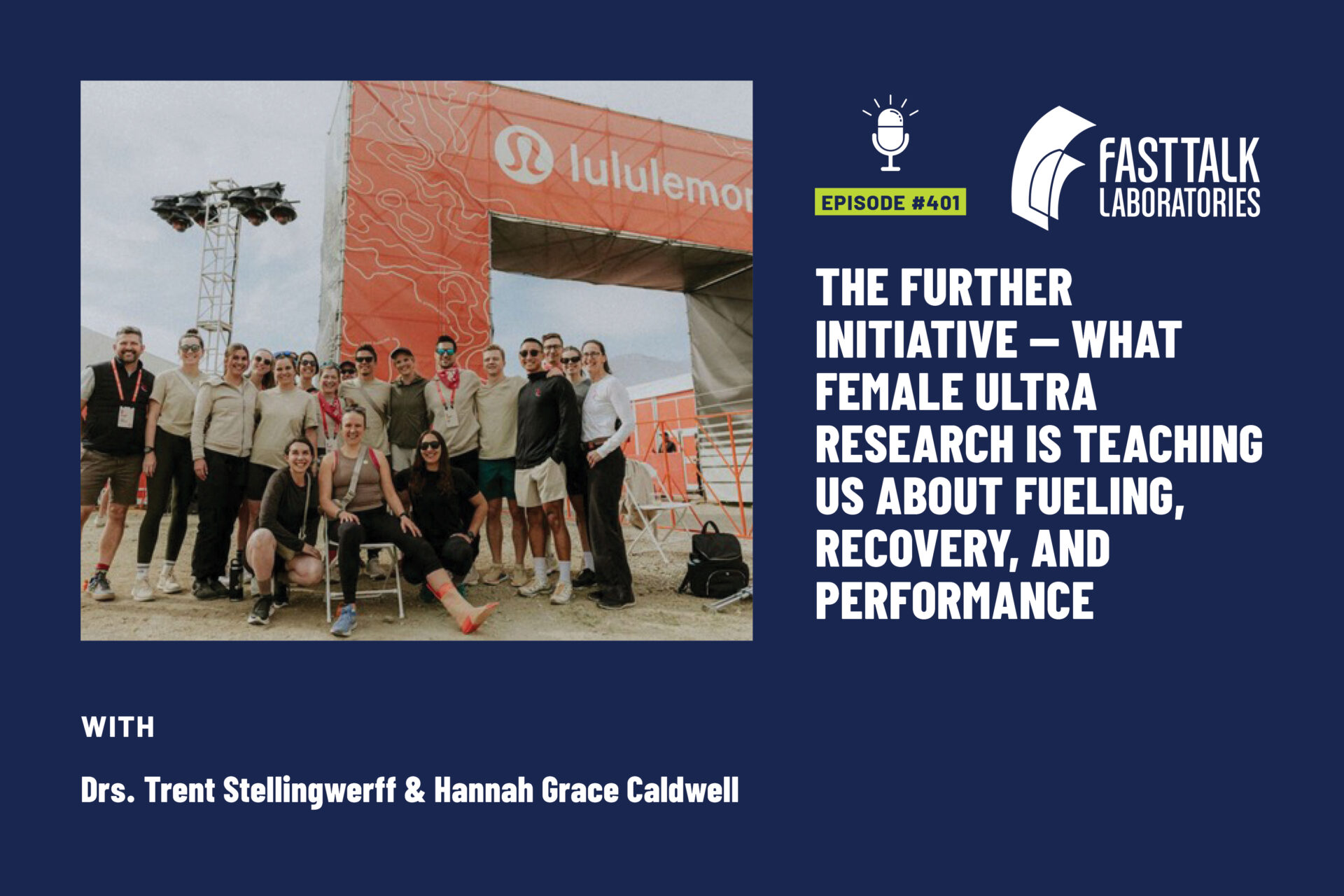






This episode highlights the Further Initiative — a groundbreaking research project on female ultra-endurance athletes conducted in partnership with Lululemon and the Canadian Sport Institute Pacific.
Episode Transcript
[00:00:00] Julie Young: Hello and welcome to Fast Talk your source for the science of endurance performance. I’m your host, Julie Young, here with Dr. Griffin Mcma. Today we explore what it takes to do meaningful female specific research, what this project has already revealed about fueling energy, balance, recovery, and performance, and why these findings matter for athletes and coaches.
Right now, we’ll connect the science to real training decisions and help listeners understand how to apply lessons from this Benchmark initiative. We are honored to have two of the lead researchers on this project. Join us, Dr. Trent Ellingworth and Dr. Hannah Caldwell. For decades, women have trained and fueled from data that did not represent them.
Oversimplified headlines and tiny studies created persistent myths about female endurance physiology. The further initiative is a major step forward. Finally, studying female athletes at the edge of human performance in real world conditions. We dive into the details of why this research matters and what it takes to produce high quality, ecologically valid research on female endurance athletes.
We gain insights as to why this project sets a new standard and female physiology research. Most importantly, Dr. Ellingworth and Dr. Caldwell share their findings from this groundbreaking project on fueling and energy, balance recovery, and the physiology of resiliency, as well as performance predictors from the female athlete lens.
So get ready for an insightful conversation to help you go further and make you fast. Hello, Dr. Ellingworth and Dr. Caldwell.
[00:01:54] Trent Stellingwerff: Thanks for having me. Backwell. Julie, it’s great.
[00:01:56] Julie Young: Good to see you. Thanks, Julie. Yeah, it’s good to see you. Would you both provide us with a little bit of background and what you’ve been up to lately?
[00:02:04] Trent Stellingwerff: Sure. I’m Trent Ellingworth, so I’m the Chief Performance Officer at the Canadian Sport Institute Pacific, which is one of our Olympic and Paralympic training centers here in Canada. And most of my role is actually leading our research and development projects at the institute. I’m also adjunct at the local university, so I have a few different things going on.
[00:02:22] Julie Young: Dr.
[00:02:23] Hannah Grace Caldwell: Caldwell, can you tell us a little bit about yourself?
[00:02:25] Trent Stellingwerff: So
[00:02:25] Hannah Grace Caldwell: I’m a postdoctoral research fellow. I have appointments both at the University of Copenhagen and the University of British Columbia, and my research is primarily in. Exercise physiology and specifically extreme systems physiology. So my work in Denmark is actually a clinical focus on clinical sepsis, and my work in Canada is primarily applied sport performance based looking at female ultra endurance performance.
[00:02:56] Griffin McMath: What an intro. Both of those, I mean, just casual Friday, talking to some incredible people. This is such an awesome opportunity. Thanks for joining us today.
[00:03:04] Trent Stellingwerff: Thanks for having us on. We look forward to talking about this project.
[00:03:07] Griffin McMath: Yeah, and I think let’s get started. Maybe giving this project and the work that you’re doing, a proper intro here.
And before we get into it, I kind of wanna set the stage that we talk a lot about how there needs to be. More research, particularly on women and female athletes for this audience, but we don’t really have a great appreciation of what that actually means. We can demand something all we want, but until we understand how to do that justice and all who are involved and the funding and the infrastructure and just what mechanisms even have to change to make sure that research is done properly and fairly is so all encompassing.
So can we introduce the project, why it exists, and particularly why you two are drawn to this work?
[00:03:53] Hannah Grace Caldwell: So I’ll just start by saying what I think was quite an important aspect of this initiative was that we were trying to really prioritize and support female early career researchers. And so all of the research project leads.
We prioritized females to be involved in the research, and the research itself was completely female specific. And so for this initiative, we were looking at really describing a multidisciplinary perspective on female endurance performance, but from all aspects of physiology, psychosocial, biomechanics, neuromuscular, to try to get a very interdisciplinary integrative perspective on female ultra performance.
[00:04:37] Julie Young: When I first heard about it. It was on Instagram and it was very mysterious and covert, and I saw these things starting to show up, but seemed like a desert setting. And in these runners and all these scientists,
[00:04:51] Griffin McMath: Julie just described this in the most underground research way, like gorilla warfare meets research, meets female athletes.
This sounds amazing.
[00:05:01] Trent Stellingwerff: Yeah. What you saw, there was a culmination of about two years of work already behind the scenes in terms of putting together a research program that included 30 researchers across five universities all coming together for six days in the desert in California, just outside of Palm Springs.
And we had pretesting and health. Baseline testing and all these things that happened before the event. But for this specific event, I’ll just highlight maybe a few pieces, and Hannah already highlighted the idea that it was multidisciplinary. So we had teams, we had an energy team, we had a biome neck team, we had a wearables team.
Hannah led the bloods team. We had a psych social team, and prior to the event we moved one of our entire labs from Canada down to a hotel room. So we did baseline testing and metabolic testing and VO two max testing and resting metabolic grade and blood draws. Then during the event, the actual competition, over 144 hours straight, we were collecting data across all those sports science and sports medicine facets.
And so just the schedule to figure out. How to have people there 24 7. Middle of the night. Middle of the day, but give people a break, but also realize that a biome mechanist can’t go work on the energy team. You know, Hannah, who’s great at Bloods, can’t necessarily do the biome tent, et cetera, et cetera.
It just made the scheduling quite challenging. So, you know, it was approximately a three mile loop. They would do loops. They had their pit stops, they would continue to run, they’d pick their own schedule. You know, it’s just accumulate as much mileage as you can in six days. That’s the rule. So you can rest as much as you want, but you’re just not accumulating mileage.
They had trailers there in tents there for the athletes to rest and recover. But for example, on the energy intake team, we an entire chef. With four or five helpers so that we could measure every single gram of food that was being prepared. We had entire shells of sports nutrition that were being tracked.
Every single time an athlete took something out so we could measure energy and take it just as best as we could. There was a massive bio neck tent on the back of the loop, so the athletes ran through that tent. Naturally. There was force plates in the ground as well as markerless motion capture so that we’re able to look at the changes or decay in biomechanics.
Over the six day event, every morning we had a window for blood draws, which one of the physicians was there to do. It wasn’t exactly time for everyone because it’s a race. We can’t stop someone in a race, but we’d say, Hey, between 8:00 AM and 12 noon, if you’re willing, we’ll capture a blood and you know, kudos to the 10 athletes, and then their entire crew is Without the cruise, this wouldn’t have happened.
They would watch the wearables and say, Hey, this watch is getting low, or this core temperature sensor swallowable is getting low. We need to switch it out. Or This continuous glucose monitor is getting low, or We need you to drink this. This is a tracer that we’re gonna measure something on, or We need you to pee in this cup.
We need to collect this. And the athletes and the staff were amazing, and every single runner was able to set a personal record and a personal best for six days. Fair enough. It was all of their first time doing it. You know, one athlete went on a set 11 world records or 12 world records and the women’s world records.
So I like to think, and a lot of athletes said that the science was there to support, not get in the way of the competition. And that that was a key piece. So I’ve been involved in a lot of field-based research in my life all over the world, and altitude camps and this and that. And this, by far was the most complex and audacious and stressful event that I’ve helped lead.
I didn’t tell Hannah this, but certainly leading and I was like, ah, I think we bit off more than we can chew here. Like this is nuts. Like it was a biggie. So hopefully I didn’t exude that nervousness, Hannah.
[00:08:33] Julie Young: No. And you had a range of those 10 athletes, quite a range of abilities.
[00:08:39] Trent Stellingwerff: Yeah. Like I think that’s what made the project so neat.
It wasn’t just the super elite. Female endurance athletes, and I can say hand on par, every single one of those athletes performed over six days just beyond what I really expected and thought they could do. A couple athletes had just started running a year and a half earlier, and the volumes that they put up were, to me, just as impressive as someone who sets a world record ’cause it’s all.
Individual to where their journey is and where they’ve come from. And it’s neat as well, like we’ve ended up with a more heterogeneous or dispersion of data to then analyze, and Hannah will get into that a little bit more about what we’ve been able to pull out. If it was all just elite females, all the data might have clustered together and we actually can’t make associations out of it about what matters for female ultra performance.
So that was unique too.
[00:09:25] Griffin McMath: I think something that’s so spectacular about all of this is that it’s a real event, it’s real life data. This is, as you had mentioned, with even the blood draws, like, hey, this is an event. It can’t be staged completely. Like something that might happen in a lab or an environment is incredibly curated.
Why is this such a landmark opportunity to capture this real time data at a real event?
[00:09:51] Hannah Grace Caldwell: So I think what makes this. Type of environment, so powerful is that these ultra vents really strip away the filters. And so in a lab, for example, you can isolate a specific single stressor. So you can look at the effects of temperature or altitude or fatigue and isolation.
But in a real world, ultra, all of these stressors are integrated. And so you have aspects of train weather, sleep deprivation, caloric deficits, psychological fatigue, and that’s all integrated. So this is really the real sort of raw version of human performance. And so. I think this really allows us to see how the body actually copes with complex competing demands and how the athletes themselves prioritize energy and hydration and recovery in real time.
[00:10:41] Griffin McMath: So, you know, I hear that, but I can also think of different people I’d have conversations with about research who’d almost use that as a negative and say, well, if you can’t draw independent associations, then how do you even begin to make meaning from this data that can actually be supported or verified or replicated, like the true scientific process.
[00:11:03] Trent Stellingwerff: Yeah. So you mentioned scientific process at the end of your sentence there, and I think it’s important for the listeners to understand that there is a breadth and scope across the scientific continuum from cells to rodent, to lab controlled data, to semi controlled field data, to just open competition data and all of that data that’s published that you can get online integrates together to make sense of a project.
Each of those different types of data streams, again, from cells to real humans, allow you to interpret your data in certain ways. So we will lean on the literature and say, oh, in this really well controlled lab study, you know, neuromuscular fatigue in females consistently seems to be less than males.
There’s published, really well done, we’ll have controlled data on that. So, you know, later when we get to the results, we found some really neat neuromuscular outcomes where the females didn’t fatigue at all in certain instances, at least on lower body. And that just blew me away after six days of an ultra.
Like they were still able to do this neuromuscular test the day after, just as well as the day before the event. And so we integrate all that. We recognize the real world is messy, but then I’ll flip it around if we can’t show something works where we measure the heck out of it scientifically in a real world environment.
How the heck as a coach, are you gonna understand if that works with my athletes? So again, it requires that spectrum of research and data from cells all the way to what we’ve done. And as part of this project, we just published an open access paper on the methods and the protocols involved with field-based research.
It’s a big paper. It’s a very practical paper. It’s got like checklists for like, how do you set up a physiology lab in a desert? Thinking about power sources and then yes, our generator popped and all of our equipment popped. At one point we had stuff smoking.
[00:12:48] Hannah Grace Caldwell: It’s a casual day at the office. Yeah, right.
[00:12:50] Trent Stellingwerff: We’re running around like, oh my God. It’s like at six in the morning. The sun’s rising. It’s beautiful. And all our equipment’s smoking. You know, like the stories we have or the blood gas analyzer that Hannah was using is only happy when it’s like between 10 Celsius and 30 Celsius and the desert gets cold overnight.
So, you know, we had a heater and a blanket just for that machine. You know, and like all these things that go into the experience of doing field-based research that both makes you rip your hair out, but it at the end of the day is just so satisfying when you’re able to collect all the information.
[00:13:19] Julie Young: Trent, you said audacious project and it truly is audacious and that you really did try to test the various performance predictors.
And I think that’s real life because we know it’s not just one thing that goes into a performance. It’s several different components. I’m not sure if you’re involved in the practice as well, but just I’ll say to Trent that I value the fact that you’re. A researcher and scientist, but also a practitioner and a coach.
So you’re understanding that interplay between the science and the practice. And no matter our experience, we’re all going to kind of focus on, oh, I’m a coach. I’m focusing just on the experience. Or I’m a scientist, I’m focusing just on the science, and it’s trying to blend those two brand together and know that it’s not gonna be this perfect world where you can take whatever’s learned in the lab and just apply it.
I know we’ve had this conversation, sometimes sport is leading science, so the scientists are actually learning from the athletes and the coaches. So that’s the one thing I really appreciate about this project.
[00:14:24] Trent Stellingwerff: Yeah. You know, to add on that I would probably, and most people would break down any event, whether it’s a cycling event or a running event, a hundred meter dash or a six day ultra, and I think you can break everything down to probably five or six buckets of limiters.
So you might have physiological limitations, your VO O2 max, or your lactate threshold’s not good enough. You might have biomechanical limitations. So in a sprinter, that’s literally how much force they can put into the ground. But in an ultra, that’s how much muscle damage they can run through. How Healy is the course.
You can have thermal reg or environmental limiters. So if this event was in 40 Celsius or a hundred Fahrenheit, it’s much different than if the event’s at 10 Celsius or at altitude. Sprinters love heat in altitude, by the way, you end up with elementary limits, meaning just how much calories can you consume over six days to keep the engine running.
Is that a limit in this? Do we know what that limit is? And then you probably have technical and tactical limits that are more in team sports. And then finally, psychological limits. And I, you know, we don’t have time to talk about the central governor and what actually fully limits sports. I believe it’s a push and pull of all of these integrators, but the psychological limit is huge.
Like how can you just keep going and moving forward under extreme pain and sleep deprivation and what have you? So. What’s neat about the Six Day Ultra is that each one of those buckets I just mentioned are involved and integrated in the output. In some other events, it’s almost irrelevant. It just doesn’t matter as much.
So as a coach, I think about those things. We try to mimic that in training or address it. But again, in this Six Day Ultra or any ultra event, whether it’s cycling or running, even on day to day, what limits an athlete probably changes and evolves throughout the event.
[00:16:04] Griffin McMath: I wanna hop back for a second. ’cause in talking about the scientific process and where this specific initiative falls within that scientific process and the different types of data that can be pulled, you talked about the open access paper that was just published and we’ll absolutely make sure that link goes in the show notes.
So if you’re listening, check it out and look into the methodology here. But why should coaches and athletes care about this data now, or the data along this scientific process that you talked about, the cells versus this, why is this particular type of data that was pulled through this initiative important for them and what should they be able to draw from it, if anything?
[00:16:43] Hannah Grace Caldwell: Yeah, so just to reiterate that it really was a female specific research project, and that is important because. This initiative was matching the complexity of real female performance with the same level of rigor that we’ve historically given to male data. So even though this project was expensive and complicated and demanding, that’s sort of the point when we invest in this type of research, it is going to start finally replacing some of the assumptions that we’ve had about females and their physiology and their performance with actual evidence.
And so I think from that perspective, this data is in high demand.
[00:17:21] Griffin McMath: I love how you described that and yes, when people say We need more research on women. We don’t necessarily talk about the cost, the logistics, the machines that need their own blanky and heating pad, right? The logistics time, the data burden, the athlete demands, the patience and the flexibility.
And I wonder if there’s some type of hockey stick curve in those different areas of what it’s gonna take to invest to get research on females or female athletes caught up to where we are with men.
[00:17:53] Trent Stellingwerff: Yeah. You know, there’s been a few analysis of the last 10 years on the number of female versus male participants in research, and definitely there’s more male participants.
That is only part of the issue. The other part of the issue is the studies that have used female participants, the quality of the research is low to dubious at best and by quality. Uh, a few of us during COVID work to make an audit tool to say, Hey, this female project gets a gold medal, a silver medal, a bronze, or is it’s just un unlikeable.
’cause it’s just, there’s nothing there. And so it’s things like if you get a gold medal, if you’ve tracked the menstrual cycle for three months leading into the project plus a month out, and by tracking I mean we’re, you’re measuring. Urinary ovulation detection, luteinizing hormone. In these women, you’re measuring their hormones at certain cycles to make sure they don’t have a luteal phase defect.
It’s incredibly important that that is done really well, but it is arduous. You know, it is an extra step, you know, when you test them, finally you’re hoping at the end of the month they, their blood work looks to be in the right spot and that they ovulate. Otherwise, you know, your assumption is, oh, we expected them to ovulate, but they didn’t this month.
And so maybe the data we collected, we have to do it again next month. So there is studies out there and you know, one of the things we did with that audit tool is there’s been females involved in 1,800 supplement studies. So supplement studies like creatine or caffeine or carbon intake or protein. Just classic good old supplements studies.
So women are involved in 1,800 plus supplement studies, only three. Of those 1800 were done at a rigor that we can take information on female athletes and use it in a way that’s unique to males because they just included them, but they didn’t characterize their menstrual cycle. They didn’t even report what birth control they’re on in those papers.
And so like 99.5% of supplement papers in women, we can’t actually pull female specific recommendations from them. So it is a massive gap, and I raised my hand as a researcher in this space that needs to do more work and is trying to do more work and helping others and finding ways to get this work funded.
[00:19:56] Julie Young: Speaking of that, Trent, how did you control for the menstrual cycle in your study?
[00:20:01] Trent Stellingwerff: Yes. This was a tricky challenge and it’s a tricky challenge because we mentioned earlier that we had a very wide range of females, and so half of our cohort was either perimenopausal or menopausal. One of the athletes was on medication that would impact the menstrual cycle.
So then we’re only left with three that we could track. So we weren’t in the design of this study because the women were all over the world able to use a gold standard tracking. We looked at that extensively to try and do. We used probably a broad standard tracking, which is, yeah, good self-report over the last three months.
So where their menstrual cycle was tracking or not. If I could do it again and we could get more women and all those women were in the same location for three or four months leading into the event, then we absolutely would’ve done gold standard tracking. But we had athletes from Australia, from Singapore, from China, from South Korea, from us, like it was challenging to implement the gold standard.
So there you go. Like I, I just complained about projects and quality and we didn’t hit a gold standard on this, and it just shows you. Even though we had the resource, the knowledge and the funding to do it, we just logistically we weren’t able to implement it.
[00:21:13] Hannah Grace Caldwell: If I can add to that as well, ’cause Julie, I think you asked about how did we control for the menstrual cycle.
So there’s kind of two issues. There’s tracking it and there’s controlling for it. And with this type of study, it’s six days. And it’s those exact six days that we’ve chosen. It’s completely impossible to actually control that. All of our participants are going to be at the exact same stage in their menstrual cycle.
And so it’s also realizing within the experimental constraints of your study, what is within your control and otherwise, what is your. Gold standard or best way to measure and report any sex hormone changes in your subjects. Yeah,
[00:21:56] Julie Young: and I guess what I was thinking about is based on where they were, how that possibly was affecting performance.
’cause I know there’s a lot of people wanting at this point to make these sweeping proclamations about how the menstrual cycle is affecting performance and physiology. So I was curious if there were any connecting of the dots in terms of where people were in their cycle and kind of how they were performing.
But also, I understand Trent is a small pool by the time you were able to pull those people. It just leads to another question for me. Leading into this event, were you providing a training program for these athletes and or nutrition plan?
[00:22:35] Trent Stellingwerff: Yes and no. So Canadian Sport Institute was contracted by Lululemon as the main project lead and funder and visionary for the project.
And so. Already about a year and a half out as each of these 10 athletes was kind of signed up, we would sit down with them and their coaches always integrating the coaches and sit down with a lead of physiology, lead of nutrition, lead a mental performance, and we had a physician on board as well, and sit down and do a bit of an individual audit.
Where are you at? Who do you have on your team already? Do you need sport nutrition input? If yes, great, we have Susan here. Do you want mental performance support? Great. We got Charlene here, so. We were able to make bespoke and unique sports science medicine packages around each female leading into the event.
So some of the more elite athletes already had an incredible infrastructure and team around them. They’d already had worked with a nutritionist for a bunch of years, so we’re not gonna get in the way of that. They’ve been successful. Great. You’re taking care of, no problem. Other athletes would opt in to various levels in some of those sports science, sports medicine opportunities.
Each individual athlete was still coached by their own coach and prepared. We did a lot of physiological testing leading in, so we could sit down with the coach and highlight where an athlete’s say. Peak Fat Max was for optimal ultra performance or where they were least efficient or most efficient in their paces.
We did stuff fresh and fatigue to show outcomes as well, which was really neat. One thing I’ll highlight is in the literature bears this out at most major championships, Olympics or Worlds or whatever, if you have a big team, usually 10 to 20% of your team is either outright injured or banged up a little bit leading into the major event.
And I am just absolutely mind blown that we’re able to deliver 10 women to the event. We had 10 start and 10 finish, and it just shows the power of, I’m a little biased here, but the power of like a, just a really good integrated supportive program for female athletes. Like we were able to do that and to help deliver that and I’m not sure the brand folks at marketed at Lulu really got that, but I was like so excited that we had 10 women on the start line.
I was like, no one got injured. It’s like, we’re here. Here we go.
[00:24:41] Griffin McMath: A win before the
[00:24:42] Suzy Sanchez: race even starts
[00:24:44] Trent Stellingwerff: totally.
[00:24:46] Suzy Sanchez: Hey coaches. This is Susie Sanchez from USA Cycling. We’ve partnered with Fast Talk Laboratories to upgrade our coach education program. By the end of this year, USA Cycling will have over 50 new CEU courses for coaches produced by experts from Fast Talk labs.
Visit usa cycling.org/coaches to learn more.
[00:25:06] Griffin McMath: So let’s go back to this actual initiative. We’re talking a lot about this event, but I wanna give the listeners one cohesive, setting the landscape. Close your eyes. Imagine this. Can we talk about the demands of this event and why this data is uniquely powerful because of that?
[00:25:25] Trent Stellingwerff: You bet. So the event was at Lake Kuia, California, just out outside of Palm Springs, and it was a 4.1 kilometer course and we looked a long time at finding a course that we felt would be ideal for a six day ultra. So the course was about 80% gravel, 20% paved. Had a few little slopes in it, but was a circular course where there was an A tent on the back.
As well as their main crew tents at the front end. So every two kilometers are being supported. It was great that it was an open lake, so you could almost visually watch your athletes go around because we knew to set a six day ultra, we needed maximal support of crews and of tents and of food availability of trailers right on site for the athletes to rest when they needed to rest.
There wasn’t very many slopes on it, and maybe one spot at the back was a little less than ideal. There’s a little bit of a softer spot, not sand, but just a little bit of a softer spot that the athletes didn’t like. So overall temperature wise, it was about 20 Celsius on average. Like we looked at all these things.
So from a thermal reg perspective, it was great. The course was pretty flat, but not completely flat. So hopefully on the neuromuscular and muscle damaging side, we’ve picked a course that doesn’t have a lot of elevation changes. You know, it’s still a four kilometer loop that you’re gonna do hundreds of times over six days, and so psychologically that’s challenging, but.
A lot of the ultra runners that set six day world records do it on a 400 meter track. So for them this was like, oh, this is at least 4K. You know, had people out around the course and music going and you know that as well. So those are probably the big infrastructure pieces to this course that kind of give you the visual of how it was.
[00:27:04] Griffin McMath: So then Hannah, why is this environment that he just described so useful for studying human energetics and adaptation?
[00:27:12] Hannah Grace Caldwell: I think for this and this type of real world data collection, it has the highest level of ecological validity. So we’re able to really apply these results to athletes in the context of their competition and performance.
And I think that gives us a very specific perspective that we can provide for athletes and their coaches that’s going to be highly relevant for what they’re experiencing in competition.
[00:27:40] Griffin McMath: Can we dive into a little bit more specifics now with the findings, particularly around fueling energy balance? Can you share a little bit about that?
Yeah,
[00:27:51] Hannah Grace Caldwell: and first, just to kind of give a bit of color to how Trent was describing the race itself, I could try to characterize what we saw in terms of performance and just to put some values on what these athletes were doing across six days. So we had athletes active durations ranging between 22 to 103 hours across six days that they were active, covering distances between 30 to 150 kilometers per day and achieving total distances across six days, uh, between 180 and over 900 kilometers.
Across six days. And so when you imagine that they’re running constantly, you can appreciate that they’re also not sleeping and hardly resting and recovering as well. So they were sleeping on average across six days, between nine to 41 hours in total. That’s not per night. Oh my gosh. So it was extreme.
And with that as well, we can talk about fueling and energy expenditure and energy intake and really whether these athletes were able to support this either. And so from this data, we do have three of the highest recorded total energy expenditures in females. The highest value being over 11,000 calories per day for six days straight.
And we can consider that at more than seven times your resting energy expenditure that you’re doing for six days straight. It’s pretty extreme.
[00:29:28] Griffin McMath: When you say highest, highest compared to highest female energy expenditure for that sustained duration
[00:29:35] Trent Stellingwerff: ever measured like in any study.
[00:29:38] Griffin McMath: That’s phenomenal. Were there any other massive data points that kind of broke the charts during this?
[00:29:44] Hannah Grace Caldwell: Yeah, so when you have an energy expenditure that high, you’re also going to have extremely high energy intake, although it’s impossible to match that energy expenditure. And so in that athlete and in all athletes, we saw energy deficits and it was approximately 2,500 calories per day on average across the athletes that they were in a deficit.
So compared to the calories that they were burning, they were 2,500 kilo calories less than what they were able to consume.
[00:30:15] Julie Young: And Hannah, I think in the study you concluded that, or you saw that the energy balance was negatively correlated with the distance.
[00:30:24] Hannah Grace Caldwell: Yeah. So I can explain that a little bit better because all that’s saying is that the further the athletes ran, the larger their energy deficit was.
And so, and that is actually pretty intuitive that the athletes that were running the furthest had the largest mismatch between the total number of calories they were burning and the total energy intake they were able to consume.
[00:30:46] Trent Stellingwerff: It’s important to note that relationship is acutely over a six day race.
And that relationship, if you continue to train like that, it’s just not sustainable. Like you, you would break down and that, you know, that’s the cause of low energy availability and reds and you know, et cetera, et cetera. So I just wanted to highlight that piece.
[00:31:03] Hannah Grace Caldwell: Exactly. It’s, yeah, it’s knowing that these acute energy deficits in this type of shorter duration endurance event, we can almost expect that’s inevitable that we will see those energy deficits acutely.
But what’s important is that we don’t know the long-term implications of that.
[00:31:21] Julie Young: Hannah, you sent me a paper on the Tour de France femme and a writer that had been investigated in terms of her energy balance over that event, and it was similar finding that she was in a negative energy balance, but still competing.
At a world class level and that they also noted that she most likely didn’t go into the event in an, in what would be considered an optimal health condition, like low T three and irregular menstrual cycle. So I just think it’s interesting that it’s something that doesn’t necessarily inhibit performance, but obviously, like you said, it’s something that you don’t wanna do on a chronic progression.
Exactly.
[00:32:02] Griffin McMath: You talked a little bit earlier about being able to assess some of the fueling. What went into fueling decisions? Was that led by the athlete’s choice? Were they kind of told what could happen? What did that look like?
[00:32:15] Trent Stellingwerff: Yeah, so we actually very purposely months out had some major discussions around how much we wanted experts to influence the study design or not, or what actually happens in the six days because we wanted to try to keep it as natural and as ecologically valid as possible.
We said many athletes and elite athletes now have experts involved and they’re getting recommendations on their fueling, or they should seek feedback in the middle of a race. So we had a dedicated, I mentioned earlier, Susan Bowman is head of our sport nutrition department here, who was an absolute resource before the race and during the race.
And we told her, just act like you normally would with any athlete in the field, any sport in the field, and if an athlete’s having a GI episode on day two and you have some ideas to help solve for that. Go for it, help them. We’re here to maximize performance. That was our overriding ethos. The research comes second to help measure and support that maximal performance.
So yes, athletes were advised, various different things. We had on certain days, physios and massage therapists come in, but one of the researchers on the biome team is also a certified physiotherapist and one of the athletes was having some hip flexor issues. Well, next thing I see is, you know, head of biome in the tent doing some therapy and got her back up and running again and he ended up treating her, I think every single day of the event.
So it was all hands on deck. It wasn’t me treating him ’cause I’m not certified, but you know, he is certified. So it was great.
[00:33:42] Griffin McMath: I mean, just the fact that you had 10 at start and 10 at finish. There should be a side study done on just the success rate that everyone finished. This is fantastic to have all of that expertise in one place.
[00:33:55] Trent Stellingwerff: It was emotional, like I, I don’t know Hannah, about you like it, you know these women really bonded ’cause they got together a bunch of times and the lead in at different events and. We should have had Erica on here as she’s the lead of the psych social program. She’s a professor, Erica Bennett, editor of the University of British Columbia, and that’s not my research area, but the insights and stuff that she’s pulling are, and the interviews and the Stronger together and you know, all those pieces just came into I, I think that was a huge part of why all 10 women finished it’s own
[00:34:22] Griffin McMath: study.
I
love that. If I can just add as
[00:34:25] Hannah Grace Caldwell: well the question, whether it was intuitive or instructed. I think that was a really cool part about this project is that everything, the race strategy, fueling nutrition, recovery, hydration, everything was up to the discretion of the athletes and their coaches. There were no instructions given for that.
However, they were maximally supported in all aspects of that. And so if they wanted expert advice on any of those facets, we were there to provide that expert advice. But there were no specific instructions for that.
[00:35:00] Griffin McMath: That’s a really important thing for listeners to hear. If anyone who’s more of an amateur is listening, they can’t just think, oh, I’m gonna run out in the desert.
And you know, these athletes just followed their intuition. I can do the same. I think that’s a really important disclaimer in, in case someone is more of an amateur or doesn’t necessarily have a coach and is listening to this and is getting any very self-empowered ideas. Can you set out any disclaimers real quick?
[00:35:24] Trent Stellingwerff: Yeah. Get a coach. Maybe start with a 50 K Ultra, and then if that goes okay, move to a hundred, then move to a hundred mile. Yeah, be fully supported. And you know, we were able to do a full health screen on all these women before they started. And it was actually another Reds project we were doing. We had it under ethics and they all wanted to participate.
And afterwards, yes, there was a lot of fatigue and soreness, but you know, every single one of those women has come back to race. Couple of them have now publicly announced that they’re pregnant. Everything looks as best as you can. They’ve recovered really well and they’re healthy coming out of it. But a six day ultra is not for the faint of heart and not, should not be done unless it’s well supported.
We had three physicians on site like 24 7, like it was awesome. And just to put it in perspective, we had to leave physician for Western states. We had the lead physician for Burning Man.
[00:36:13] Griffin McMath: I was hoping Burning Man was gonna come into this somehow when we talked about running around the desert,
[00:36:18] Trent Stellingwerff: right? One of the top physicians, Emily Crouse from Stanford, who leads female health research.
So we had the dream team of medical support for this event as well. So it was great.
[00:36:28] Julie Young: Hannah, while you guys were not providing instruction for the fueling, were you tracking what they were taking in terms of macros and total calories?
[00:36:37] Hannah Grace Caldwell: Everything they ate and drank, consumes energy intake for six days straight was measured, weighed, analyzed by an expert nutrition team.
Yeah, so
[00:36:48] Julie Young: one thing I think about when we’re talking about individualization rather than going with the crowd is this idea of 120 grams of carb per hour has gotten a ton of attention because everybody looking at these Tour de France athletes, I think what. It kind of troubles me outside of sport. We’re giving these relative prescriptions for intake.
There’s so many grams per kilogram of carb and protein and fat, but then once we get into sport, it’s just these absolutes fits over three hours. It’s 90 plus grams per kilogram. Did you gain some insights into the individuality? Seems to me women probably are, the intakes are lower in sport,
[00:37:24] Trent Stellingwerff: so there’s a few pieces there.
So I think first of all, for the listeners, like 200 France writers that are taking in 120 grams of carbs an hour are also expending. 1000 to 1,200 calories an hour. The intensities are very high in a six day ultra. I just did the math quick on my calculator while you’re asking the question. They’re expending only, well only but about five to 600 calories per hour for energy expenditure.
So it’s a completely different intensity, but they’re gonna do it for six days straight, so it’s impressive that way. So they do not need to take in 120 grams an hour. That is way too much in terms of what they would do, and it would most certainly probably cause bloating and gut issues and what have you.
You gotta fuel for the work and intensity required and to understand the demands of the individual event to make an individualized fueling plan.
[00:38:14] Julie Young: How can you determine that then with these athletes? What are their grams per hour required?
[00:38:19] Trent Stellingwerff: Yeah, so because we did metabolic or like VO two max testing in the lab multiple times, leading in as well as the two days leading in, we started them at walking pace and they went right through to.
Lactate threshold pace. We didn’t need to bring them to VO two max that the day before ’cause no one’s gonna be at those intensities and we didn’t want to fatigue them with that because we have the mouthpiece in, we’re collecting OSH oxygen and carbon dioxide, and then we can back calculate the carbohydrate and fat oxidation that they do across various speeds.
From that, we can back calculate their caloric demands at various speeds. But also, you know, is this very fat dependent. So some of the top athletes had some of the highest fat oxidations that we’ve ever measured. Sub maximal states. And so they’re still trucking along at a pretty good pace, but it’s 70, 80% fat oxidation.
And one of the athletes, in fact we told her to dial back her carbohydrate intake in shorter a hundred mile races. And she did. And that actually minimized GI side effects and had a really good race of it. ’cause she was. Her fat oxidation was so high, she just didn’t need as much carbs in the race. So that is a lab based assessment, you know, to bring that up forward for your listeners as well.
There are companies now that exist where you can measure the actual oxidation from the drink. So they put a tracer in the carbohydrate drink, you drink it, you collect the breath samples, you send it off to a lab, and they measure the amount of the tracer in the drink that you’ve actually oxidized from your sports drink.
And it’s, yeah, it’s like a 500 to a thousand pound type test that’s probably above and beyond what 99% of your listeners need, frankly. And instead, you should look at the estimated caloric demands per hour of your event. Realize that in most instances it’s gonna be 50 to 80% carbohydrate oxidation and probably start at about 60 grams an hour and see how that feels.
And if that feels pretty good, we’ll move it up to 70 or 80. And I think a lot of people will land in that 60 to. A hundred gram range where they feel strong. They don’t have GI side effects, they don’t get bloating or diarrhea or other issues. They’ve tested it a bunch in their training, so they feel confident with their plan on race day.
To go back to your other question, yes, there is some evidence that women might have slightly lower carbohydrate needs in racing, because on average they oxidize more fat as a fuel source and they’re on average a little more petite than their male counterparts. So they’ll have a less of a caloric need.
Whether that’s accounted for in body size or not, I think is still remaining science. Like if we recruit 60 kilogram females and 60 kilogram males, do females then need less than males? We can’t answer that yet, but on average they will come in a little bit lower. That said, I think there’s still an opportunity, regardless of sex, to maximize carbon intake in those high intensity events.
So events, you know, three, four hours of duration or shorter.
[00:41:07] Griffin McMath: So taking all this deep dive we just did on fueling and intake, what should amateur athletes do to gauge energy? Balance?
[00:41:16] Trent Stellingwerff: Yeah. Ultimately, everyone from amateurs to pros for the vast majority of their training year, you want to be close to or. In a very good healthy energy balance and not in deficit.
So I think there’s some acute symptoms we can look for as well as some chronic symptoms. So acutely I tend to tell people, look at your training, workout and racing fatigue and or performance. Are you boning in workouts? Are you running outta gas? Do you have problems with day-to-day recovery, muscle soreness, overall fatigue?
Those are some acute things to look for. It might not just be energy balance issues, it could be a training issue or some other challenges with your program. But if you’re chronically beat up and tired all the times, something’s mismatched chronically. You know, low energy availability leads to reds and those symptoms.
For a female, it’s loss of menses. If you’re not on birth control. For males, it’s lower libido, increase in bone stress injuries, but also early indicators tend to be. Large changes in mood, increased anxiety and stress, changes in dietary pattern changes in self-selected food intake, concepts of body dysmorphia and restriction and controlling behaviors.
These are all things that may go into early signs and symptoms that you’re in a poorer energy balance.
[00:42:33] Griffin McMath: I so appreciate that you mentioned body dysmorphia as a sign. I don’t think people realize that is a potential sign.
[00:42:40] Trent Stellingwerff: There’s a lot of data to support that in the eating disorder literature, and there’s much more data coming now in the sport field as well.
And I’m not surprised, like even when you look at male to female sex-based differences of what beach volleyball players wear on the court, you know, I am like, guys, why don’t you have to put on a bikini bottom and try and play in front of 50,000 people?
[00:42:58] Griffin McMath: Absolutely.
[00:43:00] Trent Stellingwerff: I’m a pretty confident speaker, but I can’t imagine going out on my next big talk in a bikini bottom and have to present at a conference.
It’s just crazy. It’s dumb and it’s inappropriate. Everyone should self-select what they wanna wear.
[00:43:11] Griffin McMath: That’s gonna be a social clip, Trent, and I’m gonna make sure that the world hears it. Okay. I know Julie has some really great plans for us talking about recovery, fatigue holding up, but I just kind of wanna wrap up this section.
I wanna go to you, Hannah. What was the single most surprising fueling insight from this data?
[00:43:31] Hannah Grace Caldwell: So I think between our athletes, we saw an extremely wide range in energy intake. So on average, across all days, athletes were consuming approximately 4,200 kilo calorie per day. But the range of that between athletes was nearly 4,000 calories.
So we had at the highest ends, an athlete consuming. Nearly 7,000 calories per day and then just below 3000 for another athlete. So the range of that was incredible. And even with that, we still saw extreme acute energy deficits. So it’s really just highlighting that in terms of fueling, you’re trying to find what is.
Easily digestible, palatable and tolerable that you can try to consume at a rate that’s going to support performance that you can also sustain for the competition itself. And just adding to that as well, we saw quite an extreme variability in the macronutrient intake, so the contribution of carbohydrate, protein, and fat that the athletes were consuming.
And so just to provide values. On average, carbohydrates were approximately 50% across athletes, but the range between athletes was between 35%, up to almost 75% of carbohydrates. And so on an individual basis, there was actually quite a lot of. Variability in terms of what the athletes were self-selecting for their fuel, and I think that really just highlights, there is a lot of individual variation in their nutrition strategies and their preferences because ultimately it’s just going to be, what do you feel like in the moment that is going to provide you with those calories that can get you through the next 25 50 kilometers?
[00:45:19] Trent Stellingwerff: Yeah, in Ultras, people will gravitate more and more to just real normal foods. The intensities are lower. There’s no way you’re gonna take in 278 gels over the event of like, forget it. Like people are literally out. You know, at certain points walking on the course, eating a burrito because they wanted a burrito.
Cool. Well, the chef cooked it up, so there you go.
[00:45:39] Julie Young: I was gonna say along those lines, Trent, I think in these long events you get that food fatigue and it’s whatever sounds good and the sugary stuff’s just becomes so awful and you need that salty, savory, yummy stuff.
[00:45:51] Trent Stellingwerff: Totally agree. Yeah.
[00:45:52] Julie Young: So it seems to me it’s almost, at a certain point, it’s more about getting those calories in and being a purist of, oh, I need this many carbs and this much fat.
’cause with this kind of expenditure, the fats are obviously gonna deliver a higher calorie content.
[00:46:08] Trent Stellingwerff: That’s correct. And I think when it comes to elementary limits of ultras, you know, that plays into it and palatability and desire to eat and consume and that that comes back to the taste of the food, the preferences.
And so again, the chef was amazing because he and his team was able to make foods for, you know, some of the athletes that loved like Mexican food to South Korean food. There is a sense of cultural Normandy to that. And Susan worked really hard in advance to develop menus for each of the athletes so that they could get foods that culturally would work for them.
[00:46:38] Griffin McMath: What a considerate crew. That’s amazing. I know this sounds like my version of Disney, like I can go run around the desert with amazing women and have physicians on staff, someone who’s gonna work my hip flexors and make me a South Korean cuisine. I’m not finishing, there’s no way I’m finishing, but definitely sign me up in your next research project.
This is fantastic.
[00:46:59] Julie Young: I agree. What an opportunity for these athletes.
[00:47:04] Jared Berg: What if you could optimize your nutrition to perform even better in your sport? Well, you can. I’m Jared Berg and I’m a registered dietician and exercise physiologist With Fast Talk Labs, I can help you with your personal sports nutrition or you can take control of your own nutrition through my new eight week sports nutrition course.
Learn more@fasttalklabs.com. Look for athlete Services and Sports Nutrition.
[00:47:27] Julie Young: So let’s start wrapping up. We’ll talk about recovery and fatigue. Hannah, I’ll shoot this one to you. What did the data show about fatigue and inflammation? Yeah, so with
[00:47:35] Hannah Grace Caldwell: that, we saw quite impressive inflammation in the blood samples.
And so we measured things like creatine kinase, which is an important marker of muscle damage. That was 15 fold higher when we measured it immediately post-race. So as soon as the athletes finished. Across the finish line, they went straight to water, anti-doping control, and then they came straight to us for a blood sample.
And so that was our most acute measurement of these inflammatory parameters. We also measured C-reactive protein, so that’s an important marker of inflammation. So systemic inflammation, and that was 52 fold higher, so pretty off the charts for that as well. And twofold, high increases in until we can six, which is also a really important exercise, inflammatory marker.
With that though, and kind of contrary to what we expected, we didn’t actually see any evidence of neuromuscular fatigue, particularly in the lower limbs. We measured this in the legs and we also didn’t see any evidence of cognitive fatigue, and this was, these tests were done 24 hours post. So the next day and was a little bit shocking and we’re still trying to rationalize exactly why that was.
And we have an idea at least that it could be partly attributed to the very low intensities that they were racing at. So although they ran for six days straight, relatively, it was quite a low intensity. I think about 45% VO O2 max that they were sustaining.
[00:49:06] Julie Young: Did you test any supplements during this study?
Like ketones? Because I know of the many things that it’s been tested for, it’s blunting. The symptoms of over-training,
[00:49:15] Hannah Grace Caldwell: we haven’t yet. We’re considering it as well, but at this point we did see in our blood samples, we also did metabolomics and lipidomics, pretty comprehensive analysis, and we did see upregulation of fat oxidation.
So at these low intensities and across six days of running, we saw a lot greater fat utilization. And so there may be some idea that ketones are playing a role with that as well. But it’s to say as well that they were not in a state of starvation or that severe energy deficits to really. Necessarily elicit increases in ketones on that scale.
[00:49:52] Julie Young: Trent, from this study, what would you say to our listeners are the top two to three recovery strategies that you’ve learned from this study?
[00:50:01] Trent Stellingwerff: Yeah, two of them come out right strong and clear, and they’ve always been consistent as long as I’ve worked in sport, and that’s just good old fashioned sleep and nutrition.
And I think a lot of us get way too far into the weeds looking at this drink or that supplement or this or that. And I know sleep isn’t that sexy, but folks, it’s free and it doesn’t hurt. It is the cheapest, lowest hanging recovery tool you have. And it’s nuts to me that someone sleeps six hours a night and then they’ll spend $3,000 on a norm attack, pressurized pants.
You know, you gotta balance this stuff out. So sleep is huge. Great nutrition adequately throughout the day so that you don’t have those signs and symptoms we talked about earlier about under fueling in this extreme environment though. The third one that I’ll add in is some sort of neuromuscular recovery.
So we did have ice tubs and ice baths there. We had therapists there and we did have norm tech there. And I do think the evidence is strong enough to say that I wouldn’t use cold tubs year round. There’s some evidence to say it might blunt train adaptation, but when it comes to DOMS and delayed onset muscle soreness and muscle fatigue acutely using a cold tub can be quite effective day to day.
So in this performance environment, they were well used as a way to recover and get ready for the next bout, whether that’s a few hours later or the next morning after a short, very short sleep. So those would be my three biggies to tell your audience is focus on the big rocks of sleep and nutrition first.
[00:51:24] Julie Young: Yeah, I appreciate that, Trent. And curious about the cold tub or the ice bath. I have heard that. Is controversial. So are you saying in the context of a stage race or you’re doing a big training load, is that where it’s applicable as opposed to every day in training?
[00:51:40] Trent Stellingwerff: Yeah, so the only evidence that it does anything is around muscle soreness.
But there is some evidence suggests that if you’re doing it every single day, it may blunt the inflammatory responses that you want to tell your body to adapt. And so chronically using it does not make sense. So in and around competitions acutely over a few day period? Absolutely. You’re not in a training phase adaptation phase.
You want a maximal recovery to use in competition phase to bring core temperature down will enhance sleep and recovery as well. And then perhaps it can be strategically used very periodically in training when maybe you’ve just entered into a new strength conditioning thing where your legs are beat up and you’re just getting, you know, used to a new strength program, you use it for a few days to get over the hump.
But yeah, I think the idea to use it day in and day out all the time that. Probably it was around 15 or 20 years ago. I would not recommend that.
[00:52:32] Griffin McMath: I think what a lot of athletes are really curious about is really what we can take away from this study when it comes to performance predictors, especially through the female athlete lens.
So can we maybe start out, Trent with you connecting physiology, sex specific context without any overclaiming before we dive into the nitty gritty here?
[00:52:55] Trent Stellingwerff: Yeah, you bet. I’ll keep it brief and then pass it over to Hannah. I think there’s more and more data being developed that does show women may naturally.
Be better at ultra endurance or close the gap on performance to ultra endurance compared to males. I’m not sure women will outright set world records compared to males. The, I mean, the sex-based differences are profound, but women on average have 20% more slow twitch fibers, slow. Twitch fibers are a real asset.
The longer you go, they’re less fatiguable, they oxidize more fat. There’s been some neuromuscular outcome tests that show women tend to have less neuromuscular fatigue overall than males. On average, women are more petite than males. So on a hot race day, more petite athletes, whether male or female, can thermo regulate a little bit better.
So there’s multiple factors there that does suggest that women can go the further distance. The last one I’ll highlight is there’s also some aspects of psychology and tactics. Women have less ego and therefore they pace better than males. Males tend to go out too fast and blow up, but there’s papers on that, and that is especially important in ultras, where dumb moves early can really unravel you later in an ultra race.
And there’s aspects of pain management in women. Women have babies. My mom always said if men have babies, there’d be one child families, the world over. ’cause she knows women are tougher. So I think that plays into this as well.
[00:54:17] Griffin McMath: The best part is that you’re the one who said it.
[00:54:19] Trent Stellingwerff: Yeah.
[00:54:20] Griffin McMath: Hannah, Julie and I didn’t have to say anything.
You step back and just dropped like four things each of us would’ve loved to have said. So thank you. Yeah,
[00:54:28] Trent Stellingwerff: you’re welcome.
[00:54:30] Griffin McMath: Well, Hannah, let’s move over to you here. How do physiology and what sometimes unfortunately gets dubbed by soft science psychology interact in ultra performance?
[00:54:41] Hannah Grace Caldwell: Yeah, so, and I’ll first start by saying we had an incredible team and Dr.
Erica Bennett was really leading this work on psychosocial research. So I’m going to try to do this my best in describing her work, which I think is so incredibly important and impactful. But I think I’ll start with the physiology because that’s what I feel like I’m an expert in and. Physiologically, in these types of races, you’re dealing with extreme fatigue, energy depletion, and pain signals that are constantly telling you to stop.
But psychologically, at least we see with elite alter endurance athletes, they have this extraordinary ability to reinterpret those signals, not necessarily as danger, but as information. And so the athletes in our study were able to position that pain as if both a physical and psychosocial demand, which allowed them to cope with.
The training through a more task oriented approach. So they were able to adapt their pacing and race strategy and draw on support from their crews and their athletes in an effort to optimize their individual performance. And that lasted up to a point. But during the six day race, as pain really increased and became more central and fatigue was really starting to set in.
Attending to pain in this way was not effective and it was no longer adaptive. And so with these sort of extreme alter events, extreme fatigue and pain, these athletes. They moved away from that and started to reframe this pain as more of a collective experience, and they kind of described it as well as this collective experience of suffering that the 10 of them were out in the desert running around a lake for six days straight.
What they were doing it together, and that was actually really impactful to see a lot of the time in competition, you think that it’s me versus you, but in this type of event, they were all competing also against themselves and what their own personal limits and restrictions are on their own performance.
And so it was really quite impactful to see them come together and experience this collectively so beautifully said.
[00:56:56] Julie Young: Trent, you mentioned this. We are better together. And I think that’s what racing does, raises the bar for everyone, and you really see that. But in my experience, having raced at the elite level, I feel like there is a certain point where the mind is the differentiator.
All things equal, it becomes the mind. And in this group of runners, some of them may not have been as experienced or had that opportunity to pull themselves through these type of experiences. And that’s obviously a confidence builder as well. So as an athlete encounters more of these experiences through racing or training.
They know they can run to the other side of it and get through it and pull themselves through it. And every time they do that, it’s a boost in confidence. And then I was also thinking about the woman who broke a bunch of the records and maybe for her mentally there was more at stake, so she was maybe willing to dig a little bit deeper, but also her experience as that athlete.
[00:57:52] Trent Stellingwerff: To take that a step further. Just last week we submitted, we, Hannah did most of it, but as a co-author submitted the very first big capstone paper from this whole project, the top five women were all elite ultra runners. Obviously this one woman set 12 ward records. So we did a sub-analysis to look at all the physiological, biomechanical, neuromuscular elements that makes this top runner unique from the top other four ultra runners.
And we really couldn’t find anything. So I always joke with my colleagues down the hall who are the medical performance experts, they’re like, oh, I only deal with neck down measurements. I’m like, when I can’t find anything, it must be a neck up thing.
[00:58:32] Hannah Grace Caldwell: Oh my gosh.
[00:58:33] Trent Stellingwerff: And I absolutely think a six day ultra is probably more neck up than neck down, like this athlete.
Literally. I think our first sleep was on day three. Like it was just bonkers. It’s so impressive. And I think there’s such a huge piece to the mental side of this event where race, you know, cycle race across America like it is mainly a mental task before a physical task.
[00:58:54] Julie Young: I’ve heard some ultra runners say this and I believe it.
Like they love the event or they’re drawn to the event because of those lows and seeing how they mentally can deal with it, how they can pull themselves through it, keep running, get to the other side of it. The more you do that you gain the confidence like, I can do this.
[00:59:10] Trent Stellingwerff: Yeah, for sure. And you know, I think everyone, everyone had multiple lows in the race and we had a golf cart to go around and I remember at 1.1 athlete was just walking alone and she was crying.
It was like day four. It was in the middle of the night. I just asked her, I said, Hey, do you just want me to walk with you for a bit? And she’s like, yeah, I would like that support. I just didn’t say a word. I just walked. We weren’t supposed to pace athletes. That’s part of the rules. But I was off to the side and then, you know, she kind of got through her patch and at the end of the event she’s like, Hey, two days ago I just, I really needed that.
Thank you. And all of us did that, you know, and it just, everyone had their lows that they had to work through. And the joy after day six at 10:00 AM in the morning when they finished, like the event was so long, we went through a time change. It started at 9:00 AM later.
[00:59:54] Griffin McMath: For the female athletes and their coaches who are listening, what would you recommend that they take away from the findings as far as performance predictors go,
[01:00:03] Trent Stellingwerff: you know, for those amateur athletes out there that want to take some, take homes from this and apply it, coaches and athletes.
One, I think you need to really think about the limitations. Of the event and what the event presents. Is it gonna be hot? Is it at altitude? Does it have a lot of vertical? Is it multiple day? Is it one day? And then think about the athlete that you’re working with in that event and do this well in advance.
Then try to work on those specific event limitations with the athlete. So nearly everything is, I improvable in adaptable. So if the athlete is gonna have multiple nights out on a course, you gotta practice that a few times. If the event features a lot of vert, you gotta practice that a few times. But I also understand.
This was a six day ultra. You can’t practice that. See, you gotta chunk it up and only isolate specific aspects of it that you then have the confidence hopefully, to pull it all together on race day. I think that there’s ways to finally practice elements of fueling, elements of fatigue, elements of vert that you’re slowly building up in terms of everything that we’ve talked about today.
Never done such a way that don’t get you injured or get you sick. But at the same time, all elements of the race are practiced in different facets, and then you put it all together on race day.
[01:01:14] Griffin McMath: Thank you so much. I think that’s really gonna help people apply a lot of the things that we talked about today before we get to take homes.
I think there’s one thing that we haven’t touched that’s really important for people to understand. We’re in a day and age where people are always seeking out the capital T truth. They’re digging to the bottom of who funded this and why, and does that skew data. And when we’re calling for an increase of research on females and in female athletes, specifically with this population, funding may have to come from a variety of sources.
And that doesn’t necessarily mean that there’s some unethical motive or that this scientific process has been compromised. And so I think something of this scale deserves mentioning how this was funded and why, and what athletes can understand from that. Can someone explain who helped make this happen?
[01:02:06] Trent Stellingwerff: Yeah, sure. So this project doesn’t happen without Lululemon getting behind it fully. And for foremost, and they were the absolute primary funder, top to bottom of the event, the structure, the athletes, all the vendors to set up a world record event, the timing match, the measuring systems, and then all the researchers and everything else.
It really was a once in a lifetime opportunity. Obviously Lululemon gets exposure through it. That’s their win. Our win is that. They honestly stayed completely out of the way on the research program. They really let us drive what we wanted to do and measure. And I can highlight, it’s not like we were measuring their shoe versus another shoe, or their equipment versus another equipment, you know?
Then it becomes a little more, oh, okay, that’s, you know, that’s why they did it. They want to get the super shoe out of it. They didn’t, the research question really was, how can we maximize performance to have women run further than they ever thought possible? And so that was a neat project. You know, even to the point now that the research lead at Lululemon is a guy named Rob Erco.
You know, he knows Hannah and I are on this podcast today, but I said, Hey Rob, why don’t you join? He is like, no, no. You guys talk about the science. It’s great. Go ahead. He’s like, I wanna know about it so I can flag it up to our. Our leadership. ’cause you know, Rob would love to do another event like this, and I think we would all love to be involved in the future again.
So kudos to the companies that do that. I do a lot in sports nutrition. 80% of sports nutrition probably doesn’t exist without company sponsorship. It can be done in a way that’s ethical, it can be done in a way that’s transparent. And the paper that will come out here and under acknowledgements, it will list Lululemon.
So the reader can see that, understand it, and understand that it was funded by them. But I can say that, you know, on the research program, it wasn’t influenced by them. We just went in and captured everything we needed to do.
[01:03:47] Griffin McMath: Thanks so much. I think it’s really important for people to understand. So on this show, when we get to the end, we like to do one minute take homes, and really just make sure at the end of the day, what’s the one message, or what’s the message You can find within one minute.
I’m gonna put you all on the clock here that listeners really should take away from your perspective. So to give an example of this, we’re gonna put Julie on the hot mic, and I’m gonna time her for a minute here. Oh my. Oh, here we go. Julie, you’re gonna lead the way. Dang. And then I’ll be the bookend here.
All right, Julie, you’ve got one minute. Go for it.
[01:04:19] Julie Young: What was so impressive to me is the scope of this project and understanding the contrast in terms of what some people are using as their evidence to make conclusions about women’s physiology. And then Trent, reading your paper on the scope and depth of this project and just understanding.
What it takes to produce the highest quality research and the highest quality findings. So that was my first impression. I think the second impression is just the importance of individuality that was brought out throughout this conversation today in terms of the fueling the training, understanding someone’s strengths, weaknesses, the demands of the event.
Trent, I loved what you said about chunking the training, because I often go through this with the athletes I train. You know, we’re not training exactly a race in training. It’s taking those individual parts and then taking that leap of faith on race day. We put ’em all together.
[01:05:15] Trent Stellingwerff: My one minute take home for me is this, it’s best scientific.
It’s more emotional. And it’s this concept of when you can support female athletes to the maximum, the unlock potential there, that is incredible. And I’m not saying that the women’s world records are ever gonna meet the men’s world records, but I think part of that gap is physiological. But part of that gap absolutely is psych, social and opportunity.
And when we can finally support women through their entire lives, you know, like my son’s 11, he gets the preferred soccer time over the other 11-year-old girls right now on the pitches. So they get to go on the turf and the girls go on the buddy field. That needs to be resolved already at that level to truly understand what female potential is and where the gap in performance ranges in men and women.
And so I hope this project and what we’ve talked about today can be inspiration for others in that space.
[01:06:06] Hannah Grace Caldwell: Hannah, all you.
Yes. I think this project. It was special in that we had an extremely diverse athletes and that allowed us to really explore sort of extremes of physiology as well and get a really rich perspective on that.
And for me, that was really emphasized with a lot of our energetic data, and specifically when we were looking at the athletes’ nutrition strategies, what they were prioritizing and how that was impacting their performance and energy expenditure. And just realizing that when you measure this and observe this in the real world, it’s going to be.
A lot more relevant to the athlete, specifically when you’re trying to address almost case study research that is really targeted and specific for an athlete. I think it gives you a lot more detailed prescription for that specific athlete.
[01:06:57] Griffin McMath: Well said. I think I’d round us out by saying my takeaways on the research and the logistics and the team effort overall, I’m just so in awe and so grateful for the work that was done on this initiative and by the two of you and the rest of the team.
Just hearing that gives me so much hope for what will be able to become a norm in the future. I think the further initiative and the work by both of you and your team, like I said right now is being discussed as like, wow, look at this thing. It’s being done. And what I hope is that because of the work.
That you are all doing and because of recognizing things that went up in smoke or things that behaved a certain way, or, oh my gosh, we didn’t even realize we’d need this. The work that you’ve laid out is what helps make this research in the future become a norm and just automatically desire like, oh, yep.
Well of course we need this type of data, and of course women need this X, Y, Z when it comes to research and this consideration, and so thank you so much for the work that you’ve done and cheers to what may be ahead. Thank you so much. Thank you.
[01:08:04] Hannah Grace Caldwell: Thank you.
[01:08:05] Julie Young: That was another episode of Fast Talk. Subscribe to Fast Talk wherever you prefer to find your favorite podcasts.
Be sure to leave us a rating and a review. As always, remember the thoughts and opinions expressed on Fast Talk are those of the individual we love your feedback. Join the conversation@forums.fast talk labs.com or join us on social media at Fast Talk Labs for access to our endurance sports knowledge base coach continuing education, as well as our in-person and remote athlete services run.
Don’t walk to Fast Talk labs.com for Dr. Trent Ellingworth, Dr. Hannah Caldwell, Dr. Griffin Mcma. I’m Julie Young. Thanks for listening.