
Getting to the Core 

The importance of a strong core for athletic performance can’t be overstated. Trevor Connor details the various benefits of a strong core, and the disadvantages of a weak one.
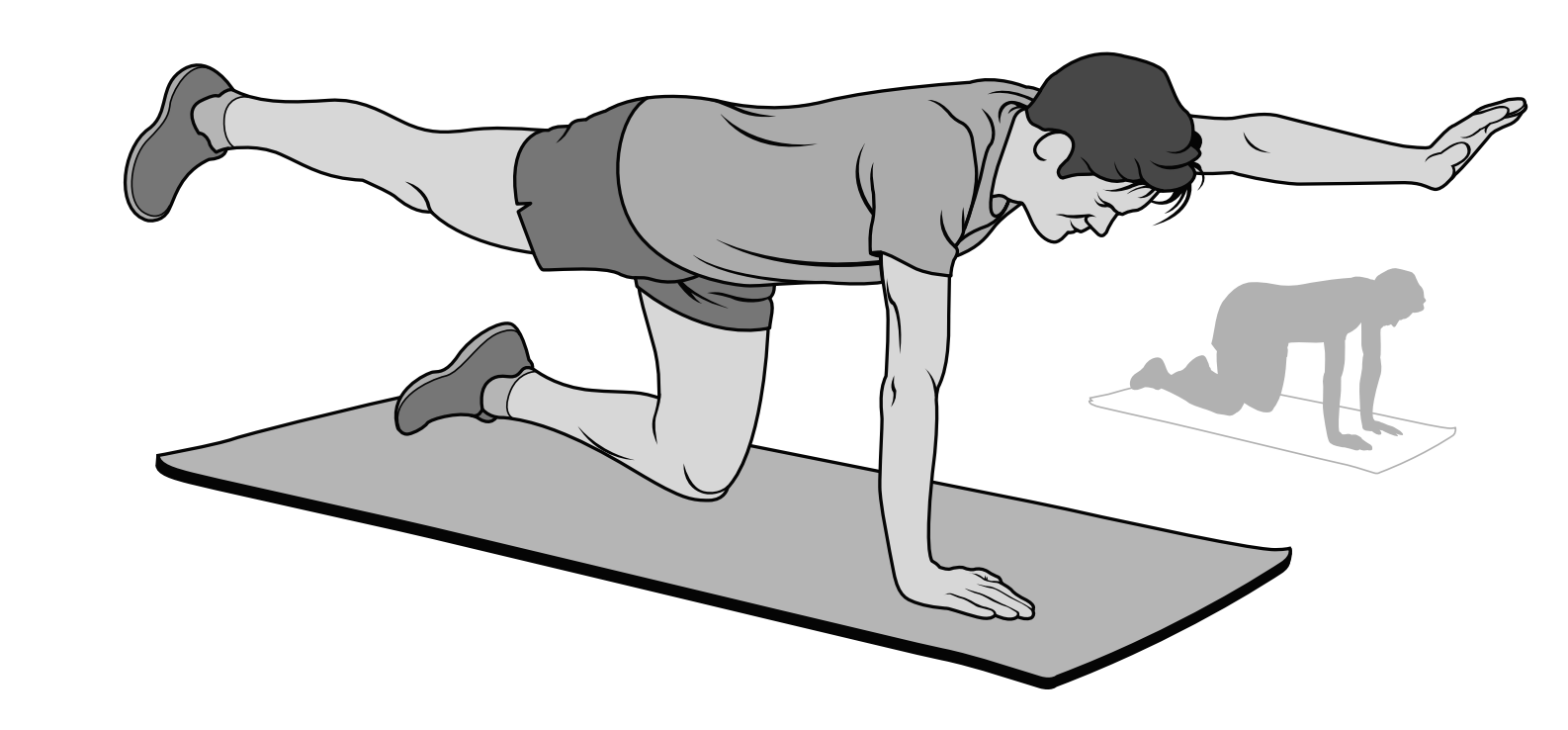
Bird dog core exercise illustration

At one of the first group dinners I attended when I arrived at the National Training Center in Western Canada, a two-time mountain bike world champion slid into the booth beside us. Everyone was sharing their training and racing secrets, which I was very happy to listen to.  

Someone asked the world champ what was different about his two years on top. His answer was simple, and the best advice of the night: “I just did four things: eat, sleep, ride my bike, and core.” 

Fortunately, nowadays, it doesn’t take much to convince a cyclist of the importance of core work.  

“It’s tremendously important and incredibly underrated,” says Chris Baldwin, a past national road cycling champion who now coaches at DaybyDay Coaching. Baldwin can tell the difference when a rider is pedaling from the center of their body or just with their quadriceps. It’s a matter of “style… smoothness,” he says.  

Most of us probably sense that we would benefit from strengthening our core. But what, exactly, do we gain from it? This is where the science gets… a little quiet. 

Craig Abrams, founder of CADC Chiropractic in California, worked with a team of researchers from the University of New England to answer this question, partially motivated by the fact that when they looked for existing research, there wasn’t any (then). 

 Abrams feels that core training offers both performance and health benefits—some of which are surprising. For example, the study explored the effects of core work on VO2max.  

Many of our inspiratory muscles—including the diaphragm, which is our largest muscle of respiration—act as both respiratory muscles and stabilizers. In a 2014 study of runners, it was found that fatiguing the core hurt performance by causing more labored and perceptually harder breathing. Likewise, too much heavy breathing weakened the core. ​[1]​  

“If you can breathe better and you can breathe longer,” says Abrams, “core is like Viagra for your lungs.” 

But breathing isn’t the only performance gain. The core provides stability that, according to Baldwin, allows riders to pedal from the center of their bodies, using every muscle from neck to toe, instead of just their quads to pedal. This results in superior power production. 

Former WorldTour pro Joe Dombrowski agrees: “In the fifth hour on the final climb of the day, once you’re fatigued, that’s when the stability work really pays off.” 

On the flip side, a weak core can hurt you—literally. 

Abrams doesn’t know a single cyclist who hasn’t experienced tightness in their lower back—a common result of a weak core. Which goes to the notion that maintaining health may not seem like a winning formula, but missing a season due to back problems is guaranteed to prevent you from reaping any rewards from all the training.  

In another study, researchers found that as a cyclist’s core fatigued, their knees began to sway laterally—a malalignment that could cause injury. ​[2,3]​  

Ultimately, health and performance go together. “If you’re injured, you can’t perform well,” Abrams says. “There’s a great word I use for the benefits [of this type of strength training]: ‘anti-fragile’ is the best way to describe it.” 

To learn more about how mobility, flexibility, stability, and strength can make you a healthier cyclist, see our three-part series from Dr. Stacey Brickson. 

How to Develop Your Core

Whether your focus is health, performance, or both, Abrams, Baldwin, and Dombrowski agree that core training is very different from what many think. Here are a few key principles to guide you: 

Endurance and function over strength and flexibility 

In multiple studies, Stuart McGill, one of the top experts on back stability and health, found that elite athletic performance did not correlate with core strength or back flexibility. Core endurance and neuromuscular function, however, were critical. 

Abrams, who said he never uses the word “strength” when prescribing core work, has found that building neuromuscular function instead of strength ultimately makes his clients stronger on the bike. 

For this reason, it’s recommended to prioritize function, using exercises that simultaneously work all muscles involved in cycling. 

Don’t isolate 

McGill’s research warned about the dangers of applying a weightlifter paradigm of single-muscle isolation and hypertrophy to an endurance performance setting. Baldwin agrees, pointing out that squats and deadlifts are one of his favorite core exercises because of the nature of the movement, which involves simultaneous activation of key muscle groups. “Simultaneous is the key—you’re using your back muscles while working your quadriceps,” he says. 

Train moments, not movement 

Let’s set aside complex biomechanics for this next point. If you held a weight with your elbow at 45 degrees, you’re training a particular moment of the bicep curl movement. Abrams warned about the dangers of training movements of the back, especially rotations. 

“Those movements themselves cause erosion of the spinal disks and irritate the spinal nerves,” he says. “That’s why sit ups are the devil.” Lateral bends, according to Abrams, are just as bad. 

The primary function of the lumbar region is to be stable. With all core work, Abrams recommends keeping the lower back locked in a neutral position. Avoid flexion or rotation.  

Of course, flexion and rotation are going to happen in competition, and you need to be able to move through those ranges without pain. You just don’t need to train them. 

Increase repetitions and holds, not weight 

Since core endurance is more important to performance than strength, increase the number of repetitions or the lengths of your holds as you adapt, instead of adding weight. Baldwin recommends doing core up to five days per week. 

No pain for gain 

Abrams points out that there should be no pain with unweighted movement. If there is, see a doctor right away. “You can add strength on dysfunction,” he says, “but you’re still dysfunctional.” 

Individual limit 

If a friend offers you Jackie Chan’s secret three-hour core routine, first remember that you aren’t Jackie Chan. Each of us starts at a different point. Core work to stabilize an injured back is very different from core work for top performance. Abrams recommends always identifying what you are capable of controlling.  

Not Always the Exercise You’d Think  

Below is a routine from our experts to get you started. Seek a professional trainer for anything more complex. The exercises must be flawless, maintaining tension throughout the body, warns Baldwin. Keep the spine neutral and locked. 

Bird Dog

  • Start with 6 reps on each side; hold for 3-5 seconds. 
  • Keep lumbar spine neutral. Do not arch back or rotate hips. 
  • Extend right leg and left arm. Hold. 
  • Repeat with alternate leg and arm. 
  • Add repetitions as you adapt. Do not hold longer than five seconds. 

Barrel Roll

  • Start with 3 reps on each side. 
  • Lift arms and legs to compress and hold the ball on stomach. 
  • Tuck your chin by pressing it back into the ground and then unweight your head. 
  • Rock from side to side without using momentum. 

Front Plank

  • Start with 2 reps of 45 seconds each. 
  • Support your weight on toes and elbows. 
  • Tighten abdominals and glutes. 
  • Keep neck and lumbar spine neutral (don’t raise your butt). 

Side Plank

  • Start with 2 reps for 30 seconds each side. 
  • Support weight on forearm and feet (use knees if not strong enough) 
  • Upper foot should be on the floor in front of the lower foot. 
  • Keep lumbar spine neutral. 

Single Leg Squat and Reach

  • Start with 3 reps with each leg 
  • Stand upright, with abdominals braced and lumbar spine neutral. 
  • Step forward with right leg, then return, 
  • Repeat, stepping to the side and the back. 
  • All movement should come from the hips. 
  • Repeat with the left leg. 

Goblet Squat

  • Start with 8 reps. 
  • Hold a moderate weight against the chest. 
  • Keep abdominals braced and lumbar spine neutral. 
  • Lower to a squat position. 
  • Knees should not bend beyond 90 degrees or extend beyond toes. 
  • Return to standing position. 

For more core exercises, strength and conditioning coach Jess Elliot details a multi-planar approach to core integrity based on stability, efficiency, and resilience.

References

  1. Tong TK, Wu S, Nie J, Baker JS, Lin H. The occurrence of core muscle fatigue during high-intensity running exercise and its limitation to performance: the role of respiratory work. J Sports Sci Med 2013;13:244–51.
  2. Abt JP, Oliga JM, Brick MJ, Jolly JT, Le SM, Fu FH. Relationship between Cycling Mechanics and Core Stability. J Strength Cond Res 2007;21:1300. https://doi.org/10.1519/00124278-200711000-00056.
  3. Burnett AF, Cornelius MW, Dankaerts W, O’Sullivan PB. Spinal kinematics and trunk muscle activity in cyclists: A comparison between healthy controls and non-specific chronic low back pain subjects—a pilot investigation. Man Ther 2004;9:211–9. https://doi.org/10.1016/j.math.2004.06.002.