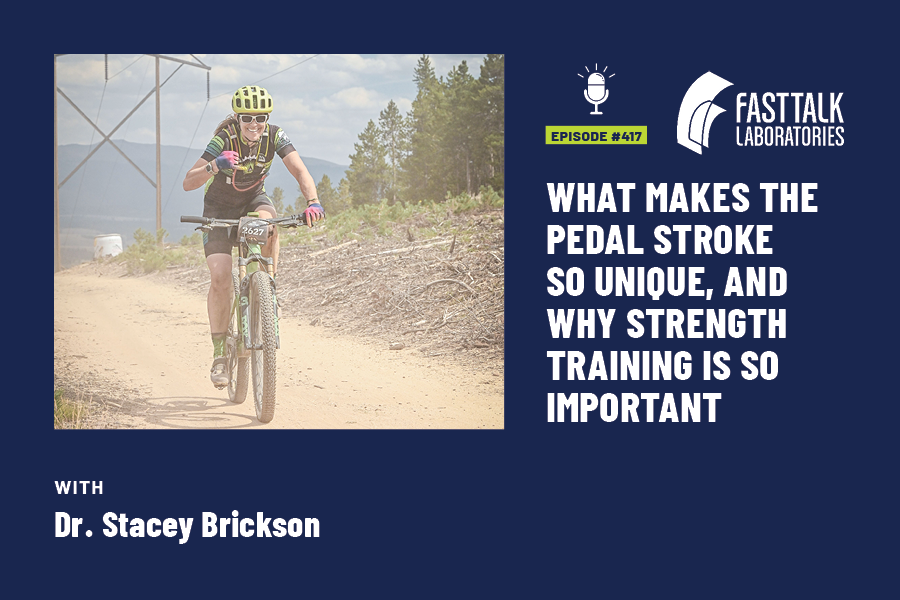






Functional training expert Dr. Stacey Brickson joins us to explain why no other sport movement is like the pedal stroke and, more importantly, why that requires doing additional strength work.
Episode Transcript
[00:00:00] Trevor Connor: Hello and welcome to Fast Talk your source for the science of endurance performance. I’m your host, Trevor Connor here with Coach Grant Icky. Our legs were designed for running and walking, and they were remarkably good at it. What they weren’t designed for was the repetitive circular motion we used to ride a bike.
The pedal stroke is, in fact, a very unique motion. It’s the only movement in sport that is constrained, closed, chained, a closed system, and almost entirely concentric. That doesn’t mean the pedal stroke is bad for us. It’s just not great for us if that’s the only thing we do. It is critical for cyclists to practice other motions that include eccentric activity and movement in all three directions.
They’re important, both for our long-term health and to be stronger on the bike. Here to explain all of this and to tell us what we should be doing off the bike is Dr. Stacy Brixham. She’s a professor of exercise physiology, a bike fitter PT and founder of Draft responsibly Coaching. Two years ago, she joined us to explain how to build mobility, flexibility, stability, and strength.
The workouts that she built for that episode are still some of the most popular downloads on our website today. She will explain the critical concepts of how our muscles produce, force, what we mean by the four Cs of constraint, closed chain, closed system, and concentric activity, and why the pedal stroke is the only movement to check all four boxes.
Then she’ll do what she did in the past episode and give a ton of great practical information and how do you strength training, and three plain work on the bike to keep your legs both healthy and strong. Joining Dr. Brixham will also hear from Dr. Jamie Whitfield, a professor in the Center for Human Metabolism Performance at the Australian Catholic University on Melbourne.
He’ll talk with us about the value of strength training. We’ll also hear from coach and physiologist si Seiler
and her thoughts summing up our discussion today. So clip into your pedals, but let’s try something different and let’s make you fast.
Well, Dr. Brixham, welcome back to the show. Been looking forward to this.
[00:02:06] Stacey Brickson: Me too, Trevor. It’s really a privilege.
[00:02:08] Trevor Connor: Yeah. We were just talking before the show, off mic first about Grant’s new beard. I have to point that out.
[00:02:16] Grant Holicky: It’s very sophisticated, everybody.
[00:02:18] Trevor Connor: Yeah, no, you are looking very, um, what’s the right
[00:02:22] Grant Holicky: erudite?
[00:02:23] Trevor Connor: Well, that didn’t help. I was about to say professorial, but then you put the baseball cap on backwards and I’m gonna change what I said.
[00:02:31] Grant Holicky: Let’s go
[00:02:35] Trevor Connor: now. Honestly, it has been great with the prep to this episode because. Dr. Brison, I will give you credit of all the guests we have had on the episode. You are hands down the one who comes the most prepared. You wrote some notes for this episode ahead of time. I think it was nine pages long and I thoroughly enjoyed reading it and I immediately said it to Chris and said, Chris, we need to make articles out this.
This is amazing.
[00:03:01] Stacey Brickson: Well, I don’t know if it’s amazing. I’ve been following your podcast since its inception in the quality of guests that you have from coaches to athletes to scientists is really impressive and a bit overwhelming now being on the show. So I wanted to make sure I had something intelligent to say.
You set the bar pretty high.
[00:03:20] Trevor Connor: You have a lot and excited for this and loved that you prepared that much for this because I think this is an episode we’ve needed to do for a while, and I’ll set this up by saying Dr. Ray Browning, who we’ve had on the show was my biomechanics professor, and I remember in his class him talking about the whole human body evolved around walking and running.
That is the activity that we do that is the most balanced, where we’re really using all of our muscles in the way they’re designed to be used. And then he said, and then you have something like cycling where you’re locked into this circular movement that your body wasn’t designed for it all. And there are all sorts of imbalances that result outta that.
So in this episode, we’re gonna go through why the pedal stroke is so unique, what makes it so different, and what are some of the positives of that, but also what are the negatives of that and what happens if you only just ride the bike and then hopefully finish up with talking about what are some of the things you can do to keep your whole body in balance.
We’ve mentioned that a few times in the episode, but this is gonna be our deep dive and I think it’s gonna be really fascinating.
[00:04:34] Stacey Brickson: Well, I’m excited. Let’s get to it.
[00:04:36] Trevor Connor: So Dr. Brison, I know before we dive into this, there’s some terms that you need to define for the conversation. We had recruitment, activation, synchronization, so why didn’t you take it away and tell us what some of these terms are?
[00:04:50] Stacey Brickson: Alright, will do. I’ll try to keep the heavy physiology talk to a minimum, but I do think it’s important to understand the variables of strength. Intuitively, we all know what strength is. It’s this maximal force a muscle can generate to overcome resistance. In our case, the resistance at the crank or the pedal.
And the cool thing about the body, one thing I love about studying physiology is it usually elects the simplest pattern. So when we’re talking about strength, we’re looking at the junction of the muscle. In the nerve. We call that the motor unit. So let’s think about the quadriceps, since that’s the muscle we’re most familiar with cycling.
And we’ll take one of the four quads, the vast lateralis.
Mm-hmm.
So that muscle is composed of fales. Each of those bundles then has hundreds and thousands of fibers that run the entire length of the muscle. And then you have a nerve, think of that as your power plug. And the femoral nerve in this case is what innervates the quad.
And that power plug has in it hundreds to thousands of wires. And those are called neurons or nerve cells. At the end of each of those neurons is an axon, which then has many projections called terminals. You can think of them as like Medusa heads or snakes. There might be 20 terminals, there might be 200 terminals.
But each one of those axonal terminals touches or innervates a muscle fiber. And that’s really cool. So one motor unit could include 20 fibers. One motor unit could include 200 fibers. And the interesting thing is that motor unit is like a light switch. It’s either on. There’s strength X or it’s off.
There’s no strength. There’s no force being generated. And that’s kind of crazy to think about because if you’re sitting on someone’s wheel in a pace line or you decide to break away, you need to grade force. It’s not an on off thing. So that’s really the essence of these three terms.
[00:06:51] Trevor Connor: So really important to understand.
As you said, it’s not like a neuron can say, well, I enervate 200 fibers, but I don’t need to put out a big four, so I’m just gonna activate 20 of those fibers.
[00:07:05] Stacey Brickson: Correct.
[00:07:05] Trevor Connor: It has to activate all 200 or none.
[00:07:08] Stacey Brickson: Absolutely. Spot on.
[00:07:10] Grant Holicky: There’s no dimmer switch,
[00:07:11] Trevor Connor: right?
[00:07:12] Stacey Brickson: There is kind of a dimmer switch, but in the way you’re talking about there’s not, you’re absolutely right.
It’s on or off. The dimmer is how we grade force. So kind of two different terms. Exactly. Right. Grant,
[00:07:24] Trevor Connor: so what is the dimmer switch? How does it grade force?
[00:07:28] Stacey Brickson: So the first thing is that those motor units come in two basic sizes, small or large. And based on that difference in resistance, the small motor units reach threshold first and the large motor units reach threshold later.
So that’s the first way that we grade force is through recruitment from small to large.
[00:07:53] Trevor Connor: And so in this case, we’re talking about the smaller ones are gonna be your slow twitch muscle fibers, correct?
[00:07:58] Stacey Brickson: Yeah. So the interesting thing about this motor unit is that if it’s a small motor neuron, all of the fibers that it innervates have similar characteristics.
To your point, Trevor, a small motor neuron is gonna innervate small fibers, small in size, small number of fibers, and those fibers tend to be slow twitch. So they’re really resistant to fatigue. They’re very highly oxidative. It makes sense from a physiology standpoint that those would then be the first fibers that we would want to execute force.
And then the larger motor units, innervate large. Size of muscle fibers. Those fibers are a large number of fibers and they tend to be the fast twitch or the more glycolytic high rate of force development. And so there’s a nice system of recruitment from slow twitch to fast twitch.
[00:08:57] Trevor Connor: I think that’s a really important and econ to understand is if you’re on the bike or you’re doing any sort of activity and you’re not putting out a ton of power, so you’re just riding along at say 110, 120 watts, because of that recruitment principle, you’re just recruiting the slow twitch muscle fibers, which is why you can go for a very long time because they don’t really fatigue.
But the more power you put out, you start recruiting those big fibers and they are your fast twitch and they do fatigue, and that’s why you can’t put out a very big wattage for very long.
[00:09:31] Stacey Brickson: Yeah, that is fundamentally true. And remember, it’s the muscle fiber only is recruited based on force, not on power.
So that gets a little complicated. Yes. But yes, you’re absolutely right. We start with flow and we recruit ultimately fast.
[00:09:45] Trevor Connor: Okay, so you’ve explained recruitment, so keep going. You had activation, you had synchronization, and I think a couple other terms,
[00:09:52] Stacey Brickson: just two more. So recruitment, we’ve covered. The second way that we grade force is activation.
And I like to think of this as caffeination. So let’s say that you’ve recruited X number of motor units. Those motor units that are already recruited can generate more force. So Grant, to your point, it is an on off switch, but when the switch is on, it’s not full power, it’s on. But we have more in that dimmer switch, and that’s where the caffeination or the activation comes from.
So. I explain this to my students, ’cause Caffeine’s easy to understand. If my frequency of activation is one shot of espresso per hour, that’s a very different load of caffeine than if I shoot a double espresso every 10 minutes. Right? And that’s basically activation is that the motor unit is firing at a higher frequency instead of caffeinating the system.
It’s calcium, but same idea that calcium basically allows tongues, more interaction of cross bridges. That caffeine or that calcium allows twitches to summate. So more cross bridges. So the switches on, but now it’s on full brightness. That’s the second way that we grade power is activation.
[00:11:06] Grant Holicky: I’m just gonna jump in here and say, if you had taught my physiology class, I probably would’ve done straight physiology in college instead of the general biology, because the caffeination piece is one of the best ways to describe activation I’ve ever heard.
So keep doing what you’re doing. This is fantastic.
[00:11:25] Stacey Brickson: Well, thank you.
[00:11:27] Trevor Connor: Just to give some real basics for anybody who’s very new to this, when you’re at rest, your muscle is not activated. And that’s because basically there’s an activation site that needs to bind with calcium for the muscle to start contracting.
And so when you want to use the muscle, basically calcium is released into the Sarco plasm of the muscle. It binds to those sites, and then the muscle starts contracting. And so basically what you’re saying is you can control to a degree the amount of calcium that’s released. Am I hearing you right?
[00:12:00] Stacey Brickson: Yeah, absolutely.
Well said. So yeah, there’s that little organelle called the sarcoplasmic reticulum where calcium lives or our caffeine lives, and when it’s released into the Sarco plasm. Then it’s pumped back in to the sr. But that transient, how long that calcium lives in the Sarco plasm, that’s additive. So the faster those impulses come, the more calcium is in in that space.
And that’s the greater rate that it’s being pumped back in to where it lives in the sarcoplasmic reticulum. And then that calcium binds, and again, we don’t need to talk physiology, but troponin C.
[00:12:37] Siren Seiler: Yeah.
[00:12:38] Stacey Brickson: And that triggers troponin I triggers troponint and pulls tro mycin off of actin to find the binding site for mycin.
So that’s the nuts and bolts of it, but I just like to think of it as caffeination.
[00:12:50] Trevor Connor: Which is a great way to think of it because I was trying to avoid using troponin and all these other terms that I lost sleep over memorizing. So that’s activation. What anything else we need to know about that?
[00:13:02] Stacey Brickson: Just briefly, synchronization and grant.
Maybe this will speak to you too. I think of synchronization is when the small motor units, they’re the treble. They come in first. The large motor units, they’re the bass, they come in next. Synchronization just means we have better music. The treble and the bass coming closer together, that’s all that means.
So we’re not taking henneman size principle and throwing it out the window. We’re still going small to large, but there’s less of a break. Or a distance between the recruitment of the small to large, and that’s how synchronization is. It’s a closer proximity temporarily of the two types of muscle fibers.
[00:13:38] Trevor Connor: Okay. I like the analogy except for the fact that since I have no fast twitch muscle fibers, that means I’m a soprano.
[00:13:45] Stacey Brickson: I’m right there with you.
[00:13:46] Grant Holicky: You have a couple, there’s just not many.
[00:13:51] Trevor Connor: What’s that old song? It’s all about the bass.
[00:13:53] Stacey Brickson: Yeah,
[00:13:54] Grant Holicky: I think that might be my theme song.
[00:13:57] Trevor Connor: I
[00:13:57] Grant Holicky: don’t have the other side, so, but you and I together, Trevor, and we might actually win some bike races.
[00:14:05] Trevor Connor: Yeah, well it’s the same thing with Rob Pickles. We have that great video on our website of Robin. I printing against one another and everybody looks at it and goes, Trevor, why weren’t you trying? I’m like, I was, I was. That was everything. Okay, so those are our concepts. The recruitment, activation, synchronization, key concepts about the muscle.
So now let’s dive over to the pedal stroke and talk about the ways the pedal stroke is unique. And what I loved in the notes that you sent me, you defined four things. So sorry, this is gonna be a, a terms heavy episode, but I’m gonna say to all our listeners, these are really good terms to understand and know, particularly if you’re a coach.
’cause you can really impress your athlete. These are great concepts. But of these four terms, these four concepts, you provided us a chart showing all the different sports and the one thing that was unique was cycling was the only one to check all four. No other sport does
[00:15:08] Stacey Brickson: not to my knowledge.
[00:15:09] Trevor Connor: Yeah. So take us through this.
[00:15:11] Stacey Brickson: Yeah, so thanks for bearing with me on the, on the fourth generation. Hopefully now we can put it into practice. So cycling for sure, it’s repetitive, but so are a ton of other sports. The unique thing about cycling is it checks four boxes. I call these the four Cs. To my knowledge, no other sport checks even two of the four.
So the first one is that it’s constrained, and all I mean by constrained is mechanically your foot, whether or not you’re clipped in, is really limited to the shape of the chain ring, usually circular. I’m sure there’s a few oval lovers out there, and the crank length. And so time and time again, your restricted motor patterns and joint angle excursions are limited to that direction, that range.
We can’t change the stroke length, we can’t change the direction. We can’t really even change the timing. Rowing is probably the only sport that’s even remotely similar. You know, the ore is locked into a. Or lock, but it’s meeting water, and water is compliant. So that’s really the only other sport I can think of that’s constrained.
[00:16:25] Trevor Connor: So yes, the idea here being like running the motion is repetitive, but when you are running, you can do a longer or shorter running stroke. If you’re on rough terrain, you can move your leg to the left or to the right, depending on the terrain.
[00:16:40] Stacey Brickson: Exactly.
[00:16:42] Trevor Connor: You can’t do any of that on the bike. It’s always the same circle.
You have no choice.
[00:16:46] Stacey Brickson: That is exactly right. So said positively. The crank really simplifies our coordination, but it sort of makes us motor morons. There’s not much neural generation of new patterns. It’s the same old, same old, and I think that’s arguably in the long run, hurtful to us is human movement machines maybe not hurtful to a cycling performance, but I think if we think beyond cycling.
There could be an argument that repetitive neural patterning is not great,
[00:17:17] Trevor Connor: and I love the fact that you said, let’s say this in a nice way, we’re neural morons. I’d hate to see the not nice way of saying this.
[00:17:27] Stacey Brickson: The second C is really related, and that’s that cycling is a closed system. All that that means is that we don’t really see ground reaction forces.
We’re not hitting the ground and the ground isn’t hitting us back, and so there’s no external force for us to accelerate. Our center of mass over our center of mass is staying unless we stand on the bike. Our center of mass and acceleration is staying right over the cranks. That provides very little in the way of motor planning as well.
So again, we’re sort of creating a motor moron rather than someone who can really explore different motor patterns.
[00:18:07] Grant Holicky: That’s part of why I think it’s interesting when you take people who have ridden for a long time but haven’t done a lot of sprinting and try to teach them to stand and sprint. There’s real limitations in the technical ability to stand and sprint because it requires movement of the bike.
And you do have some sort of a reacting force that you normally don’t have.
[00:18:27] Stacey Brickson: Grant, that first occurred to me this last summer. I had a new athlete and she had asked to go do some hill repeats ’cause she was struggling. And so we talked about when it was important to stand and she looked at me and she said, I can’t stand.
And I thought, what? Yep, what do you mean you can’t stand? And that’s the first time I really understood. That this is a closed system for the lion’s share of the time unless you’re standing. So I think that’s really important, a distinction from all other sports that I can think of, and that’s different than the next C, which is closed kinetic chain.
There are lots of sports where it’s a closed kinetic chain and that just means the end of your chain, your foot is fixed on something, you know, when you’re running or even if you’re skiing or speed skating, there’s a time when the, at least briefly, that the foot is not in contact with the ground and then it comes back to meet the ground.
And that requires all sorts of accommodation. To your point, at the very beginning, Trevor, about your mentor and that we’re born to run, you know, the foot is meant to go from supination or. Outer force to pronation to an inner force back to supination. And when you’re on the bike, we’re just stuck in pronation over and over again.
And then people wonder why they get hoppy. You know? We just weren’t made to not have to accommodate things. So again, one of the only sports that I can think of where it’s complete closed chain, because the hands too are on the handlebars and the butt is on the saddle, which is unique
[00:19:59] Trevor Connor: just for anybody who’s new to a lot of these terms.
Explain supination and pronation.
[00:20:06] Stacey Brickson: Yeah, so supination and pronation are a natural, it’s a tri planer motion, so it involve. Joints both in the frontal, the sagittal, and the transverse plane moving so that basically you’re creating a rigid lever at the foot in supination, a very compliant, accommodating foot that’s sort of, I don’t know, for better word, this isn’t true, but more flat just for visualization during the weightbearing phase, and then back to that supinated or more on the outer border of the foot.
And that just allows a rigid lever to an accommodating bacteria rigid lever, which is how we ambulate or run or walk. So it’s a tri planer motion at the ankle and foot.
[00:20:49] Trevor Connor: So I, I was just at my massage therapist the other day and we were talking about kinesiology and I was telling her my intro kinesiology class, my professor was very old school and we used this textbook that didn’t have a single picture.
It explained every joint by, you had to understand insertion points and distal and proximal and supination. And so just describe the joint and you had to try to picture it in your head. And that was a miserable class giving me a few memories of this, talking about sagittal and distal and supination and everything else.
So these are all key concepts.
[00:21:28] Stacey Brickson: Exactly. And the last CI think is probably also one of the most important in that the bike really only allows for the type of contraction that we call concentric. So concentric is shortening, eccentric is shortening under load, so it’s lengthening under load and we don’t have much in the way of eccentric contraction, which is really too bad in cycling because forces in all of the muscles are really exaggerated.
During eccentric. We can’t generate as high a contraction, a highest force during a concentric contraction as we can during an eccentric contraction. So we never see nearly the magnitude of quadricep force as we do in anything else that allows centric, centric. Also a really important for tendon. Both improving stiffness for force transmission and just tensile strength.
So our tendons really suffer. And I’m sure you’ve all had athletes that have repeated tendinopathies patella quadricep, and that’s one of the reasons is that our tendon health really struggles. So the contraction type is only concentric for the most part. Well,
[00:22:39] Trevor Connor: I am a huge believer that the eccentric loading is a hundred percent necessary for preventing injury in the long term.
[00:22:47] Stacey Brickson: It is
[00:22:47] Trevor Connor: that if you don’t have that eccentric work, you are setting yourself up to be injured.
[00:22:51] Stacey Brickson: You are, and I think as coaches, we’re not just, or we shouldn’t just be interested in how our athlete is performing on the bike. You should be interested in how they’re performing off the bike, at least with respect to injury prevention.
And I’m sure you’ve all had. Athletes that take their time off and they go play something like pickleball and they come back to you mortally wounded. And if we don’t have them addressing all of these strength issues and motor pattern issues and eccentric loading issues off of the bike, then I really don’t think we’re doing them much of a service.
Even if they’re on the podium, they’re gonna be other places like physical therapy at some point.
[00:23:31] Trevor Connor: Yep. Well, I mean I still remember my old coach, Huang and Mary, he was very big on in the fall and the winter, we would go and do these gym sessions where he would hit all of us knowing that we were all cyclists who spent way too much on the time on the bike and not enough time doing anything else.
He had hit us up with this, all this eccentric activity and it would be funny ’cause the next day. I mean, you, you, you had Olympians in this group. Next day we’d all be walking around like 90 year olds after the first session because none of us were familiar with any sort of eccentric load and it would just kill us.
[00:24:06] Grant Holicky: Well, yeah, I remember my brother trying to get me to come play soccer with him again recently. And my answer is just no, it’s not gonna happen. I know what would be the day after, so call me back when I’m in an off season and absolutely I’ll go play. Or at least in a build season, right, so that I can function.
But this was, I think right before cross, I’m like, this is a week where I’ll be so to do anything and soreness is the least of your concerns. I mean, injury is the highest. So yeah, I mean it really is a product of the sport. And the more we can do to, I mean the simple way to put it is to promote any athleticism within our population is probably a good thing.
Yep.
[00:24:50] Stacey Brickson: Absolutely.
[00:24:51] Trevor Connor: The dangerous cycling’s unique pedal stroke comes when all an athlete does is ride a bike. Before we dive into off the bike work, let’s hear from Jamie Whitfield and why it’s so important.
[00:25:02] Jamie Whitfield: I think particularly for
cyclists, strength work is really important Part of the overall training plan.
Cyclists in particular, are very well known to have low bone density, and that’s because there’s so little load that’s actually going through bone when you’re actually on the bike. And particularly if you’re spending 20 plus hours training a week on the bike, the chances are you’re not doing a whole lot else outside of that.
Certainly with the old school environment, it was very much a case of don’t stand if you can sit, don’t sit if you can lie down, that sort of thing. And so it was really emphasizing work on the bike at the expense of everything else, and so I think it’s important to realize that. Cycling is only one aspect of life, and sometimes that’s a very important aspect of life.
But there are other components that you need to think that even the most successful athletes with the longest careers are probably retiring from high end competitive cycling in their forties. And there’s a lot of life to live after that. And so making sure that you’re building a body that is going to be long lasting and healthy, I think that’s a really important component.
And so making sure that you’re incorporating things like strength training that’s gonna induce that load and really help not only just your musculature, but also your bones and other aspects of your body. I think that’s an important component to cycling.
[00:26:24] Trevor Connor: So you’ve explained now that cycling is this unique sport where it is constrained, it is closed chain, it is closed system, and it’s basically all concentric contraction, which makes it very unique.
So my question to you is. What impact does this have? So let’s take that cyclist who all they do is ride their bike. They go, forget the gym work, forget doing other sports, forget cross training. I am just gonna ride my bike and that’s the only activity I’m going to do. What effect does that have on them?
These four C’s?
[00:26:57] Stacey Brickson: So if you take those four Cs when you have a constrained system, so you’re limited to the excursion of the crank arm, you’ve got very limited joint ranges of motion. I think you can imagine that the ankle and the knee and the hip are capable of way more degrees than what we’re putting them through.
So you’re not loading the joint, it’s full excursion and joints. They like WD 40 like the tin man, right? And you only get that WD 40. Nature’s WD 40 synovial fluid, and you only see that when the joint is going through full range of motion and is loaded through full range of motion. So I don’t think we’re doing our joints a huge service.
The argument to that is that if you have an athlete with poor joint cycling’s a great opportunity to do something that doesn’t hurt it. So you know, there’s a flip side to both. Mm-hmm. But I think for joint health, it’s not a great place to start, as we talked about, because it’s closed and constrained, you’re not seeing big forces.
So you might not be weak per se. I did not look at Teddy Faccia and say, oh, you’re weak, or any of those cyclists, but they’re not as strong as they could be. And as they age, your whole pool of muscle is going to start to undergo what we call sarcopenia. Fire fibers are going to be lost with age, no matter who you are.
And more preferably the system takes the fast twitch. So if we’re already only. Mostly recruiting slow twitch. Can you imagine when we start losing fast twitch, what we’re gonna be like? Not great. So I worry about that. I really worry about our tendon health is granted, he doesn’t play soccer when he is called to do so for good reason.
And then we do it in the off season. And what happens when we do it in the off season, we get hurt.
[00:28:44] Trevor Connor: Right?
[00:28:45] Stacey Brickson: So I think that paying attention and you know, a lot of cyclists, they may not be asking to do those things and that’s fine. They may not wanna go play pickleball or soccer, but I think it’s in our best interest maybe to do very gentle limited biometrics.
So at least the tendons are seeing eccentric contractions and they’re gaining stiffness and they’re gaining tensile strength. Which they’re not seeing on the bike. And I think our bone health suffers. And I, you know, I was a triathlete for a long time before I switched to cycling. And I think that since I just switched to cycling for the past 25 years, my bone health is evidenced by my most recent DEXA scan sucks.
And it really was a wake up call to get back in the gym and do what I don’t love to do, but I love to preach, which is strength train. And so I think bone health is something else that takes a really big hit. And then the last thing that takes a hit is our motor patterning. And I’ll give a really silly but poignant example.
I lived in the same house for many, many years and then I moved. This is what happens when you get divorced. And I bought a condo two blocks west of that house and do you know, for three months I drove the same route that I had
[00:30:02] Grant Holicky: You drove to the house.
[00:30:03] Stacey Brickson: Yes, I think my ex-husband probably thought I was nuts, but I, I couldn’t get my motor pattern to turn two blocks earlier.
And so I think when you just have the same, I don’t, maybe this is a really bad analogy. We could go crazy places with this that we shouldn’t, but my point is that if you just do the same thing over and over, it’s really hard to break that motor pattern. So I think getting off the bike and moving in other planes is, in the long term, really healthy for us.
[00:30:34] Grant Holicky: So there you have it, everybody. Dr. Brookson says that stalking may just be neural pattern. It may not be nefarious,
[00:30:44] Trevor Connor: it’s just my pattern. I had to do it.
[00:30:47] Grant Holicky: I’m sorry. It just drove me home.
[00:30:50] Stacey Brickson: I also wasn’t trying to say that we should get divorced to change our neural patterns. This is not, that was not the point.
[00:30:57] Grant Holicky: Fair enough. I will say that I had the same thing happen here. We just moved back into our house a year and eight months after the fire, and I drove the other day to the rental house.
[00:31:07] Trevor Connor: Yeah,
[00:31:07] Grant Holicky: right. And parked and then went home. Right. I gotta go somewhere else.
[00:31:12] Trevor Connor: I don’t live here anymore.
[00:31:13] Grant Holicky: Yeah. You know, and I do think those points are really well made, just about cyclists and bone density and athleticism.
And as you mentioned, you know. Maybe we don’t want to go play pickleball or we don’t want to go play soccer, but we do need to reach behind the seat in the car and grab that thing. We do need to reach up and grab that heavy object off a shelf, and all these motions and all these movements that are required in life then puts you in a place where you’re behind the eight ball and you’re not able to do those things.
If bone scans maybe go down and people may sit there and go, well, that’s worth it. Yeah. Until you get injured picking up a sack of sugar off a shelf and you can’t ride because you did something to one of your intercostal muscles. So well-rounded athletes on and off the bike mentally and physically are fast athletes and I think that’s something we’ve seen really change in the sport in the last decade.
And that’s good and there’s benefit to that.
[00:32:13] Trevor Connor: Yeah, and there’s been some really interesting studies that prove the points that you’re making. I remember reading one. That looked at basically professional cyclists in their twenties and early thirties. And in a lot of them you were actually already seeing signs of osteopenia.
They had the bone health of somebody in their fifties or sixties. Likewise, a study I really enjoyed looking at aging, looked at lifelong cyclists and what you saw was these cyclists in their fifties and sixties, they could go out and do a 20 to 40 minute time trial almost as fast and as strong as somebody in their early thirties like you.
You just don’t lose that form ’cause that’s a mostly slow twitch muscle fiber activity. But then when you tried to measure their variables above that threshold, so what people think of as the threshold. So you look at their VO two max power or their explosive power, there was nothing there. Yeah, as you said, they lost all of those fast to muscle fibers ’cause they just weren’t really working them.
[00:33:14] Stacey Brickson: Exactly.
[00:33:16] Trevor Connor: So anything else to understand here? Or do we talk now about what we can do to prevent some of this and keep that cyclist in balance?
[00:33:25] Stacey Brickson: Yeah, I don’t think I have anything more just, you know, that, revisit that idea of recruitment and emphasize that we are mostly recruiting slow twitch muscles and that we are mostly recruiting from a very small pool of those motor units that we’re confined and constrained and so that our pattern is reusing, recycling the same motor units, leaving lots on the table that are largely ignored functionally.
[00:33:58] Trevor Connor: Oh, that’s a great point. And you had this great message in the notes that you sent that was kind of the theme that goes with this, that we need to build an athlete that is adaptable, not adapted. And it sounds like that’s kind of what you’re talking about here.
[00:34:12] Stacey Brickson: Yeah, I really wish I would’ve thought of that phrase, and I really wish I could credit whoever did.
It’s not mine. It’s not your phrase stole it because I love that
[00:34:20] Trevor Connor: phrase.
[00:34:20] Stacey Brickson: It’s not my phrase. So someone listening is like, I said that and thank you. It’s brilliant and it didn’t come from my brain, but I really like it. And I think that for your athlete who might give you some pushback and say, Hey, I wanna be a really well adapted cyclist, they’re not mutually exclusive.
There’s nothing to say that you can’t be a very proficient, successful, high performing cyclist and not also be adaptable. They’re not mutually exclusive. You do have a limited amount of time. I had a high school teacher once tell me, remind me, everyone has 24 hours in a day when I was complaining about not having enough time.
We all have the same amount of time, but we all have different amount of resources and how you choose to allocate That is really where I think it’s important for the coach to impress that a little bit of time off the bike spent in the weight room is really going to not only not hinder performance, but help performance on the bike and across the human lifespan.
I think that’s really the message that I would like to give and listen to myself since I, I’m not always great at doing what I say.
[00:35:29] Grant Holicky: Well, no. I think as so many of us are in the same boat, I mean, we build our schedules around the bike and then the other things feel like add-ins. So, you know, for me, we take the kids to school and we go for a little run and we take the kids to school.
I have a pretty consistent time of day that I go ride and then. If I have something that’s really scheduled consistently, that’s my strength work. Like today, I go to the gym at noon and that’s scheduled, and that’s defined. I’ll always do it. It’s the time where it’s just kind of an add-on at the end of the day, well, I gotta get this done and I don’t wanna do it.
You know, maybe I don’t wanna do immediately off the bike, which isn’t a bad idea in and of itself, but you get off the bike and you want to eat and you want to do this and you wanna do that, it’s just easy to let it slip away and not to speak too much to the older audience. ’cause I think it’s incredibly important for neo pros and amateurs and young pros.
And I think it’s even important for teenage athletes, but for the aging population, which. Trevor is part of, I’m not, you know,
[00:36:31] Trevor Connor: oh boy.
[00:36:32] Grant Holicky: I’m so much younger than him and I have no gray in my beard whatsoever. But for the aging population,
[00:36:39] Trevor Connor: I’m sitting here reading the outline and all of a sudden I just hear outta the corner of my ear,
[00:36:44] Grant Holicky: you’re just getting lit up.
I just wanted to make sure you were still paying attention. But I went to the physical therapist last year and I hadn’t been lifting and he was talking about, you know, your right hips be really struggling. You have some imbalance that’s forming all these things that are really consistent with what happens.
And when we only bike and I got with freeze and even just once a week consistently going to a class, A strength class at the gym. And I did that for most of the year and I went back in randomly this year just to kind of check on things. And he’s a friend and we wanted to talk a little bit and he is like, your imbalance is almost gone.
Yeah. And so there’s, and I wasn’t actively working on it. It was just about becoming universally strong again.
[00:37:27] Stacey Brickson: Yeah.
[00:37:27] Grant Holicky: And it makes a huge difference. And it makes a huge difference in how I ride the bike. And then lastly, and everybody who ever listens to this podcast knows how much I love VO two max work.
It changes what we’re able to do in the higher ranges, and I think that’s just crucial as we age. Absolutely. Spot on.
[00:37:49] Trevor Connor: Let’s hear again from Jamie Whitfield and keeping up weight training through the season.
[00:37:55] Jamie Whitfield: I think similar to a lot of other things, you need to periodize what you’re doing. So trying to lift really heavy and inducing a lot of neuromuscular fatigue probably isn’t gonna be the focus when you are getting into to key competition phase.
So perhaps transitioning to maintenance as opposed to trying to build strength. And it will also depend on what your focus is. If you are a cyclist that’s focusing on shorter duration events, maybe you’re a track cyclist. Weight training is probably gonna be a bigger component of your overall training program than doing long rides.
If you’re a road cyclist, obviously the physiological demands are gonna be a little bit different, but making sure that you’re still touching base with that gym work, I think throughout the season is going to be important because apart from anything else, it’s gonna hit different antagonist muscles and it’s just gonna make you a more well-rounded, robust athlete.
[00:38:53] Trevor Connor: If you’re an endurance athlete, you already know that performance isn’t just about how hard you train, it’s about how well your body adapts to that training. And one system that plays a surprisingly important role in that process is the gut microbiome. Research is increasingly showing that the gut communicates with skeletal muscles through what’s known as the gut muscle axis, which influences inflammation recovery, and the signaling molecules called myokines that help drive muscle adaptations.
One way to support that gut muscle connection is through the right probiotic. That’s where Arago from Mira MD comes in. Arago is a physician formulated probiotic and prebiotic designed to help optimize the gut muscle axis, supporting microbiome balance, and helping maintain the right relationship between inflammation, recovery and adaptation.
Each capsule delivers 35 billion CFUs with 17 probiotic strains, plus Saccharomyces bilar. A clinically studied probiotic yeast that’s rarely included in most formulas. It also includes the prebiotic, inulin, and a delayed release capsule designed to deliver these beneficial bacteria to both the upper and the lower intestine.
Rago is made in the United States with clinically research ingredients and FDA inspected CGMP certified facilities, and it doesn’t require refrigeration, and that makes it easy for athletes traveling to races or training camps. To learn more about supporting the gut muscle connection for endurance performance, visit sera md.com/fast talk and use code fast talk 15.
That’s F-A-S-T-T-A-L-K 15 for 15% off your first order. I think another really important thing to point out here is people love to talk about the number of hours that pros spend training. They always go, pros are spending 20 to 25 hours a week on the bike. Isn’t that impressive? But they aren’t spending 20 to 25 hours a week training.
They’re spending 30 to 40 hours a week training. They’re doing 10 to 15 hours of work off the bike to keep their bodies functional.
[00:40:55] Grant Holicky: Yeah, in some capacity. And it’s as simple as we’re watching. Activations become a huge part of people’s routine before they go ride a 10, little 10, 15 minute activation routine to make sure everything’s firing before they go do a ride where they have efforts.
Certainly that’s a huge change that I’ve seen in the last decade as I look around before a state race, even just here in the States and there’s like 10, 15 dudes in a parking lot with bands, you know, doing clamshells and fire hydrants and all these things to get ready to go ride. I mean, that’s what you see at arrays.
That doesn’t even cover what they’re doing in the gym. So I think this is a crucial piece that is kind of missed. We like the glorious workouts and the stuff that Todd talks about on podcasts, but this is the behind the scenes work that we don’t really talk about and I think a lot of people just don’t do.
Including you and me, right? Stacy?
[00:41:53] Stacey Brickson: Uh, for sure. Yeah. I just hired a strength coach last year and I, and twice a week. And I think one of the challenges we probably all have with our athletes is. If you don’t have eyes on them during the strength workout, I’m really uncomfortable giving them strength workouts ’cause it’s also a great way to get injured.
You know, a poor squat or a poor deadlift is a great way to get injured. So to tell them to do it without checking their form is dicey. But that’s a podcast for another time. Just acknowledgement.
[00:42:23] Trevor Connor: Right.
[00:42:23] Stacey Brickson: Grant, you mentioned something that I really wanted to jump on ’cause it’s the activation piece. You know, I think one cell for me, for having the athletes do activation or weights is to tell them, listen, the strength training really raises the ceiling for force capacity so that you’re working at a smaller percentage of that force capacity.
That’s a pretty easy thing for all of us to go. Yeah, great. I have more strength, so I’m for the same output. I’m working at a smaller percentage of that. That’s awesome. And then to the activation, the clamshells and the bands. I think of that as, this is another really goofy analogy. I played college basketball and before you imagine.
Like something cool. I played division three and I mostly sat at the bench, so that’s my college basketball career. So as a scrub, and if you only play the same five starters, if you are only recruiting the fibers that are putting power through the pedal at the same phase, right over and over again, what happens when you need to put in a scrub?
Like me, we freak out. We don’t know the plays, we don’t know the pattern. We’re not able to contribute in a meaningful way to the power stroke or to the basketball analogy to play. And so put in the scrubs, you know, do your clamshells in your activations, and remind those scrubs of if they need to contribute.
They’re not out to lunch, that they’re still part of the game. They’re still part of the team. And so it, you know, a lot of athletes are like, well, I don’t use those muscles when I’m riding. Well, you don’t use ’em ’cause you don’t have to. ’cause it’s constrained. But what if you could tap into them?
[00:43:57] Trevor Connor: Yeah.
[00:43:58] Stacey Brickson: What if you create motor patterns where you can.
Sort of bring in more glute or bring in more a b ductors or bring in more external rotators to make the, maybe not generate more power, but make the power handoff through the cycle a bit more smooth so there’s not accelerations, decelerations. ’cause that’s what really kills us. Right? So I just wanted to bring that back to tie in activation at the beginning with what you see now,
[00:44:25] Trevor Connor: as you said, you can make an athlete who’s both adaptable and adapted.
I read this really interesting study leading into this episode titled The Relationship Between Neuromuscular Function and the Watt Prime and Elite Cyclists. And so Watt Prime, it’s, it’s a complex term. I’m just gonna give a simple definition. It’s basically how much power or energy do you have above your critical power, which is.
Basically equivalent to your threshold. So it’s really saying how much explosive power do you have when you’re in that race and people are attacking how many matches can you burn? Think of what prime that way. And I get athletes that come to me all the time and go, I need to build that more explosive power.
I need those attacks. What sort of interval work should I do? And this study was looking at what are the factors that seem to contribute to the development of watt prime? And I’m just gonna read right outta their conclusions. The regression analysis found that 87% of the variability in watt primed was explained by two variables, MVT.
So that’s the maximal voluntary torque and PPO, which is the peak power output. And basically they said it’s likely the muscle size and strength. Contribute meaningfully to watt primes. So basically saying, being in the the weight room, doing strength work, building the size of the muscles, making sure you can use all those muscle fibers, that’s what’s gonna give you the watt prime.
[00:45:52] Stacey Brickson: Yeah, I would agree. There’s two things there that I think you said that are important to tease out. One is the size of the muscle, right? Bigger fiber, bigger strength generation. That’s the hardware of the muscle. But the software is what I would argue is more important. And that’s the pattern. That’s the ability to activate what’s already been recruited.
And so that’s part of strength too. And those are the gains that you see immediately before the muscle grows in any sort of size. You see the software exaggerate strength. So both of those two.
[00:46:23] Trevor Connor: So Dr. Bricks of, I know the listeners are probably really interested in hearing what sort of things they should be doing and completely respect.
You said you don’t wanna give a strength routine here on the episode because they need to be doing it with proper form and they can injure themselves if they just hear, do this exercise or do that exercise. So avoiding that, tell us a little bit about where they should generally be focusing with the strength training.
And I know you wanted to cover the difference between functional training and strength training.
[00:46:53] Stacey Brickson: That sounds great. You know, we’ve done a episode before that covered mobility and flexibility, so I’ll just throw that out there that those should be precursors to strength work
[00:47:04] Trevor Connor: and we’ll put that in the show notes for anybody who wants to see that or hear that.
[00:47:08] Stacey Brickson: So for me, the big thing about strength training is time under tension with the goal of really expanding our motor unit pool, so expanding what the cyclists can access, and then also raising the ceiling for force generation on what they can access. So what strength training? When I’m talking about strength training, I’m talking about heavy, and heavy to me means a lift that I can do three to five times with maybe a rep or two left in reserve.
So that to me is what I say is heavy. And when you lift heavy like that, we’re really working on the software. We’re working on the central nervous system, learning how to activate and recruit fighters. We’re not really building hardware or hypertrophy. That’s more really high volume, high repetition, high number of sets.
So that kind of lifting, and I think that’s, as we talked about, it really allows us to recruit those high threshold or big motor units. It really improves coordination of those motor units. So that’s what I like to do. I usually recommend one push and one pull. So one squat and one maybe trap bar deadlift.
Then to sort of supplement that, I like to do accessory lifts and I like to do these with single leg, so much lower weight, little bit higher rep. My goal here is more. To complement the system, not to build, strengthen the system is the primary purpose. So remember that because cycling, I mean, we have to balance on the bike, but then there’s not much balance beyond that.
It’s just not a complicated motion. So I like to do things like Bulgarian split squats or step downs or single leg R dls, where you’re really focusing on letting gravity take you such that you require balance. I think that’s a critical piece. So strength training is probably the first thing. I also like in strength training to throw in isometrics cycling doesn’t have any eccentric, it also doesn’t have much of an isometric, and yet we spend so much time generating force over such a small range.
I think you can get a big boost if you do some things like wall sits or isometric lunge holds. So I like to throw a few of those in there as well. As far as. Functional strength training. Everyone defines this a little bit differently. I don’t know that there’s one correct definition, but how I define functional strength training is trippler.
So on the bike we are sagittal bound. All we do is flexion and extension of our hips and knees and ankles, and we forget about rotation and we really forbid any frontal plane, right? We don’t want our knees outside of that sagittal motion that creates all sorts of problems. So to me, functional strength training is body weight or at most resistance bands, elastic cords.
And I’m moving in other planes, coordinating all of the three planes. So I’m not trying to isolate one muscle. I’m not trying to isolate one motion, I’m trying to coordinate them. And Grant had said something earlier about. Getting injured when you lift a pound of sugar. But I was at the grocery store the other day and rotated to pull a bag of groceries into my car, and I’m like, dang.
And so that’s just a reminder to me of functional strength that I’m using rotation in the transverse plane I’m using. AB deduction in the frontal plane, as well as all the sagittal motion. So that’s to me, functional training. And sometimes in my athletes who really like to strength train, I’ll have two days in the gym and one day of function.
For athletes like me who don’t love that, then I’ll incorporate a functional exercise within their circuit. Something to make sure that they can move outside of the sagittal plane.
[00:51:04] Trevor Connor: Very quickly, for anybody who’s new to this, the human body, we kind of break it into three planes and talk about movement on the different planes.
So if you’re standing and you reach forward with your leg, you’re moving in one plane. If you reach to the side with your leg, you’re moving in another plane. And forgive me, I have memorized this a thousand times and I never remember which plane is which, but I believe that moving your leg forward, as you’re saying, is the sagittal plane.
And the issue with cycling is it only moves in a single plane. What you’re saying is for functional work, we really need to learn to move the body through all three planes. Am I getting that right?
[00:51:41] Stacey Brickson: You are exactly right. And you know, the athlete may come back and say, well, if I’m only performing in the sagittal plane, why do I need to spend time in the other planes?
So the tissue cooperative is not gonna be there just because you’re not moving. In the frontal plane. So legs out to the side like a jumping jack, those hip a b deductors still generate enough force to keep us sly sound. Right? So even though they’re not participating necessarily in the torque at the pedal, they’re certainly participating in the stability while you’re riding.
So they absolutely are important. And the core is will, which we haven’t even talked about, which is a big part of what I think is functional training.
[00:52:26] Grant Holicky: Well, I think a good point is we, you know, we’ve talked a little bit about standing on the bike or standing and sprinting. Think about that side to side movement that the bike takes on and the momentum that’s pushing the body side to side.
You are now keeping that in line with those same muscles that would normally be functioning and and like say a jumping jack, right? They’re providing the edges they’re providing so that when you really lean hard onto the left side and you swing that bike back to the right, the bike stops. And so that’s where that strength comes into play so dramatically.
And that ability to stop direction and push back to the other direction that provides power, that elasticity in that movement is what can create some of the most. High sprinting powers that we have. So that’s why that strength in those planes are so, so important to everything we do on a bike. And this doesn’t even come to something like mountain biking or cyclocross where you really controlling the bike underneath you.
So, you know, road or time trolling, which feels like this very, you know, defined activity still needs that. But when we start talking about things where we have to actually use our musculature to control the bike in a mountain bike or in, in a cyclocross setting, that’s when it becomes really, really essential.
[00:53:50] Stacey Brickson: Yeah. Great point. Well said. Which is then also one of the things that I strongly encourage my riders to do, where I’m in Wisconsin, so we have snow right now and fat biking like mountain biking maybe like cyclo Cross really allows different motor patterns. And so if you have an athlete that just really is cyclo centric, try to encourage them at least to be off the road bike and on something like gravel or mountain or cyclo, clasts or fat in the snow to give them a little different stimulus.
I also really encourage my athletes, once a week, I sort of insist mostly on what I call a flex day. And then flex day is, it’s flexible. One, it gives them the freedom to do what they haven’t been able to, what I haven’t asked them to do so. So it gives them a little bit of ownership. But two, it reminds them that they can be off the bike and still be fit.
And most of them here tend to snowshoe ’cause we have snow or they go cross country skiing. Or in the summer they’ll go running. You know, there’s certainly data that suggests that if you’re a cyclist and a runner, you’re a little bit less economical than a pure cyclist. And I would agree with that. But that data comes from triathletes who are doing a big bolus of running along with a big bolus of cycling.
You’re not, that’s not gonna happen with a one day, a week 5K run, right? So that that’s just not gonna decrease your economy on the bike. So a flex day is another thing that I really encourage. And then the last thing is, and I’m not gonna talk about this much because other guests have done a phenomenal job of discussing it, but it’s cadence, drills on the bike.
Both low cadence, high torque. And the reason there being is wake up those other motor units. Remember to ask the big dogs to come in and play in the game. And then the high cadence, low torque, and this is really about neuromuscular patterning. When you’re spinning, I’m all slow twitch. I really have a hard time with drills, but it’s good for me, right?
It wakes up a motor pattern that I just really don’t possess. And so then when I go back to my 80 RPM on the bike, I have a better sense of that because I have spun up to one 20 or maybe 1 25 on a good day. Wow. So yeah, those are just some things on the bike. Uh, different kinds of bike, a flex day. But the primary thing is weight room, both heavy weights for at least the two primary lifts.
Some lighter weights for accessory lifts to throw in balance and unilateral work. And then functional drills or functional strength. Body weight or light resistance in tri planer, that’s the secret to success. I think.
[00:56:34] Trevor Connor: That’s great. I’ll admit I have for the last five minutes, but I’m able to get this image outta my head.
You talked about how when you go to the grocery store, you need to be moving on all three planes and then you said cyclists like to say, I only wanna train the sagittal plane. So I’ve had this image in my head of a cyclist going to the grocery store and trying to shop, only moving on the sagittal plane and then having somebody at the store come up to me and go, what the heck are you doing?
And they’d be like, I only work the sagittal plane. Sorry.
[00:57:05] Stacey Brickson: Yeah. Pretty robotic looking, isn’t it?
[00:57:07] Trevor Connor: That would be a good
[00:57:08] Grant Holicky: YouTube
[00:57:08] Trevor Connor: thing for us. Yep. So is there anything else that they can do on the bike besides what you just discussed?
[00:57:15] Stacey Brickson: Yeah, so on the bike we just briefly mentioned the high cadence and the low cadence. Drills. I also really like single leg drills. I mean, I hate them, but I like them.
So it really allows just one side to see all the missing links. It allows you to actually, how do I say this? You’re not trying to generate force equally in a 360 degrees. That’s not even possible, but you are trying to recruit muscles so that the handoff between the power phase and the rest of the phase is smooth.
And I really like that from a motor, a motor patterning standpoint, more so than recruitment. I just like instilling that pattern. I really like for athletes to do what I call the hover drill, which is basically hinging forward into a, from a seated to. Standing but not standing whereby you unhinging. So you literally stay in the same position, but you go from saddle to a little over the top tube and you can do this on a trainer and it allows you to experience what Grant was talking about is, well, not exactly ’cause you’re not moving the bike underneath you, but you’re moving yourself over the bike.
And I think that is a really important skill to have. So I like that one. Sometimes I do fun things where I have the athlete just imagine moving slightly forward on the saddle so they’re not visibly. Moving forward, but that’s the intention. And they’re thinking about leading with their toe or dropping their toe again without actually going into plantar flexion, and they can really feel how that biases the quad.
And then conversely, have them imagine sliding back just a micrometer and dropping their heel. Again, not truly into dorsiflexion, but just think about weighting the heel. And they can that way bias the posterior chain, the glutes and the hams. And I think that’s a really simple way for athletes when they’re doing endurance things in particular, if something starts to cramp or fatigue to sort of offload that muscle temporarily and bias another.
Muscle to help you through. And again, I’m not saying that you can pedal a bike with just your glutes, that you don’t need your Quas. I’m just saying that there’s a load sharing there that you can bias that really is helpful when you get into troubles with fatigue. So again, putting in the scrubs or the subs, that third string so that everybody learns how to function and can be called upon to participate when fatigue sets in.
[00:59:58] Trevor Connor: All great advice. Finally, before we give our take home, let’s hear from Siren Seiler, given a good summary of what we discussed today,
[01:00:07] Siren Seiler: if you asked me that a few years ago, I don’t think I would’ve really cared to recommend training heavy strength or doing the gym work because as an endurance athlete, you don’t need a lot of muscle mass.
It’s also. Detrimental in terms of just the weight aspect, but there is a life after running or cycling and you wanna stay healthy. So I find that with my athletes. I do prescribe heavy weight strength training with, uh, low repension and heavy load like around a year. But in the season. Maybe reduce it to once a week instead of twice a week just to maintain.
’cause you can maintain very well with doing one good quality session per week or even every 10 days, but that might be stretch it a little bit. But I think it, it has a lot of beneficial aspects to it to maintain that strength training or gym training and, and not really thinking of doing it. Sports specifically, I think that strength training is basic at its core.
If you do the basic compound movements, you will get stronger and it will transfer to your sport. You don’t have to do the movement in the same direction or pattern as your sport to get benefit from it.
[01:01:35] Trevor Connor: Well, Dr. Bricks, and as I expected, because as I said, we’ve never had a guest on the show who comes as prepared as you.
This was a great conversation and I am gonna say, and this is completely to put pressure on you, the outline that you sent was amazing. I hope we can turn it into an article for anybody who is interested in this. I mean, in the outline you were talking about Henman’s Size principle. OMS law. I read that and went, somebody who’s majoring in biomechanics would get something out of this.
So hope we can convince you to convert that outline into an article that we can put on the website. And for any of our listeners who are interested in a deeper dive into what we just talked about, please come and check that out. And if we do get it on the website, we’ll link to it from this episode. But with that, you’re now an old hat on the show.
You know what this is about. We finish out with our take home, so we will give everybody. One minute to say what they think is the most important thing to take from this episode. And Dr. Brixham, I will, I’ll let you go first and please feel free to take a second to think about it.
[01:02:41] Stacey Brickson: Alright, well I don’t need to take a second, ’cause I’m gonna take someone else’s quote.
So, I think the take home is to be an adaptable athlete, not just an adapted athlete, and that they’re not mutually exclusive. I love cycling. I am a one trick pony and I mean, I ride road and I ride gravel and I ride mountain and I ride fat. But there’s one trick and that’s me cycling, but it only makes me adapted to cycling.
So really think about those four Cs, the constrained and the concentric, and the closed system and the closed kinetic chain. And realize that really limits you is an adaptable human being. And so. Hop into the weight room, make sure you do strength, make sure you do functional strength. Never ignore the core and yeah, stay an adaptable athlete.
[01:03:34] Trevor Connor: What did you, to go first? ’cause I had a feel like that was gonna be your message and I wanted you do to be the one to have it. So,
[01:03:40] Stacey Brickson: well, thank you. Since you put me on the hook for writing an article, that’s the least you can do is to let me go first.
[01:03:46] Trevor Connor: So Grant, you wanna go next?
[01:03:48] Grant Holicky: Yeah, sure. I just, I kind of want to reiterate what we talked about before to me getting out of our movement patterns, right?
Understanding that just because we are applying power on the pedals in a fixed way and in one position, doesn’t mean that the rest of our musculature is ignored and not needed. I think the benefits of core and stabilizing muscles. Are so important in the ability to produce good power on the bike and to age gracefully.
Whether you’re a 22-year-old that’s really, you know, on top of the world and kind of superhuman right now, or you’re in your fifties like Trevor, it really is important to make sure. How old are you, grant that you have what?
[01:04:36] Stacey Brickson: I got you both covered. So let’s not be talking age here. That’s
[01:04:40] Grant Holicky: why I didn’t say anything about you.
I’m just talking about Trevor. Thank you. I didn’t say thank you. I didn’t say we were younger. Grant loves the fact that no matter how old he gets, I will always be older. Yep. You and Neil Henderson will always be older than me and I will never let you two forget it. That’s my most important takeaway.
Sorry, Graham, we, we killed your message. Nope. That’s my important takeaway. I’m younger than Trevor and Neil. We’ll go from there.
[01:05:14] Trevor Connor: That is a good takeaway. That is the message of this episode. Alright, so mine is actually to give an example of the great message that Dr. Brisson brought to the episode. I was talking with one of my athletes a couple days ago who Grant is older than both of us. He is works full time, so a long time ago we hit the max number of hours we could have him train per week, he can get in about eight to 10 per week.
We found a good mix for him on the bike and saw a lot of adaptations, but hit a point where we went, if we just keep doing all the same stuff on the bike and do the same number of hours, you’ve kind of hit. The best you’re gonna hit. And he wanted to see how we could improve further. So the last couple years we have thrown in a lot more work in the weight room.
I had him buy a set of rollers and we’re doing a lot of cadence work on the rollers. And a couple days ago he did the four DP test, which is that you do some sprints, then you do a five minute effort, then a 20 minute effort. And he called me excited because his 20 minute power was over 30 watts higher than it was four years ago.
And he was like, what is explaining this? ’cause I’m doing all the same work on the bike. And I said, that’s all the neural work, the strength work, the balance work, the functional work that you are doing, that is how big a difference it makes. So it’s, he has done that work and he is more adaptable. He’s very fit, meaning he, he goes out and he can do all the functions of life, but he’s also a more adapted athlete for it.
So it really does work.
[01:06:59] Stacey Brickson: Well said.
[01:07:00] Trevor Connor: And with that, Dr. Brixham, always a pleasure having you on the show.
[01:07:04] Stacey Brickson: Oh, thanks so much guys. It’s been a blast. Appreciate it.
[01:07:08] Trevor Connor: That was another episode of Fast Talk. Subscribe to Fast Talk wherever you prefer to find your favorite podcast. Be sure to leave us a radiant review.
Don’t forget, we’re now on YouTube. Give us a like and subscribe there too and help us reach new audiences. As always, remember that the thoughts and opinions expressed on Fast Talk are those are the individual we love your feedback. Join the conversation at forums of Fast Talk labs.com or join us on social media at at Fast Talk Labs for access to our endurance sports knowledge base.
Continuing education for coaches as well as our in-person and remote athlete services. Head to Fast Talk labs.com For Dr. Stacy Brixham, Jamie Whitfield Siren Seiler, and Grant Holick. I’m Trevor Connor. Thanks for listening.