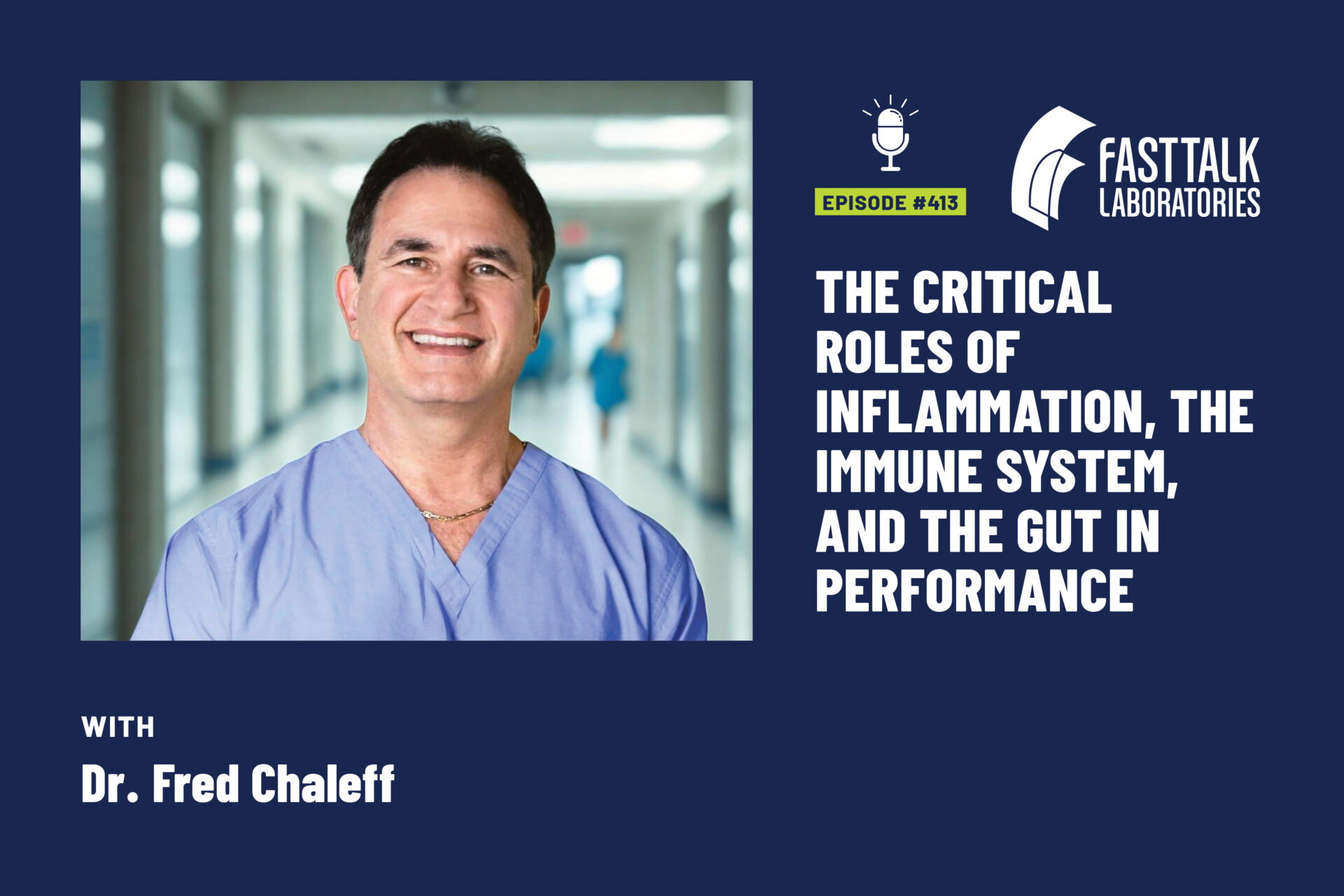






A healthy gut and appropriate inflammation are critical to our training, but finding the right balance is challenging. Cardiologist Dr. Fred Chaleff discusses the ways we can all find equilibrium.
Episode Transcript
[00:02:34] Trevor Connor: Well, Dr. Chaleff, thanks for joining the show.
[00:02:37] Fred Chaleff: Thank you for having me here. It’s a pleasure. Looking forward to it.
[00:02:41] Trevor Connor: So any of our listeners who, who have been listening for a while probably already figured out that I am excited about this episode ’cause we’re about to talk about the immune system, we’re about to talk about the gut, we’re gonna be talking about IL six and TH 17 and all these things that,
[00:02:57] Chris Case: giddy. He gets giddy when he talks about this stuff.
[00:03:00] Trevor Connor: We’re gonna have some fun. This is gonna be an exciting one,
[00:03:03] Chris Case: and I can tell that Dr. Chaleff is giddy too. He’s got a big smile on his face, so this is gonna be
[00:03:08] Fred Chaleff: Oh yes. This is great stuff to talk about.
[00:03:12] Trevor Connor: Chris, you’re gonna have to keep us under control. But
[00:03:15] Chris Case: I’ll try.
[00:03:17] Trevor Connor: Chaleff if you are a doctor who has been working with patients for years, you research this, you study this.
So couldn’t ask for a better guest to have on the show to talk about. Basically we’re discussing the, how the immune system functions in athletes, how it relates to the gut and gut function. ’cause that’s really important in athletes. and some of the things that we can do to keep everything functioning well.
[00:03:42] Fred Chaleff: So it is so true and I think, a lot of my patients and maybe even athletes to some extent, I just think they don’t take the gut or may perhaps should understand it more, and how important it is to so many bodily functions that symbiotic relationship between all the microbiome in your gut is so important for muscle adaptation, the brain immune system health.
it’s incredibly important and people just don’t, I think they overlook it a little bit too much in my opinion.
What do we mean by inflammation?
[00:04:12] Trevor Connor: So we’re gonna get there and we’re gonna dive into this, but let’s start with the most basic question. ’cause I know you hear in the media all the time,inflammation is bad, you don’t want it, which isn’t totally true. Could you give us just a real simple, basic one sentence definition of what is meant by inflammation?
So inflammation in the broad term is basically not always, but related to immune system response. most of the time you can get inflammation related to toxins or tissue damage. the response is somewhat similar and there is a lot of overlap, but basically inflammation occurs and the body responses, inflammation in order to repair or to fight infection, repair, body tissue, or fight infection Yeah, and you hit a really important term there ’cause I think this is another really key thing to understand as we go through this is repair. Because we’re talking to athletes right now and athletes are training, they’re doing damage to muscles and to tissues. And then your body repairs that damage and the whole idea of adaptation is it then repairs it back bigger and stronger and better.
And it’s the immune system that does that. Right?
Inflammation is Necessary for Training Adaptations
[00:05:29] Fred Chaleff: Absolutely. Now there’s, when you damage, muscles, when you exercise, cycling or long distance running or Olympic training, whatever the case may be, you need to get these little micro tears and damage to the muscles. Then you have to rebuild and it’s inflammation. That’s part of that process.
Now, if you mitigate or prevent this inflammation from occurring, you’re not going to build. Then on the other hand, when inflammation gets out of hand, you cause the damage and sometimes that body tissue doesn’t heal and grow as fast as it should because its overwhelming. Inflammation will prevent that from happening.
So you have to have that balance of just enough tissue damage. Inflammation repair, adaptation. Now will, a very interesting thing about muscle adaptation is that these, this micro tears that you get, you have to facilitate the healing and the growth. But there’s important component is the vascularity that’s involved with it as well.
And when you dive deep into this, a lot of this comes from the mykines that are released from the muscle when you get the damage. And that’s very important as well. And I don’t know if you’ve talked about mykines in detail before, but
[00:06:46] Trevor Connor: Oh, I just gave Chris a big smile ’cause I’m like, we’re already getting into the fun terms.
[00:06:52] Chris Case: yeah. Let’s define Myokines for those who’ve never
[00:06:55] Fred Chaleff: Okay,
[00:06:55] Chris Case: before.
[00:06:57] Fred Chaleff: so okay. Every, A lot of science related people have heard cytokines. These are proteins or chemicals released from cells. Mykines are similar proteins, but they’re released from the muscle. The muscle has an autoregulatory component of these mykines that help the muscle adapt, and it’s a balance between something these mykines and these cytokines that come from the inflammatory process that help the muscle build and adapt.
[00:07:28] Trevor Connor: There’s many different types of myokines. IL six, as commonly mentioned, is one another myokine that’s very common. It’s called BDNF. And BDNF is called brain derived neurotrophic factor, even though it’s in the muscle. It’s called BDNF ’cause it was first discovered in the brain. But what BDNF does at the muscle tissue level is when you’re undergoing the adaptation, it maintains that neuromuscular connectivity as well as when angiogenesis develops, we get new blood vessels to supply blood to the new adapted tissue so it can grow.
[00:08:06] Fred Chaleff:
So it’s very complex. Matter of fact, IL six is the muscles, natural anti-inflammatory. Then you get the IL six that comes from T cells and the side of inflammation that becomes pro-inflammatory.
So you have this balance here. but a good athlete’s adaptation always wins.
[00:08:26] Trevor Connor: Yep. Well, IL six is one of those. Whenever you read anything about the immune system and inflammation, IL six coming up, and as you said, sometimes it’s anti-inflammatory, sometimes it’s inflamm,
it is such a complex protein.
[00:08:40] Fred Chaleff: and it’s released from many cells in the body. And that’s the thing. And so it’s the overall interaction too, with the other chemotactic factors. but it’s very important that you have the angiogenesis, the new, blood vessel growth to provide to the muscles,to help the adaptation process, like you said.
[00:08:58] Trevor Connor: also, as you said, this inflammation in the muscles is really critical. And there was a time when we felt, oh, after you exercise, you’re getting this inflammation. We need to get rid of the inflammation. And people were taking, NSAIDs and they were doing icing and all this, and recent research is shown that was actually hurting the repair process that was causing damage in the muscles.
So that’s something you wanna avoid. You want that inflammation to happen after you
[00:09:24] Fred Chaleff: yes. and people don’t realize it’s actually a good thing. But what happens sometimes is I think the way this issue of inflammation and trying to resolve the inflammation happened is that sometimes you can’t go out the next day ’cause you feel sore, which is actually a good thing. But people wanna be able to go exercise the next day.
So go, let me take this and feel better so I can go exercise. But that’s actually counterproductive. sometimes now a very low level athlete, maybe not, but high endurance athlete cyclists or runners. That’s very important to get that muscle adaptation.
so, and it varies for everybody too, genetically, some people adapt much faster than others, and that’s because the level of these mykines and other cytokines vary from person to person, and it is genetically,programmed, by certain, genes that we have.
The Relationship Between Our Gut and the Immune System
[00:10:14] Trevor Connor: So there’s more here than just the immune system, though. Um, the gut is intimately tied to this. So let’s talk about how the gut and the immune system are intimately linked. I.
I’ll start out.
Another really important thing for everybody to understand is about 70% of your immune system lives around the gut.there is a huge relationship between the gut and your immune system. So talk a little bit about that and how that looks when it’s functioning well.
[00:10:48] Fred Chaleff: So that’s a good question. To understand the basic pathophysiology of what goes on in the gut. Yes, it makes everything a little more understandable. Just to put it in perspective. It’s hard to know for sure, but it’s been estimated to be between 38 to a hundred trillion microbacteria in your gut. No one knows for sure, but that’s an estimate.
And when you add the total amount of all those bacteria in your gut, and there’s also viruses, believe it or not, and there’s yeast and there’s many strains. there’s maybe hundreds or thousand strains. Actually, 30 to 40 strains are the most common, and we see that probably make up at least about 95 or so plus percent of the strains, 30 to 40 of those strains.
If you add the total amount it all, the microbiome probably weighs about two kilos of weight, maybe four to five pounds. And there’s this relationship between those good bacteria and the toxic bacteria, and they balance each other out. They produce, they each have these byproducts where they feed off of each other.
They provide each other with nutrients, but you need to keep the good in check as well as the the bad in check as well. There’s, it’s a symbiotic relationship when you get this dysbiosis, we call it, where there’s an imbalance. Then you start to get this whole response at the cellular level between the cells that connect the endothelium there, the, at the cellular level, you get inflammatory response where you start to get tissue swelling, the mucus membrane and some bacteria by the way, that just produce, help produce and synthesize this mucus that protects the lining.
When you, that starts to break down because of this imbalance, then you get all these byproducts of metabolism that break down that can get into your bloodstream. And those are very pro-inflammatory, sometimes at a low level and people don’t even realize it. You get fragments of, nucleic acid. You get,lipoproteins that get inpo lipopolysaccharides that get in the toxins that get into your bloodstream and that causes low level inflammation.
To make it even further more complicated, you have lymph tissue throughout the gut. We call ’em, especially in the ileum. it’s called pyres patches. And you have this infiltration of T cells, both on the regulating side and on the suppressor side that keep these in check. And this is kind of a back and forth mechanism, to keep the bacteria from growing or entering and causing an adverse effect on the mucosa in the gut.
So it’s highly complex.
[00:13:34] Trevor Connor: Yeah, this is really complicated and unfortunately we’re just touching on the surface here. But for anybody who’s new to this, just to put this in really simple terms, we have billions of bacteria in our gut. Some are good, some are bad. They all interrelate and they connect to our immune system. If we just keep them in the gut, then they can be beneficial to us. but if it starts breaking down, if the balance gets wrong, if they get into our bodies, then they cause inflammation, then they cause all sorts of issues like dysbiosis that you were just talking about, just excessive inflammation and that leads to all sorts of problems.
Why do we have good and bad bacteria and why the balance
[00:14:19] Chris Case: From a lay person’s perspective, maybe this is relevant. There’s always a sort of pro and a con. There’s a balance here. There’s things that are good, things that are bad. From an evolutionary point of view, why is there always this balancing act taking place amongst these complicated systems?
What’s the purpose?
[00:14:47] Trevor Connor: Well, so before you dive into this,let me just give a little bit here as some background. One important thing to understand about this bacteria in your gut is we talk about there’s good bacteria, bad bacteria, it’s all back bacteria. If it gets into your system, it’s good when it’s in your gut.
Sure. But if it gets past the lining of your gut and gets into what’s called systemic circulation, then it’s all
bad.
[00:15:10] Fred Chaleff: get bacteremia, sepsis. That is correct.
[00:15:13] Trevor Connor: and your body wants to deal with that. But going back to what you’re saying about the evolutionary side,this is the way bacteria, viruses, they all evolve. We’re their home, their host, they want to find a good relationshipand so over billions of years, bacteria has evolved a symbiotic relationship where we give it a good moist home. We feed it and it gives us beneficial things in return.
[00:15:43] Fred Chaleff: And then you have to realize we cannot control what we consume and the bacteria and what we consume. So the nature takes care of that balance, kind of over evolution. And some of the toxic bacteria do provide nutrients in their metabolism that the good bacteria actually feed off of.and that’s where the symbiotic relationship, and that’s how that evolved.
But it takes many years how that process happens. And it’s little by little, so it never gets outta hand where it becomes toxic.
[00:16:14] Trevor Connor: there some bacteriologist who say that, humans don’t run the world. bacteria runs the world. They just made us to give them a home.
[00:16:23] Fred Chaleff: Actually they were there before we were, so we, so you know, I guess we owe it to them.
But yeah, it is very complex and we can’t function without it.
Lipopolysaccharide (LPS) and How It Causes Bad Inflammation
[00:16:34] Trevor Connor: Yeah. But you mentioned, and this is something that’s, we’ll probably bring up a few times, you mentioned lipopolysaccharide, LPS. We’ve mentioned that on the show, and it’s a really important thing for people to know about because it is a marker on gram-negative bacteria, which is generally considered the bad bacteria.
And when it gets, when your body starts detecting it inside your body, so in systemic circulation, alarm bells go off and that’s when your immune system starts reacting and reacting very strongly.
[00:17:05] Fred Chaleff: Absolutely. It triggers a significant immune response. And yes, a lot of the gram-negative bacteria happens is lipopolysaccharides and it can become toxic, response. And you can, it can overwhelming sepsis, your blood pressure will drop, your blood vessels dilate. And this is a cascade that happens where you can die.
so it’s very serious. Now we have the gram-negative bacteria in our gut, but like you said before, Trevor, it’s kept in check. The mucosa protects the intestines. There’s a barrier to entry. They do provide nutrients for other bacteria that helps produce, certain chemicals. the vitamin K and neurotransmitters are produced from the help in the gut, from tryptophan, serotonin, things like that actually help, in the, to the brain gut access as well.
So we do have it, but there is the balance and it is kept in check in your gut. Yes. If it gets in your bloodstream and you get septic from it, it could be really serious.
Dendritic Cells and Leaky Gut
[00:18:04] Fred Chaleff: So one particular immune cell that I wanna talk about very quickly is dendritic cells. there are a ton all around your gut and there are these little cells that have these very long arms that can kinda sneak between the epithelial cells in your gut, and get into the, where all the bacteria is and they just kinda sample what’s in there and see what’s going on.
[00:18:27] Trevor Connor: And most of the time they just go, yep, all the bacteria is in the gut, we’re fine. but when you,
[00:18:32] Fred Chaleff: get triggered.
[00:18:33] Trevor Connor: they don’t get triggered. But if you have a leak, so people talk about leaky gut, that’s when you see a breakdown in the protective barrier and the bacteria starts getting in, and then the dendritic cells go alarm bells and mobilize a huge immune response.
[00:18:48] Fred Chaleff: Exactly macrophages, there are T cells that get mobilized. there’s a lot of chemotactic factors that get released can cause local inflammation. It depends on the extent. And then you get the gut, the junctions between the cells, the epithelial cells start to break down.
And yes, that’s when you get this leaky gut. And it can then there’s variations of leaky gut. It can be very mild where you don’t know that you can’t even have it. And sometimes you get this, low energy level or you just have this kind of delay in, in, in even fighting cold sometimes, gets delayed because you have this underlying inflammatory response or tissue healing becomes delayed.
And that’s because of this,additional burden of inflammation due to a leaky gut. And that’s when the, there’s the dysbiosis between the good and bad bacteria, start to Again, sometimes it’s just low level inflammatory response. In fact, we can even check in the blood. There are some blood markers for that.
We call it C-reactive protein, which is an acute phase reactant. And sometimes we can see a level of inflammation. Sometimes it just mildly elevated, and a lot of doctors just say, well, it’s a little elevated. We just kind of keep an eye on it, and maybe it was from this leaky gut that was happening, and could be from other things as well.
But sometimes we have to think about is this a leaky gut? In patients that do have these kind of problems, especially low energy, we see that a lot.
to rule out other things. Of course.
[00:20:21] Trevor Connor: But there is a ton of research showing that chronic leaky gut can proceed a whole lot of conditions, particularly autoimmune conditions.
[00:20:29] Fred Chaleff: Oh, yes. That’s a very good point. Yeah. And the autoimmunes, what happens is that’s another type of inflammatory response where you get, these particles that get into the bloodstream and sometimes there’s a similarity between the, makeup of the particles and the body recognizes as foreign. And then on some of your body tissues, there’s, there is a similar makeup.
So your body starts to attack your own tissue.
[00:20:56] Trevor Connor: Mm-hmm.
[00:20:57] Fred Chaleff: it because of that, exposure to that sort of, protein or lipo polysaccharide or some other component that’s very similar and you can get self-destruction of your body tissues. Also, what happens in autoimmune, you get these immune complexes and then your organs become innocent bystander, these immune complexes where the immunoglobulins start to bind together, but they become, let’s say a big molecule goes to the kidneys, can’t get filtered out and just causes damage to your kidneys, for example.
And that can also happen as a result of a certain autoimmune problems.
Th17 Cells – Highly Inflammatory Cells Around the Gut
[00:21:33] Trevor Connor: And then there, there’s one other piece to add to that, to the puzzle, which is th 17 cells, which you were talking about mobilizing T cells. Th 17 cells are a highly inflammatory cell that are designed to address, when bacteria gets from your gut, this, circulation.
th 17 cells come in and address ’em.
And they’ve shown chronically elevated th 17 cells proceed. pretty much every single autoimmune condition. it’s almost a necessity for development.
[00:22:03] Fred Chaleff: Right. And that’s part of the pro-inflammatory process is when you see the TH 17, and it does, and you need the inflammation to help fight infection or whatever the case may be, inflammation there. But remember, it is balanced by the t suppressor cells too, so that, but sometimes it becomes too overwhelming.
and then you have the destructive process that gets out of hand. But under normal circumstances, you get the T 17 and the treg cells that kind of keep each other in check. But the initial, is definitely overwhelming. T 17,
[00:22:35] Trevor Connor: Yep. Told
you this was gonna get fun,
ROR Gamma-T and Fox P3 Signallers – Getting Deep Into the Weeds
[00:22:37] Fred Chaleff: now, yeah. now, by the way, if you really wanna get fun, there is something called the ROR Gammat. Okay. This is really for the people who love science. ROR Gammat is called the retinoic acid orphan receptor.
[00:22:56] Trevor Connor: Mm-hmm.
[00:22:56] Fred Chaleff: This is what regulates helps regulate some of the T 70 T cells and how the T 70 response sometimes as receptor related to by the ROR Gammat.
On the other hand, there’s something called the Fox P three. Fox P three.
[00:23:13] Chris Case: You are just making this stuff up now.
[00:23:16] Fred Chaleff: No, I swear. This is the real
[00:23:17] Trevor Connor: one. I know. I know. The Fox B three. Kidding.
[00:23:21] Fred Chaleff: And that’s called, I wrote this down, that’s called 4K, believe it or not, because it looks like a fort on the cell when they look at it at the, like this very high level. And anyway, that also is what regulates, affects the tregs.
That’s a gene. And it’s so important that they were actually looking at the therapy chemotherapy at the Fox P three gene,and all these receptors as cancer research too. So these are very important and these are, it’s fun to read about actually, ’cause it makes a lot of sense when you read about ROR Gamma T and Fox P three,
[00:23:53] Trevor Connor: Yeah,
[00:23:54] Fred Chaleff: and how it affects the regulation of T 17 and T suppressor cells.
[00:23:59] Trevor Connor: I loved it when I was studying immunology. I created a big chart of all these different chemicals and names, and finally just had to stop. It got so big
[00:24:08] Fred Chaleff: it doesn’t end. It’s like you
[00:24:10] Trevor Connor: it never ends.
[00:24:11] Fred Chaleff: and another chemotactic factor, and this affects this. And then you have this cell and that’s it. For immunologists, I have to give them credit. They have to have a lot of patients because that’s why I love cardiology. It’s a lot more straightforward
[00:24:24] Trevor Connor: Yes.
[00:24:25] Fred Chaleff: when you have the blockages.
[00:24:27] Trevor Connor: Oh. But
[00:24:28] Fred Chaleff: But anyway, but it really all makes sense. And by the way, we do get inflammation there too, in the heart on the lining of the cells. And we do, and there is bacteria there also sometimes.
Gastrointestinal Issues in Endurance Athletes
[00:24:37] Fred Chaleff: But I have to, I have a question for you guys. cyclists, Do they really learn? You think enough? Like when they’re high endurance cycl competitive cyclists, you think they learn enough about the gut and know how important it is in your conversation with a lot of your colleagues?
[00:24:54] Trevor Connor: So once again, you anticipated where we wanted to go ’cause that’s exactly what I wanted to talk to you about.
[00:25:00] Fred Chaleff: Oh, geez. Okay.
[00:25:01] Trevor Connor: I love this ’cause, I mean, well I, Chris knows me. I read a ton of research coming into this one ’cause this was like being in a candy shop for me. and there’s a,a relatively new study called exercise-induced gastrointestinal system that, lemme see if I can pronounce that right.
Exercise-induced gastrointestinal symptoms in endurance sports, a review of pathophysiology symptoms and nutritional management. And they talk a lot in this study about how much GI issues impact endurance athletes. And it was surprising, like they, in one, they cited one study where it was something like.
70% of the people that had to pull out of big endurance events, it was because of GI issues, because they’re having gut issues. And so you see in endurance athletes, a large number of them saying, I have all these GI issues. So they know that it impacts ’em. They know it’s making them pull out of events, but they have no idea
REMOVE SCIMERA
[00:26:00] Fred Chaleff: they know why?
[00:26:01] Trevor Connor: Exactly.
[00:26:02] Fred Chaleff: that’s a great point. So the thing is what happens to most athletes, they get ischemia in the gut. Okay? So what happens is the gut is not a important organ when you’re doing high level, performance. So the blood is rerouted to the muscles or wherever you need it, not to the gut.
Well, if when you keep going on and on, you get more and more ischemia, and then what happens is. This starts to affect you where you feel inside and you just can’t go because you must feel nauseous. you get abdominal pain, you think it’s lactic acid or whatever the case may be, but sometimes it’s ischemia and that’s why you have to stop.
So if you don’t have this proper symbiotic relationship and then you start high endurance training and you start to get the ischemia, that’s gonna predispose you to gut problems even sooner. So a lot of athletes get that ischemia in their gut, and they probably don’t even realize that’s what’s happening.
The blood is getting rerouted to the muscles from the gut, and that’s what’s affecting
[00:27:05] Trevor Connor: yeah, so in this study they talked about that. They said there were kind of two pathways, neuro doctrine, GI pathway, and then the circulatory GI pathway, which is what you’re
[00:27:14] Fred Chaleff: That’s ischemia. Yeah. Yeah. Right.
[00:27:17] Trevor Connor: And
[00:27:18] Fred Chaleff: And they both come into play for sure.
Ischemia Leads to Intestinal Permeability and Inflammation in Athletes
[00:27:20] Trevor Connor: Mm-hmm. But just how damaging this can be. And it goes to, so we were just talking about some of the issues you can have in the gut, and basically what they said is it leads to three things.
One is intestinal permeability. So it’s that breakdown of the barrier, release of LPS into the system, which causes, and then
[00:27:39] Fred Chaleff: a lip poly,
[00:27:40] Trevor Connor: yep. And ultimately that leads to inflammation. So talk a little bit about that in athletes. ’cause I mean, that’s not what you want.
[00:27:49] Fred Chaleff: No. So what happens is, let’s say your microbiome in your gut is not, an optimal condition, okay? There’s a little dysbiosis there, maybe not to the level that you would realize it. So there may be a small level of leak or inflammation there that may be even subclinical undetected. Now what happens is you start to train and you’re not, let’s say, hydrated enough, for example, the blood flow through the intestines becomes compromised, which is normal.
But now because of this ischemia component, the small, let’s say low level of dysbiosis that you may have had in your gut becomes more prominent, more prevalent, and now you may have more symptoms sooner, and that’s when leads to the leaky gut, transiently at that point. And then you start to get all these toxins, LPS, in your blood, and then there’s an inflammatory response, and then your muscles become inflamed as well. So now you have the local inflammation from muscle use. Now you are adding systemic,inflammation on top of that, which effects the tissues. Plus you have the ischemia to your bowel, which is uncomfortable.
And let’s say you didn’t hydrate the way you should. All this comes into play. You’ll never finish, you’ll never finish your, your routine. It’d be impossible or keep up either way. You start to slow down.
And all this has to do with training too. You do train your gut for that transient ischemia also, but again, that microbiome has to be optimal ratio. The aerobic, anaerobic yeast, all that has to be optimized to perform well.
[00:29:27] Trevor Connor: And to that point that’s review that I just mentioned, talked about you have greater, diversity in the microbiome in elite athletes and diversity is better. So there’s alpha and beta diversity. I don’t know if we wanna go into those, but you have better diversity in elite athletes and that can prevent a lot of the issues that you have, during exercise.
And another one I found inter place between exercise and gut microbiome in the context of human health and performance. Same thing. they just said in elite athletes, they can avoid a lot of these issues, a lot of the permeability because they have a better, microbiome profile than sedentary individuals or people who aren’t very fit.
Benefits of Saurerkraut and Probiotics
[00:30:09] Fred Chaleff: and and that naturally evolves as they train too, because a lot of good athletes, they’ll have,the right diets and all that. I don’t know if they’ll have,maybe like the sauerkrauts. So things like that to provide yogurts that provide additional bacteria. But if they do, that will help them train better and get their gut in even better shape.
and that’s kind of, there’s a probiotic component to the yogurts and to the sauerkrauts and things like that,
[00:30:37] Trevor Connor: What about a probiotic? Can that help?
[00:30:41] Fred Chaleff: Yeah, well, the, yes, we got very, I did a lot of research on that, and yes, the right probiotic will make an incredible difference because the right probiotic will have the proper balance between aerobic and anaerobic.
Number one, you need the right ratio. You just can’t take one that say, okay, we give a little bit of this and a little bit of that. There’s certain ratios of that’s in your gut, and your probiotic needs to emulate those ratios in your gut to make it optimized, and also when you take a probiotic to get this optimal microbiome in your gut.
We presently feel that it needs to be in a delayed release capsule so it gets released in your duodenum and not destroyed by the acids in your stomach. So you get improved deliverability. And of course it should have the prebiotic as well. So all these come into play and if you wanna be really do it right, you have to have some component of yeast in there as well. And we like smis, ’cause that’s in your gut as well, and that’s part of the symbiotic relationship.
[00:31:46] Trevor Connor: And they, interestingly, in this one review, they talked about that, that a lot of the supplements, really don’t have the diversity in it, only have a couple forms, and it’s the diversity that you need.
[00:31:58] Fred Chaleff: so, so think about this, Trevor, Chris. okay, it’s a thousand strains in your gut. 30 to 40 are the most common strains, maybe 95%. Well, why are you gonna take a probiotic that has one strain or two strains? And who even knows what amounts of those strains they’re in, they have of that in their probiotic?
It doesn’t do anything. So there’s a lot of signs and data about specific bacteria in your gut for specific reasons. Bifidobacteria, lactobacillus, sarcos, bilar, this is a yeast, OSIS, gg. All those things have a certain function and provide nutrients to each other to optimize the microbiome environment in your gut to prevent that leaky gut that will make a difference in an athlete, especially a high endurance athlete.
[00:32:49] Trevor Connor: Well, here’s right out this review. they did a probiotic supplement for 28 days before a marathon race with athletes. So it’s lactobacillus, I can never pronounce these, but Lactobacillus is acidophilus, bifidobacterium, bi,
[00:33:02] Fred Chaleff: Bifidobacterium? Yes. Mm-hmm.
[00:33:04] Trevor Connor: bacterium. S.
and it said it was associated with a significant lower incident in severity of GI symptoms and limited decrease in average speed in the probiotics group.
[00:33:17] Fred Chaleff: Yeah, so it, it goes to set the microbiome, the gut, the environment, the small chain fatty acids, their neuromuscular connections, the gut brain health. All that has to come into play. If you wanna really perform, you have to be optimized. It’s not just about, hydrating and taking a protein bar and then taking your protein when you’re done for your muscle recovery, whatever technique routine you have while you’re performing.
You need to really have everything in order. And that’s a major component. People take that. I think they take it for granted.
[00:33:50] Trevor Connor: Mm-hmm.
[00:33:51] Fred Chaleff: I know they do in my practice. They take that for granted as well. I really don’t think they look enough into it,
maybe because they don’t understand it.
Effects of Bad Bacteria on the Brain
[00:33:59] Trevor Connor: so I know we’ve gotten complex with the gut and the immune system, but let’s get it even more complex. ’cause there’s actually this axis here of the gut, the immune system and the brain. So talk about how this all impacts the brain as well.
[00:34:15] Fred Chaleff: So because the gut and the microbiome is so important as a result of the metabolism, all these different bacteria you do get, certain, neurotoxins that actu some form that are released into the bloodstream. And these neurotoxins do get into the brain. And there has been some implication here that these, molecules that get into the brain may be implicated in memory, dysfunction, a cognitive dysfunction, Alzheimer’s, autism, multiple sclerosis, Parkinson’s depression.
So. It, even the, intact, gut is important not only for muscle adaptation and immune system, but also the brain and the gut and all the possibilities, like how it can affect your brain if it’s not healthy. And it goes back to maintaining that healthy gut, not having that leaky gut syndrome where you get these adverse, toxic components that can even get into the brain.
What Can Be Damaging to Your Gut, Such as NSAIDs and Antibiotics?
[00:35:13] Chris Case: obviously diet plays a role here. you mentioned antibiotics can throw things outta whack in the gut. Are there other, are there other things like, anti-inflammatory, ibuprofen, these types of things? Are there any other things that can throw the gut
[00:35:29] Trevor Connor: So anti-inflammatories can actually be very damage into your gut and increase permeability.
So I would be careful
[00:35:35] Fred Chaleff: Yeah.
[00:35:36] Chris Case: those. Th This is why I ask, because I think that a lot of endurance athletes are often taking these things because they have the aches and the pains and you know, they’re training hard and their knees might be given going, you know, so they will take that stuff, not understanding the consequences,
[00:35:52] Fred Chaleff: secondary manifestations of, yeah. Any one of those things that alter the pH, for example, they alter the,the way the bacteria function and reproduce and metabolize will alter that symbiotic relationship. And, sometimes we don’t know which meds do what, at the, at that level because there’s really no way to study.
But we do know that yes, the anti-inflammatories, especially in your gut, are definitely not healthy. And if you wanna get the good adaptation, you really shouldn’t take much of the anti-inflammatories anyway, ’cause that’s counterintuitive, to what you need to achieve. but you know, sometimes it’s painful.
You can’t stop. So they wanna take a little bit, but you just gotta work through the process. So going back to antibiotics, what that does is, okay, let’s just say have an infection.sinus infection, for example, and you go ahead and you take your antibiotic for your sinus infection. Well, you’re ingesting this antibiotic.
It will attack, get into your bloodstream, but will prevent or fight the sinus infection, but it’s also gonna kill the good bacteria in your gut. The bad bacteria is somewhat more resistant to this just because a lot of anaerobes that just don’t,the mechanism of action doesn’t affect them as much.
So what happens now is you destroy the good bacteria. The bad bacteria or the pathogenic bacteria will proliferate. They tend to produce a lot of toxins. Well, this will destroy the lining of your stomach and sometimes it forms a membrane that is so intense, we call it, looks like a membrane, pseudo ous colitis.
And they get massive diarrhea because the fluid gets into their, from the tissues into the lumen of the intestines. and then you just cannot stop this diarrhea ’cause the fluid just comes out constantly. And that’s because the good bacteria were destroyed in your gut from the antibiotics, the pathogenic bacteria we’re able to proliferate, releasing toxins and other metabolites that cause the gut to swell and leads to a cascade of events.
In fact, it gets so bad that you can actually die from
[00:37:58] Trevor Connor: Mm-hmm.
[00:37:59] Fred Chaleff: The toxins that are produced from pseudo membranes colitis is, early, well, early part is called antibiotic associated diarrhea. And then it can lead to what we call toxic megacolon, where this colon swells and this membrane like structure forms because of what’s happened on the surface.
And yeah, it can be super serious. So antibiotics are not a simple thing. and you have to be very careful and take it for the right reason. However, if you take the probiotic, hopefully it does less of a problem.
Low FODMAP Diet and Fiber
[00:38:30] Trevor Connor: And talking about diet is something that you see a lot of athletes do is switch to what’s called a low FODMAP diet.which can relieve a lot of symptoms. But the issue with it, and I’ll let you take it from here, is, it’s also very low in, fiber and
[00:38:46] Fred Chaleff: Yeah. You need that fiber.
[00:38:47] Trevor Connor: in your diet is really important to healthy microbiome.
So
[00:38:51] Fred Chaleff: Yes. ’cause they actually digest that fiber and produce, they use it for energy and they, and the remnants of the fiber breakdown is used, for the other bacteria to live off of. So it’s a part of the symbiotic relationship, and that’s part of the prebiotic that you put in, probiotics, which helps feed the whole process.
You wanna have good prebiotic as well, when you take your probiotic to help facilitate the process. Now, do you, I, I’d be, I wouldn’t be surprised if some, people out there, they go train and they’re on antibiotics sometimes for whatever reason, and they wanna train. But my gosh, that’s a, that could be a toxic combination, when they start doing things like that.
So they have to be really careful and not to push it.
Gluten-free Diet and Antinutrients
[00:39:33] Fred Chaleff: One other thing I want to quickly throw in, and please respond to this, but you’re talking about diet and I think this is important to mention for anybody that’s having these issues and particularly leaky gut issues, is some grains, particularly wheat. you have two things that you have to be aware of.
[00:39:48] Trevor Connor: So everybody’s talking about a gluten-free diet, and gluten is something called glyadin. Glyadin, causes a release of something called zonulin in your gut, and zonulin opens, the tight junctions of your gut. So it really causes leaky gut. every, different levels of susceptibility in people, but something you have to be
[00:40:08] Fred Chaleff: absolutely true. Yeah. Mm-hmm.
[00:40:10] Trevor Connor: And
[00:40:10] Fred Chaleff: Yeah. And people don’t realize that.
[00:40:12] Trevor Connor: No, finish Trevor. that’s a good point. Embellish on that.
Yeah, well I’m sure you’re familiar with all the work of Dr. Fasano. I mean, he’s, it’s pretty extraordinary what he discovered with that. and then the other one to mention that you also get in some grain products of what called amylase trypsin inhibitors. You definitely find them in wheat.
and we were talking before about the dendritic cells, which kinda reach into the gut or oc coase sampling amylase trypsin inhibitors, bind to the dendritic cells and set off the alarm And it’s an inappropriate alarm ’cause there isn’t a bacterial invasion,
[00:40:46] Fred Chaleff: it’d be like a false activation.
[00:40:48] Trevor Connor: Right, so this is my theory.
A lot of people talk about, oh, I go to Europe and I have the breads and I’m fine, but when I have bread here, it really bugs me. What is the difference in America? They discovered these amylase trypsin inhibitors and discovered they were actually a really good pest natural pesticide. So the wheat over in America has been bred to have very high levels of amylase trypsin inhibitors, which you don’t see in the European wheat.
and so one of the theories here is you have much higher amylase trypsin inhibitor levels here, and that’s setting off these immune responses.
[00:41:23] Fred Chaleff: Yeah. And again, every individual is so different with, some may be more sensitive than others and it goes back sometimes to this genetic predisposition, just like with the T cells and the ROR Gamma T and the Fox P three. And who knows to what variation. People have these responses in their T cells as well.
but in that case, with the dendritic cells, yeah, that’s another component. And process that can, promote, dysbiosis and dysfunction and leaky gut. That’s a very interactive play between so many variables. And in order to train properly, you have to find that you have to really do a lot of research and learn.
It’s not that easy if you wanna be serious about it.
[00:42:02] Trevor Connor: Yeah. No, it’s tough.
Why Endurance Athletes Get More Colds
[00:42:03] Fred Chaleff: so do you find that some of the people that you know, tend to get, more colds or whatever, the harder they trained? Do you ever hear you, that among your peers when they talk,
[00:42:14] Trevor Connor: I gotta say, you’re the best guest ever. ’cause I have not had to make a transition yet to follow our outline. Every time I’m like, okay, we need to move on to this. You ask us a question, it’s like, oh, that’s exactly where we’re gonna go. I’m loving this.
[00:42:28] Fred Chaleff: oh, there you go. Because, sometimes I just think about this, by the way, the immune system. I’m just wondering what the, your, your colleagues, your athletic, your friends, your high endurance athletes are saying, Hey, am I getting you a lot sick when they train hard?
You ever notice that?
[00:42:41] Trevor Connor: You get that all the time, particularly in, in high level athletes they’re just like, I’m sick all the time. I don’t know why. So,
there you go. and I’ll throw this to you, but just, there was this great study that looked at these elite endurance athletes, and when they were getting so upper respiratory, infections,
[00:43:01] Fred Chaleff: Infections. Yeah.
[00:43:03] Trevor Connor: and they were looking at those and then looking for viral causes and found an actual viral cause in less than 50% of the cases, and we’re basically saying there just doesn’t seem to be a virus related.
They have the infection, but we can’t find a virus that’s causing this. So I’ll throw it to you, but this is one of my favorite things about the immune system in endurance
[00:43:26] Fred Chaleff: So we know that athletes, when they train hard, their immune system is suppressed. And that’s very natural because you’re putting a lot of physical demand and it takes functionality away from the immune system to try, to optimize your performance. But as a result of that, you get a decrease of interleukins.
This, we call this the, I think it’s the open window period of infectivity where for that short period of time, you are definitely more susceptible. There’s about three to six hours where your immune system definitely reach, reaches a lull until it kind of gets back up to normal.
now. You can get a cold sometimes because you’re more susceptible, but some people feel like they have a cold and they don’t like, they may get the runny nose and you get the runny nose for a lot of reasons.
There is bacteria and there is, in your nasal mucosa, which sometimes, can start to proliferate and causes inflammation, and then they get a runny nose. Sometimes they get the, it goes to the back of their throat. They feel like they’re getting sick, and then they. They start to recover and then their immune system kind of kicks in.
They never really get sick and there’s no virus and there’s no real bacteria. and that’s what kind of really happens. It’s low level of inflammation. It makes ’em feel sick, but it’s bacteria that’s normally there that they start to proliferate. ’cause the immune system gets weak. Sometimes the, the iga a that’s in your mucosa, can’t keep up just yet.
And then as you hydrate and relax, inter interleukin levels go back up, you can fight it and suppress it and then it just pretty much resolves. Sometimes if you’re too tired, you get too weak, it will evolve.
[00:45:08] Trevor Connor: Mm-hmm.
[00:45:08] Fred Chaleff: Sometimes it could be a virus. also, and a lot of guys too, when they train, they breathe heavy through their nose, and this movement of air causes irritation to the mucosa and the local inflammation as well, and they get a runny nose.
You haven’t noticed, let say you go up north and you, or you go in the, where you go skiing, let’s say, and your nose just starts to run.
[00:45:31] Trevor Connor: Mm-hmm.
[00:45:32] Fred Chaleff: well, that has to do, I mean, it’s part of the little inflammatory process and the basal constriction of vessels and then everything that happens that causes that you’re not sick.
But that’s an inflammatory response there to some extent, mediated by temperature. Sometimes these feel like they get sick, they’re mediated by local toxins in your nose or throat, or sometimes it’s allergens or whatever the case may be. And for those athletes that feel they get the runny nose, I feel like they’re getting sick and really don’t, and there’s no viruses there.
some of those people are very susceptible. We tell ’em to put Vaseline or waterside with gel in around the na nasal openings to help mitigate some ofthat are related to, the high breathing through their nose, for example.so little things like that. But if you do get sick, that is because in a real cold, that is because your immune system was suppressing your exposed during that open window most
Systemic Immune Response Syndrome in Athletes
[00:46:27] Trevor Connor: Well, so something I think really important to mention this, this was some of the most interesting research I’ve read in a long time is, there’s something called systemic inflammatory response syndrome. SIRS in athletes. you were talking before about how when we do a lot of damage from exercise, it’s the immune system that sparks a response.
[00:46:48] Fred Chaleff: And you brought up IL six, which can be both anti-inflammatory, inflammatory, the body goes, yeah, I need to activate the immune system to go and repair local damage. But it would be really bad if that then spilled into the entire system and went systemic.sometimes you get outta hand.
[00:47:05] Trevor Connor: Right. And so that’s part of the reason your immune system gets suppressed after exercise because it’s trying to keep it localized to where the damage is.
But that doesn’t always work well in people and it does spill out into the system and that’s that SIRS and I read a study where you saw extreme cases of this where you’re essentially seeing endotoxemia in athletes where it had gotten so bad they ended up in the hospital.
[00:47:31] Fred Chaleff: Yeah, that’s kinda like, you can see it in a, immune response for anaphylaxis. It can get so bad, you can end up in the hospital. It’s somewhat, I guess, somewhat related to that. And that sometimes is genetically predisposed on the way your immune system responds to inflammation as well. Just to give you an example, your immune system response sometimes dictates what happens.
And we even see this in patients with hepatitis. Why does some people get a t hepatitis? Well, some people get a low level form of hepatitis. Something that has to do with just your body’s immune system response. Well, that’s the same concept, depends on our immune system response. Systemic, overwhelming hyperreactive, depends on a lot of things.
But yes, all immune system mediated.
[00:48:17] Trevor Connor: Yeah.
[00:48:17] Fred Chaleff: And sometimes it’s a little unpredictable too. You can’t really predict and you never know when you’re gonna get reach that threshold either on certain people. Sometimes if you keep pushing yourself, that might throw you over too.
Finding the Balance Between Adaptation and a Strong Immune System
[00:48:29] Trevor Connor: So here’s my question to you and I’m saying this somewhat knowing your answer because you sent me some really interesting studies on beta glucans, but are there ways that we can find this balance of allowing the muscles to have their, do their repair, not have this SIRS response where we, it gets systemic, but also still keep the body able to fight infections?
It seems to be a really tricky balance between those three things.
[00:49:00] Fred Chaleff: it is a tricky balance and you basically have to know your body. And I’ll give you an example. You train hard. You cause muscle damage. You wanna facilitate that adaptation and keep growing and growing on it. But at the same point, you don’t want to overdo it where you’re starting causing damage. So in general, there’s a general rule that you want to take a few days to heal.
Let the adaptation process evolve. Let the inflammatory process evolve, get that, adaptation muscle growth, repair the micro tears, the angiogenesis process, evolve and then move on. So you really have to know your body and train. That’s the main thing. Now, it’s a funny thing. a lot of this stuff sometimes is more localized than you realize.
for example, a lot of the myokines, they’re all over, but there’s a high intensity of mykines that sometimes release, believe it or not, in your calves,
[00:49:54] Trevor Connor: Mm-hmm.
[00:49:54] Fred Chaleff: the gastroc anus and the sous muscle. Now, even though it’s all over, there seems to be a higher proportion there. for various reasons, I guess evolutionary reasons for whatever.
I guess that’s, we’re evolving and sometimes you’ll feel it in one muscle, I guess. Depends the way you use it as, as well. And not in, another muscles. And that’s, again, sometimes a myokine release is different from one set of muscles than the other. But you have to learn your body and know how to train, know how long it takes to get the, that repair.
And usually it’s a day, a few days. If not, then you are gonna affect the adaptation process. And if you work too hard, then you’re gonna get more of a systemic inflammatory response than you will an adaptation inflammatory response. And then there’s a concept of there’s inflammation from. your immune system and then is there inflammation from the free radicals that develop when you work out also?
And that’s a whole nother concept of inflammation from free radicals, reactive oxygen species, and inflammation as well. There’s a balance there too.
Potential Benefits of BETA-GLUCANS
[00:51:02] Trevor Connor: Yeah. That is a whole nother conversation that,I’ve been debating whether we even want to bring it up. But tell us, just share this, ’cause I was really surprised by this, and I read most of the studies you sent me, about beta glucan.
[00:51:16] Fred Chaleff: Yeah, beta glucans. Okay. There’s some, there’s many different types of beta glucans, and the beta glucans is known to stimulate the immune system because certain beta glucans, for example, a 1 3, 1 6 beta glucan has a pattern recognition that’s similar to lipopolysaccharides. And we all know what lipopolysaccharides do.
So what happens when you take this 1, 3 1 6 beta-glucan, the body sees it as a lipopolysaccharide. Well, what does the body do when it sees the lipo polysaccharide? It activates the immune system immediately. So your innate immune system responds immediately to this. so what happens is, now you’re your, pretty much, your immune system is primed when you take the 1 3 1 6 beta glucan and then if you ever get exposed to whatever, a pathogen or whatever, a IRS or bacteria, whatever the case may be, your immune system is primed to clear that so much faster than if you didn’t take the 1 3 1 6 beta glucan. Now we say 1 3, 1 6. ’cause that’s the repeating structure molecular that somewhat is similar to the lipo polysaccharide that we find on many toxic, pathogens. Now, not all beta glucans have that similarity to the lipo polysaccharide and will not stimulate the immune system. For example, I think, oatmeal has the beta glucans that will not stimulate your immune system.
whereas Exactly. Yeah. baker’s yeast and, a few, a few yeast. Exactly. And actually there’s these, a couple of mushrooms, believe it or not, that actually have it too. The beta-glucan that has a lipa polysaccharide similar component will stimulate your immune system. Yeah. Mushrooms and baker cheese are the big ones.
[00:53:03] Trevor Connor: But here’s what shocked me. I actually looked this up after you sent the studies to me, is like, this has to be a bad thing because as you said, it kind of acts like LPS, so it’s gonna stimulate immune response. But that’s, what’s the response to LPS is elevated TH 17 cells, and the reason we brought those up earlier is because chronically elevated, TH 17 is a really bad thing.
It precedes autoimmune conditions. They’ve now related it to cancer. Actually just downloaded in the fall a really interesting study that said that this seems to be related to neurodegeneration and Alzheimer’s So one thing you don’t want is really elevated TH 17. So I went, wait, this is not something we wanna put in our body,
So this is a study and laugh at me for how I pronounce this. It just came out last year, effective
Saccharomyces vse, beta-Glucan, thank you,
[00:54:01] Fred Chaleff: Cia, yeah.
beta-glucan on the TT helper cytokine profile. And what they showed is it stimulates the innate immune system, as you said, which helps fight pathogens. It stimulates TH one, which is our dominant response to pathogens, but they did not see any elevation in a TH 17 response, exactly what I was gonna say. Yeah. And that’s because when you take this, it’s more of the innate immune system than the adaptive and the innate immune system is where you have acutely. The adaptive is more on the chronic side. And we found, based on these studies, that was the innate immune system that was activated and the adaptive was pretty much spared.
and that’s what you’re looking for in this case.
[00:54:50] Trevor Connor: And so they were saying, as opposed to actually promoting cancer, this is being explored now as potentially an anti-cancer treatment.
[00:54:59] Fred Chaleff: Yeah. is, that is so true because what they found when they did the research on some of this, that when they looked at the one through one six beta glucan and some of the research, they wanted to give it to cancer patients who were constantly getting sick and they found how it worked, whereas more the innate than adaptive.
In fact, it worked so well. They, in Europe, they put it in the infant’s formula as well to help boost their innate immune system, while they were, evolving and developing their own immune systems. So yes, it was definitely, the data was more innate than adaptive and that’s why it’s not a problem with the T-cells.
[00:55:39] Trevor Connor: Yeah, no,
[00:55:40] Fred Chaleff: I mean, there’s always a little crosstalk, but it’s usually, it is not a, it’s not a major That’s good information. was very good information.
[00:55:48] Trevor Connor: Yeah. No, I, I was surprised and fascinated by it, so,
[00:55:53] Fred Chaleff: In fact, they did studies that showed that endurance athletes, runners, had fewer colds. When they took the 1 3 1 6 beta glucan and they recovered from their colds quicker, their fever score was less and their symptoms were diminished
this.
[00:56:10] Trevor Connor: felt better. That was one of the studies you sent me, and it was shocking the level that you saw the improvements
[00:56:16] Fred Chaleff: So when we look at products, we know, when we kinda do the research on this, we only recommend the 1 3 1 6 beta-glucan.
Now, the oats with the beta-glucan is good for your cholesterol, but when you talk immune system, it’s the 1 3, 1 6 that makes the most sense
based on the data too. A lot of research on that.
A Quick Overview of Oxidative Stress and the Immune System
[00:56:38] Trevor Connor: So I know this is, opening a whole new can of worms. So maybe we just get a broad overview, but it wouldn’t be appropriate to talk about inflammation, particularly in athletes without talking about oxidative stress, because as endurance athletes, we produce a lot of oxidative stress and that can promote, inflammation in our bodies.
So just maybe give us the four or five minute version of this.
[00:57:03] Fred Chaleff: so oxidative stress occurs usually at the local level, and athletes, consume a lot of oxygen, of course, as they’re,functioning and performing. But what happens is, at the local level, you have a lot of, oxidative metabolism going on. Well, as a result of that, you develop what’s called free radicals.
the chemicals, the oxygen. it gets a little technical here, but it’s looking, it has a negative charge, for example, and is looking for, to combine with a positive charge to neutralize,its instability. So this free radical oxygen, Binds with a positive, component on your cell membranes that are there.
Well, as a result of that, it causes a toxic effect to the cell membrane and further promotes the inflammatory process. So this is inflammation that occurs at the cellular level as a result of reactive oxygen species looking for a charge, par, component to neutralize itself. Well, that happens to be your cell membrane and that causes inflammation in itself.
Once it does that and disrupts the membrane and then you get a whole nother cascade. So what happens is the athletes have inflammation at the local level from the reactive oxygen species, the free radicals from the metabolism of the oxygen, and that will some promote the systemic effect of inflammation on top of that.
So they get hit from both sides. That’s basically what happens there.
[00:58:32] Trevor Connor: But throw a little complexity here. they’ve identified kind of four main triggers of adaptations in endurance So we’ve talked on the show, and we won’t go into these about the calcium commod and pathway, several of the main pathways, but oxidative stress is one of them. You need some oxidative stress to adapt, and they’ve shown that taking too much antioxidants can actually blunt training
[00:58:57] Fred Chaleff: that. Yeah. And the thing is, remember the inflammation that occurs is part of the adaptive process. You get the inflammation from the reactive oxygen species at the local level with a metabolic level, and you can get it from the systemic. So yes, you will get the, and you need that for adaptation as well.
It is one of the components, ’cause that’s probably happening first, and you don’t even know it sometimes due to the high oxygen level, consumption
and the whole process.
[00:59:28] Trevor Connor: I, I’ll ask you the same question here that I ask for inflammation. How do you keep the balance? So getting enough oxidative stress that you adapt without getting so much oxidative stress that you’re causing health concerns.
[00:59:42] Fred Chaleff: Yeah, that the, and that, that’s a tough question because you can’t really measure it on the microscopic level at the cellular level. It just really depends on how you feel. You are always going to get oxidative stress. always the systemic re response will depend on how hard and how pushy, how, how you push yourself.
so you just pretty much have to know your body. You nothing like you, you can’t really take anything to reduce this balance between reactive oxygen species, oxidative stress, and systemic inflammation. There’s no way. It’s just the way you feel and to understand the me, these things are going on in your body and push yourself to a point where.
You’re not gonna cause damage, but just enough to where you are pushing the muscle to its limit. ’cause remember, you are getting these micro tears and you want those micro tears. you need those micro tears to adapt and you need, and sometimes, when you stop, the inflammation process will somewhat slow down and so will the reactive oxygen species pathway slow down.
So you just have to know your body. That’s the way you find the balance.
[01:00:50] Trevor Connor: So now I have to ask Chris, have we sufficiently, confused and baffled you or
[01:00:55] Chris Case: no? You haven’t confused or baffled me. I can’t speak for everyone that’s listening, but I think there is a, a way to bring this back to, and we will in our take home messages why this is so important and what is the key message for athletes to take away from this.
We’ll get there. We’ll get there.
Hang with us,
The Origins of Scimera
[01:01:22] Trevor Connor: but maybe before we get there, so, Dr. Chow, if we owed this to you, tell us a little bit about your company. I was really, really liked the story of how you came up with your company and what it is that you do.
[01:01:37] Fred Chaleff: So that’s a funny thing, Trevor. It’s a very interesting pathway because as an interventional cardiologist, I was very cut and dry. This is the science. This is what we do. And everything we do is really, outcomes driven. So patients will come to me and they say, I really don’t wanna do this.
Can I, I have arthritis, I have gi gut issues, my immune system, whatever the case may be, and what could I take? And they will come to me and they would say, no, you don’t. No, that’s not good. That’s not gonna work. There’s no data there. There’s no data. There’s no Then along that pathway, we started doing clinical research for this company and they asked me to review the data, go through the medical literature, and see what works, for example, for, gut health, probiotic. Well, we did quite extensive research. It was over a year, several years going through all the literature, talking to companies, looking at, was clinically researched, and we found that yes, there is data to support a benefit, however. When we developed our products, for example, that we took the data for the specific strain and to the point where it was the genetic strain of a certain bacterial strain.
And we looked at that data and we saw there were true outcomes benefit, and we use that data to develop the products. But the interesting thing was that data was very specific. It says it’s this strain, it’s this genetic component of that strain, and it’s this amount that showed efficacy. And that’s what we went and used that specific information and used that in developing our products.
So each, for example, our probiotic, each one of the strains, and remember this 30 to 40, most common strains, well, we have a total of 18, and those were the most common of the most common. But we develop the product based on the data that shows each strain has a certain amount that’s proportional to what was shown to be effective.
That’s, and can relate to the proper symbiotic relationship in your gut. we chose anaerobic bacteria, aerobic bacteria, and the smis ’cause. That’s the data that showed efficacy. We put all that together and that’s how we came up with our specific probiotic, which most. It’s probably the only one that I know that emulates the right dose and the right efficacy, the what’s in the gut and has the combination of aerobic and anaerobic and you won’t see that in a lot of different products.
specific the way this was targeted based on the research and we did the same thing for the immune system with the 1 3 1 6 beta like we were talking about. ’cause that’s where the data to, led us to.
[01:04:38] Trevor Connor: Well, this is what I really liked about your story, which is you sell supplements, but you don’t sell every supplement under the sun like a lot of companies What you’ve done is, as a doctor, you looked at the issues that you were seeing patients deal with, going into the research and saying what has been proven in the research to help, and then those are the supplements that you offer, the ones that have demonstrated efficacy, and I really do admire that because you go to your website, you don’t have a giant list of supplements, but it’s lists of ones that you could say, here’s a hundred studies that show the benefits
[01:05:17] Fred Chaleff: Yeah. And it’s so specific. It’s a individual wants a specific study on a specific strain. We have that data. And as a doctor, I’m just not gonna recommend, I’ll go take this, over there at, one of your local drug stores. No. As a doctor, the patient expects me to recommend something that has efficacy and prove it something I would take myself or give my family.
And, that’s how our products would develop. With that in mind, that was the guide to, for the products to work. And now when I give it to my patients, and some of ’em don’t need it, of course, but when I feel they need it, say, this is what you need to take for this specific reason. And I can tell you I’m very, I mean, I don’t wanna say this, but I, we have this probiotic we use in some hospitals around the country, even as far as Alaska, for patients who have problems with their gut in the intensive care unit.
and we even have to. Ship it out there like overnight. Well, it doesn’t go overnight to Alaska, but as soon as possible because they depend so much on it. It has really excellent efficacy. And I’m telling you, for endurance athletes, you’d be surprised to have the proper probiotic to maintain the proper symbiotic relations in your gut will make a huge difference, over the long
[01:06:35] Trevor Connor: And I liked what you were saying before that you feel some doctors go to surgery too quick, go to medication and you’re really trying to see, is there a step before that where we can help you through a more, more natural means first?
[01:06:51] Fred Chaleff: Yeah. And I mean there’s a lot of history in some of the natural medicines out there. I mean, the Chinese been doing it for ages, not, doesn’t work for everybody and for everything. And sometimes, you have a serious problem, you gotta do what you gotta do. But yeah, there are options out there and I’m okay with that as long as I know that there’s some efficacy and clinical data to support the use of this stuff, And not just take it to the sake of just, oh, just try this. Let’s see what happens. I mean, sometimes there’s an incredible placebo effect, and I mean, patients will take things, oh, this worked great, and I look what’s in there and go, but there’s nothing in here. How does it even work? And what do you tell?
Well, whatever, I said, okay, but excuse me, you don’t need to take this anymore. You’re fine.I mean, okay. it’s like, I mean, like, there’s some stuff I hate to get in there, but stuff that’s made by teachers that they sell, like, okay, there’s nothing in here that really works.
What the heck? it’s like, okay, the placebo is better than the product effect. but yes. So everything that we did was based on, as best as possible evidence-based data with efficacy and outcomes. And we do have the studies to prove it. And then I know as a doctor, I can recommend something and feel good about it, that I just did the right thing.
[01:08:04] Trevor Connor: That’s great.
[01:08:05] Fred Chaleff: And it’s better for the patient, of course.
And the, the, one of our products is sym is excellent. when people get exposed, for example, they travel and they can potentially exposed to a high volume of individuals where they think they might get a cold or infection, like a, an event, or a convention or whatever, the movie theater.
and I always take that before I even get on a plane. So there is, I feel very good about that one And sign you.
[01:08:34] Trevor Connor: as I was saying, off mic before this episode, after reading all that beta-glucan research that you sent to me, I ordered some off of your website.
[01:08:41] Fred Chaleff: Yeah, exactly. And you’re gonna love it. As a matter of fact, I gave it to a neighbor the other day and she was coming down with a cold. She goes the next day, she felt so good. She went out and bought three boxes for her mother to take back. She’s from Russia, believe it or not, to take back to Russia, which in case she gets sick.
So yeah, it’s really good stuff and well, it’s good data to prove it and that’s why I like
TAKEHOMES
[01:09:04] Fred Chaleff: you know I could go another how many hours on this subject, but. We probably could, but I think, we’ll call this one a day. So first time on the show, we always finish with what we call our one minute take homes. So each of us will have one minute to give our final message the most important message that you feel the listeners need to hear.
[01:09:28] Trevor Connor: And we don’t have a timer, but you have one minute. Would you like to go first or would you like to go last?
[01:09:34] Fred Chaleff: you, that’s fine. I can go.
[01:09:36] Chris Case: I can’t compete with either of you guys, so I’m not sure I have much to say besides, it’s complicated, but it’s important. And I think your point, Dr. Iff, early on. Yeah, I actually posed as a question, do, do a lot of endurance athletes think about this? And I think the resounding answer is not really. No. even despite the fact that a lot of them will experience GI issues in their lifetime, or in some cases they will experience it frequently, they just don’t connect this subject with that outcome.
but as we’ve displayed here, it’s complicated, but it is very important. And it seems like in some ways there’s
a few simple things, foundational things that can help with so much of the.
Maybe reducing the cascade of effects, negative effects, whether it’s to GI distress during events or the immune system function, or some of these other auxiliary, side effects of having poor GI microbiome, function and its place in immune system function.
[01:10:59] Trevor Connor: So,
I’ll go next and I’ll let you, you finish it out. there, there’s a bunch of different messages I could give, but I think to me, the one I wanna offer is that there are areas of science where there’s still new research coming out, but it’s, just minor changes on or additions to what we already know.
And you don’t see something that exciting come out very often when you are talking about the gut, the immune system health, how they all interrelate. There’s exciting new research coming out every day. This is just this amazing area, of research that we still have so much to discover, and I think so many ways in which it can help athletes because yeah, if you’re having gut issues, that really is gonna affect your ability to perform if you are having a barr inflammation that’s gonna affect your ability to recover.
So I think this is actually a really important area where athletes can see a lot of improvement, and it’s something they often don’t think about. And so, Dr. Chaleff, we’ll let you finish this out here.
[01:12:07] Fred Chaleff: So I think those are just excellent comments from both of you. But my real important takeaway is this is don’t take the gut for granted. Like you mentioned initially, traverse 70% of your immune system really starts in the gut. But the gut brain access, the gut muscle access, the gut inflammation, access, all that is interrelated.
That all has to be optimal in order for you to maximize your performance. Your muscle adaptation will be, reach its optimal effectiveness when all that is in order. So the right probiotic for the right gut health will make a difference. You probably don’t even realize that you need this, and you will notice the difference if you take this and optimize your immune system function, your adaptation function, the gut brain access function, and your genesis for proper muscle development.
the blood flow and the proper balance between suppressor and regulatory, T-cell function at the muscle level, you has to balance the fire on all cylinders. So that’s the takeaway. Don’t take this for granted.
[01:13:24] Chris Case: Perfect.
[01:13:25] Trevor Connor: Great answer. Thank you.