
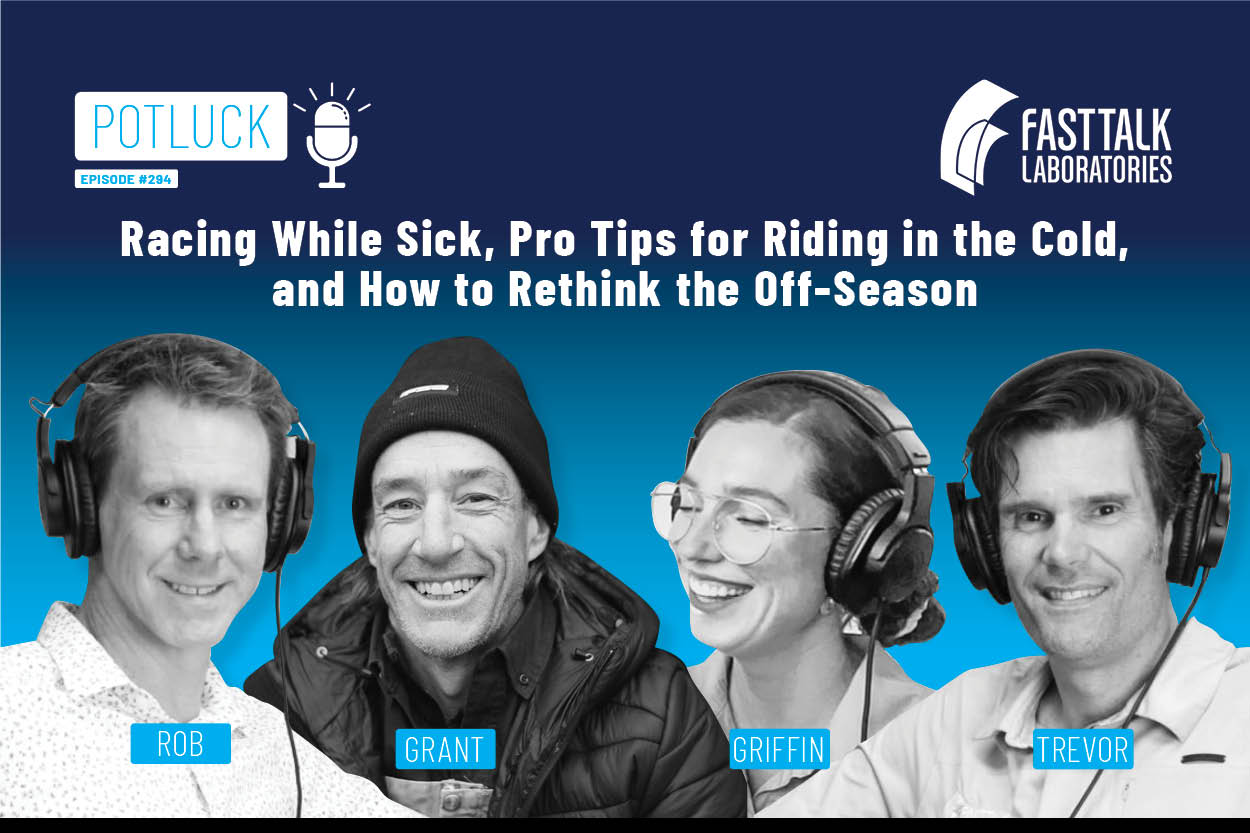
Potluck Discussion: Racing While Sick, Pro Tips for Riding in the Cold, and How to Rethink the Off Season

For this week’s potluck we discuss a host of questions, from getting sick during a target race, training in cold weather, and approaching the off season.
Please login or join at a higher membership level to view this content.

For this week’s potluck we discuss a host of questions, from getting sick during a target race, training in cold weather, and approaching the off season.

Please login or join at a higher membership level to view this content.

Episode Transcript

Intro + Potluck Setup

Trevor Connor  00:04

Welcome, I was trying to think of something kind of funny and humorous to destroy our intro and I have nothing, Rob?

Rob Pickels  00:10

It’s hard, right? Because we’ve all been in a meeting for like an hour and a half before this. And maybe this is going to be a very serious potluck episode guys, stick to the outline.

Grant Holicky  00:19

I doubt it.

Griffin McMath  00:20

Not with me here.

Grant Holicky  00:21

And not with the way you guys were lighting me up in that meeting.

Rob Pickels  00:25

Well, you have to get it out of the way-

Trevor Connor  00:29

We were complimenting you.

Grant Holicky  00:29

You complimented me once.

Rob Pickels  00:29

Well, exactly.

Griffin McMath  00:30

We’re keeping tabs.

Rob Pickels  00:32

So that everybody knows there is an algorithm, we can complement Grant once every 20th comments. And so there has to be 19 negatives and then a positive. And I think right now we’re at about 10 negatives, so I got 10 more to give you, and then, Grant, I’m going to make a-

Trevor Connor  00:48

So Grant, how’s the show doing for your self esteem?

Grant Holicky  00:51

Well, you know, it was probably too high to begin with. So just kind of gets it back to a standard place I think. For a while there I thought I was a good coach.

Rob Pickels  01:00

You are a good coach.

Grant Holicky  01:01

Then I interact with you people.

Rob Pickels  01:02

That’s why we have to cut you down, you’re too good.

Grant Holicky  01:05

Oh.

Trevor Connor  01:06

By the time we are done, you will be a mediocre coach. We promise you.

Rob Pickels  01:10

You’re done. Hey, potluck?

Grant Holicky  01:12

Potluck?

Trevor Connor  01:13

Potluck.

Rob Pickels  01:14

This is potluck season, right?

Trevor Connor  01:15

And Griffin, welcome to potluck. Thank you. I’m excited to be here.

Rob Pickels  01:18

No, I want to talk about food. I don’t want to talk about Griffin.

Trevor Connor  01:21

Got a big, big cup of coffee.

Griffin McMath  01:23

Tea.

Trevor Connor  01:24

Tea.

Rob Pickels  01:24

Tea.

Trevor Connor  01:25

Got the right spirit here.

Rob Pickels  01:26

I’m close enough I can see it.

Trevor Connor  01:29

For nearly two years Fast Talk Laboratories has brought you the craft of coaching with Joe Friel, the ultimate resource to become a better, more successful, and happier coach. We’ve bundled some of the most popular pieces of content from all 14 crafted coaching modules to reshare. And what we’re calling The Craft of Coaching with Joe Friel Coach’s Picks, which includes the star power panel of featured experts like Dr. Stacey Sims, Dr. Andy Kirkland, Jim Miller, Victoria Brumfield and Jim Ruppert, this incredible library will provide a lasting legacy and guiding life for endurance coaches for many years to come. Check out The Craft of Coaching with Joe Friel Coach’s Choice at fasttalklabs.com. So we got questions.

Trevor’s Race Story: Getting Sick Before a Big Event

Grant Holicky  02:10

We got questions.

Trevor Connor  02:11

And we have answers.

Rob Pickels  02:13

We got answers.

Grant Holicky  02:13

That will wait and see.

Trevor Connor  02:14

Okay, well, we’re gonna go out of order here because I have a question. And it’s not my standard training question. But it is a question that I think everybody faces at some point, that I know my answer to it every single time is absolutely the wrong answer. So I’m going to throw it to you guys. But let me paint the picture. Because I just had this experience. I was preparing for my big race Tobago, I was on the best form I had been on in a couple of years, I was getting my AFib under control. I was excited. I invested a lot of money in this race. I thought it was going to go there and perform really well. And the day before the race, I went out for my race prep ride, you know, I could tell I was feeling a little off, but I was thinking well, you know, just arrived in really hot weather so that’s probably what’s going on. Went out for what I thought was a pretty hard ride and went wow, I must have averaged like 220, 230 Watts and looked at my power meter and it was 130 Watts and I went okay my power meter is not calibrated.

Rob Pickels  03:18

It’s always the answer, just so you know.

Griffin McMath  03:20

It is always on the-

Trevor Connor  03:22

Ignore that, but as I’m getting towards dinner, I start getting a sore throat and again, I’m sitting there going that’s just the weather. And was an interesting night you called me that night.

Griffin McMath  03:31

I did.

Trevor Connor  03:32

And Griffin I had a good talk. And then I tried to go to bed and went I feel awful and didn’t sleep that night, but still tried to convince myself things were okay I got on the bike the next day, went to the race, survived about an hour of the race and then barely pedaled back to the hotel. The next day I’m like well I’m gonna be fine now and I took lots of naps and everything else, and actually finished that stage but about an hour in, I just tanked, I got popped, and finished way back. The third day which was the crit, I just skipped, because the last day was my big day and it’s the super hard five hour race. And tried to convince myself I was healthy for it. We were riding out to it, I was feeling pretty good. Felt strong going out tried to lead up the first climb to convince myself I’m doing well and then exploded, got popped on the flats, road to the other end of the island where you hit the big climbs got over the first climb, but had to walk half of it.

Grant Holicky  04:36

Nice.

Trevor Connor  04:37

Got to the second climb, somehow got over it and was still convincing myself, I’m going to finish this, I’m going to start feeling better. That third climb might have been the worst climb of my life. I absolutely was dying, somehow got over it. somehow finished the descent, then got off my bike and got in the car. So that was a huge disappoint because I had really cared about that race. So here’s my question. What do you do when you have a target event? And that happens, you get sick.

Why Forcing Positivity Backfires When You’re Sick

Rob Pickels  05:11

Grant, before this episode, we were talking about a local cyclocross race. And I don’t know that that’s on the same level that Trevor is talking about, right. Now is something that we do need to address is the fact that Trevor invested so much time, money, effort, travel, so on and so forth. But I think a great place to start and just an objective place, is you and your past situation where there was a local cyclocross race, and you weren’t feeling so hot before it.

Grant Holicky  05:37

Yeah, no, I had a very similar situation last week, on Friday, I spent the night, the day in bed. Had a fever. Normally, I would have just ignored it, because I would have had too much to do. But I just had a pretty easy day. So I like actually gave into being sick. And I wasn’t going to go race the next day, the local race, and my son was going out for his first race. And he goes, well, Dad’s not going to do it. He said, we’re going to do it together, so I’m not going to do it. So I put on my kit and sucked it up, and went out and did the race with the expectation that was gonna feel pretty awful. And so I think from my point of view, there’s something really important in this and the piece of that puzzle is that it’s so easy to stand there and just say, I have to convince myself that I’m going to be alright. I have to stay positive and just be positive, no matter what, this is going to work out, this is going to work out, this is going to work out. From a mental strength point of view, that’s the worst thing you can possibly do. Because what ends up happening is you sit there and you’re giving yourself all this positivity, that deep down, you know, is wrong. And eventually you’re faced with the fact that it’s wrong. And your brain goes, see, I knew I was sick.

Rob Pickels  06:47

It undermines you.

Grant Holicky  06:48

Yeah, it really can create a problem. Instead, I think the approach that has to be made is, you know what, I came all this way, do I really want to sit in a hotel room for four days and not participate, not enjoy the island, not enjoy what I’m doing? To me, I think the advice I would be giving an athlete is your sick, okay? What can you still pull out of this experience? That you can feel as a positive and admit that you’re sick, you’re not going to feel your best. And then you may give yourself an opportunity to surprise yourself just that little bit. And that feeds some positivity on top of itself. Instead of this scenario, where we’re going to be feeding negativity on top of itself.

Accepting Reality + Adjusting Expectations

Trevor Connor  07:28

That’s a really important thing, because I can tell you the whole race, I was deluding myself. I was like, oh, this is just a little cold-

Grant Holicky  07:33

Just the race?

Trevor Connor  07:34

It’ll be 24- well, we can talk about my general delusions on another episode, but I was conveincing myself it’s just a little 24 hour cold, and I could ride through this. It actually- and I feel horrible for the person sitting beside me. Because the day after the race, I woke up and I went, well, crap. Now I’m feeling fine. And then I got on the plane, and it was a six hour flight.

Grant Holicky  07:56

Yeah.

Trevor Connor  07:56

And on that plane trip, I had the realization of, oh, I’m really sick.

Grant Holicky  08:02

Yeah.

Trevor Connor  08:03

And I was coughing the whole flight. And you could see the guy beside me looking at me, rightfully so going, what the hell and I’m like I didn’t even think to bring a mask because I didn’t think I was sick until now.

Grant Holicky  08:14

Right, right. So I think it’s easy to get in that place where you’re just like, no, no, I’m okay. I’m okay. I’m okay. I’m okay. And we make some poor choices, even if it’s as simple as the mask. Because we’re convincing ourselves, we’re okay.

Griffin McMath  08:26

You said something earlier that that is the worst thing to do. And I think what you also drew attention to was the second you deny the absolute reality of the situation, your baseline, immediately moving forward with that feedback loop between your mind, your body, your performance, becomes no longer reliable to yourself.

Grant Holicky  08:46

Right.

Griffin McMath  08:47

And so I think that’s really important to understand is, we’re acknowledging a baseline reality, we’re calling it what it is. And then from there, this feedback loop has a better relationship with the athlete or they have a better relationship with our baseline to adjust, to modify, to adjust expectations, to regulate their internal talk. But if we deny that baseline right away, then how is anything else after that trustworthy.

Grant Holicky  09:12

Right, so what we do right away is we’re saying, okay, I’m supposed to be normal me, and everything’s graded or judged against normal me, if you can go in there and say, okay, maybe I’m 80% of me. Or maybe I’m some version of me. I don’t know what that version is, but I’m not my best and that’s okay. So what can I do at not my best and still just get something out of this? And so, you know, in that race at Belmont, I had a couple of people look at me and go, man, you look miserable. And they are saying, are you all right, like no, I wasn’t really feeling that good. And that’s probably why I was miserable. And then I had other people say to me, man, you look like you’re having a blast, because there were parts of that race that I was having an absolute blast, times I felt awful physically. I was still actually enjoying the process and enjoying what I was doing, I was just like, man, this kind of sucks, because we’re going up the stairs, and I’m normally really good at this. And God, it just feels bad.

Redefining Success and Changing Race Strategy

Rob Pickels  10:06

I think that this switch in mindset is really important, right? Because ultimately that defines what success is.

Grant Holicky  10:12

Right.

Rob Pickels  10:12

You know, Trevor, in your situation, your race, you didn’t have that switch in mindset. And it sounds like on that longest, hardest stage, you tried to approach it with the same results sort of driven mindset that you would normally do and you attack, you’re leading up a climb. And maybe that’s what undermined you for the rest of the race, right? Where if you had had that switch and recognized and said, yeah, I am not at my best today, I need to change my tactics, I still want to be successful. I think even if that success is still performance, we had a conversation with Keel Reinen, where he was like, I’ve done the best in races, I had the worst legs in, because I changed how I went about the race and I didn’t attack, and I sat in, and ultimately, that led to my success, right. He was still successful in a performance standpoint, it doesn’t mean you have to go back to this fluffy process, you know, find the positive in anything, thing that Grant loves to do. You can still have success on the performance side, but you have to recognize the situation you’re in. Holding back on those climbs, not putting in the effort could have led to you being more successful, even if at that is just finishing the stage.

Grant Holicky  11:23

Sure.

Trevor Connor  11:23

In this particular case, with how brutal that final stage is, it is still the hardest single day race I’ve ever done. Looking back, there was no way I was finishing it. But I think you’re right, I could have approached it a little differently.

Griffin McMath  11:36

I think what’s interesting is none of you have given a concrete answer to the original question, which just says so much about the fact it was-

Rob Pickels  11:44

First potluck for you.

Griffin McMath  11:48

Write this out with me for a second. Trevor talked about a terrible racing experience being sick, and then says what do you do in that instance? And none of you said, oh, well, you just don’t race or you don’t whatever. The only time that this came up, and I’m plotting this, like I’m there’s a way around. I’m making here. But like 10 minutes later, you said, well, maybe if you have a fever, yeah, but everything else was about just adjusting mindset, adjusting expectations, of what you’re getting out of it and how you’re approaching and then allowing yourself to potentially be surprised once you have done that. So my one is, how cool, that’s says so much about the fact of what you do specifically, but two are there are maybe a few, like absolute lines, we should be.

Should You Race While Sick? (Ethics, Risk, Contagion)

Trevor Connor  12:35

No thank you. And I’m just gonna add one other thing to that conversation, which is another thing nobody raised that I actually felt guilty about is, I was sick, I was contagious. When you’re ridding in a Peloton, people don’t like to face this, but bodily fluids get around? Was I being irresponsible as well going in the race?

Rob Pickels  12:54

Well, now that you bring it up.

Trevor Connor  12:58

So yeah, that’s the question, should I or shouldn’t I have?

Grant Holicky  13:01

Yeah, you know, this isn’t the greatest place, it depends. No, uh. This isn’t the greatest place for me, because I don’t want to give a concrete. And the reason I don’t is because the time, the money, and the effort you put into getting to that race, I don’t want to turn to somebody and say, no, you shouldn’t. If you have a fever, you shouldn’t race. Based on everything that I’ve been told by people far smarter than me. If you have a fever, don’t race, if you’ve got stuff coming out all over the place, and you’re snotting and spitting in all over the people around you. Yeah, you probably ought to think about that before you participate in the race. But if you’re in that place where nothing’s coming out yet, I mean, I don’t know.

Rob Pickels  13:41

Another general recommendation too that I’ve heard is that if the symptoms are above the neck, that you’re good to go. And if they’re below the neck, that physically in terms of your just overall bodily health.

Grant Holicky  13:52

Yeah.

Rob Pickels  13:53

You should probably back.

Grant Holicky  13:54

Yeah. Because you can do more damage, right? If you if that’s where you can get to pneumonia, or you can go down that road of-

Rob Pickels  13:59

Is it? Is it worth it, though at sometimes?

Grant Holicky  14:02

Yeah-

Rob Pickels  14:02

Putting yourself in that position where you’re running the risk of making it worse, but taking an opportunity.

Grant Holicky  14:08

Absolutely. Absolutely. When we go back to the example you were making about an athlete trying to make a team or trying to make trials. So I have told many a 50 freestyle, this is a 22nd race. I’m coughing like crazy, don’t breathe, and not in the point of like, you have to do this, just in that point of listen, understand what you’re being asked to do here. And maybe you can do this, despite the fact that you feel not so good. And sometimes that works. And sometimes that doesn’t work. But most of the time, I don’t know that I’ve ever had an athlete come back to me afterwards and say, I wish I hadn’t tried.

Griffin McMath  14:46

Do other athletes get ticked off when someone’s next to them super sick?

Grant Holicky  14:50

I don’t, I don’t even think about it, to be completely honest. But-

Trevor Connor  14:53

No my team was actually annoyed with me that didn’t raise the third day. Even though they knew I was sick.

Rob Pickels  14:58

I wouldn’t be concerned in an outdoors situation.

Grant Holicky  15:01

No, yeah, yeah.

Rob Pickels  15:02

Now, we’re not talking about you being on the team bus, maybe you shouldn’t be eating dinner with everybody, things of that nature.

Trevor Connor  15:10

Which I avoided, didn’t go the team meetings, I ate by myself, that I was careful about.

Rob Pickels  15:15

But I mean, if I was writing behind you, and I was a little concerned that you were hacking up along, then I’d pass your slow ass, you know, that’s all. Beep, sorry, I’ll post beep my.

Grant Holicky  15:27

You’re gonna get dropped soon enough, so it really wouldn’t matter.

Trevor Connor  15:29

But Griffin, I will give you my answer. In retrospect, when I went to that first day and saw how bad I felt, I don’t regret going to the first day, I should have pulled the plug there. And maybe seeing if I just took two complete days off, if I could have resurrected the final day. But I think going into the second day, when I knew I still wasn’t feeling well. And finishing the whole day, was a mistake.

Rob Pickels  15:29

But all of this is about being clear with what you’re trying to achieve and to accomplish, right. You know, Grant, you just have the conversation of, hey, if you’re feeling sick, you can still get out there. It’s worth the risk. I think that that’s appropriate and amazing advice for people who are trying to be top performers who have something ridding.

Grant Holicky  15:29

And that was the context in which it was given.

Rob Pickels  15:29

But that is not necessarily the right recommendation. If you’re in the middle of your local cyclocross season and state championships is two weeks away, maybe today you need to pull back because that is the emphasis right. And in your situation, Trevor, you, and you’ve talked about this before, that fifth day, if I remember correctly, is the big one. It’s the one that you’re geared up towards your training was a long that. It may be as you’re saying, now, the correct decision should have been hey, ultimately, I wasn’t focused on the whole week of racing, I was really focused on that fifth day. And you should have aligned your actions maybe around that, because that’s what success is.

Trevor Connor  15:29

Absolutely. The last thing I’ll point out, and then we’ll shift to the next question is, this was end of the season. So this was okay. But I was sick, really sick, for three weeks after that. And I’m certain trying to race through it. Added a week or two.

Grant Holicky  15:29

Yeah.

Trevor Connor  15:29

To that. Had I done that in the middle of the season that could have ended my season.

Lessons Learned + Why Athletes Get Sick Around Big Events

Rob Pickels  15:32

Now, I think we should probably revisit the subject at some point. And I think we should bring on a doctor because there are a bunch of people listening right now that are going why does this always happen? Why do I always get sick when I rest for my big event?

Griffin McMath  17:26

Oh, I would love to-

Grant Holicky  17:28

Right after the season is over?

Griffin McMath  17:30

Yeah. I would love to revisit that in an episode because there’s actually a few different takes to that. And you have a few different types of people, people who get sick right before, people who succumb during, and then people who, after the big event has finished it takes a couple of days and in their body and mind catch up. And then it’s like their body allows them to.

Rob Pickels  17:50

I know a cross racer who multiple streak of national championships, who said every year, without fail a sinus infection and they were always finishing antibiotics the week that they were going to cross nationals every year.

Trevor Connor  18:05

Yep, I can tell you why it happened to me. You’ll get a good laugh out of this.

Grant Holicky  18:09

Okay.

Trevor Connor  18:10

So here was my lead into Tobago. I flew out to Philadelphia. I spent two days walking in excellent. I love these looks. Brad’s face. So said Thursday, Friday walk in and expo. Then Friday drove five hours up to Ithaca, New York. Spent the weekend-

Grant Holicky  18:26

There’s your problem right there.

Trevor Connor  18:27

Yes. Spent that weekend in the hospital.

Grant Holicky  18:29

Why were you in the hospital?

Trevor Connor  18:30

Visiting a friend.

Grant Holicky  18:31

Oh, okay. Okay.

Trevor Connor  18:32

But I was in a hospital-

Griffin McMath  18:33

Very important context there.

Trevor Connor  18:38

This Sunday night, I went to bed at 11. I got up at 3:30, I drove five hours down to New York City.

Grant Holicky  18:46

Yeah.

Trevor Connor  18:48

Got a plane for six hours down to Tobago. I was- this is the race prep you don’t ever do.

Grant Holicky  18:55

Yeah, there’s part of that.

Griffin McMath  18:56

Here’s your sign.

Grant Holicky  18:57

Yeah, we’ll cover that episode at some point.

Griffin McMath  18:59

I’d love to do that.

Trevor Connor  19:00

Yeah, that’d be fun.

Transition to Cold Weather Riding Question

Rob Pickels  19:03

November, the air is crisp, the leaves are falling, and I get to take a break from riding my bike. Now is a great time of year to rest and reflect on the past season. Visit Fast Talk Labs and take a look at our pathways on recovery and data analysis. These two in depth guides can help you get the most from your offseason. See more at fasttalklabs.com/pathways.

Trevor Connor  19:32

Who’s question is next?

Grant Holicky  19:33

Robert.

Rob Pickels  19:34

Do you know it’s cold outside?

Grant Holicky  19:36

Baby it’s cold outside.

Rob Pickels  19:37

Snow on the ground as we speak right now.

Trevor Connor  19:38

We have like a foot.

Grant Holicky  19:40

Baby it’s cold outside. Sorry.

Griffin McMath  19:43

You’re singing adds so much to my life when we record.

Grant Holicky  19:47

It should.

Griffin McMath  19:47

Yeah.

Grant Holicky  19:48

I’m tremendously bad at it.

Trevor Connor  19:49

I wasn’t gonna say it. I’m just gonna compliment Grant today.

Rob Pickels  19:52

I can’t even-

Grant Holicky  19:54

Can’t even? Okay, I bet you can.

Rob Pickels  19:57

Hey, guys, did you know that it’s cold outside?

Griffin McMath  19:58

It’s a bit chilly.

Rob Pickels  20:00

I’m starting my throw all over again. Just so you know.

Grant Holicky  20:01

Aw man.

Trevor Connor  20:03

Yeah, it’s cold out there, Rob. How cold is it?

Cold Weather Gear: Heated Clothing + Core Essentials

Rob Pickels  20:06

It’s so cold, Trevor, that as I was ridding last night, I came up with my question for today. What pro tips do you guys have that aren’t the standard cold weather recommendations? Right, everybody knows you should dress in layers. You should wear synthetic, or wool, and not cotton. People know those things. What have you learned over the years that other people might not know that help you deal with ridding, or running, or activities in the cold weather?

Trevor Connor  20:37

This is like the question for me.

Grant Holicky  20:39

Yeah, I was gonna say we gotta turn to the Canadian.

Trevor Connor  20:41

I’m from Canada. I’ve lived in the Pacific Northwest where it’s 40 degrees and raining every single day.

Rob Pickels  20:47

Which is about as cold as it gets. I mean, 40 in the morning is frigid.

Grant Holicky  20:51

40 and raining is far worse than 14.

Trevor Connor  20:53

Oh, yes. Absolutely, though I I have done a six hour ride when it was negative 20.

Grant Holicky  20:59

That’s just stupid.

Griffin McMath  21:00

What, why?

Grant Holicky  21:01

Was that Celsius or Fahrenheit?

Trevor Connor  21:03

They’re, the actually the same.

Grant Holicky  21:05

That’s right, they are the same.

Trevor Connor  21:07

That’s why I didn’t specify. I tried to be so nice to you and you’re taking me apart today. All right, number one, this is a new suggestion that I’m going to offer. Heated clothing, battery operated clothing. It works. get heated socks.

Rob Pickels  21:24

Battery operated clothing? Nice.

Trevor Connor  21:31

I use the I think it’s Lenz Zyme. They are amazing. They were a game changer.

Rob Pickels  21:37

Nice.

Trevor Connor  21:38

That is number one. And I also have a heated vest. It is fantastic. Heated Gloves. I sometimes use, they don’t work as well.

Rob Pickels  21:45

I started making this stuff for PEARL iZUMi, and it never came to market, and it is breaking my heart right now hearing you say all this.

Griffin McMath  21:52

I mean he did. But you have to be careful to not sweat. Because the second that you have moisture…

Trevor Connor  21:57

They can handle the sweat.

Griffin McMath  21:58

It just-

Trevor Connor  21:59

They’re fine.

Grant Holicky  22:00

As wicked away.

Rob Pickels  22:01

You’re talking about two different things. You’re saying from an electronic standpoint, you’re saying from an if you’re wet, you’re cold standpoint, right?

Griffin McMath  22:07

Yeah, but I guess if the battery doesn’t run out, you’re fine.

Trevor Connor  22:08

They aren’t hot. So the first time I use the socks, I was like these are broken. I’m not feeling any heat at all, you know, and I only had a half a charge in the battery. So like three hours into the ride. The battery went dead. And all of the sudden my feet got really cold. And I went oh, they do work. They just keep your room temperature.

Rob Pickels  22:26

And that’s- you never feel hot, you just don’t feel cold. Okay, great.

Griffin McMath  22:30

But unless the battery dies.

Trevor Connor  22:32

And then you feel cold.

Griffin McMath  22:33

Yeah.

Rob Pickels  22:33

So heated clothing. Yeah. What’s your second tip, Trevor?

Trevor Connor  22:37

Really good booties.

Rob Pickels  22:39

Okay.

Trevor Connor  22:40

Really, like everybody gets these thin booties because it’s gotta be arrow. And you know, I can’t. It’s winter. You’re not trying to go fast. Get the giant neoprene booties put them on. And I also put toe warmers on my shoes underneath the booties.

Rob Pickels  22:55

You’re a jerk, that was mine.

Trevor Connor  22:56

Sorry.

Rob Pickels  22:57

Toe warmers. And in my opinion, you should go with handwarmer because there’s even more of the iron in there. They don’t go inside your shoes. They go above your shoe, but underneath the booty, because you can’t possibly shove another thing into your shoe and still have it fit appropriately without cutting off circulation.

Trevor Connor  23:16

So that’s another really key one is don’t clap your shoes down. You cut off blood flow. So I actually, in the winter, put mountain bike pedals on my bike and I use mountain bike shoes because they’re looser. They’re thicker, they’re warmer. The road shoes are not designed to be warm.

Rob Pickels  23:33

Okay, awesome. That’s one, was that three.

Trevor Connor  23:36

Three, want me keep going.

Rob Pickels  23:37

No, wanna hear from Grant.

Trevor Connor  23:39

Go Grant.

Grant Holicky  23:40

Now I got a couple. One is get yourself a metal water bottle. An insulated metal water bottle, Bivo makes them, they’re fantastic.

Rob Pickels  23:49

Insulated.

Grant Holicky  23:50

Insulated.

Rob Pickels  23:51

Not just metal.

Grant Holicky  23:51

Not just metal, insulated metal water bottle, hot tea.

Rob Pickels  23:55

Hot tea.

Grant Holicky  23:56

Hot anything. Hot water, just steaming hot water. It’s amazing what a difference couple mouthfuls of warm, hot water do from the inside out. But that’s not going to last right, you put that in a regular plastic water bottle. It’s cold super fast. Tastes like crap because you taste the plastic in the water bottle. And it really is worth the insulated water bottles. I’m a big fan.

Hands, Feet, and Hydration in the Cold

Rob Pickels  24:21

And this seems worth it both from a warming you from the inside out, but also from just a hydration standpoint.

Grant Holicky  24:27

Right.

Rob Pickels  24:27

And granted, maybe you don’t need to hydrate as much in the cold because you’re not sweating as much, but I know I will actively avoid drinking, because that water bottle is usually frigid and it’s an unpleasant experience.

Grant Holicky  24:37

Right.

Trevor Connor  24:38

If you’re like me and you go out on really cold days, water bottles freeze.

Rob Pickels  24:43

Yes.

Grant Holicky  24:43

Yeah,

Trevor Connor  24:43

I have done long rides where I didn’t take a single drink because I had frozen water bottles. Insulated bottle.

Grant Holicky  24:50

Yeah, those are really nice. The other thing is we used to do this a ton when I was a kid because growing up in almost Canada, upstate New York, you get that, we would double layer gloves. So the little silk gloves and then a big roomy glove over the top of that glove. I think one of the things that you kind of alluded to with the don’t do the tight booties, I think everybody kind of goes down that road. Don’t be afraid to do some roominess in the glove, because that heat can build up within that insulation piece and keep the fingers a little bit warm. If it’s really tight in there. Sometimes you’re constricting the thinsulate or whatever is in there where it doesn’t work quite as well. But you’re also- listen the whole reason you can get in like do the sauna into the frozen lake thing, is if you sit still you warm the water around you and that water stays the temperature of your body and insulate you. The same thing can happen in the gloves. If you’re going to warm a little bit of air alone around those fingers, keeps the fingers warm.

Trevor Connor  25:54

And I personally use ski gloves. Get good thick gloves don’t go into that, oh, you know, I’ve got to have those thin gloves and again be arrow or whatever it is. If you can easily shift your gears, your gloves aren’t big enough.

Rob Pickels  26:07

Well and that’s, that was what I was going to point out is big gloves are great until you can’t control your bike anymore because you’re pinched between the brake lever and the handlebar and you can’t effectively brake. So just make sure that your hand ware allows you to stop and….

Trevor Connor  26:24

So I will give you an alternative that is extremely warm, brake pads. These are these neoprene things that go on your handlebar arm… they go over your brake pads.

Rob Pickels  26:35

Yep.

Trevor Connor  26:35

I have gone out when it’s like five degrees Fahrenheit with those and I only need a thin glove because it is so warm inside those.

Grant Holicky  26:43

Now I will say this, that the cyclocross element of this, right, we will do races in zero. We’ve done races around here in zero. We’ve done races around here in negative.

Rob Pickels  26:54

Nationals in Connecticut was-

Grant Holicky  26:56

That was chilly.

Rob Pickels  26:57

Yeah, real quick. The worst part about that was it was warm earlier. And there was a running section that then froze into like a lunar epochal surface. That was the worst.

Grant Holicky  27:07

I was pretty bad.

Rob Pickels  27:08

Yeah.

Grant Holicky  27:08

And then it started snowing during the Masters races, so it snowed enough that you could not see said potholes.

Rob Pickels  27:14

Yeah.

Grant Holicky  27:15

That was awesome.

Rob Pickels  27:16

Anyway.

Grant Holicky  27:17

Anyway, we, going on, one of the things that I’ll do in cyclocross is put a little embro on the back of the hands. So Embrocation is something that it’s like Icy Hot, and it doesn’t really create warmth, but it creates the illusion of warmth. And I think on the back of the hands, that’s a really nice thing. I’ll, I’ll use it under my leg warmers, just know that it will degrade your leg warmers because it’s petroleum based over time, so use your old ones. But the other thing, a little tip that I learned during cross, is you will watch riders swinging their hands or banging their hands trying to get blood back into their hands. You don’t have to do that just rhythmically, squeeze the handlebars. And that motion of rhythmically squeezing the handlebars will bring warmth and blood flow back to the hands and warm the hands back up.

Rob Pickels  28:04

Back to the embryo side of things, I think that the irritation can actually induce a little bit of blood flow to that area. So granted, it’s not necessarily adding external heat, but it might help you internally heat yourself.

Grant Holicky  28:16

Yeah.

Trevor Connor  28:16

One of the first episodes we did was on dressing for cold weather. And we did cover embrocation and read a couple of studies on it. And embro can actually have the opposite effect, it can block blood flow.

Rob Pickels  28:17

Oh really?

Trevor Connor  28:18

If your’re feeling warm. It confuses your body and your body then says I don’t need blood flow there and it will actually take blood flow away from the extremities.

Rob Pickels  28:36

I know, but that shine on your legs looks good.

Griffin McMath  28:41

So you’ve talked about hands, you’ve talked about feet, what about other exposed areas and how to keep that warm, like your face, you’re ears?

Advanced Cold Tips: Body Heat, Layers, and Circulation

Trevor Connor  28:49

So, only two points and then you guys can can jump at this. One, people tell you all the time you lose most of your heat from your extremities, so keep the extremities warm. Keeping the torso isn’t as important, but there is a counter argument to that and first, yes, keep your extremities really warm. But you want blood flow into your extremities and your body prioritizes keeping your core warm. So if you’re not wearing much on your core, all the blood is going to go there to protect the core and you’re not going to get any blood flow to the extremities, so they have shown multiple times in research that if you keep that core, if you keep your torso warm, your body is going to allow more blood flow to the extremities. So I do think it’s important.

Grant Holicky  29:35

Yeah.

Trevor Connor  29:35

To have multiple layers.

Grant Holicky  29:36

And one quick thing about the layers, do remember it’s not about the thickness of the layer at all. You can do like a summer weight under shirt underneath another weight under shirt. Like if you get your four layers on there you’re gonna get- and this is more on the obvious thing you didn’t want to necessarily touch.

Rob Pickels  29:55

Small social media worthy pro tips guys, talking too much.

Grant Holicky  30:00

Okay.

Rob Pickels  30:00

I’m kidding, I’m kidding.

Trevor Connor  30:01

I’m going to jump on my soapbox here because it is a big soapbox. And this thing drives me nuts.

Grant Holicky  30:06

You have wear marks on your soapbox, you’re on it so often.

Rob Pickels  30:12

Soapbox so much. It’s actually warn down, it’s just yeah.

Trevor Connor  30:17

Right, right there. So it drives me nuts seeing people dramatically under duress in cold weather. And whenever you talk to people, it’s always well, I don’t want to sweat. I could tell you having done many, many cold rides and having sweated, is that the correct term? Sweet, sweeted.

Griffin McMath  30:34

Not at all. But let’s ride this out.

Trevor Connor  30:36

On many of them, sweating is not that bad over dressing and sweating a little is not a giant issue. Under dressing and getting really cold is, so to me, that argument is kind of like saying, if I handed you a glass of arsenic and a glass of something that might cause you indigestion, you choose to drink the arsenic because you don’t want to risk getting indigestion.

Grant Holicky  31:00

Jeeze, that went, that escalated quickly.

Griffin McMath  31:03

And that’s just because you’re gonna continue to keep your body temperature up throughout the event anyway.

Trevor Connor  31:09

If you are cold, you are doing damage, you are literally doing damage to your muscles. If you’re warm, you’re just a little uncomfortable.

Grant Holicky  31:16

But I think, you know, one of the questions is, what are you going to go do right, if you’re going to do an a base ride, you can keep that homeostatic place pretty easily, because you’re doing the same kind of effort the whole way. If you’re going and doing some sort of a race or some sort of a workout, take some clothing off, do the workout, get the clothing back on after the workout. So you can, you know, use your layers to kind of keep everything in line.

Rob Pickels  31:38

Well so to bring this back to a pro tip, type of format that I wanted to talk about, you know, climbing and descending is very much in line with what you’re talking about. It’s okay to be removing clothing on the way up, not wearing it, you might not be warm at the bottom, but you’re going to be warm soon enough, but have that clothing that you can put back on when you’re warm and then do the descent.

Trevor Connor  32:00

So here’s another pro tip, handlebar bag.

Rob Pickels  32:02

To carry extra stuff with you.

Trevor Connor  32:02

Carry a lot of extra gear. So if you’re doing that long climb, put a bunch of your gear in the bag, but then pull it out for the descent.

Rob Pickels  32:10

Yeah, some for me, you, Griffin kicked it off, and you were looking for things that weren’t hands and feet, I do want to get to feet eventually again, but on the head side of things, no matter what my head always gets really hot. And I do have a few different winter specific, warm cycling caps, I always find them to be too hot. So I oftentimes will do a combination of a traditional cycling cap with a headband over my ears, because my ears get cold. But that allows a little bit better of a regulation of the heat on my head where it’s not getting the direct airflow through my helmet, the cycling cap is blocking that. But my really exposed ears, they’re able to be covered up and warm.

Trevor Connor  32:51

So on the head side, I strongly recommend neck tote or whatever you call it, thing that-

Griffin McMath  32:57

Neck gator?

Trevor Connor  32:58

Yeah, gator. I personally cover my head. But you can also, as you said, get ones that are more of a headband. Here’s my take, I never cover my face, even when I go out and it’s like negative 20. I don’t cover my face. Because my experience has been when you cover your face, whatever is covering it collects the moisture from your breath, that moisture freezes. And I find that much more unpleasant. I would rather deal with that first 20, 30 minutes of my face being really cold, eventually the face goes numb and then you’re fine. Serious.

Rob Pickels  33:29

No I think, that I think you have a point with covering your mouth and your nose. But I do kind of like wearing the ball for the neck gate or whatever you want to call it, in a manner that is kind of like up high on the back of your head but then down low over your chin. And it’s covering 70% of your exposed face. But it’s not getting that hot, warm breath that eventually freezes.

Grant Holicky  33:51

Grow a beard.

Rob Pickels  33:53

Ooh you could do that.

Grant Holicky  33:54

Without a doubt. I mean, I went through this with for years on the pool deck because I coached outside year round.

Rob Pickels  34:01

All those lucky athletes in the nice heated pool.

Grant Holicky  34:03

Oh it was-

Rob Pickels  34:04

Poor Grant.

Grant Holicky  34:04

It was rough. It was hard. But I do remember vividly, this was way back when I was still swimming, and racing, competing. There is a brief period there. But you shaved down for the championship meet and I remember going back on the pool deck after I had shaved. I was like I could not get warm.

Rob Pickels  34:04

Really?

Grant Holicky  34:05

I could not get warm. I mean there is something to body hair that helps regulate heat. Grow your leg hair back in the winter.

Rob Pickels  34:31

Wow interesting.

Trevor Connor  34:32

I do.

Grant Holicky  34:33

I do.

Trevor Connor  34:33

Same thing.

Rob Pickels  34:34

Can we switch back to feet real quick?

Grant Holicky  34:35

Yeah.

Rob Pickels  34:36

Grant you probably know this. Trevor brought up shoe covers. Right, for us, shoe covers don’t really work very well for people who do cyclocross or mountain bike because inevitably they flip off the front of your toes and you got this little like mole flapping around. You could duct tape that stuff down but I don’t know, that’s just a messy way of doing it. I have old shoes that I have Aqua sealed, brand name, the thick sort of poly urethane goop, all of the vents all of the holes, everything closed. And oftentimes with a pretty warm pair of socks in there and no airflow through them, I stay pretty warm and they’re perfect for cross racing in the cold.

Bike Setup, Clothing Systems, and Final Cold Weather Hacks

Grant Holicky  35:17

The cheap version of that is bread bags inside.

Rob Pickels  35:20

Yeah, I did that with my kids last night on the way to practice I happened to have some some new bike parts for them in the car that happened to have bags on them. I was like perfect.

Trevor Connor  35:29

So that was a big one. When I lived in the Pacific Northwest when it was always raining and cold. You put, your coat your feet and Vaseline, then you put the bread bag, or the grocery bag and use an elastic band so that no water can get through and completely seal off your foot.

Grant Holicky  35:44

The only reason to wear your socks underneath your leg warmers is if you have a plastic bag under there.

Griffin McMath  35:50

I just want to go back in time and be the first person who thought of that and just like yeah, I’m gonna put petroleum jelly over my feet.

Rob Pickels  35:57

Yeah. Let’s tell me more about this one. This is maybe a pro tip, but I don’t know.

Trevor Connor  36:01

It is not pleasant, but it’s far better than the alternative.

Rob Pickels  36:06

Is it more or less pleasant than embro on your feet?

Grant Holicky  36:09

Oh embro on your feet’s awesome.

Trevor Connor  36:09

I’ve never tried them.

Rob Pickels  36:09

Until you get in the shower after and then you can’t stand.

Grant Holicky  36:14

That’s the only problem with embro is that it feels like it works the best because it does, two hours later, when you’re in the shower, you just that you definitely got to take a moment and wipe down your legs before you get in the shower.

Rob Pickels  36:27

And then after you’ve wiped down your legs with the towel, you’re okay with destroying because the embro is going to be like deep in there. Yep, spray yourself down with a little diluted mixture of dish soap and water and get even more of that embro off because no matter what, it’s a bit of an experience in that hot water.

Trevor Connor  36:42

Yeah, nobody warned me about that my first shower, that was unpleasant.

Griffin McMath  36:46

Last two body areas I have a question about. One is our trunk, right, cecause this gets cold, question.

Rob Pickels  36:53

She’s pointing to her crotch, let’s be honest.

Griffin McMath  36:55

Oh my god, Kelly cut that out. No, I was pointing to my butt. So one, and maybe that’s just me projecting and because that’s like the first thing that gets one of the first things that gets cold for me. But second, speaking of females, and keeping our trunk warm, like the chest, right, and there are heated options as well. But I’m not sure if any of you have coached female athletes. But I think those are the two areas that we have not talked about.

Rob Pickels  37:26

Yeah, one of my tips actually addresses the first one. But in in kind of an indirect way. Cycling clothing is expensive. And tights are expensive. A way to make that go a little bit further is to get some longer over tights that don’t have a shammy in them, and to wear regular bib shorts underneath the tight. That way, you know, everybody has a ready supply of regular bib shorts, you can be changing those out every day. But you’re not necessarily washing or getting your over tights as dirty because nether regions are protected by the under short.

Trevor Connor  37:59

And I buy the warmest tights, as you said without a shammy that you can get.

Rob Pickels  38:04

Yep. And then that also has the dual nature of adding a little bit of extra protection in an area that’s not doing much work and is exposed to a lot of airflow and can get pretty cold.

Trevor Connor  38:15

So in terms of the upper torso, again, the simplest solution is multiple layers with zippers, like put three four layers on and then again, when you’re getting warm, you’re doing the workout, you can unzip one or two you can control the temperature.

Grant Holicky  38:29

The thing about the tights that I think is really interesting is again, coming back to that whole idea of not everything has to be tight. The over tights that are a little loose, not loose enough that they’re gonna get in the way of the Mac or anything like that. But you know, a lot of companies make the full zips, the full zip pants for cross or skiing.

Rob Pickels  38:48

Nordic skiing. Zip pants are awesome.

Grant Holicky  38:51

And that okay, that’s my last pro tip. Nordic ski wear, don’t buy cycling gear, buy nordic ski gear, they’ve made it to be windproof, they’ve made it to be waterproof, they’ve made it to be all those things. For years we would be racing in Nordic ski gloves, because they were windproof they were all those things and I could never find a cycling glove that could hold a candle to it.

Trevor Connor  39:14

I get a lot of ski gear. My last pro tip, but your road bike away if you’re a road cyclist, get the gravel bike or even the, what’s what’s the one with the giant thick tires, why am I blanking on the name.

Rob Pickels  39:25

The ones with the fat tires?

Trevor Connor  39:27

Fat tire bike.

Grant Holicky  39:28

Well it is Trevor.

Trevor Connor  39:33

Point being, like slow that bike down. Bring the air pressure down, everything. When it’s cold outside speed is not your friend.

Rob Pickels  39:43

No.

Trevor Connor  39:43

Nor are you trying to be fast, make the bike as slow as possible. If you can be doing a hard workout at seven miles an hour, you’re gonna enjoy the cold a lot better.

Grant Holicky  39:55

Fenders.

Rob Pickels  39:56

Fenders.

Trevor Connor  39:57

Yes.

Rob Pickels  39:57

Hugely important for not only you, but the people behind you.

Trevor Connor  40:01

And the fender should go to the ground. I kid you not.

Grant Holicky  40:04

Yeah, that one’s big. It is worth the fender that is full tire on the back and a good chunk of the front.

Rob Pickels  40:11

They’ve gotten a lot better.

Grant Holicky  40:13

They have gotten a lot better.

Rob Pickels  40:13

Right.

Trevor Connor  40:13

Now I showed up, when I was racing with CSU, I showed up on my bike. I just moved from Pacific Northwest. So I had this huge fender on it. And everyone was making fun of me, why you got that fender and then we all went out for a ride in the rain and everybody was fighting to sit on my wheel.

Grant Holicky  40:27

Yeah, well, it was Colorado. So it was the one time it rained over the course of three months, people.

Trevor Connor  40:33

But I was the hero that one time with three months.

Dr. Stephen Seiler  40:37

Listener, the guide you’ve been waiting for is here, our guide to the polarized training method. Visit fasttalklabs.com to see our new deep dive into polarized training featuring Dr. Stephen Seiler, me, Trevor Connor, and coaches Ryan Bolton and Alan Cousins. In this groundbreaking comprehensive guide, we show you how to polarize, why it works, how it compares, how to measure it, how to coach it, how it changes over the season, and how to know when it’s working for you. This is the season you can master the polarized training method. Join Fast Talk Labs to start polarized training. See more at  fasttalklabs.com.

Rob Pickels  41:15

What do we think? Did we get some tips in there, maybe some take homes for people? Somebody’s gonna incorporate one of those.  Yeah, I think so. I got something out of it.

Trevor Connor  41:23

Hot tub when you get home.

Grant Holicky  41:27

Tub it up?

Rob Pickels  41:28

Sounds like the offseason to me.

What “Offseason” Means (Different Perspectives)

Grant Holicky  41:31

Which brings us to my question. And mine is very general. And I’m kind of interested to see where you guys take this. And I put the phrase in quotes, what does “the offseason” mean to you guys?

Rob Pickels  41:45

I thought it was an interesting question. And frankly, well, because I was talking with an athlete the other day of sometimes the answer to the question isn’t as important as the process it took to get to the answer. And that’s why the question is so important to ask, right. So the thing I was thinking about Grant was, I think that the offseason is any time that I would de emphasize training in a purposeful manner, not as the reaction to something, but as a preparatory decision for any sustainable amount of time. I think oftentimes, the offseason tends to fall around now for people, but it doesn’t necessarily have to. And I would maybe extend that thinking to other times of the year, that training really has to take a backseat to something else. Whether that’s social because you want to spend time with the holidays, maybe you have a ton of work trips for the next three months, and you have to deprioritize, I tend to look at those in very similar manners.

Trevor Connor  41:45

I just want to clarify because we clarified this off mic beforehand, I, when I think of the offseason, I think of something that’s like two, three weeks, where you’re truly off. You’re defining that offseason as that plus, probably that first month or two where you’re training, but you’re so far out from the season, it’s not that critical.

Rob Pickels  42:31

Ultimately, it’s anytime that training is not first and foremost, there are times where for the best performance, you really have to put your emphasis on training. You have to maybe you know, I’m sorry, Grant, I can’t get beers with you tonight because I got a hard workout. There are other times of the year where it’s like screw the workout, man, I’m getting a beer. That is the offseason to me and that could be if you’re super dedicated racer that’s racing multiple seasons, that could be two or three weeks. If you’re maybe like more of a general recreational rider or racer, then maybe that’s more like two or three months.

Trevor Connor  43:45

Well, I’ll start it out by saying to me, it’s two things. One you just covered, the offseason is when if you got friends going out. If you’re not feeling up to it, it’s okay to say I’m skipping the workout, which I personally will tend not to do at the height of the season. You know, it’s gotta do the work. You got to get out there. You got to make it happen. Offseason you don’t necessarily have to. The other thing that the offseason is, for me is the time to do all that stuff you can’t necessarily do it other times of the year. So I spent a lot of time running. If I’m on the bike, I go and do those routes that aren’t good training. I spent a lot of time in the gym to get involved in other sports. I was hoping to play tennis this year, but there’s a foot of snow on the ground. So that sort of thing.

Grant Holicky  44:26

And I think that’s part of why I asked the question is I was interested in different people’s versions of what offseason means to them. I use this phrase a lot with athletes, be active, but don’t train because it’s different, right? If I look at somebody like one of the elites that I coach, we get to a very dedicated offseason and we’re taking time off. I don’t want them to train at all, I don’t want them to run, I don’t want them to hike. I want them to basically lay in bed, I want their body to recover. And I remember back in the day when I was racing, triathlon at a fairly elite level I would finished Maori, it was Exterra Worlds. And I remember telling people that the first week I just, my body didn’t want to do anything, right. It was kind of what you were mentioning it shut down, it was done. I don’t have to rehhh, we’re not doing anything, and I would just lay around. What always would happen during that second or third week that I took completely off, nothing would hurt anymore, I would get into this place where I would wake up and be this is amazing. I feel amazing. Like my knees don’t hurt, my hips don’t hurt, nothing hurts. I’m not sore, holy crap, that’s great. But by the end of the third week, I was like, okay, I feel slow and fat, I gotta get going again. Like, for me, it was a very distinct progression through that time off. So that’s one piece as an elite athlete, take time off, don’t do anything. But I think that conversation very much changes with the age of not putting you in this Griffin, the age of the boys in this room. We’re older I’m 50. Trevor’s 73, Rob’s I don’t know, like 12, mentally. But you get in a place where training, or the bike, or exercise is a part of who we are, it’s a part of what we do, it’s a part of our break from the stress of life. It’s a part away- it’s really, really important to me to stay active, like things start to fall apart mentally if I’m not active. So for me, that becomes an offseason isn’t this period of inactivity, let everything recover. It’s a period kind of like what you’re talking about, Trevor, do something different, be active, but don’t train. And I think that becomes a really important distinction. And I think far too many athletes go one way or the other. They oh, I can’t stop training or take a break because this is what my life is and this is how I do my life really, really well. No, you still need some sort of a break at least mentally, or an elite athlete that doesn’t take that full on time off, because they’re afraid of losing something.

Offseason as Recovery, Play, and Exploration

Griffin McMath  47:01

Since joining Fast Talk Labs in talking about offseason in general, something that I’ve heard a little bit more and a little bit more of has been looking at offseason, not necessarily from Trevor, but just the people that I’ve been able to meet, is looking at offseason as a time of play and experimentation. And beyond that, first and foremost for the purpose of joy, really enjoying your life and what else can be added to it. Secondly, from this competitive edge, or opening up a second career door of can I diversify, you know, my activity in sports. And so I think that’s been something that’s been introduced to me one, like I said, a sense of play, and just not everything has to have a purpose. Not everything has to have a trophy or a podium at the end of it. And then secondly, wait a minute, can this give me an edge somehow?

Grant Holicky  47:54

I think that’s really interesting. You know how I feel about the word joy, right? Like joy is everything to me. And I think the offseason.

Trevor Connor  48:01

Happy, happy, joy, joy, happy happy.

Grant Holicky  48:03

Man, a Ren and Stimpy reference? That’s fantastic.

Trevor Connor  48:06

Greatest shows of all time.

Grant Holicky  48:07

I don’t even know where to go with that. But you know, you know how I feel about that, that word and that idea in sport. And it’s so easy, especially leading into the big event to lose some of that joy and to find ways to bring that back, Trevor talks about riding the roads that he wouldn’t train on. That’s big. Like, you don’t necessarily think about it, but you get stuck in these ruts of doing the same thing, because that’s a good training road, or that’s the grade I want, or that’s the loop time I want. And I think bringing some of those elements back into what you’re doing, bringing that joy of like, oh, yeah, this is why I ride the bike, is a really, really big deal.

Trevor Connor  48:47

So I kid you not during the season, when I’m training hard, I’ll constantly pass roads. I’m like, I wonder what’s down there. But I can’t do it today. I got intervals. I keep an app on my phone, where I write down the roads that I saw them like I want to go explore that. And my offseason is when I pull that out.

Grant Holicky  49:04

That is so Trevor.

Griffin McMath  49:05

That’s so sweet.

Rob Pickels  49:08

The other side of this is how have you not-

Trevor Connor  49:10

I think that was even a shot from Griffin.

Griffin McMath  49:13

Like that is the cutest thing. I want to know these roads.

Grant Holicky  49:18

Griffin, you’re the best part of these shows.

Rob Pickels  49:20

Well that yeah, that’s the other side of this for me is how do you not know every inch of every road in the surrounding 100 miles by now?  This is the whole thing, they’re a bunch of little- half the times you go up them and it’s like it’s a mile long and it’s nothing. But every once awhile you find something really cool.

Griffin McMath  49:34

I have questions. What does it for you on these roads? Is it the architecture, what’s happening here?

Trevor Connor  49:39

It’s something new I love to explore.

Griffin McMath  49:41

See, and that’s my point, right? Like is the purpose of offseason this exploration play that doesn’t have a goal attached to it.

Grant Holicky  49:49

A means to an end, yeah.

Trevor Connor  49:51

The thing I’m gonna add is don’t set the length of your offseason, don’t say I’m gonna have two weeks and then I’m back at it. You need need to kind of go with how you feel. So I’ve had some offseasons where I was pretty motivated and got right back on the bike and back to training pretty quick. I think of my best season ever was 2007. 2006 ended rough, I got hit hard by a car, and then injured had to do two more stage races. So I was done at the end of 2006. And I took the typical offseason got to the point where we’d normally be back to training and went. No, I don’t want to and spent all November playing tennis, did not touch my bike took much, much longer offseason than I had ever taken and went on to have my best season ever.

Rob Pickels  50:38

And then I think that this is a good point in both directions, right? Where if you haven’t been training purposefully for a significant amount of time, if you haven’t been working towards specific goals, and those are now behind you, do you need an offseason? Or can you continue forward? Because you don’t need to come back down from something.

Grant Holicky  51:00

You know, I’ve made this argument before. This is going to sound like it’s off topic, but I think it is on on topic. I make the argument that people are like, oh, you can only stay peaked for so long. I agree with that, but I think most people think that that’s a physical thing. It’s not as much a physical thing as it is a mental thing.

Trevor Connor  51:17

Yep.

Grant Holicky  51:17

Right, so your form, you could theory, in theory, if you race, recover, race, recover, and you really time it right, you could be on form for a long time physically. But mentally, that is a lot to ask, right? And I think that’s the point you’re making a little bit when you’ve made that sacrifice, you’ve made that singular focus for yourself mentally when you get to a place where you get to shut that down. That’s the key. And people who do it really, really well can do this proactively throughout the season. While I have a vacation coming up in June, I’m going to plan my life around that vacation. I’m gonna go on that vacation, I’m gonna shut down. If you’re planning those things in three times a year, four times a year. Maybe you don’t need this really distinct, dedicated offseason. Maybe you use the holidays as the offseason I can’t tell you how many times I’ve talked, especially with Masters athletes, but I do this with my professional ones, too. What are you doing for the holidays? Well, I’m going here and I’m thinking I’m gonna bring my bike and, don’t bring your bike. What? Just don’t bring your bike dude just go and enjoy the holidays that sport age, you’re not gonna lose anything. Think about what you might gain.

Mental Reset, Coaching, and Training Philosophy

Trevor Connor  52:24

So we had several listeners of the show reach out and say why do you always recommend de training in the offseason, letting your fitness come down? Why don’t you just maintain it? And so being who I am, I said, let’s try it. Let’s experiment. So I had a good season 2007 and just said, I’m going to keep my fitness and de trained, like I went into base training. So lost a little bit of the top end, but really didn’t have the de training I typically have. And I can tell you December, January, February, half of March of 2018, I was putting out the best numbers I’d ever put out in the winter, I got to May and exploded it in a way I’ve never exploded before.

Grant Holicky  53:07

Yeah, and it’s hard to delineate, it’s hard to define whether that is more mental or physical, because they both have a component to it for sure. But for me, I just know that it’s so much mental. And this comes all the way back to your point, Trevor, of like really understanding where you are, how much that season took out of you, or how much that last event took out of you? Or what do you need, and being able to communicate that with your coach, you know what I need a week, I need a little bit of time.

Rob Pickels  53:35

And I think that this is what you just said at the end is really important. I think that this is something that a coach can help an athlete with because they’re an objective third party that’s able to see the bigger picture and make larger recommendations on what is and isn’t appropriate, based on feedback provided explicitly by the athlete, but also feedback in terms of observation that the coach is making about the athlete for the past year or multiple years. And I think oftentimes it can be difficult for an individual to know, in this situation, what is best for them.

Grant Holicky  54:09

Oh, absolutely, I would go so far as to say that an individual is going to be constantly conflicted. I don’t know very many athletes that are very good at sitting there saying you know what, I need more time. Actually, that’s wrong to say, a lot of them will say I think I might need more time. But I can’t take it now or I can’t afford to do this, or I don’t want to de train or I don’t want to go down those roads. That’s why the relationship between the athlete and the coach is so essential is to have that place that you can go, hey, man, I’m thinking about this. What do you think? And if the response is always well, that’s the plan, stick to the plan. No offense, I think you need to find a new coach. Coach athlete relationship is a partnership. And you need to be able to be looking at each other going well what do you think about this? What do you think about this? Where do we go from here and really understand that that does decision has been made together. And that the plan still has the agility and the ability to change. Cuz it’s gonna change.

Griffin McMath  55:09

I think having, you know, a goal for the athlete to be able to increasingly be able to voice or understand be self aware of what time they need to, I think to expect that someone’s going to have that at the outset is unrealistic, but having a coach give that feedback over time, that almost gives them permission, like you had said, like, no, no, no, you’re gonna be okay with four days off or like, go have a second piece of cake, you will be okay. Or you know, you’re no beer, a hot toddy, great time of year, right? Whatever it is.

Grant Holicky  55:43

Seriously, you know, no, I’m gonna jump in. You’re wearing corduroy jumpsuit. I’m pretty sure I watched you pull a Kleenex out of your sleeve earlier. And now you busted out hot toddy.

Griffin McMath  55:54

You really think I am a grandma, whar kind of rad grandmas are you knowing and please introduce them to me that wear white high tops, and corduroy jumpsuits.

Grant Holicky  56:04

I know those grandmas, they’re awesome. You’re gonna be a great grandma one day, go, I’m sorry.

Griffin McMath  56:10

No, it’s, it’s fair. And I need you to introduce me to them. They sound amazing. But there is this in any relationship that we have, we have an opportunity, especially in that type of dynamic to reflect back someone like it’s going to be okay. And sometimes we need external permission that we can kind of co opt and then take on as our own. And then over time, we can start to give ourselves that permission. And then over time, it becomes less about permission, and it becomes a proactive measure of creating space. So I really like how you talked about that. And then to the point of, and if your coach is not doing that, dump him.

Grant Holicky  56:46

Yeah, I know, it’s a key point of any relationship, right. In your- in the early part of any relationship, and you’re looking for permissions. And then when somebody is creating an environment where that permission is assumed, like, they’re like, no, you don’t need permission. And let me help you understand that you don’t, that’s when it starts to become this really balanced, supported relationship. And not to get off topic here. But I can’t tell you how many athletes are going to walk in the door for coaches that are listening for everybody that don’t understand that they’re allowed to do that, they’ve never been allowed to do that. Youth sport does not create that and my desire to go on tangents on development and sport are, it’s through the roof. But we don’t create that autonomy in many young athletes so they come to these relationships with a coach that maybe is able to do that. And they don’t have their voice yet.

Griffin McMath  57:36

Yeah.

Grant Holicky  57:37

A coach’s job is to help them find that voice and then the relationship can be what it can be.

Trevor Connor  57:43

And to add to that if you are one of those athletes, who obsesses the numbers, looks a lot at the charts, particularly if you are self coached, the offseason is a time to stop looking because you are not going to like what you see. I haven’t looked at my performance management chart in weeks, but I can guarantee you my CTL is in the 40s right now.

Grant Holicky  58:04

Oh, yeah.

Trevor Connor  58:04

And there’s a lot of athletes out there who if they saw that they would panic. Oh my god, I’m in the 40s, my season’s over. Personally, if you ask me for a CTL mark, I’m not ready to start training until it has tanked down that low.

Grant Holicky  58:18

But well, and I wouldn’t even go so far as to I like what you say about don’t look, as much as I know that as much as I know to not look at those numbers. Dude those numbers are addicting, to everybody, to me. As a coach for a long time that would never look at CTL for an athlete. Like I don’t honestly look at it unless something’s wonky. Then I go back and look at, I look at mine every day. And I shouldn’t look at mine every day. You know, I know better than that. So that separation is really, really smart. Just put it away for a little bit. That’s something we’ve said about cross season for a long time. It’s an inevitable dive during cross season just because it doesn’t understand it, so don’t look. But yeah, that’s a great point.

Outro + Closing Banter

Trevor Connor  58:19

Well, do we have anything else to add to this conversation?

Grant Holicky  58:19

I think we have a lot of things to add, but I think that’s a good place to stop.

Rob Pickels  58:19

I’d agree.

Trevor Connor  58:19

So Grant.

Grant Holicky  58:19

Yes, sir.

Trevor Connor  58:19

I feel like today was kind of a revenge for you because we have beaten up on you so much in this episode. You use today, you got all of us, you even called Griffin grandma.

Grant Holicky  58:36

Well, I don’t, I, Griffin came on. I don’t want her to not feel part of the group, I want her to feel like loved and involved in that. It’s really important that I treat you guys like crap to know that you’re loved.

Trevor Connor  59:37

Do you feel loved, Griffin?

Griffin McMath  59:38

I feel so loved and honestly, if this is how the grandmas, you know, they talk about hot toddies and they were high tops and I’m in the right crowd, I’m doing it right.

Grant Holicky  59:48

Yeah, doing great.

Griffin McMath  59:49

Thanks.

Trevor Connor  59:50

So, Grant, I feel like you should take us out today.

Grant Holicky  59:53

I don’t know where to take us. This has been another episode of Fast Talk. That’s all I know.

Rob Pickels  59:58

The thoughts and opinions expressed on Fast Talk are…

Trevor Connor  1:00:02

Those of the individual.

Rob Pickels  1:00:03

Yes.

Grant Holicky  1:00:04

Not of Fast Talk. Please listen, subscribe on your favorite podcast app. And if your podcast app has something where you can put a comment in, put a comment in, tell us how we’re doing. Why are you laughing? I’m doing the best I can. Oh I’m sorry-

Griffin McMath  1:00:19

I love that.

Rob Pickels  1:00:19

No, man. I-

Grant Holicky  1:00:20

This has been another episode of Fast Talk. I’m Rob Pickels. Behind door number two.

Rob Pickels  1:00:27

You’re not baiting me into doing it.

Grant Holicky  1:00:29

I’m trying.

Rob Pickels  1:00:30

You’re not.

Grant Holicky  1:00:30

Come on, that voice is really good. You should be a game show host.

Trevor Connor  1:00:34

He has a point, you do have a good voice.

Rob Pickels  1:00:35

I’m not doing it.

Grant Holicky  1:00:36

So depressed. My day is just not gonna be the same.

Trevor Connor  1:00:39

Thanks for listening for the grouchy Grant Holicky, for the grandma Griffin McMath, the very tired Rob Pickels. I’m Trevor Connor.