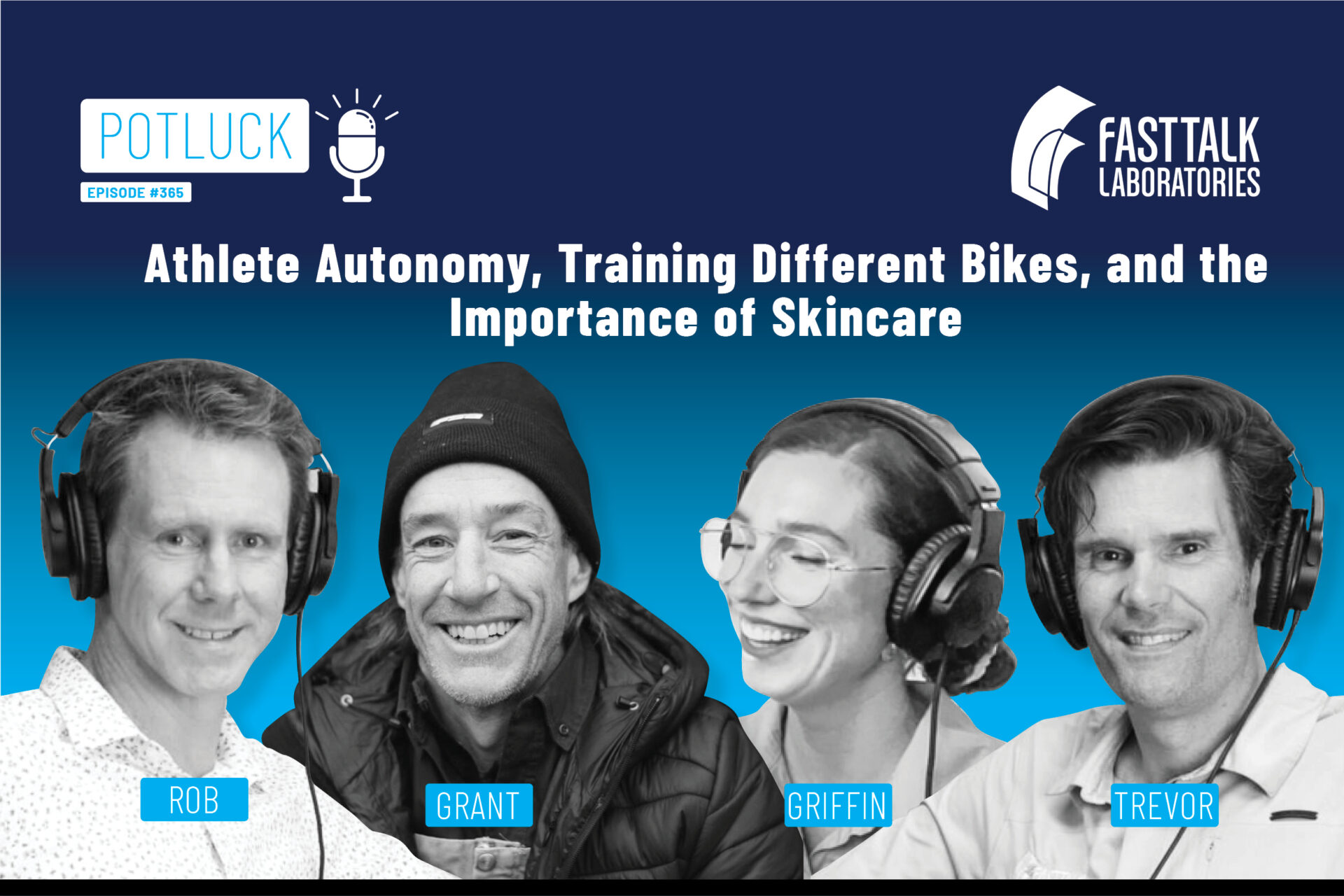






In this week’s potluck episode, we discuss the balance of athlete autonomy versus prescription, how to balance training with multiple types of bikes, and how to avoid being swayed by athlete-marketed skincare trends that may not be worth the hype.
Episode Transcript
Introduction and Banter
Trevor Connor 00:00
Hello and welcome. I’m not even gonna try just hello and welcome to-
Rob Pickels 00:08
You know, you know how to do it. Do it. If you don’t think about it, you’ll do it. Let’s do it exactly. But that’s how I remember the code to get in here. I remember the code by not remembering the code. Trevor knows I’ve had to call him when I’ve tried to actually think about what the code is.
Grant Holicky 00:24
It’s on my phone.
Rob Pickels 00:25
But if I walk up to the door and just push buttons.
Trevor Connor 00:28
You get it.
Rob Pickels 00:28
Every time.
Trevor Connor 00:29
Yes.
Grant Holicky 00:29
I don’t think I’m there. I’m not here.
Rob Pickels 00:29
You’re not there?
Grant Holicky 00:29
No, that’s true. I haven’t been here in a while.
Rob Pickels 00:30
I haven’t been here in a while. I was just commenting on the fact that this place is teaming with people.
Trevor Connor 00:38
Rob didn’t know people.
Grant Holicky 00:40
Teaming.
Trevor Connor 00:40
Let’s- let’s just establish where we started here. So we’re 15 minutes late. Griffin is upset that nobody knows she got a haircut.
Rob Pickels 00:41
First off-
Trevor Connor 00:43
A huge haircut.
Rob Pickels 00:48
We’re 15 minutes late because your giant staff is overflowing the parking lot.
Trevor Connor 00:54
But that’s a good thing.
Grant Holicky 00:56
Rob and- I pulled in. Rob’s parked on the sidewalk, curb, slash, wherever. I was getting ready to park on the street.
Rob Pickels 01:03
Can I point out though?
Grant Holicky 01:04
I can’t afford that.
Rob Pickels 01:05
The biggest issue is that none of these jerks know who I am. They’re like, oh, you’re coming in here. Like, yeah, I’m coming in here.
Grant Holicky 01:11
Did you try it? Did you ask? Do you know?
Rob Pickels 01:14
Do you know who I am?
Griffin McMath 01:15
Is it that they don’t know or they just don’t care?
Rob Pickels 01:17
It’s that they don’t know Griffin.
Grant Holicky 01:19
If they knew, they’d care.
Griffin McMath 01:20
I’m just feeling an immense amount of apathy in general.
Rob Pickels 01:23
You know, who cares?
Grant Holicky 01:24
Rob Pickel.
Rob Pickels 01:24
The dog cares.
Trevor Connor 01:26
We’ll introduce you.
Grant Holicky 01:26
The dog?
Trevor Connor 01:26
When we’re done recording we’ll take you upstairs.
Grant Holicky 01:30
Who’s the dog?
Rob Pickels 01:31
Bell, Bell’s- dog
Griffin McMath 01:32
Remy.
Grant Holicky 01:33
We have an office dog.
Rob Pickels 01:35
It is the only dog in the world that hates my guts.
Griffin McMath 01:38
Yeah.
Trevor Connor 01:38
It hates me too.
Rob Pickels 01:39
Oh, perfect.
Trevor Connor 01:39
But it was like jumping on my leg when I’m eating.
Rob Pickels 01:43
Well of course-
Trevor Connor 01:44
It’s like, most the time it’s scared of me. It won’t come within 20 feet of me. But when I have food, fear goes away.
Griffin McMath 01:50
Maybe because you call him it, you know.
Trevor Connor 01:54
I really don’t think that bothers him.
Rob Pickels 01:57
You never know.
Griffin McMath 01:58
All right, still haven’t commented on my hair. Let’s proceed.
Grant Holicky 02:01
How many inches did you cut off?
Griffin McMath 02:03
It has to be at least six, like minimum.
Trevor Connor 02:07
She cut a fair amount off.
Grant Holicky 02:08
I know, I can. I can tell now. Come on, it’s not the first thing I’m gonna look at.
Rob Pickels 02:13
Your hair is almost as long as Grants.
Grant Holicky 02:16
Hers is curly. Hers is dramatically longer.
Rob Pickels 02:19
You don’t have any curl.
Grant Holicky 02:21
No, no, my hair is real straight.
Trevor Connor 02:22
Griffin, just to prepare you, the artwork for this episode, we’re not swapping your photo.
Rob Pickels 02:27
Wait what’s your photo?
Grant Holicky 02:28
I think it looks good.
Trevor Connor 02:30
Yeah, yeah it looks great.
Grant Holicky 02:31
I think it looks honestly like it better.
Griffin McMath 02:34
Thank you.
Rob Pickels 02:35
Than the other thing he can’t remember.
Grant Holicky 02:37
It was longer.
Griffin McMath 02:38
It was long. Was wild, but thank you.
Grant Holicky 02:41
You’re welcome.
Griffin McMath 02:44
Was it feral, or was it just wild? It was just Griffin, just both.
Grant Holicky 02:51
Feral.
Griffin McMath 02:52
She’s a little feral. I have to be-
Trevor Connor 02:53
Shall we get to our first-
Rob Pickels 02:55
She’s trying. She is trying so hard.
Griffin McMath 02:58
I’m trying. Let’s, let’s do it, fellas, Rob, I feel like you should start us off today.
Rob Pickels 03:05
I should start us off?
Grant Holicky 03:09
Rob usually goes last.
Trevor Connor 03:09
The issue with this is Rob probably doesn’t remeber his question.
Rob Pickels 03:09
Well, I was hoping to remember it when she was asking her question. No, I remeber my question.
Griffin McMath 03:09
Here we go. Let’s hear it, Rob.
Grant Holicky 03:09
I don’t have a question.
Rob Pickels 03:09
You don’t. Because you liked my question so much you you were like, that’s a question I would have asked.
Grant Holicky 03:17
I did like your question.
Rob Pickels 03:20
Yeah.
Trevor Connor 03:21
That’s a good question.
How Much Autonomy Should Athletes Have in Training?
Rob Pickels 03:24
My question is this, well, let me start with a statement. Thought of this question last week, which is ahead of time. I was writing training for an athlete and I had put on their schedule, kind of a, I don’t know, do whatever you want today, sort of workout. Not even a workout. I think I just left a note in training peaks that said, do whatever makes you happy today. And it sort of, I don’t know. I do that with athletes a lot, you know, Grant knows, kind of, after an athlete has a big race, you know, maybe I’ll put a whole week of like, hey man, whatever you feel like doing this week, it’s all you. And I don’t know what that athlete’s gonna do. They might go out and do 5, 10, hour days in a row, or they might sit on the couch. And frankly, I don’t necessarily really care. But then I also will, sometimes, just in the middle of training for someone say, hey, what do you think you want to do today? What do you think you need to work on? What do you think is going to be fun? And go do it. And what I want to know from you is, this is a balance, right. So I’m looking for your input of how much, I don’t want to say leeway, but maybe how much autonomy do you give to your athletes, versus how structured are you? Obviously, we can’t just say hey, you go and do whatever you want all the time, because that’s not really coaching. But at the same time, I don’t think that we should always be super prescriptive in that I think athletes should have to have the ability to provide their input or to make decisions for themselves, and also the confidence to know that they can do that and that whatever they choose to do is a great thing for them to do. So from the three of you, what’s the balance of athlete autonomy versus prescription?
Trevor Connor 05:02
I’m getting pointed at. Okay, I’ll go first.
Grant Holicky 05:04
You go first, because I think we all know where I fall.
Trevor Connor 05:06
Yeah, when you ask this question, I gave it some thought, and I honestly can’t think of a single time, and I know this isn’t exactly what you’re asking, but I can’t think of a single time I gave an athlete a workout and they just turned around and said, no, I won’t do it. I don’t think I’ve ever had that, and it might be they’re thinking that in their head, and I’m the coach, and they just feel they have to do it. But I’ve never actually had them say that. So the start to my answer is, I do think it’s important, as a coach, when you’re figuring out what you’re going to have them do, to involve them in that conversation. I had that conversation all the time. If I could give you this, I could give you that, we could go do training races, what do you feel like? And make it a dialog where, I think early in my coaching career was just, you are going to do this work. I do less of that. But once we’ve landed on something, we’re in agreement, and that’s what they generally go and do.
Grant Holicky 05:59
Yeah, I think there’s a lot of validity to that. If the athletes really involved in the process of setting the goal, and they know what the path is toward that goal, then we can really be on the same page. I think in a lot of ways, for me, that’s where that partnership is. When you want, you’re walking in lockstep with an athlete, not leading the athlete, or not directing from above, kind of thing, that you get a lot of that path. I really love the value, though, of that free day. Go do whatever you want, because it’s hard to be in the athlete’s body and in their mind, right. So my favorite place to put it is the two days after a race, so they go do a big gravel race or something like that the next day is almost inevitably says, fun day on and off the bike. Be active, don’t train. And that frees them up to, hey, I felt amazing. And Grant often puts a base day after my race days. If we’re trying to, you know, cultivate volume or cultivate depth, I feel amazing. I’m going to go do that. Because that’s a fun day on the bike, and that’s what we ask for. Sometimes it’s a hike with their significant other, because they don’t spend enough time with them or with their kids, or it’s a bike ride with whomever, or it’s a ski day. It’s that thing they never get to do because they’re training super hard.
Rob Pickels 07:14
Half the reason I do this is one for the athlete side of things, to give them the autonomy. The other half is to see what it is that they actually do.
Grant Holicky 07:22
Yeah, there’s a curiosity there.
Rob Pickels 07:24
Because I think that that gives you a lot of insight into where is this person. And if you do this multiple times throughout the year, you begin to see like, oh, normally they always did these big, hard days. But last time I did this, they didn’t really do anything. Are they feeling a little overcooked? And you can get insight into them that way.
Trevor Connor 07:41
So question I have for both of you, do you not have any concerns when you say, go do what you want to do, that they go and do something that really isn’t what you would want them to do? Like, let’s say they did a bunch of hard work, and you say, go do what you want to do. And you really hoping they go easy, and they go jump in some two hour race and destroy themselves.
Rob Pickels 08:02
I’ll jump into this first and for two reasons. One, something that I always try to do with athletes is prep them with the knowledge that they can make decisions on the fly that ought to be somewhat appropriate for what we’re trying to do. Sometimes, maybe I’ll give people an alternative, like, hey, if the weather is bad, then do this workout instead. But for the most part, I try to have an athlete be like, oh, the weather was bad, so this is how I changed. I moved it to the trainer. I did less- whatever it is, and my hope is that when this free day comes up, they have the ability to make that good decision. Now, if they do do something that’s totally out of left field. As a coach, I’m okay with that. I’m very much about how does one thing beget another? I don’t care that they destroyed themselves on Sunday. We’re just going to modify what they do moving forward to get them back on track, as long as they’re good with that. I’m good with that.
Griffin McMath 08:58
This is so interesting to me because I almost expected one of you to rein in scope a little bit the way you just tried to do. And I think knowing you, at least as much as I do, your response actually makes sense in hindsight, after hearing you say it.
Rob Pickels 09:14
Duh.
Griffin McMath 09:14
And that-
Rob Pickels 09:16
I am nothing if not predictable.
Griffin McMath 09:18
And this is interesting, because, slightly awkward. I didn’t know that you were still working with athletes, so I started talking to another coach.
Rob Pickels 09:27
That’s fine.
Griffin McMath 09:28
Okay, cool, cool, cool. Who I’m probably gonna start with, Jeff, TriDoc.
Rob Pickels 09:33
Oh, okay, yeah. Jeff Sankoff, for what it’s worth.
Learning Through Mistakes and Developing Athlete Independence
Griffin McMath 09:36
So in this conversation that we had, in kind of interviewing to see if we were a good fit. We had this exact conversation, and we talked about how he’s like, his philosophy, and Jeff, if you’re listening, I’m sorry I’m about to butcher this, but is that there’s no rest days. It’s active recovery days. And I said, oh, that’s so interesting. You know, one of the challenges I think you had in taking me on was just getting me into this habit. And his work life balance, and what my training plan meant. And I think that was a big wake up call, those few months together. And so when we talked about it this, I was so curious at what an active recovery day being prescribed by him would be. And I think now where I’m at, I don’t think I want a huge, wide, open range, like go, just do it. I don’t think that that would do well for me. I think that, not to break up a line from a previous episode, but I think I need to be told, what to do.
Rob Pickels 10:30
There you go.
Grant Holicky 10:31
I worry about that, long term. I worry about athletes that say that long term.
Griffin McMath 10:35
I don’t want it long term. I want it right now.
Grant Holicky 10:38
I know, but when you’re getting it right now, she’s losing it, when you’re getting that right now, sometimes it’s hard to break out of that. I think. To go back to Trevor’s question, because these two need a moment.
Griffin McMath 10:52
I can’t be placed next to Rob.
Grant Holicky 10:54
Anyway, they need a moment. But to go back to what was noted before, I don’t think I’m gonna give it unless I’m okay with the full range of choices.
Rob Pickels 11:04
Correct.
Grant Holicky 11:05
Right. So if I know they’re coming off of something where, man, you really can’t go hard again, or we’ve got problems, then I’m gonna make sure it’s dictated as a day off. You know, if we’re rolling out of Unbound, they’re probably not gonna see, go do whatever you want. But then again, on the other side of that coin, most of the time, they’re not going to be able to do whatever they want, right. They’re going to be pretty limited. And the beauty of that, too, is you write that in after Mid South, Mid South got canceled. Now they go do whatever they want, and they go to a five hour ride, and there’s not another big piece of communication back and forth, like, what should I do? Go do whatever you want. Says I could do whatever I want. Yeah, go do whatever you want. And I had a couple athletes the day after that got canceled. It’s a six, seven hour Death March. They went and did somewhere, because that’s what they were keyed up to do. And so they did it. And then into Rob’s point, then downstream. Everything gets adjusted from there. So, oh, you went hard two days in a row. Okay, now I’m going to rein you back in this week, or I’m going to keep you going, and we’re going to have more of a concerted adaptation week in a week, where as before, maybe it’s going to be two, three days lighter load. Now it’s going to be a full week, very light load. So there’s, I’ll joke all the time with athletes. There’s consequences to the actions. You can make that choice. Just understand, I’m not gonna just let you make that choice and screw yourself up. There’s gonna be consequences one way or the other to that choice.
Griffin McMath 12:36
I think that might be my point in this, and that I’m still, I mean, I had to take, I took such a big time off after the moose, and also, mostly just because I was so scared of the outdoors, not even the physical component. That I’m still now resuming being in what the phase I was this summer, that I need an expert’s help of understanding the consequences, so that I can, like, reverse engineer. It’s like, hey, the consequence of whatever your active recovery day is is that you should be tired in this type of way, or I want you to be sore in this type of way, but not XYZ ways. Like, I think I need help temporarily, at least experimenting trial by error. Like, this is the type of thing that you should look for. And then maybe in a few months, I can feel more empowered to make an informed decision with that creativity.
Rob Pickels 13:25
But no, because you said you need the experimentation, right? That’s how we learn, and how do we have the conversations about more recovery or what too much is, unless you’re free to explore that, right? Where’s the edge?
Griffin McMath 13:39
Can I get a multiple choice-
Rob Pickels 13:40
The other, the other side of this-
Grant Holicky 13:42
Yeah.
Rob Pickels 13:42
Is.
Trevor Connor 13:43
Yeah, sure.
Rob Pickels 13:43
Yeah I think that’s fair.
Griffin McMath 13:44
That’s what I mean like.
Rob Pickels 13:46
But I’m okay with the athlete being uncomfortable with the unknown, and maybe it’s because of a lot of the athletes that I tend to work with, right, Ultra people, multi day stage racers, big adventure sort of people. I don’t work with criterium racers. I don’t work with people who, outside from my wife, who are like 10k specialists, right. And so there is this component of self reliance, I would say, that permeates 90% of my athletes. I want them to be okay with not knowing. I want them to be okay with being uncomfortable and having to make decisions, and this is almost a part of practice, because at some point it’s gonna matter. When you’re 50 miles into 100 mile trail and you’re like, **** what do I do? Like, I’m running out of water, I don’t feel- you know, you have to be in this position where you can make good choices. Because a lot of people would be like, I have to finish this, right. I have to keep moving forward. I have to go at this speed. I have to XYZ, because that’s what I’ve been told, or it’s the only thing that I know.
Grant Holicky 14:53
So that’s where things have repercussions and get really dangerous.
Rob Pickels 14:56
Exactly.
Grant Holicky 14:56
And I think that’s a fair assessment. I used to do this with 15 year olds all the time. Well, should I come to practice today? That’s your choice. That usually was the answer in a text. I have this, this, this, this, this, and this, I don’t know man, should I be at practice today? Should I do this work out of my own? What should I do? You make the choice. You’ll make a good one.
Trevor Connor 15:14
Yeah.
Rob Pickels 15:14
And if they come to practice and it sucks, then they know.
Grant Holicky 15:16
Yep.
Rob Pickels 15:16
And they can do something different next time. If they don’t come to practice and wish that they did, then they know.
Grant Holicky 15:22
Yeah because that’s my favorite, right? I mean, I, I grew up Catholic, and I use Catholic guilt. I will sit there and tell athletes, I use Catholic guilt. You know what you should be doing. I can’t tell you how many times I’ve said that to a teenager through the years, like, you know the right choice to make and you didn’t make the right choice, that’s on you, that’s not on me. I’m not gonna get mad at you for it. That doesn’t make it better. I get mad at you that athlete turns around, gets mad at me, gets defensive. They didn’t learn anything.
Rob Pickels 15:55
I was joking with my mother in law last night, she’s amazing, but she’s a recipe follower, and I think that that almost it has some implications here. She is a recipe follower, and she will be actively saying, this is going to be terrible, and will continue following the recipe. And it is terrible. It’s like, if you know it’s gonna be terrible, then make the informed decision and do the right thing.
Griffin McMath 16:16
I think understanding consequences, and when you’re in the beginning of that, I feel like I would want a guided thing, because if not, I’ll send a note to my coach of like, oh, I decided to just run completely at like, X RPE, at this altitude for fun. And now I’m completely.
Rob Pickels 16:35
Great.
Grant Holicky 16:35
Listen, the human mind does not- this is the most important piece of this whole discussion, and we can end it here. And I’m gonna tell you right now.
Griffin McMath 16:42
Oh, okay. Oh, okay, yeah.
Grant Holicky 16:43
Now my question here, because this is the ending to your question. But to your point, the human mind does not learn until it makes a mistake. You literally cannot learn without making mistakes and doing things wrong. Otherwise, everything’s good. There’s no consequences. There’s nothing. That you get- positive reinforcement works up to an extent, but personal negative reinforcement to go, wow, that didn’t work. That’s learning, and that’s the human mind, and that’s how it creates learned memories. And learned behavior is through mistakes and bad behavior. This is why it’s so dangerous that we’re getting to a, and I’ll make a blanket statement, but we’re getting toward a generation of young kids that have been guided so perfectly through their lives that they don’t make mistakes, they’re afraid of making the mistakes, and they don’t get into growth mindset. They get into fixed mindset. And that’s really one of the more dangerous things growing up. Not to share too much, but my eldest is very much a fixed mindset kid, and it’s very, very difficult, especially for a second child. The definition of a growth mindset kid generally, right. And a blanket stereotype for me as a dad, to sit there and go, just go screw up, and he looks at me like, I got four heads, right. I’m going to ski race, and I’m like, I’d almost be happier with you if you missed a gate.
Griffin McMath 18:03
Yeah.
Grant Holicky 18:03
Dude, and you were really pushing it. And he looked at me and went, what? You want me to miss a gate? Like, wait, okay, let’s back up. That’s not really what I said, but that’s hard, and we have to cultivate that. And I think cultivating that in athletes is really beneficial.
Rob Pickels 18:18
I told an athlete in his upcoming race, I want him to crush the bike, and I don’t care if he implodes on the run.
Griffin McMath 18:23
Kind of like, I think that concept of building up an athlete’s confidence in their own self reliance during the experience of the unknown.
Trevor Connor 18:34
So the answer to your question is, give them the choice so they can screw up.
Grant Holicky 18:38
Yeah.
Trevor Connor 18:39
And then you can run Catholic guilt on them.
Grant Holicky 18:41
It’s just like parenting sometimes.
Rob Pickels 18:45
Yeah, it can’t be all the time. It has to be at the right time, in the right dose, and that, that’s your role as the coach. Is, when is this person ready? Or when is it appropriate? As you were saying before, like somebody’s on the brink of overtraining, you don’t give them just a free for all on Sunday.
Griffin McMath 18:57
Yeah.
Rob Pickels 18:57
But uh.
Grant Holicky 18:58
You gotta know that athlete.
Rob Pickels 18:59
Yeah. So, exactly. So.
Trevor Connor 19:01
Okay, shall we move on? Did you get the mic drop? That’s a GoPro.
Griffin McMath 19:07
Oh my God.
Grant Holicky 19:11
It was.
Rob Pickels 19:12
Box of electronics now.
Training Specificity: Should Workouts Match the Bike You Race?
Trevor Connor 19:13
All right. We’ll finish out with Griffin’s question. So my question, I did put in at this time of year, but it’s kind of a general question of we have a lot of different types of bikes, and I always struggle with this, mountain bikes, gravel bikes, road bikes, time trial bikes. Can keep going.
Grant Holicky 19:29
Rob just remembered your question.
Rob Pickels 19:30
I did.
Trevor Connor 19:31
Yeah and so the question I have because I’ve been thinking about this lately, I’ve got this time trial series coming up, and I’ve started doing my intervals on the TT bike. And the fact of the matter is, I put 25 watts less out on the TT bike than on my road bike. So I’ve been hitting myself with that question of, how much time should I be spending on the TT bike? Should I be doing my intervals on the TT bike if I can’t do them as high of quality? And I just broaden that question out to how much specific training should you be doing on all the different bikes? If you are racing on multiple different types of bikes, or doing events with multiple different types of bikes.
Grant Holicky 20:08
I had this conversation with an athlete yesterday. They primarily are a cross racer. They cross over to crits in the summer. They raced a mountain bike race last week, and they were sitting around going people I normally shell in a cyclocross race or a crit, were dropping me. On the mountain bike. And they said it wasn’t on the descents, like I was actually pretty good on the descent, it was on the climbs. And my answer was, yeah. I mean, it feels different if you’re not comfortable on a mountain bike, particularly a full suspension. How you drop into the back end a little bit, what musculature you’re using, how that feels, the upright nature of the bike. A lot of those things translate to different feelings of power, different feelings of power output. It’s hard. Again, I think you have to come back to and what I said to this athlete is, what’s your focus? What’s the thing you’re really preparing for? Well, I’m really preparing for crits and cross. Okay, then I wouldn’t spend a ton of time on the mountain bike. You can race it, but adjust the mentality, adjust the goals, adjust what you’re trying to get done there. I don’t think you can race for position, but you can race for an effort level. But if you have that athlete, and I have a couple of these that want to race everything, then, yeah, man, you’re doing a dance and training to try to get them on the correct bikes in the correct ways. I got an athlete doing Redlands, and they’re doing XCO. I got to get them on the TT bike, because Redlands opens with a time trial this year. And I got to get them on the mountain bike, because how you deliver power on the mountain bike, and how you ride berms, and you ride descents, and you ride all those things is a really big deal. So, yeah, man, like, I think you do, if it’s a primary focus and it’s something you care about, you do have to spend time on that specific bike.
Rob Pickels 21:39
Yep.
Trevor Connor 21:42
And do you have to do intensity on that?
Grant Holicky 21:57
I think so. I don’t know how you don’t, for lack of a better way to put it, but it is hard to be in a place where you’re trying to make three different disciplines each your main focus, right. And that’s where you have to, it’s hard too because we’re watching somebody like Peter said, do it. You’re watching somebody like Matthew Vanderpool do it. You’re watching Pidcock do it. You’re watching these guys move from a cross bike to a road bike, which I don’t think is much of a stretch, honestly. But then when you go to the road bike to the mountain bike, that is, that’s a hard adjustment. And you watch Vanderpool it’s not talked about a lot. He’ll finish the tour, and then he’s got World Championships in a month. He’s on the mountain bike almost every day in that period between those two things, or maybe not every day, but regularly.
Rob Pickels 22:46
Yeah, I agree with Grant here. First off, I do want to say, I mean, obviously power on the TT bike is never going to match power on the road bike, right. And if-
Grant Holicky 22:55
For some people, it does.
Rob Pickels 22:56
Eh for most people, it’s not going to, though, because of things like changes of length, tension relationships. And the range of motion you’re going through. So to have a one to one power is very rare. The other thing that I want to separate out of this is a skills component, right. If you never, ever ride a mountain bike and you’re going to do a mountain bike race, well, there are skills, things that you have to learn. I think that Trevor, we’re talking a lot more about the physiological, the power application side of things here. And yeah, I agree sort of with Grant and that if you want to be effective across all bikes, and I think that you need to be, in my opinion, somewhat regularly riding all of your bikes, right. And that’s a year round thing for people. And even if it’s cyclocross season, I think that people can get out for a ride on their mountain bike, you know, regularly, once a month, twice a month, something like that. And that just sort of keeps everything aligned and adapted, and the body used to that, so that you don’t need to come out of such a big hole where your body is so totally adapted to something else that it’s no longer effective on this particular bike. In that case, you know, then I think that you can do a few key workouts, right. I’m thinking maybe of the stage racer who needs to be on a TT bike, right. I’m not going to put them on their TT bike and go out and do a three hour long base ride. This is not what they need from that, right. They can do all of that volume on their road bike, but they do need to do a couple key workouts so that they’re used to power in that position. And I think that that is as much a mental component as it is a physiological and a neuromuscular one. And as long as that athlete hasn’t, you know, forgotten about the TT bike Trevor for the past nine months, and suddenly they’re like, I have the Cherry Creek Time Trial series next week.
Grant Holicky 23:07
Yeah, yeah, absolutely. Theoretical.
Rob Pickels 23:57
Theoretical, yeah, excatly nobody in this room, you know, then I think that that’s totally workable. But if the TT is your goal-
Trevor Connor 24:43
To counter you, I did do a five hour ride on my time trial.
Rob Pickels 24:50
I’m sure that you did, yeah, with your power cranks and.
Trevor Connor 24:54
Not with my power cranks. I made the classic Boulder mistake. I headed east. Which anybody who lives here knows, yeah, is super fast, because it’s slightly downhill, you tend to have a tailwind.
Rob Pickels 25:06
Yeah, so you rode one hour that way and four hours back.
Trevor Connor 25:10
Past I25 like down to the middle of nowhere.
Rob Pickels 25:13
So you wrote an hour and a half that way.
Grant Holicky 25:15
Yeah.
Trevor Connor 25:16
And then turned around and had a huge headwind, all uphill, and yet ended up and being a five hour.
Grant Holicky 25:22
I will say this. I, one quick caveat. If you are a triathlete, a three hour, four hour base ride on a TT bike makes a ton of sense, because you’re trying to get used to that position. But if your main time trial is 20k TT in a stage race, no, just do. I mean, I’ve even had athletes go out for an hour on your road bike, then get your TT bike, do your intervals, and if you want to go back out on the road bike. One thing that I saw the other day that I thought was really interesting to Rob’s point, Red Bull, BORA – hansgrohe, the team. World Tour team put up a video of them playing foot down. Thank God, you had a TT bike.
Rob Pickels 25:25
Yeah, would’ve been much worse, yeah. Mhm, nice.
Grant Holicky 25:51
And saying, this is how we work on our skills. Foot down is a game where you put everybody in a fixed area. Boulder Junior cycling loves this game. And you basically force each other to try to force somebody to put a foot down. And when you put a foot down, you’re out.
Rob Pickels 26:15
So it’s a lot of slow riding. Maybe you can set up a ring with like backpacks or jackets or something that keeps people in clothes, like too many fish swimming in a small area.
When Lower Power Doesn’t Mean a Worse Workout
Grant Holicky 26:25
And really good athletes will try to cut somebody off. They’ll track sand, they’ll hold them, and try to force somebody down. But two of the guys on Red Bull were on TT bikes, the other guys were on their road bikes. So whatever their focus is, that’s the bike that they took into foot down, right. Because they were trying to improve their skills to the utmost on that bike. Another side note, one of the few people that I’ve known through the years, Taylor Finney, actually had a better power on his TT bike than he did on his road bike, but that’s somebody coming up through a track background and extraordinarily focused on TTS. So you can create it, but it takes a ton of time, and at times to the detriment of the other bikes. And it’s something you really have to walk into it and understand. One last note that I’ll throw out, Trevor.
Trevor Connor 27:17
Uh oh.
Grant Holicky 27:17
Is just because the watts are lower.
Trevor Connor 27:19
Is this Catholic guilt?
Grant Holicky 27:20
No, this isn’t. Just because the watts are lower, doesn’t mean you’re in a different energy system.
Rob Pickels 27:26
It doesn’t mean that it’s a less effective workout.
Grant Holicky 27:28
Right. And I think that was really-
Trevor Connor 27:30
So that was part of my question.
Grant Holicky 27:33
And I think that’s really important for people to realize, too. Just because you’re going out on a different bike and you can’t put out the same watts, it’s probably not that black and white. You’re probably in the same effort level. You’re just less efficient, and therefore in the same energy system, and everything’s okay.
Trevor Connor 27:48
So heart rate is the same, perceived exertion is the same.
Grant Holicky 27:51
Yeah.
Trevor Connor 27:51
Just powers lower.
Grant Holicky 27:52
But watts tend to be lower, yeah.
Rob Pickels 27:54
Yeah, I’d agree with that. I wouldn’t worry so much about trying to maximize the number that you see on your computer. And, you know, I think Grant kind of like, as you said, or alluded to, if we’re going, like, road bike, cross bike, gravel bike.
Grant Holicky 28:05
Pretty similar.
Rob Pickels 28:06
They’re pretty close. I think the elephants in the room here are obviously the TT bike and the mountain bike depending, I think, from like a hip power. Sometimes the mountain bike can be pretty close to the other ones. Some, some people’s fits are pretty far off. But, uh yeah.
Grant Holicky 28:20
Yeah, it’s pretty fit related.
Rob Pickels 28:22
Yeah.
Grant Holicky 28:22
I always love going from the cross bike to the road bike, though, because you just feel fast.
Rob Pickels 28:26
Oh, you feel so fast.
Grant Holicky 28:27
It’s so nice.
Rob Pickels 28:28
Yeah, gliding. You’re like, not even peddling.
Grant Holicky 28:32
My last two weeks, I finally got my road bike. This is amazing. I’m so good. And again, everything’s-
Rob Pickels 28:38
No, that’s, that’s usually a tailwind for me.
Grant Holicky 28:40
In this town, yeah.
Rob Pickels 28:42
I am a cycling God- uh oh, tailwind.
Trevor Connor 28:44
I have-
Grant Holicky 28:46
Time to go south.
Trevor Connor 28:47
Not ridden my road bike all winter.
Grant Holicky 28:49
No.
Trevor Connor 28:50
Because my last ride on it in the fall, my front shifter completely died. Like metal and it snapped. So of course, I immediately ordered a new one, and the new one’s been sitting on my counter since November. And I’m pretty sure I’m gonna figure out what my first race is, and the night before that race, I’m gonna put the new shifter on.
Grant Holicky 29:12
Is it the right shifter?
Trevor Connor 29:14
Left shifter.
Grant Holicky 29:15
Oh, you, you don’t need a small ring.
Trevor Connor 29:17
Yeah, but you do need a break.
Grant Holicky 29:19
Oh, yeah, that’s, I mean, it’s overrated. It’s the front brake.
Rob Pickels 29:22
Yeah, that cable is, like, the foot long, it’s very, it is very easy to run.
Trevor Connor 29:28
I had that. Thought we had a beautiful day, and I’m like, I can go out. Same thing you said. I’m like, I’ll just ride in my small chain ring. I don’t need it. And then I realize, but that’s like, the more important break. Particularly if I’m coming down out of the mountains.
Grant Holicky 29:42
That’s why you don’t go in the mountains.
Trevor Connor 29:43
Yeah, there you go.
Grant Holicky 29:44
It’s just like riding a cross bike with canties. You have to plan your breaking three to four turns ahead, and you’ll be right. You’ll be fine.
Rob Pickels 29:53
Yeah.
Grant Holicky 29:55
Everything will be fine.
Rob Pickels 29:56
Because everyone knows the front brake on a cross bike is the worst break. As your forks going, grrrr.
Grant Holicky 30:02
Hey, listen, man, and you have cross athletes who run Moto.
Rob Pickels 30:07
Oh, yeah.
Grant Holicky 30:08
And don’t tell you.
Rob Pickels 30:08
Which is dangerous.
Trevor Connor 30:10
Yeah.
Rob Pickels 30:10
Been there before,
Grant Holicky 30:11
Almost died on somebody’s bike, just riding it back to the truck.
Trevor Connor 30:15
So ride moto-
Rob Pickels 30:17
The levers are swapped, so the weight is the front.
Trevor Connor 30:20
Yep. With that.
Grant Holicky 30:21
Somebody else’s bike, or does somebody just wire yours backwards?
Trevor Connor 30:24
So when I was living in Ithaca, we played cyclocross polo. So we had a big beach ball, we all had sticks, and would play polo on the bikes. And I didn’t have a cross bike at the time, and I showed up and somebody was like, here, Trevor, take my bike.
Grant Holicky 30:38
Didn’t tell you it was moto.
Trevor Connor 30:39
And I had to come to a instant stop, so I’m thinking, okay, hit the right brake so I don’t go over the handlebars, which, of course, was my front brake. Right over.
Grant Holicky 30:45
At least you’re in sand.
Trevor Connor 30:45
No, we were in grass.
Grant Holicky 30:45
Oh, okay.
Trevor Connor 30:45
So.
Rob Pickels 30:46
Are we done with this? We good?
Trevor Connor 30:46
Okay, Griffin-
Rob Pickels 30:46
You gotta ride the bike.
Trevor Connor 30:46
Picked up her sheet of paper, so.
Grant Holicky 30:46
She’s ready.
Griffin McMath 30:47
You closed your computer.
Trevor Connor 30:47
Let’s wrap this up real quick. Everybody has to ride all bikes all the time, right? That’s the recommendation that we came to.
Grant Holicky 30:52
There we go.
Rob Pickels 30:54
Okay, great. Spend a lot of time on your BMX bike.
Grant Holicky 31:05
You know, what’s the worst? What?
Rob Pickels 31:08
Those like Peloton bikes are like stationary cycles in the gym.
Grant Holicky 31:12
What about them? Why?
Rob Pickels 31:13
They’re terrible.
Grant Holicky 31:14
Why?
Rob Pickels 31:14
I don’t know. See two bangles all off, like the big thing is all up in your rump. Those don’t carry over at all.
Grant Holicky 31:21
No. I mean, the newer ones have better adjustment. The stages bike, you can micro adjust pretty well.
Trevor Connor 31:27
Yeah, stages, yes.
Grant Holicky 31:28
Yeah. But most of the other ones, like, just the holes, like you’ve got to pick and you’re like, I’m totally in between.
Rob Pickels 31:33
It’s like, rusty.
Grant Holicky 31:35
Yeah.
Rob Pickels 31:35
Like- pull it out-
Trevor Connor 31:38
Just a monarch with better marketing.
Rob Pickels 31:40
Oh, God, the monarchs.
Grant Holicky 31:41
Okay, hey, Griffin, how you doing?
Griffin McMath 31:43
Hi guys.
Rob Pickels 31:43
Looking good with your hair.
Griffin McMath 31:45
Oh, thank you. Spring is here. Spring has-
Grant Holicky 31:48
Did you cut your hair?
Rob Pickels 31:49
Wow, there’s something different about you. Are you younger?
Grant Holicky 31:52
I think she cut her hair.
Griffin McMath 31:54
Here we are.
Rob Pickels 31:55
You know, you missed an opportunity to say Spring has sprung. Just saying.
Griffin McMath 31:59
I was in the middle of my sprung-
Rob Pickels 32:03
Sprunging.
Grant Holicky 32:04
Lost term.
Trevor Connor 32:06
Griffin, I’m not saving you here.
Griffin McMath 32:08
I know it’s, it’s happened. Spring is here. Spring has sprung. And with that-
Trevor Connor 32:15
Can I just say quickly on that note, no, this is important?
Griffin McMath 32:21
Oh my God. No.
Grant Holicky 32:23
We were doing it on purpose, he didn’t even mean it.
Trevor Connor 32:26
Kind of, I just wanted to sound authentic. I looked out my window today, the little tree in front of our building.
Griffin McMath 32:33
Is it blooming?
Grant Holicky 32:33
It’s blooming.
Trevor Connor 32:35
We’re seeing leaves. Wasn’t that worth interrupting for?
Griffin McMath 32:37
I mean, because my window was right there, yes, I will, I will-
Trevor Connor 32:41
Take a look when you go back into your office.
Skincare for Endurance Athletes: What Actually Matters
Griffin McMath 32:42
Thank you. Okay, so the office tree is blooming, which means that more and more people are going to be emerging and really, you know, maybe getting off their trainers and actually-
Rob Pickels 32:53
Bringing their pasty selves outside.
Griffin McMath 32:55
Exactly. And with that, our skin is about to embrace many of the elements in a way that maybe we haven’t in the last few months. Wind, sun, rain, if they’re running along the beach, you know, trying not to get surfer eye, all that stuff.
Rob Pickels 33:11
That’s when you trip.
Griffin McMath 33:14
We actually had an episode for those listening. You can go back to it. It’s episode 277, and I’m probably going to pronounce her name wrong, Dr. Lankerani.
Rob Pickels 33:23
Yeah close enough from memory.
Griffin McMath 33:25
Close enough. Apologies Doctor, if I am mispronounced, where Rob actually dives into this with her about really, ultimately, one of the things you talked about was getting back to the basics, right. Like mineral sunscreen, cleansing properly, both in method, and timing, and thoroughness. But what I’m curious about is now in the age of social media, we are about to be bombarded on our social media feeds with ads for athlete specific skincare. Now that people are starting to re emerge and go outside. So as people are doing their bike maintenance, tuning up, getting new kits, re emerging. What is actually worth it when it comes to athlete specific ads that people are gonna see and what is just like, bypass it all together. That is just hype. Don’t do it, because Instagram ads work my friends, we have all fallen prey to it.
Grant Holicky 34:17
Well, my wife yelled from the other room the other day, I love targeted ads. These are perfect. I’m buying them. And I thought to myself, wow, alright, good for you, whomever.
Griffin McMath 34:30
Yeah.
Grant Holicky 34:31
Great. Well done.
Rob Pickels 34:32
Grant, tell us about your skincare routine.
Grant Holicky 34:34
Well, I had skin cancer 16 years ago now. 17 years ago, had mohs surgery on my face pretty-
Rob Pickels 34:41
You can’t even tell.
Grant Holicky 34:42
I don’t know, man. I gotta, I got a decent scar over there. But-
Trevor Connor 34:46
How big did it get? Was it melanoma?
Grant Holicky 34:49
No, it wasn’t a melanoma, but it was under a pock mark. I had an old pock mark, and it just started scabbing and wouldn’t heal. And I happened to be with my parents, and my mom, said yeah, I got this thing. It won’t heal. My mom said that skin cancer go home and get it checked. And I went in and he said, yep. But it was big. Like, quite large, under the skin and this was right on the outside of my eye socket, and it was actually moving down, which is why the scar was so big, because he couldn’t see where it was. And Doc was like, I was moving to your eye, which would have been bad.
Griffin McMath 35:25
Yeah.
Grant Holicky 35:25
But again, from the surface, no way to really tell other than a very, very small scab that wouldn’t heal.
Griffin McMath 35:34
Thank God for your ma.
Grant Holicky 35:35
Yeah.
Griffin McMath 35:36
Shout out.
Grant Holicky 35:37
Yeah. The same woman who used to say, put your nose coat on when I was a kid, because I would burn the crap out of my nose. So now I go to the dermatologist once a year, all the time, always come out with something frozen off. Often come out with something cut out.
Trevor Connor 35:54
Yep.
Grant Holicky 35:54
It’s kind of the nature of the beast for somebody who spends so much time outside and-
Rob Pickels 35:59
And for you, doubly so, an outdoor pool deck.
Grant Holicky 36:02
Yeah, and that was, I mean, it’s interesting to say as much time as I spend on my bike that it’s gotten easier on my skin, because I’m not on the pool deck outside 350 some days a year anymore. But I have a moisturizer I use every morning on my face that has sunscreen in it. That is just part of my morning routine. And then anytime I go outside, no matter what time of year, and I think for me, that’s the biggest adjustment. I mean, we all know this. It’s not like it’s rocket science, but just because it’s middle of the winter doesn’t mean you’re not going to get a sunburn.
Rob Pickels 36:37
Right.
Grant Holicky 36:38
And especially around here at altitude, the sun is always out. So that was the biggest adjustment I’ve made. I used to be like, only when it’s hot I’ll put on sunscreen. Now, if I’m going outside for an extended period of time, I have zinc.
Griffin McMath 36:56
Yeah.
Grant Holicky 36:56
Sunscreen, mineral, sunscreen on my nose and face.
Griffin McMath 37:00
You know, that’s so interesting, too. What you talked about with altitude is, I lived in Hawaii for two years. And I mean, irresponsible, but in the same amount of time that I lived in Colorado, my skin has aged so much faster.
Grant Holicky 37:13
Some of it’s how dry it is up here too.
Griffin McMath 37:15
Yeah, but like I-
Trevor Connor 37:16
Dry and sun is stronger.
Griffin McMath 37:18
Yeah I was outside all the time, and I got sunburnt to hell when I was in Hawaii too, but I was in my bathing suit every single day. I lived 50 yards from the ocean, and here I, like, aged so quickly. It’s so much damage.
Rob Pickels 37:32
No you haven’t.
Griffin McMath 37:32
Yeah I have. Because I use frownies.
Grant Holicky 37:35
I will say you’ve turned the clock back with that haircut.
Rob Pickels 37:38
Yeah, definitely.
Grant Holicky 37:39
Looking 22 over there.
Rob Pickels 37:41
I’m gonna, I’m gonna agree with Grant here. I think that-
Grant Holicky 37:45
She does look 22.
Griffin McMath 37:47
That I do look 22?
Rob Pickels 37:50
You look great.
Griffin McMath 37:52
Thank you. Yeah, I did, genuinely get carded recently, actually. No, he, no they were- Oh that’s true it is a college town.
Rob Pickels 37:53
Oh, proud of you.
Grant Holicky 37:54
So did I, you live in Boulder.
Trevor Connor 37:55
There’s actually a law here that they have to card everybody.
Griffin McMath 37:58
No, but I asked. I was like, no, but I had asked about it in there.
Grant Holicky 38:02
Listen, when you get carded in Berthoud, then you’re looking 22.
Rob Pickels 38:06
There you go. Not wrong.
Griffin McMath 38:08
No, yeah.
Rob Pickels 38:09
I’m going to agree with Grant in that skincare starts from a good base, and that good base is making sure that you’re getting checked, right. And there are a lot of things that seem like they’re nothing. And my thing, it’s not a big deal. But I see a dermatologist regularly because I have, like, with my autoimmunity, I have some, like, Alopecia Areata issues, and I get, like, scalp injections with steroids and stuff. But one day I was in there for that, and I was like, hey, I have this, like, little thing on my forehead. It feels like some dry skin, you know, like, should I just put some more moisturizer on it? And she’s like, I need to freeze that off. Like, oh, like, this is, she’s like, that potentially, is more than just a little bit of dry skin. And you know, it was something that I had kind of noticed. It had been there for weeks. I had, like, written it off, not a big deal, but it was just, like, this little area that wouldn’t kind of go away. And so I think that everybody does. And Trevor, it sounds like you kind of get regular checkups as well. I think that that’s where everybody needs to be. Is if you don’t see a dermatologist, you need to see one once a year to make sure that you’re in a good place.
Trevor Connor 39:06
I’m in every six months, and unfortunately, in a couple weeks, I’m in for surgery to get a big chunk of skin cut out.
Rob Pickels 39:12
Yeah.
Trevor Connor 39:13
They found a mole on my back that was pre melanoma.
Rob Pickels 39:17
Which is good that they found it, right. Ahead of time before it became a big deal. And all of us, right. We’re out in the sun all the time, and even when you’re wearing clothes, you’re out, oh, I’m riding in a jersey, but it’s a mesh jersey, and there’s a whole bunch of UV that’s still hitting your back and everything else, and I can’t see my back, right. And so we do need these people. Now, more on to your question about the skincare side of things, I’m going to take it a slightly different direction in terms of being nice to your skin, as opposed to products. And something that I notice in myself is that I can be really rough, especially on my face. As I get sweaty, I’ll start like wiping stuff with my sleeve, I don’t think about it, and then I’m like, why is my upper like cheek under my eyes, like always so sore? It’s because I am abrading myself all the time when I’m on the trainer, just wiping sweat away, and it’s a little crusty with salt and so that, you know, my biggest issues come from like sweat management and literally the physical process of trying to remove that. And so I notice as my volume goes up, especially this time of year, things like that tend to get even worse than they were before. So for me, oftentimes it is things like moisturizer. What can I do to sort of calm some of this inflammation and help repair my skin barrier? Because I literally just sandpapered it off of my face.
Grant Holicky 40:42
I am, one of the solutions that I’ve taken to over the years is when I ride on the trainer, I have a hat on all the time to absorb some of that sweat that it’s not bone in my face, but same thing outside, I always wear a cycling cap under my helmet. Part of it’s to keep the hair out of my eyes, but most of it’s keep the sweat off of my face, in terms of dripping down. From that, and then downstream of that, is how it makes the sunscreen run, and get in your eyes, and burn your eyes while you’re trying to ride and race, which I think we’ve all experienced, which is miserable.
Trevor Connor 41:14
Many times.
Rob Pickels 41:15
Here’s a pro tip with the cycling cap. I think I learned this from Keel or Alex. You can cut the top out of the cycling hat-
Grant Holicky 41:22
Yeah, yeah, make it a visor.
Rob Pickels 41:23
So it’s just like the visor, and then it’s great in the summertime and the sweat drips away from your face, even if it does drip. So pro tip, old cycling cap, literally cut the top off of it off, and now you get a visor.
Griffin McMath 41:27
Reduced, reuse.
Rob Pickels 41:31
Yeah.
Griffin McMath 41:34
Up cycle. So one of the things I’m first hearing is for the amount of screen time that you’re, you know, looking at Instagram, or Tiktok, or YouTube or something, you could spend that same 30 minutes by figuring out who your dermatologist is, and that same amount that you’d spend on some flashy skincare product is probably better spent as the copay to go see that visit.
Grant Holicky 42:02
I think, I think that’s always true, and I think just simply asking that dermatologist, this is my lifestyle, this is what I do, what do I need to be doing to take care of my skin? And I think they’re going to give you- now, there are some products you come out of a dermatologist, and they’ll come out and say, these are products that really work and are not cheap.
Griffin McMath 42:23
Yeah.
Rob Pickels 42:24
Yep.
Grant Holicky 42:24
Right. You can get some stuff that works incredibly well, anti-aging, protection wise, that are not cheap, but make sure that the right things for what you’re doing and for what your lifestyle is.
Rob Pickels 42:37
The other side of it too, though, right is if we’re talking about anti-aging. Oftentimes we’re talking about retinols, and people have to be careful with retinols in the sun.
Griffin McMath 42:44
Yeah.
Rob Pickels 42:44
Right, because of the damage there. Exactly. You know, the thing that I remember from that interview, the big takeaway for me, because, like, I had read all, like, the EWG stuff and like, don’t use this sunscreen. It’s gonna, like, disrupt your hormones and all of that. And at least the Doc that we talked to, and this could have been her personal opinion, was sort of like, listen, there are so many people in the world that don’t wear sunscreen. Just freaking wear sunscreen. Like, I don’t even care what it is, just put it on. She’s like, the safety stuff is so like, and this is obviously like, doctors that are seeing all of this across the thing, she’s like, that is so far beyond what I have to worry about. I just got to get people to put sunscreen on. And she’s like, mineral stuff. It’s hard to reapply. If you got that Coppertone that you have in your back pocket, and you can slather it on, then I don’t care, just make sure you’re putting it on.
Trevor Connor 43:30
Well the thing I remember from that episode that I took to heart, so I now have both the mineral and kind of a chemical sunscreen. Well, she said that the chemical stuff only lasts an hour and a half. And then you got to reapply. So if I’m going out for a long ride, I don’t want to keep having to stop and reapply sunscreen. So I have the mineral ones that I put on for a long ride, and I look pasty white because it doesn’t fully disappear. If I’m going out for a short ride or quickly going to the beach. I’ll just use the chemical stuff.
Grant Holicky 44:02
Yeah. And I think the biggest part of this whole thing is we live in a sport, in cycling. Where people actively cultivate their tan lines.
Rob Pickels 44:12
Crisp and clean.
Grant Holicky 44:14
And clean and, but I remember one of my dermatologists I went to saying, looking at my lower thigh and going, man, that is aged. You need to get sunscreen on your knees and your thighs. And it just wasn’t something that I had really thought of before. But that little bit from mid thigh down the knee, now it’s smaller because the style is longer cycling shorts, which is nice because there’s more coverage. But I have a lot of sun damage on that area of my body because of riding my bike so much. And just always sunscreen on my face, generally, putting on my arms. Didn’t kind of think about my legs. And I’m sure there was part of it too is like, yeah, man, I kind of want this tan line.
Griffin McMath 44:59
Yeah, yeah.
Grant Holicky 44:59
Cause, it, when the town line is clean and you’re getting in the hours.
Griffin McMath 45:03
Street cred.
Rob Pickels 45:04
So- some of us don’t have to worry about that.
Sun Protection, Cycling Kits, and UV Exposure
Griffin McMath 45:06
So a few specific questions here. UPF, clothing has that moved over to kits yet?
Rob Pickels 45:14
It has, and I can answer this from the Pearl Izumi side of things, for the most part, all fabric, for the most part, is going to have some UPF. The more solid the fabric, the better. So UPF is different from SPF, right? SPF, sun protection factor, is kind of like what you’re putting on in, like creams. UPF is what you’re getting from, like a mechanical shade, like clothing. The more of like a jersey knit, something is, and less of a mesh, than the better. Also, the big thing that makes a big difference is the darkness of the color. White lets a heck of a lot more UV through than black does. Black just absorbs more. So if you are concerned about that, then uh yeah, go for more solid, darker colors.
Griffin McMath 45:51
What about collagen sprays that athletes might be swiping by and seeing?
Rob Pickels 45:55
I mean, does your body absorb collagen in that? I mean, I think that, I think that taking in collagen orally has been, for the most part, debunked, aside from the fact that it has amino acids in it. It’s not like collagen in goes immediately to collagen. And I don’t know, can we transdermally absorb collagen?
Grant Holicky 46:13
I think we can.
Rob Pickels 46:14
I think you can.
Grant Holicky 46:15
But at the same time I think that most of what, correct me if I’m wrong, this is out of left field, but a lot of collagen is used to puff up the skin, absorb moisture, or just take away wrinkles.
Griffin McMath 46:28
Elasticity.
Grant Holicky 46:29
And it increases elasticity. I don’t know what benefit that’s going to give us in terms of anything other than appearance.
Griffin McMath 46:35
Recovery sprays.
Rob Pickels 46:36
The heck is-
Trevor Connor 46:37
What is a recovery spray?
Griffin McMath 46:38
These are some of the marketing claims that people are seeing when they swipe through are like, oh, here’s a recovery spray or magnesium sprays.
Rob Pickels 46:48
What is it that you search for that this shows up in your targeted ads, Griffin?
Griffin McMath 46:51
Are you guys not seeing these-
Rob Pickels 46:51
No.
Grant Holicky 46:51
No.
Griffin McMath 46:51
This is the type of language that-
Grant Holicky 46:51
Well, no, no, I know what the type of language they use.
Griffin McMath 46:56
Yeah.
Grant Holicky 46:56
But you do have to understand that. I think, well, you do know this, obviously, but the algorithm is based on what we’re looking at. And this isn’t something I think the three- you.
Griffin McMath 47:07
No, I’m not saying-
Rob Pickels 47:10
This is the, actually the value here, because I had not been exposed to this stuff.
Griffin McMath 47:14
So this isn’t necessarily on my feed right now. My feed right now is more on bikes and kits, because that’s what I’m looking at.
Rob Pickels 47:14
Nice.
Griffin McMath 47:14
But this particular-
Rob Pickels 47:14
Perfect.
Griffin McMath 47:14
Yeah.
Rob Pickels 47:14
Yay, look at you.
Griffin McMath 47:14
I have questions for you after this.
Rob Pickels 47:17
Okay, good.
Griffin McMath 47:19
That’s why I was listening so much during the bike cars, okay, but like topical magnesium sprays to help your, you know, your muscles relax after workouts, those types of things you might be people are seeing.
Grant Holicky 47:37
We’re pretty- and you guys can, I mean, I know you’ve looked at the research better than I have, but we’re pretty minimal benefit to topical anti inflammation and recovery. And even anti, like there’s the one you put on for exercise that’s supposed to reduce.
Rob Pickels 47:54
Yes. Trevor, why don’t you tell us more about your opinion on-
Grant Holicky 47:57
Production, all right, isn’t it?
Trevor Connor 47:58
Well, I’m just gonna say you have a very thick dermal layer.
Griffin McMath 48:01
Yeah.
Trevor Connor 48:02
And it’s designed to protect things from getting into your body.
Rob Pickels 48:05
You have a thick dermal layer.
Trevor Connor 48:06
Yes, I do.
Rob Pickels 48:08
Thick skin.
Griffin McMath 48:09
You have to to be in this room.
Trevor Connor 48:11
Most things that you spray on your skin, and that is making claims about it’s getting to your muscles and doing wonderful things. I mean, I’m always open to seeing the research on it, but I’d be skeptical.
Griffin McMath 48:22
I have skepticism when it comes to this, like, little pattern I’m starting to see of athlete influencers, or I shouldn’t necessarily call all of them athlete influencers, who are doing- well after this.
Grant Holicky 48:33
The paid promoters.
Griffin McMath 48:34
Yeah, paid promoters who, I spray magnesium in the bottom of my feet. I’m like, excuse me? What about chafing balm?
Rob Pickels 48:40
Uh…
Grant Holicky 48:41
Generally, like shammy cream?
Trevor Connor 48:43
If you are needing to use a lot of that, go see a bike fitter.
Grant Holicky 48:47
That’s fair. That’s a fair statement. I mean, I personally like shammy cream for certain rides, certain bikes, certain situations. Remember vividly Michael Robson once saying to me, you don’t need shammy cream, you need to condition that. Just get out there and work it and you won’t need it anymore. And to an extent, that’s really true, but generally, I will say that across the board, my opinion on most things is, until it’s mainstream, there’s not a whole lot behind it, that makes it, I mean, maybe you get in on the bottom level of some of this stuff. But, I mean, we’ve watched so many things come through as the next great thing in terms, like CBD and some of these things for anti inflammatory or recovery, across the board, if they’re that good, they’re going to be used by mainstream medicine. I really, truly believe that.
Griffin McMath 49:39
So to recap, everyone should go listen to episode 277.
Grant Holicky 49:43
Absolutely, yeah.
Griffin McMath 49:44
You should take 30 minutes off of your screen time and go schedule an appointment with your dermatologist. The money you are about to spend on some eccentric product you can spend on your dermatologist copay.
Trevor Connor 49:55
But I am going to throw one more at you.
Griffin McMath 49:58
Okay.
New Research: Sodium Storage in Skin and Aging
Trevor Connor 49:58
So this is some research I’ve been reading lately, that’s relatively new research. It hasn’t hit the sports world yet. I’m very excited for when it hits the sports world and we see the impact. But there’s what they’re now, researchers are calling it the third compartment of your skin cells. So it basically comes down to sodium consumption. We have a limit on our ability to excrete sodium. So this is why you can’t drink seawater or ocean water, because the sodium concentration is too high for your kidneys, and you’re actually going to lose water, as opposed to gaining water just to get rid of that sodium. The other thing is, your blood tries to keep the sodium concentration at a very set level. So when you’re over consuming sodium, your body can’t get rid of it. It needs to do something with it, and what they’re discovering is it gets stored in epithelial cells. So your whole skin is epithelial cells. And so it gets stored in what they’re calling this third compartment, essentially. It’s not truly a third compartment, but it’s what they call it. This is an issue. All lining your blood vessels is epithelial cells. And this is an issue because they’re discovering that’s one of the factors in heart disease, where, if you start having sodium build up in there, that can trigger atherosclerosis. But what they’re seeing in skin cells is, if you start storing too much sodium, it actually impairs skin cells ability to produce natural antioxidants, particularly nitric oxide, and that’s one of the ways your skin cells protects itself from the sun. So what they are showing outside of the athlete population is, when you’re storing too much sodium in the skin, that you start seeing premature aging. You start seeing more wrinkling, because your skin loses its ability to protect itself. And I raise this. This is really important to me, and I want to see it get into the sports world, because as endurance athletes, we tend to drink very salty drinks. And the other thing I wonder about, which I have seen no evidence for, and I hope they do this study, they always have the are you a salty sweater or not? If you’re a salty sweater, you should be consuming more sodium. My question is, is that the case, or are you somebody who’s actually already consuming too much sodium? It’s being stored in the skin. And part of the reason it’s being stored in the skin is because it’s easy to get rid of it when you sweat. And you actually shouldn’t be consuming more salt. It’d be very interesting to see where this research goes. And like I said, I want them to bring it into the sports world and see.
Rob Pickels 50:37
But Trevor, I do have to ask, what does that have to do with creams? And shammy creams?
Grant Holicky 50:44
Well, and diet is related to salt content in the sweat too. If you have a high salt diet, you’re going to be getting rid of a little bit more salt. We’ve had, I know my wife, when she was doing nutrition for athletes, she would have athletes that had very salty diets, that would end up having to take salt tablets in races because it was so easy for them to get not enough salt. Because they were used to such a high amount the rest of the time. I think that’s interesting.
Trevor Connor 51:18
Yeah.
Rob Pickels 51:20
It was a joke.
Grant Holicky 51:21
It was, it didn’t land.
Rob Pickels 51:25
Yeah it didn’t. Scratch that.
Griffin McMath 52:16
A for effort.
Trevor Connor 52:43
I knew it was a joke I just couldn’t-
Rob Pickels 52:52
Kelly, you can, you can delete that.
Grant Holicky 52:54
Keep it. Keep it. I want everybody to see that Rob’s not perfect. It’s all witty and great comebacks, till he doesn’t have one.
Griffin McMath 53:03
That’s so-
Rob Pickels 53:03
No, you didn’t have the comeback.
Trevor Connor 53:05
Actually, I was kind of blaming that, like Rob kind of laid it up, and I was trying to think of how to slam it, and I just fell on my face.
Griffin McMath 53:11
It’s good. Well, guys, thanks for answering my question.
Rob Pickels 53:14
Did we? I don’t know that we did.
Griffin McMath 53:16
Well, I think what was important rose out of that. And I think that as you’re scrolling when you see things like that, rather than, obviously budget dependent, rather than spending, you know, three digits on some random product that says it’s going to do something for you. Go back and are your basics covered? If they haven’t been, save your time and money. Do what you need to do first, and then you can start exploring.
Grant Holicky 53:41
I will say that I tend to approach all of this stuff with the skepticism of somebody who is educated in science. It’s just how I approach everything. Somebody comes out with a claim, I generally am going, I doubt it. But I’ll go look at it. I mean, I’ll have an open mind, but I tend to approach it with skepticism, especially when it’s on Instagram.
Shammy Cream and Chafing
Rob Pickels 54:02
Although I approach shammy cream with a big, giant scoop.
Grant Holicky 54:06
Do you? You’re all for it?
Rob Pickels 54:07
I’m for shammy cream, yeah. More sometimes, from the experience, right? If you’re trying to solve a problem, then you need a better fitting bike, you need better fitting shorts, you need a better fitting chamois, whatever else.
Trevor Connor 54:20
I haven’t used shammy cream in 10 years.
Grant Holicky 54:22
European style, or?
Rob Pickels 54:23
Oh yeah, baby.
Grant Holicky 54:24
Oh yeah.
Rob Pickels 54:24
Oh yeah.
Grant Holicky 54:24
Agreed.
Griffin McMath 54:25
Guys I have a dumb question that we probably shouldn’t air.
Grant Holicky 54:27
Yeah, he does a nice job.
Rob Pickels 54:27
He does a great job. Um.
Trevor Connor 54:27
Griffin, there’s something going on here.
Rob Pickels 54:27
Real quick. I love, I’m a big like smell guy and whatever. I love, you know, Matt Elkme, if anybody wants, you know. I just love shammy spray.
Griffin McMath 54:36
I’m gonna smell, bring it in one day.
Rob Pickels 54:40
I’ll bring in some shammy cream for you.
Grant Holicky 54:42
Oh, yes, he’s good.
Rob Pickels 54:44
He has femme specific shammy cream. He’s got, yeah. Okay, what’s your question? What’s your inappropriate question?
Grant Holicky 54:45
It goes on your crotch.
Rob Pickels 54:51
Yeah.
Griffin McMath 54:51
Like.
Grant Holicky 54:51
Your taint.
Rob Pickels 54:52
For me-
Griffin McMath 54:53
That’s different spot.
Grant Holicky 54:54
No.
Rob Pickels 54:55
For me it goes-
Grant Holicky 54:56
The area between, the area between.
Rob Pickels 54:58
But I could see, I, I’m more of an all over kind of guy.
Grant Holicky 55:01
Oh yeah, I am too. I am too. But there’s more parts down there for guys that you gotta.
Rob Pickels 55:05
Yeah.
Grant Holicky 55:05
Like, you got crevices.
Griffin McMath 55:06
Just like, like, if you were to put, like, on diaper cream to a baby.
Rob Pickels 55:10
Anywhere that there could be some skin to skin contact, or uh, you know, in your bits, you know, then if you’re gonna have, you know, sometimes I’ll rub some specifically in the chamois itself, kind of where I’m sitting on it.
Griffin McMath 55:23
Okay.
Rob Pickels 55:23
But for me, it’s more of a oftentimes, a skin to skin sort of location.
Grant Holicky 55:28
The traditional use of shammy cream is actually the application is on the chamois?
Rob Pickels 55:32
Correct.
Trevor Connor 55:32
Yes.
Rob Pickels 55:33
When it used to be made out of chamois, the material.
Griffin McMath 55:36
Oh.
Grant Holicky 55:36
So it goes on the chamois from where your skin is going to make contact with the chamois.
Griffin McMath 55:41
Okay.
Grant Holicky 55:42
And where you’re going to have the majority of that pressure between the saddle and the chamois. That’s where the chamois cream goes.
Griffin McMath 55:49
And is there a different formula for men versus women?
Grant Holicky 55:51
Different people make different styles for men versus women. I think some of that is formulaic, some of that is fragrance, some of that is lots of different choices. But.
Griffin McMath 56:00
Okay, I would think formulaic because of the hypertrophy in females, right? That whole thing that came out.
Rob Pickels 56:05
I don’t know that they go that deep.
Griffin McMath 56:07
No?
Rob Pickels 56:07
No.
Griffin McMath 56:08
Why not?
Rob Pickels 56:08
I think this is more like good smelling bum cream.
Grant Holicky 56:12
Small population, hard to make money.
Rob Pickels 56:14
Yeah, and when Grant says Euro style, he’s talking about the tingle.
Griffin McMath 56:18
I was just gonna ask does it burn a little bit?
Grant Holicky 56:20
Not, not tradition- not, European style does it has a little-
Griffin McMath 56:24
But like in a good way?
Grant Holicky 56:24
It has a little, in there.
Griffin McMath 56:24
Yeah, nice.
Grant Holicky 56:24
Some people hate it.
Trevor Connor 56:24
I feel like, I need to read the outro before we have to slap a rated R sign on this.
Griffin McMath 56:32
I don’t know, I feel like we’re all adults. It’s the sign. It’s like, might as well make it feel good you’re putting on, right?
Rob Pickels 56:37
Yeah.
Grant Holicky 56:37
There you go.
Rob Pickels 56:38
Nice little cooling breeze.
Outro
Trevor Connor 56:39
That was another episode of Fast Talk. The thoughts and opinions expressed on Fast Talk went too far.
Grant Holicky 56:45
Nothing like a cool breeze in your nether regions.
Trevor Connor 56:48
Subscribe to Fast Talk wherever you prefer to find your favorite podcast. Be sure to leave us a rating and a review, but please not on this one. As always, we love your feedback. Tweet us at @fasttalklabs. Join the conversation at forums.fasttalklabs.com or learn from our experts at fasttalklabs.com. For Dr. Griffin McMath.
Griffin McMath 56:48
Eww.
Grant Holicky 57:12
I’m out.
Rob Pickels 57:12
Pickels, Robert J.
Grant Holicky 57:14
Grant Jason Holicky.
Trevor Connor 57:16
I didn’t know that was your middle name.
Grant Holicky 57:20
That is my middle name.
Trevor Connor 57:21
I’m Trevor Connor, thanks for listening.