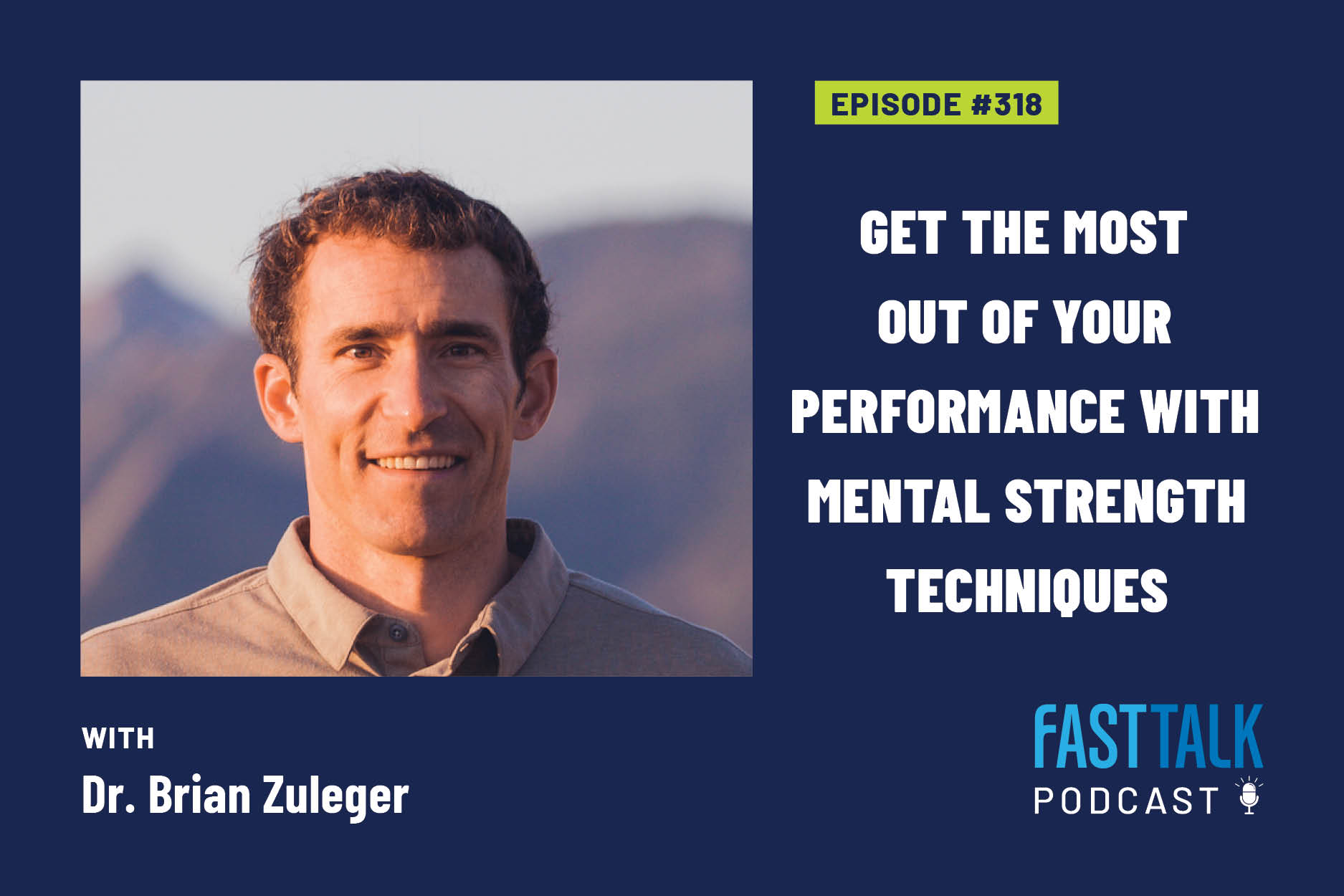






We’ve talked a lot about sports psychology tactics, but in this episode Dr. Brian Zuleger explains how to effectively apply them to your performance.
Episode Transcript
Introduction and Why Mental Training Matters for Performance
Trevor Connor 00:05
Hello and welcome to Fast Talk, your source for the science of endurance performance. I’m your host Trevor Connor here with Coach Grant Holicky. Mental strength techniques are not going to make you stronger. That’s a point frequently made by people who don’t see a value in sports psychology and the fact is, they’re right. Things like visualization and self talk are not going to make you stronger. So then why do we do these things? The answer is simple. A razor can arrive at the start line with the strength to win the event. But what ultimately is going to determine their result is whether they have the mental fortitude to tap into their full power, or if they mentally collapse before the gun even goes off. The tactics taught in sports psychology allow you to make the most of the strength you have. And many athletes discover, once they start practicing these techniques, just how much of their physiological gifts they weren’t actually using before. Dr. Brian Zuleger is a professor of applied sport psychology at Adams State University. He teaches a graduate program in sport psychology for coaches. That our own Grant Holicky he graduated from. In today’s episode, he explained to us why we shouldn’t just visualize optimal outcomes, why we should focus on goal attainment instead of goal setting, why we should use more instructional self talk, and leave motivational self talk to Stuart Smalley. And finally he gives us some tips on how to build self confidence. Joining Dr. Zuleger we’ll also hear from professor of physiology Dr. Ernst Hansen, and author of The Brave Athlete Dr. Simon Marshall. So visualize listening to the best podcast ever and let’s make it fast.
Advertisement 01:32
Coaches, we have exciting news. Now you can get certified with the polarized training method. Fast Talk Labs has collaborated with USA Triathlon to provide the first ever polarized training certification from a US Olympic Federation. This course includes an in depth look at the 8020 training method, with extensive contributions for Dr. Steven Siler, myself, Trevor Connor, physiologist, Alan Cousins, triathlon coach Ryan Bolton, and my Fast Talk Podcast co host Rob Pickels. Complete the polarized training certification course and you could become one of the first polarized training certified coaches in the world. Take advantage of the excitement surrounding the 8020 training method in this 2024 Olympic year. Learn more at triathlonlearning.com. Just search for polarized training certification.
Introducing Dr. Brian Zuleger and the Purpose of the Episode
Grant Holicky 02:18
Hey, everybody, welcome to this week’s episode of Fast Talk. We’re super excited this week to have a friend of mine, a mentor of mine, and the head of the sports psychology department at Adam State University, Brian Zuleger. Welcome to the show. Good to have you here.
Dr. Brian Zuleger 02:35
Thanks for having me. I’m excited to be here.
Grant Holicky 02:38
So I’d like to start with you telling us a little bit about you. But I want to take a moment here and say a little bit about what we’re trying to talk about on the show today. So what we’re really looking to talk about is you’ve heard us talk about, particularly me, a lot of mental strength, and where it applies, and how it works in sport. But what we haven’t spent a lot of time talking about yet is the specifics of how to do it. Actionable items of how we can personally work on our mental strength for our performance, and outside of sport, just performance in life. And that’s something that you, Brian, talk about a lot is that holistic athlete, everything in the athlete, and we’ll get into this a lot as we go through the episode. But why don’t you tell us a little bit about your past how you got to this point. And yeah, where we’re going from there.
Dr. Brian Zuleger 03:30
Yeah, coming up on 40 years old this year. So that’s a long story. So the short version is I wanted to coach at the college level. And a lot of times you need a master’s degree to kind of advance up to being a head coach, which was my long term goal was to be ahead, track and field, and cross country coach at a university somewhere. And so in that process, I took a sports psychology class and funny story is actually got a B on an exam. And that’s what led me to go into office hours to talk to the professor who at that point I hadn’t had a formal relationship with, I was just another student in class. And I was coaching track and field at the same time. And so I was helping as a volunteer assistant coach, and in getting that coaching experience and learning while I was doing I was actually finishing up my undergraduate degree at the time. And I was taking all these classes I had like 6 or 7 classes because I was behind I was like a fifth year when I should have already graduated kind of thing. But long story short there is, I went into his office hours and left that signing up for his master’s degree program. And his story, it was that he was a college track and field coach and sports psychology professor and back in the day that was more common to kind of do both of those things. And over the years, he retired from coaching, and was just a professor then. And that was kind of, in that meeting basically realized, hey, the sports psychology pieces is a big piece of the puzzle when it comes to coaching, and training athletes, and working with people in general. And looking at, okay, where can I maybe do that and also continue to study. And that led me to doing a PhD in sports psychology. And then in that pathway, I got into this intersection of doing a lot of coaching education stuff, my mentor, there was a former head track and field coach and sports psychology professor as well. And in that process, really realized, there’s a lot of people who are coaching, and they don’t have a lot of time to do a lot of coaching education. And there’s a lot of people who are doing research, and they don’t have a lot of time to do coaching education. And so it’s sort of felt like there was this gap, there was people who had lots of knowledge in the research stuff, there are people with lots of knowledge on the applied side as coaches. But nobody was really there to teach coaches in a formal way outside of, hey, I’m your assistant coach, and I learned from you in that kind of manner. And so that kind of said, okay, where does sports psychology and coaching education kind of mix and that’s where both my masters and my PhD programs really, were doing that. And I didn’t see a lot of other people necessarily doing that or doing it in a way that I felt was connecting to the people in the way that they needed to be connected to. And so here I am now 10 years into being a professor and started a master’s degree program in applied sport psychology to fill that need to get that education, which fortunately, I get to meet awesome people like yourself through that, and yeah. So that’s work I’m doing.
Grant Holicky 06:27
Yeah, and one of the things that’s, I kind of want to put out there, I went through the sports psychology department at Adams State, there’s also a master’s in coaching available at Adams State, just a really nice selection of master’s degrees there that really can enhance what a lot of coaches out there trying to do.
Mental Strength as Accessing Existing Fitness, Not Replacing Training
Trevor Connor 06:46
So something that I listened to the two of you talk about before we started recording here that I think is a really important context for this episode, is you brought up, you hear from athletes who go, oh, so there’s mental training techniques that’s supposed to replace training that that’s going to make me stronger. And that’s kind of how people look down on it. And this is something I’ve experienced, both as an athlete, and as a coach. No, that’s not what this is about. I’ve seen in myself, I’ve seen in every athlete that I coach, there is a point where they are strong enough to do what they want to do. Whether it’s race, whether it’s throwdown with their friends on the local ride on Saturday, whether it’s the big Gran Fondo that they want to go to, but they aren’t able to do it yet, even though they’re strong enough. And that is where that mental side comes in, the mental side is about teaching you to be able to use everything that’s available to you because you might have the fitness, but you can’t always make yourself use it.
Grant Holicky 07:44
Well in taking that, and this is really where I’d like this episode to go, is this idea of we talk about it in theory, and we’ll talk about a lot in theory today. But how does a random person put that into practice? And why does it matter? Trevor, you really touched on why it matters. And one of the things I think you’ve said a lot to me is this isn’t about inventing some degree of fitness. This is about how to bring out what’s inside of us already.
Training the Mind Like a Skill, Not a Quick Fix
Dr. Brian Zuleger 08:12
Yeah, definitely. And I think a core concept that sets the stage for a lot of things, is this idea that we’re thinking, we’re always thinking, and I hear people sort of along these lines of what we’re talking about here is like, oh, mental training is something that’s separate from my physical training, right. And it’s like, well, no, when I’m training, I’m thinking. In sports psychology, what I’m trying to do, and as a mental performance coach, is train people to think more effectively. While they’re training and then in competition, I take that into my competition then, right. And I think a lot of times in sports psychology on that note, is people try to, like conjure it up in competition.
Trevor Connor 08:50
No.
Dr. Brian Zuleger 08:51
But they don’t train it. Right. And that’s where the problem comes in, then they’ll maybe come to somebody like me and go, well, it’s not working in competition. And often I go back to what is your training look like? Are you training this? And if you’re not training it, it’s likely not going to happen on race day.
Competition, Pressure, and Why Some Athletes Rise or Collapse
Trevor Connor 09:09
Let’s pause for a minute to hear from Dr. Simon Marshall, who explains how our mindset can either enhance, or completely neutralize our strengths.
Dr. Simon Marshall 09:18
Some people, it makes them go faster for others, it makes them go slower. It’s interesting, isn’t it, when you start to sort of formalize the competition part, that’s one way pinning a number on really is one of the most overt signs of direct, you know, head to head competition that you can get. For some people they seem to sort of buckle under it and other people rise to the challenge and, and often one of the reasons for the difference is really about the architecture or the brand of your chimp brain, right. So folks who are worried about feeling a bit imposter issue or they might be worried about social approval, they might have more anxiety. Other people who are, the way that they’re feeling shows dominance is by everything’s a competition. I love, I can’t wait to put a number and so on, and it helps them perform. We do know that competing with other people makes you faster. Pretty much the, the literature is almost universally consistent, whether it’s from time to exhaustion on a treadmill or bike, the speed that which you can wind a fishing reel in, how far you can throw things. When you’re around other people, and they’re doing the same thing as you and you’re competing compared to them, you get better. Now, the challenge, of course, for athletes is trying to convince them that you will be better even though that you’re terrified and you hate this, you will be better. And so that really is where the psychological piece comes in. I said that we could talk for an hour just on this topic. So one of the things… the big issues is what we call a participant versus a competitor mindset. And the way that materializes in sort of everyday normal person world is the athlete who says, oh, I just want to, I just- I just want to enjoy it. I just want to have a good time. I just want to… no one is saying that that’s a bad thing. Of course we want to enjoy competition, but when you put on a number and many people don’t feel as though that they have the, I’m not competitive or I’m just gonna somehow, if I can give every reason ahead of time about why the outcome is the way it is. I can never truly, my talent, or abilities, or however they’re interpreting them, can never truly be on measured, right. It’s because, when you, this is what we often call self sabotaging and self sabotaging, for the folks who number pinning, they get nervous is the default strategy for them. So we try and unpick the self sabotaging. So in other words, if you remove all of the obstacles to why you couldn’t have performed. So in other words, oh, I just did this, it’s just a training day or, oh, I hadn’t, I didn’t sleep that well last night it was raining or all the reasons that we give. Of course, the real reason for all of these things is because the worst thing that your you can do to your chimp, is to say there were no barriers, no excuses for why you’re here. Do you know what the actual answer is, after you’ve done this? You’re just not good enough, you don’t have what it takes, your chimp will shit the bed. So what the human brain does is implants, little things along the way. So it never has to say everything went according to plan and you know what, I still came up short. So the strategy is to undo some of the self sabotaging mechanisms, learn how to evaluate, we… change people’s fundamental relationship with failure, which is we talk about effort and attitude versus performance and goals and podiums, and so on. And when you can do that, your performance takes dramatic leaps. Leslie was a mid pack pro much of her earlier… she was an ITU athlete from 19 to 21, left the sport because of all those reasons. I’m not taking credit for it, but we worked together on it, she got more confidence, or she got to a point where she literally has no more left in the suitcase, she doesn’t care. She does a local cross country in San Diego, there’s a target on her back. Everyone wants to beat her. Now you have to have, and you, and she’s just done 40 hours of training, she’s tired. She’s already done a session in the morning. And she’s turned up to this race, that for most people’s chimps is like, oh my god, every race has to be my A race. So if you can get to the point where you can run unshackled, or race on it, you don’t care about this, it’s all processed, focused, but still be competitor, that competitive mindset, not, I’m just out for the… that’s the sweet spot. If you can manage that and develop that, the world opens up to you athletically, it really does. We’ve seen it time and time again.
“Build It, Don’t Fix It”: A Strengths-Based Mental Training Model
Grant Holicky 13:49
So really quickly, one of the things that you talk about a lot is this idea of we have to build it, not fix it. And so taking a moment here, as we’re talking about general perceptions of mental performance, you kind of just noted it, a lot of people come and say, well, my brain is not working right, I need you to fix me. But that’s not really what we’re looking at here. It’s not something that we can do all of a sudden.
Dr. Brian Zuleger 14:15
Yeah, and we’re not broken, necessarily like, right, like, and so it’s this idea that, where are we at? We’re trying to create a baseline, right, and establish what that baseline is. We do that in a lot of different ways. In sport and training. We do all sorts of testing and things like that. Any coach in any sport, you come out what are the well on the first things they do, they’re running you some through various drills or tests to kind of see okay, where people at? Where are things that people are maybe better at than others? Where things that we need to work on and stuff like that, right? Well, trying to do the same thing from a mental standpoint is just kind of figuring out where you’re at. What’s your mindset? How do you think? How do you respond when you face adversity and things like that, right? And then from there, it’s not that that’s good or bad, per se, is to say, okay, this is where we’re at, and how do we build from here, right? And it’s also an educational and strengths based approach. A lot of times people look at this as interventional, I’m struggling, you know, I need to get back to normal or whatever it is, right. And it’s like, no, I’m not necessarily concerned, even with getting you back to normal. I want to optimize and get you to be the best version of yourself. Well, that’s not getting back to normal, that’s going well beyond that, ideally, right. And so that isn’t really what the focus is. It’s more about education, and training, and saying, okay, what do I already do well, and how do I build on that? Instead of saying, okay, like, I’m good at focusing, but I’m terrible at responding to mistakes, I’m going to put all my time and energy into how I respond to mistakes. And it’s like, well, no, that’s misguided, that would, you know, we want to lean on what you do well, and then build off of that kind of thing. So that’s kind of the general concept there with that build that model versus fixed model, I think that alone is just such a huge shift for so many athletes and people in sport is to kind of say, okay, don’t have to have a problem, to work on this kind of thing. And when you start there, that makes a big difference.
Losing Mental Skills Over Time and the Need for Maintenance
Trevor Connor 16:09
I think of it as a skill set. It’s a skill set that you can develop, and just like training, it’s also something you can lose if you don’t keep up. So.
Grant Holicky 16:17
Yeah, we’ve talked about this before on the show.
Trevor Connor 16:19
I remember the last Pro 1 race that I did, where I went, I can’t do this anymore. It was Cascades 2017 and I was more than strong enough, all the numbers were there, the strength was there. I just remember the first day in the road race, being at the back of the field and unable to get to the front. And it had nothing to do with strength. It was whatever mental skills I used to have that made it very easy for me to get at the front, be at the right place to race, the race. You know, I hadn’t done a race that big in like a year and a half, and they were just gone. And I had been practicing them.
Grant Holicky 16:54
And you bring up a really good point. And this is something we’re gonna really touch on today is that whatever skills I had, I didn’t have many more, but you were struggling to even identify what those skills were. So many of us develop these skills as athletes just along the way, we haven’t realized we’ve done them. And then suddenly, when they’re gone, and sometimes it’s not even suddenly, right. Sometimes it’s just slowly but surely, because the rest of our life gets in the way and eats away at what we’re able to do. We’re 26, 27 years old, and I was racing Xterra, I didn’t have anything else to do really, I was coaching, some swimming, I didn’t have anybody to take care of, I wasn’t worried about my kids or my family or anything like that. Now, that shift is completely different. Now I go home and my mental energy is to my children and to my wife and to those things. So how do I turn that on? And turn that off? And that gets really difficult.
Dr. Brian Zuleger 17:46
Yeah, yeah, it evolves over the course of our life, you know, kind of thing. And this is another thing I see to this point of like, if we’re not training, you sort of lose it to some degree, is I’ll have people maybe talk to me or somebody like me as a mental performance coach, maybe one time, you know, and they maybe were… came to me in a case where they were struggling with something or whatever, and I give them something to work on. And it helps. And then I’ll maybe never hear from that person again. Right, like in some kind of think I’m like, well, maybe they’re continuing to do that. Maybe they’re not, but it’s this idea that, you know, I use the analogy, like you get a prescription or whatever you’re supposed to take it for 14 days, most people take it for seven or eight, they start to feel better, and they stop kind of thing, right. Like, there’s this idea that you have to continue to do it. And there’s a maintenance component to this, right, just like there’s a maintenance component to our fitness, right. And it doesn’t have to be like this 1% better every day concept either. It’s just simply working on these things and maintaining it even. It’s not that I always have to be improving even, but I see so often that people kind of do something and it kind of helps. And then they like forget about it and stop doing it because they haven’t formally trained it. And again, that’s where if you’re coming in and that sort of interventional context, you maybe used that thing, that strategy or whatever, you know, that skill in that moment, and it helps, but then if you haven’t really trained it and gotten it to be part of your subconscious really, eventually is what you’re trying to do. So that in those pressure moments in sort of the heat of the moment, you can rely on that, because that’s what you’re relying on most of the time is your subconscious in those moments. And if you haven’t trained it, well, it’s not going to be there when you really need it.
Grant Holicky 19:26
Well and that’s one of the, I love that idea of the subconscious right. This is the technical definition of choking is to be putting conscious thought towards something that should be wrote, something that we just know how to do, somebody goes up, they’re going to take a free throw their 90% free throw shooter, and suddenly they miss. 9 times out of 10 they’re aware of the situation and they’re up there trying to think about push the ball, follow through, and our bodies can’t keep up with our brain. So if we’re thinking about it actively, we’re already in trouble. So as you talk about it, building this into the subconscious, it may not just be a physical movement, it’s a mental pathway that we have to really burn in, and know, and have available.
Dr. Brian Zuleger 20:10
Yeah. And to your point about the free throw examples, like, I can shoot that in the gym, okay, and then okay, I can go shoot that in a game. But now it’s the championship and we’re down one. And it’s a one in one. If I make it, we tie if I make the next one, we win kind of thing, right. In that moment, have you trained for that moment mentally as well? And that’s again, where like, as you progress through just like any other skill, there’s a progression to it, right? And so yeah, you practice that in the gym with nobody else around. And I see people do that a lot, metaphorically and in a lot of sports, but then they don’t take it into the actual like, nuance of like, okay, I’m in this exact situation, I’ve prepared for it. So then they get in those situations, and then they’re trying to dial it up. And they can’t. And again, it’s like, well, I haven’t, I haven’t trained for that scenario.
Grant Holicky 20:58
So just so you know, a free throw is kind of like a penalty shot in hockey.
Dr. Brian Zuleger 21:03
Okay.
Grant Holicky 21:03
I just wanted to make sure you were following because you’re, you know, foreign.
Trevor Connor 21:08
Yeah, so that was 19- who won the NBA championships? Do you remember this?
Grant Holicky 21:13
Oh, yeah. No…
Trevor Connor 21:14
I was there.
Grant Holicky 21:15
Oh, you were there?
Trevor Connor 21:16
Yes.
Grant Holicky 21:16
Wow.
Trevor Connor 21:17
Toronto. Raptors.
Grant Holicky 21:18
That’s not really Canadian, though.
Trevor Connor 21:21
Well, for a week I call the basketball.
Grant Holicky 21:25
Anyway.
Trevor Connor 21:27
So I am looking at this outline very happy about the fact that for once, I didn’t have to put together the outline. And the two of you put together what you’re calling, four real world examples of mental strength.
Grant Holicky 21:41
Yeah.
Trevor Connor 21:42
So should we dive into these, I?
Rethinking Visualization Beyond Perfect Outcomes
Grant Holicky 21:44
Yeah, I think it’s time to get into… and where I wanted to start with you, Brian, is the idea of visualization. And I really wanted to talk about this because I grew up in a sport swimming in the 1980s, where visualization was all the rage. We did it all the time. We sat down and had our coaches talk us through, okay, now picture, the perfect race and touch the wall and look back and see the time, and there was so much about this idea of visualize your perfect scenario, visualize the race going perfectly. And while I think there’s a lot of effectiveness in that, and there can be a lot of benefit in that, and we can get into the technic- technical piece of like, your brain does struggle to differentiate between an act of memory and something we’ve created. But when we get a little too fixated on the perfect, we’re losing real world application of this technique.
Dr. Brian Zuleger 22:40
Yeah, absolutely. And a quick note on the element of perfect, and I won’t get too deep on this, but I teach that there is no such thing as perfect. And I say that because so often this idea of perfect is one of the huge things that athletes, causes problems for them, from a mindset standpoint is they are trying to be perfect. And we are inherently imperfect and competition is imperfect. It’s chaotic, it’s complex. And even when you know, people say the pitch a perfect game, or, you know, somebody breaks a world record, right. If you sit down and talk with that individual, they can always find areas where they made mistakes, or could have been better. And you think, okay, this person just broke a world record? How could they be any better make mistakes, right? And it’s like, no, if you actually talk with them in their mind, they can pinpoint these things. And so that’s where I’m like, well, why are we trying to be perfect? Why don’t we just try to be as best as we can be in the context, and then that gives us some grace, to know there’s going to be some mistakes. And really, what differentiates you then is how you respond to that, right. So then take that into this visualization. Yes, we want to like think about it in a mastery orientation of things going well, not necessarily perfect, but going well. But we also want to think about some of these scenarios, right. That could potentially happen, whether it’s challenged adversity, and you can’t prepare for anything. And many of these things, some of these things, you don’t even know what’s going to happen. Right? Like, we could go on and on of examples of this, right. And so it’s a broader idea of like, how do I train for adversity from a visualization standpoint? And what are some common things that could happen in my particular sport or activity that I’m doing right, from a performance standpoint? You know, a quick example is like, okay, you know, like, I do a lot of work with track and field athletes, right? Well, they have a meet schedule, a meet schedule often gets off, things happen, whatever it is, and so the schedule gets off, right. So then, how does that impact me? Like if I’m warming up at a certain time, and I’m really like, oriented on I have to warm up at a certain time and I have to do this, and this, and this, and then you get all warmed up and then something happens and there’s a delay. How do you handle that? Well, that’s the thing that is pretty common in the sport so I can prepare for that, I can visualize what that might look like. So that when that happens, I’m not freaking out kind of thing with that, right. Or you get, you know, if you’re running a race where you got blocks darts, for example, or something like that, like you get held in the blocks a long time or somebody false starts, right. Have I thought through what that’s like, and prepared for that, or if I just prepared for, it’s going to be perfect, I’m gonna get in the blocks, everything’s gonna go great and goes out. And then all sudden, there’s a false start, this stuff happens, whatever. And you see that athlete, just to your point, like you’re saying that everything physically speaking, is primed and ready to go. But now all sudden, their thoughts are starting to get to be ineffective, because they’re like, well, I wasn’t, you know, what, what about this and…
Preparing for Adversity, Chaos, and Race-Day Variables
Grant Holicky 25:41
And beyond even ineffective, maybe now there’s a panic, and we’re off book. And one of the things I’ve talked about a lot with my cyclocross athletes is we’ll prewrite a course. And they’re prewriting a course with almost nobody in front of them. So when they go through their head, and they go through that course, again, they’re picturing it with nobody in front of them. So we’ll come to certain sections of the course and say, alright, look at this course. Now, remember, you have third row start. There’s 25 people in front of you, where do you go? What’s your out? What’s the next step? What do we go through these pieces? And even that idea of what you’re saying, what happens when you flat? What happens when you drop your nutrition in a gravel race, right? What’s your backup plan? And so that might even not be a traditional visualization. But it’s working through this stuff, in our minds before we’re there. So that we have alternative plans, alternative flight routes.
Dr. Brian Zuleger 26:37
Totally. And I think about courses, you know, whether it’s you know, cyclocross or a road race, or whatever it might be, there’s so many nuances to that, right. And in a perfect world, we’ve, you know, you can pre ride the course, you can go through it, see what it is, and stuff like that, right. Some cases you don’t, right, you know, like, I think of myself, I’m not a pro athlete or anything like that. So like, in a lot of cases, you show up to a race or something like that, you’re kind of figuring it out as you go, right. But nowadays, we’ve got things like video and stuff like that, where you can maybe watch a video online, like I talk a lot about athletes like that. It’s like, okay, has there been a race there before? Can you go on YouTube and maybe get some footage and kind of look at that, and visualize, and see what those things are like, right? And when you do that, you’re priming your brain to be more ready for when it actually happens. And you see it, you’ve kind of thought through these scenarios. And then to a point about earlier, how do I read and react to it in real time? Well, you can do that much better when you’ve thought through some of those things. But if you’ve thought it was gonna go perfect, and then also, some of these things happen, now all sudden, your alarm system kind of has gone off, like you said, and that has a physiological response to it, right. And that’s where people kind of tighten up, or their heart rate really spikes or something like that, right. And that’s not what we want in those moments. And so when we prepared for that, we can handle that a little better.
Trevor Connor 27:54
Well, I love that you brought up a little bit earlier, when you’re talking about not being perfect, pitching a perfect game. Because it made me think, so I’m trying to remember the name of this movie, I think it was called For Love of the Game… a movie about where he was pitching a perfect game, because what I loved, and there was a great example of what I would consider a form of visualization, where he got up on the pitcher’s mound, and I can’t remember the exact word he used. But in his head, he said…
Grant Holicky 28:18
Clear the mechanism.
Trevor Connor 28:19
Clear the mechanism, that was it. And then the editors, you know, the made the whole sound of the audience or the crowd go away. And he was able to get into his mode and pitch. But then as he got to like the seventh or eighth inning, he did the same thing, you know, clear the was-
Grant Holicky 28:34
Clear the mechanism.
Trevor Connor 28:34
Mechanism. And he couldn’t do it.
Grant Holicky 28:36
Right.
Trevor Connor 28:38
And then he started to struggle.
Grant Holicky 28:38
Yep. Yeah, it’s a great example of having your methodology, right. And we’re gonna come back to this over and over again, this idea of, it’s very holistic, and it’s very individualistic, right. What works for Trevor is not going to work for me, it’s not going to work for Brian.
Trevor Connor 28:56
Who we talked about, that’s all about anger.
Grant Holicky 28:57
For Trevor, it’s all about anger. Yeah, it is not about anger for me. As we go through those things, and we’re gonna get to eyes off in a little bit, we’ll talk a little bit about your individual zone of optimal functioning, which concerns me. But.
Trevor Connor 29:14
Don’t make me angry.
Grant Holicky 29:15
You have, you can have your individual thing, but even your individual thing may fail in a wicked environment, when things are constantly changing, when it gets difficult, or even when it’s going well. That’s one of the hardest things that we run across in sport is alright, now, what do you do when you’re going oh, oh, God, I’m winning.
Dr. Brian Zuleger 29:37
Yeah, I’m leading the race. Right. Like, you know, and have you thought through that, have you planned for that. Right, which, you know, that ties into competence and other things, too, you know, but like, I think I see that a lot. And that’s, you know, in terms of race strategy, that’s something that comes up a lot. This idea of like, well, I don’t want to lead or you know, what, if I am leading or I’m leading, I’m not supposed to be leading, you know, like, right. You know, and that kind of stuff happens a lot. And in particular, I think in championship type events, because sometimes the people who are most talented or should be leading, they’re maybe using a strategy that is different than what people would think they would, people would think they should be leading. But maybe in their mind, they’re trying to conserve energy for a sprint finish, or they’re going to make a move at a certain point. And you don’t know when that is, you don’t know what their strategy is necessarily. But if they’re not doing what you thought they were going to do, and this is another thing I talk about a lot with people with visualization and race prep is don’t just visualize it going the way you think it’s going to go. Visualize what if you’re in the front. Visualize if the person who you thought was going to be in the front is, is sitting next to you all sudden, or you’re like, oh, hey, the leaders are gonna go out, I’m gonna tuck in and kind of just sit behind them and get towed along. And let’s say the leaders don’t go out.
Grant Holicky 30:56
Yeah.
Dr. Brian Zuleger 30:56
You know, and all sudden, you’re in that group. And you’re like, looking around, I have so many athletes, they, they just start to like, panic, because they hadn’t thought through that scenario at all. They just assumed, oh, they’re always, they’re going to go do this and I’m just going to kind of hop in line or whatever it is, or I’m going to be gapped. And I’m just going to be back here. And then there isn’t that gap. Or the reverse, they think there’s not going to be a gap and then somebody is like, hey, my only chance to win today, it’s just go from the front. And I’m going to see how long I can hold on. And then that person goes out there and they’re basically like, oh, crap, we weren’t expecting that. Right, like, how does those things impact you? And I think those are things that are all, they happen in races all the time. And so why wouldn’t you prepare for that to some degree.
Grant Holicky 31:42
And we talked about this with Matteo Jorgenson, you’d sent me that screenshot of his plan for Door Vlaanderen. And this was my mental plan. And then his team leader… crashes, and he talked about we’ll go back to my plan, I, this plan is still applicable. And he was able to adjust on the fly to a disaster. But the plan still applied, and the mental protocol kind of still applied.
Dr. Brian Zuleger 32:05
Yeah and that’s the important part about that to note, too, is that you develop a plan that can adapt, right, like we talked about, you brought up that baseball example. And there’s ties to, without going deep into that story, with Kevin Costner if you’ve watched a lot of his sports related movies, they all have like a mental sports psychology kind of theme to him. Well, he.
Trevor Connor 32:33
Thank you…
Dr. Brian Zuleger 32:33
Loosely connected to Augie Garrido, and when he was at Cal State Fullerton, and Augie Garrido was connected to Kendra Visaa, who is a sports psychology professor and mental performance coach and Augie pick those things up. And Kevin picked up some things from watching Auggie coach and being you know, on the sidelines at these baseball games and stuff. But going back to this idea of like, I have something that set up well, one of the things Ken teaches is like if you have a focal point, for example, for focusing in the context of baseball, is finding something that’s always going to be there. So one of the things they use as examples, the left field follow up poll, every base major league baseball park collegiate baseball park has a left field follow up pole. So that is something that isn’t going to change, no matter what happens around me, right. And so when I develop a race plan or visualization, and I think through some things, I’ve got a system set up that can adapt to a lot of different situations. And it might be somewhat specific to that race or whatever. But in general, it’s got some room for some adaptability, because like we talked about, it’s chaotic, and it’s complex. And you can’t plan for some of this stuff. But you can plan to have a plan for like the unknown, if that makes sense.
Making Visualization More Realistic and Sensory-Based
Grant Holicky 33:47
Yeah, I think it makes a lot of sense. So we’ve talked a lot about, alright, what are we doing specifically with our visualization or making sure that we have visualization for when it goes wrong, for when it changes? How do we actually do that visualization? What are some techniques that can make that visualization more relatable to the sport itself?
Dr. Brian Zuleger 34:09
Yeah, you want to think about what it feels like and this is part of the visualization part that I think people think about what it looks like, and you want to think about what it feels like. Because then I have this sensation, right, because the sport is physical in nature, right. So I do on my, is my heart rate elevated in this period of time, am I more relaxed in this particular moment. Am I going to you know, am I just kind of riding in the pack, or am I attacking at downhill and then you know, a very curvy section of the course or something like that or whatever it might be, and taking into those things into account in your visualization as well. You know, one of the things that I talked about with biking for example, like you can get on a stationary bike, you can get on the trainer, and you don’t have to do a workout per se, but you could do a little bit so that you are, one, actually doing the activity while you’re visualizing, and two, you’re getting a physiological stimulation to get you somewhat, not that you’re maybe like, you know, max heart rate per se, but you’re doing something to kind of get you in that mindset. It’s not like you have to sit with your legs crossed in a quiet room and close your eyes and visualize kind of thing, you can do some things to help make it more simulation like for what you’re going to face. Things like time orientation too potentially, obviously if you’ve got a super long, you know, endurance race, you’re not going to sit and visualize for, you know, three to six hours or whatever it is, right. But thinking through maybe sections of the course, and how long is that section going to take. And so then I visualize roughly along that timeframe, right, so that I’m matching, what it’s actually going to be like, you know, and all of those kinds of things. So sort of like a sensory experience, all the different things that are going to go into that I think really can heighten that visualization, and make it better. And then again, you know, video is a good tool. And we have so much of that now at our disposal, you can throw a GoPro on your head, or somebody else has on their helmet. And you can get what feels like, you know, first person viewpoint of doing things. And that can be a really good way to train our mind about what it’s going to look like, especially if I’m trying to do something that I haven’t done before, but somebody else maybe has done. And I’m trying to level up in that skill sense, I think that’s a really good thing. What I was, I used to be a water ski coach, and I would watch and coach other people from the boat skiing all day, and they maybe weren’t at the skill level that I was at. And then if I went out and skied, I tended to replicate some of the things that I’ve been seeing for the last four or five hours. But if I watched a pro who was better than me, for even just a couple of minutes before I went out and skied, I started to kind of replicate the things I was seeing there. And it was something I didn’t necessarily intentionally do right away. It just was happening because I was coaching and then I would go on skiing and I was like, oh, that’s kind of a, not a very good set. And I’d be like, oh, I know this, because I’m learning. There’s actually classes I can apply. And it’s like, oh, I’ve been watching it done not at the level that I’m trying to do it at. And that was then, I was visualizing it but in an ineffective, way.
Grant Holicky 37:27
Right, right. Like one of the things that I like to do on the trainer is if you have a one minute effort, close your eyes on the trainer and tie that one minute effort to something that’s out on the road. Something you know, and now you’re starting to take the feeling of that one minute high end effort, which we’ve been talking about. And now you’re tying it to the real world and going, oh, well, you know, maybe at 45 seconds, I’m almost up with that hill, it’s not that bad, I can get through the back end of it, or I know what this is going to feel like. And that can be a real benefit because instead of the feeling holding us back, now the feeling can be encouraging. And it’s the exact same feeling, right. We’re experiencing the same 400 Watts, we’re experiencing the same heart rate at 170 beats per minute, but we’re experiencing it with a different outlook. And that changes a lot. We’re going to talk a lot more about that a little bit later.
Dr. Brian Zuleger 38:18
Yeah.
Trevor Connor 38:18
I can tell you very early in my cycling career, I spent a whole lot of time out in rides picturing being in the breakaway,
Grant Holicky 38:25
yeah,
Trevor Connor 38:26
with some big name writers. and doing a whole lot of visualization. And then one of my first pro races, I ended up in a breakaway with Horner, Ben Jack Mains, and one other guy. I took my poll at 500 Watts.
Grant Holicky 38:27
Yeah, Yeah.
Trevor Connor 38:38
Just about killed myself and one of them yelled at me, don’t slow down the group when you pull through.
Grant Holicky 38:43
Exactly.
Trevor Connor 38:44
And I’m like, this isn’t what I pictured at all.
Dr. Brian Zuleger 38:50
Yeah, no, but that’s something where like, that’s real world thing. So then, you know, if I was working with somebody in that context, those are things that I’d want to learn about that and figure out and say, hey, like, you know, I’ll tell people sometimes like, hey, this isn’t like all sunshine and rainbows up here, maybe, you know, kind of thing, like it’s pretty cutthroat or whatever. And maybe that’s not, you know, healthy to Grant’s point about, there might be some anger, there might be some things going on, right, like, but how do I in that moment, how do I leverage that, right? And then if I’m going to go into that world, if I’m going to go into that context, I’ve got to be prepared for that, right. And maybe I can’t know what that’s like, but if I can know what that’s like, I can have somebody who’s been there and now that you’ve done it, right, you’ve had that experience. It’s like, okay, well, I’m gonna go back into that arena again. How do I get myself better prepared for that? Right, so that I’m not maybe caught off guard by some of that stuff where it’s like, oh, I wasn’t expecting that.
Grant Holicky 39:37
I love it.
Limits of Visualization and Individual Responses
Trevor Connor 39:44
Before we end our conversation about visualization, let’s hear from Dr. Ernest Hanson, who had a different experience with visualization techniques.
Dr. Ernst Hansen 39:53
One year I prepared for the World Championships in cyclocross, and we went to look at the course before the race, so that we could go back home and visualize our race. And I did that every night for months prior to the championship, and it was somehow very effective. So it had an effect, but at the same time, I actually felt that after the race, my mood went down a lot. And I suspect, actually, that it had something to do with all this mental training up to the race. So after that experience, I never did it again, I didn’t like that experience.
Trevor Connor 40:39
Credit athletes reach a point where performance gains depend more on the skills they build between their ears, than on the strength of their legs or their heart. The very best athletes are strong mentally as they are physically. At the sports psychology pathway from Fast Talk Labs, we explore how to build mental skills with experts like Dr. Simon Marshall, Dr. Julie Emerman, Grant Holicky, Leslie Patterson, and Julie Young, build your mental strength, visit Fast Talk Labs and explore the sports psychology pathway.
Goal Attainment vs Goal Setting
Grant Holicky 41:07
So moving down the line. So the next thing, kinda wanted to touch base on is this idea of, and again, this was something that was very, very in vogue when I was a young swimmer. And it still is. I every swim team on the planet, and every junior team, for most sports, we’re going to have goal needs, we’re going to talk about goal setting. And I remember very early on in my master’s education with you, I brought up this idea that I want to do something on goal setting. And the first thing you said was, let’s make it goal attainment instead of goal setting. So I want you to speak a little bit about the difference between goal setting and goal attainment.
Dr. Brian Zuleger 41:45
Yeah, it’s an interesting thing, because I don’t think most people have really thought about it or unpacked it, because it’s so common in language. And it’s not just in sport, it’s in everything in life. You know, you set goals, you set goals, you set goals, right. And when I first got into sports psychology, some of the things that bothered me is that people be like, oh, you’re the goal setting person, you’re like this motivational speaker. And I’m like, I don’t motivate anybody, you motivate yourself, I help you figure out how to motivate yourself. And goal setting is actually not what we’re trying to do, like we’re trying to attain goals. And as a mental performance coach, I’m in the business of trying to help you attain your goals, not set goals. And when we think about it, it’s goal setting for goal attainment. So the goal setting is to try to set you up to attain the goals. But where most people fall short with this is they set the goals and kind of just stop, it’s sort of what I call the set it and forget it model. Or they do it maybe at the beginning of the season, and we have these lofty goals and we set them or whatever. And then nobody really talks about how we’re actually going to attain them. And we just start going into training. And we never talk about our goals again. And it was like, well, we set our goals, we’re supposed to accomplish them, right? What happened, you know, like kind of thing. And so it’s working backwards, what are we trying to accomplish? And then, you know, whatever that is, and I’m of the you know, proponent of saying, make it as big as you want. Like, I don’t care if somebody comes in and says I’m gonna, I want to be an Olympian, I’m gonna say, great, let’s figure out what it takes to do that. Let’s figure out where you’re at in relation to that. And what can we do to try to move you closer to that pathway, but so many people will say, like, oh, you know, set SMART goals, or bla, bla bla, or things like that. And one of the components of SMART goals is that it’s realistic. And it’s this idea of realistic, it’s like, well no, the, we were just talking earlier about that person who set a world record. Well, if it’s realistic, how are they, I mean, how are they going to do something that nobody’s ever done before, right? That’s unrealistic by nature, right.
Grant Holicky 43:49
Yeah, yeah.
Dr. Brian Zuleger 43:49
So if I’m working with that person, I can’t be telling them to set realistic goals, right? You know, you’re talking about trying to, you know, win a race and go out and be in this lead pack, right. Like, if I tell you to set a realistic goal, you would say, well, based on where I’m at right now, I should probably be 5th in the pack. So I’m gonna try to aim to be 5th in the pack instead of trying to win the race. And it’s like, and somebody might say, well, that’s crazy for you to try to say you could win the race, you’re not, you’re not ready for that. And it’s like, but how do I know until I try and I gotta put myself out there. And the thing with the mind is, we have to set that thing out there quite a ways ahead of us to go try to chase it. And where I think most people want to set realistic goals, is because they’re afraid to set big crazy goals, because then if they don’t achieve them, and we’ll talk about this more later on, our self esteem gets tied to that, and then all sudden, it’s like, well, I’m not good. I didn’t achieve my goal. And it’s like, well, you could have set a really easy goal and attained it. But you set a big goal and you didn’t get it, but you got much further than you did had you set that easy goal.
Grant Holicky 44:49
Yeah.
Dr. Brian Zuleger 44:49
Right. And so it becomes this idea of, are we trying to push ourselves to be the best we can be or are we just trying to check a box?
Grant Holicky 44:56
Yeah, and I think one of the things that I’ve started to see a lot lately is that goals and expectations are starting to become intertwined. I expect that I should be able to do this, two really dangerous words, in my opinion in the world of sport, I should be here. And so what, I start to listen to athletes do is maybe deep down inside them, they do have that big, lofty, huge goal. But they’re like, well, okay, so I want to win the cat three race here. Okay, yeah, well, we know that can happen, we know you can do that. Let’s look for something a little bit bigger. Let’s, let’s find what that piece is. And so you talked about going backwards, right? And starting, like, here’s the goal, this is what I want to go do. Now, how do we create that pathway to get from A to B? And one of the things that, you know, I’ll mention a lot, and I know you say is, yeah, you can have that big lofty goal, but it’s got to have some grounding in possibility, right. It’s gotta have some grounding and logic, we, if everything goes, right, what’s the pie in the sky? If everything is just, lines up, and our nutrition is dialed and this is that, what can we do? And that’s a, that’s a great starting point.
Dr. Brian Zuleger 46:10
Yeah, yeah, definitely. And the other thing with that, too, is I think a lot of times people don’t even know what it takes. So like, if I use that example, a person who says I want to be an Olympian, right. Many times, they have no idea what it actually takes to do that.
Trevor Connor 46:24
I would take it a step further to say most people when they set those sorts of goals, completely underestimate the work, the time, the commitment it takes to hit that level.
Grant Holicky 46:36
Sometimes obsession.
Dr. Brian Zuleger 46:37
Yeah, totally. And there’s some level of happenstance involved with all this stuff, too, right. Like, who are your competitors? People don’t talk about that either, right. Like, you know, maybe you’re in a, you know, a cycle on Olympic cycle where it’s just some of the best we’ve ever had, right. And then maybe there’s another one that’s maybe a little bit more down for various reasons or whatever, right. And so it’s not diminishing, anybody who made it, or made a team like how strong it was, that’s not the point of that is to say, do I understand what it takes and what it takes in general, right. So just a quick example of this is like, I’ll use track and field just because it’s easy. So in track and field, the you got to be in the top three in the US in your event, and you also got to have the Olympic standard. But in general, if you’ve, if top three, you’re gonna often have that standard, but not always, depending on the event. But let’s just say it’s the 10k, for example, right. Well, in the last two or three Olympic trials, what were the average top three times that got in, right? And that doesn’t mean that the next one that’s going to be exactly that, but it’s going to be probably in the ballpark of that.
Grant Holicky 47:42
Sure.
Dr. Brian Zuleger 47:42
Right. So it’s at least a place to start. And then let’s say it’s, I don’t know, let’s say, you know, for women’s time, let’s say it’s 31 minutes or something like that, right. Just to pick a time. If I am currently, my PR is 32:30, let’s say, and I’m trying to say I want to be an Olympian, and I’ve got to probably be somewhere in this 31 minute range. Let’s say hypothetically, well, that means I’ve got to improve a minute and 30 seconds right on paper, but the likelihood you’re going to run your PR at the Olympic trials is really low.
Grant Holicky 48:17
Right
Trevor Connor 48:17
Right.
Dr. Brian Zuleger 48:17
So I’ve actually probably got to be able to run even faster than that. And this is the part a lot of people miss when they’re setting their goals is they set their goal for what they think that thing is, instead of saying like, okay, this is a championship environment, that 31 minute time, they probably negative split the second 5k. And they probably like the last 2k really negative split.
Grant Holicky 48:40
Right.
Dr. Brian Zuleger 48:41
Like, you know, and so then it says, okay, like, can I get my PR to be fast enough to where I could run that type of race? And that’s where it’s like, because you could look and go, okay, maybe a minute 30, that’s possible, right? But it’s really probably more like, you got to do like two minutes, or two minutes and 30 seconds better, because, taking that into account, so that just says, okay, that’s in general, what it hypothetically would take. And then where am I in relation to that, and then how do I ground myself and where I’m at? And what do I need to do to put myself in position to have the best chance, to your point about this sort of guarantee or like I’m going to accomplish this goal kind of thing, it’s the best chance to attain that goal. And when you think about it that way, then it frees you up to not have this so much this pressure of fear of failure and all these other kinds of things that come into, well, what if I don’t get my goal.
Grant Holicky 49:33
Right.
Dr. Brian Zuleger 49:34
And that’s where it’s like, that’s not actually really what I’m interested in about. I’m interested in how close can you get to it.
Grant Holicky 49:40
Yeah, and I think that’s really interesting too, because one of the things you brought up we just talked about in swimming is cut times. There would be this cut time is 2739. And everybody, that’s my goal, like okay, so you just created the perfect race being that goal time. So what happens when you dive in and your pinkie moves out of place? You’re immediately going, ah I can’t do it. If you set that time for faster, then you’re giving yourself margin for error, because like we talked about no race is going to be perfect. No environment is going to be perfect. And now we’ve set up an opportunity to make some mistakes on the path to that. And Ken Revisit us to talk about the path, you have to be able to visualize the path that takes you from where you are now, to that end result. So when I’ll do goal attainment meetings with athletes, I’ll go, okay, and you guys bring up this great point. What’s it going to take? What is it realistically going to take? What do you have to change about your life in order to do this?
Dr. Brian Zuleger 50:32
Yeah.
Grant Holicky 50:32
X, Y, and Z.
Dr. Brian Zuleger 50:33
Oh, yeah.
Grant Holicky 50:34
And then the next thing I’ll ask them is, are you willing to do that? Because if you’re not willing to do that, we need to modify the goal.
Dr. Brian Zuleger 50:40
Yeah.
Progress, Motivation, and Celebrating Small Wins
Grant Holicky 50:40
One last thing I want to touch on, kinda the, the goal attainment, and we talk about creating a path and we’ll talk about creating way markers along that path. And okay, how do I know that I’m on the path? I gotta check every once in a while. It’s not just from here to infinity.
Dr. Brian Zuleger 50:55
Yeah.
Grant Holicky 50:55
I got to know where I am along the path. But one of the things you put in the notes is celebrate the achievements along the way. And I think that’s such an important piece of the puzzle.
Dr. Brian Zuleger 51:03
Yeah, definitely, I think gets lost a lot of times, and there’s a culture in sport of, I always have to stay hungry, or I always have to be grinding or whatever, which I totally don’t like that term. Because if you grind something too much, it gets dull. And if you grind it just right, it gets sharp.
Trevor Connor 51:21
Right.
Dr. Brian Zuleger 51:21
It’s not something you do every day, necessarily, otherwise, you won’t have anything left to grind, you’ll be burned out as metaphorically speaking, right. And so celebrating the achievements is one of the ways to mitigate that, right. It’s like I have to take into account my progress that I’m making. But for so many people, they think if I do that, I’m gonna get complacent.
Grant Holicky 51:40
Right, I get soft.
Dr. Brian Zuleger 51:41
Or I’m gonna get soft, or whatever it is. And it’s like, no, that’s actually the opposite. It gives you, one, it gives you a little relief, it gives you a little like, kind of, oh, yeah, I’ve made it. I made it one more step closer, whatever, kind of thing, right. But it also circles back into this intrinsic motivation context, and process orientation, and enjoying the process, and enjoying those little steps along the way. And it doesn’t have to be that, I can only be happy when I attained my goal. If that’s the case, you’re going to be unhappy most of the time.
Grant Holicky 52:10
99% of the time.
Dr. Brian Zuleger 52:10
So it’s like, why not be happy most of the time? And then yeah, if I can attain this thing, great. But then it also doesn’t create a dependency on that either, right. And people think, well, that’s what drives you. That’s what motivates humans, like, yes, that can be very motivating. But it comes with all these psychological side effects, right. It’s like a prescription drug commercial or whatever, right. Yeah, this pill will lower your blood pressure, but it’s gonna like give you all these other horrible things with it, and they just rattle it off really quickly at the end, right. Well, that’s what extrinsic motivation and avoidance motivation, fear driving type of things, that’s what that does. It’s can be very motivating, but it comes at the psychological cost, and it to your well being. And that’s why if you look at a lot of pro athletes memoirs, they’re kind of dark.
Grant Holicky 52:55
Yeah, yeah.
Dr. Brian Zuleger 52:56
Like Jerry West memoirs, literally, like, titled My Charmed, Tormented Life or something like that, right. It’s like this idea that, you know, Jerry West was the person that the NBA little logo is modeled after and the Hall of Fame for basketball, right. And so it’s this idea that we tend to think everything’s so great, right? And they maybe are driven to success, but they’re also driven with all of these other negative things that come with it, right. And so if we can shift that to be more intrinsic, if we can shift that to be more fun oriented, to enjoying what we’re doing, and celebrating those progress that we make along the way, that’s just going to come back and feel our motivation even more, to do it. Because we love to do it, not necessarily just to achieve the outcome.
Grant Holicky 53:43
Yeah, and I think we see that in coaching now. We’re seeing more of that in coaching in major sports people like Pete Carroll, people that are creating this fun environment, this competitive, fun environment for their players. Let’s go have a good time. Fun is fast. I mean, I’ll say it all the time. When we’re having fun with my teams and my athletes, they’re going fast. When we’re grinding, maybe not so much. And it’s something that you’ve said is enjoy the plateau, enjoy this, I’m just here doing the work more than I’m enjoying the work. Like those two things can be different, and they’re really important.
Trevor Connor 54:20
This is why I’m so much more a fan of performance goals than results goals.
Grant Holicky 54:24
Yeah, right.
Trevor Connor 54:25
I think results goals take you to a really dark place. And I told you that story as joke earlier, but I think it’s a really good example of that, when I was in that breakaway. If my goal had been to win that race, I would have been a very unhappy guy because, I was you know, I was a brand new cat one in a breakaway with Chris Horner, who I gave my best poll and yells at me for going too slow.
Grant Holicky 54:43
Right, right.
Trevor Connor 54:44
I wasn’t winning that race.
Grant Holicky 54:45
Yeah.
Trevor Connor 54:46
He was gonna rip my legs off no matter what I did. So I would’ve been very unhappy had it been a results focused. But instead you know, I left the race and went, yeah I was in a 20 minute break away with Chris Horner, on like my third ever pro race. That was a great performance.
Grant Holicky 55:01
You know, cycling is a really good example of this. Mark Cavendish was the very best sprinter in the world there for four or five year period. And it wasn’t close, right. If he got set up, he won. But he didn’t win every race, he didn’t win every sprint. If we’re situated on, I want to win this, or I want to go this time, or I want to do those things. We’re really setting ourselves up to be disappointed. But if we go through this process that you talked about, I want to put out the performance that is capable of doing those things for me, then I can pull a lot of positives and I can pull a lot of optimism for the next time out of those performance.
Trevor Connor 55:35
Well Cavendish is a great example because you have a guy that at the height of his career, when the Olympics came around, he wanted to win the Olympics. He gave up on the tour, he gave up on pretty much every every race that year for that Olympics, got the Olympics breakaway went up the road and everyone got a shot.
Grant Holicky 55:50
It was over. And then yet he won a world championship doing the opposite. He raised everything that season and race worlds and he won worlds. So I think it is about the effort, setting yourself up for the performance. That’s why we call it mental performance training, not mental results based winning.
Dr. Brian Zuleger 56:06
Yeah, yeah.
Motivational vs Instructional Self-Talk
Grant Holicky 56:08
So moving down the line. And this is a really nice segue because the next thing we want to talk about is the use of motivational and instructional self talk. This is one of those things that I think every athlete does, they just don’t know they do along the way. Everything we’re doing in the moment is self talk. Trevor may be yelling at himself going, come on, you **** you gotta go harder, because he gets a little bit motivated on anger.
Trevor Connor 56:32
Oh, no, I don’t get angry myself. I may get angry with you.
Grant Holicky 56:36
I’m just gonna be a whipping boy the next time we race together. And be like, Trevor, for you to be successful just yell at me the whole time, buddy. But, we do it. You know, we talk ourselves into stuff, or we talk ourselves out of stuff. That self talk is constant. But what is the difference here between an instructional self talk or a motivational self talk?
Dr. Brian Zuleger 56:59
Yeah, in simple terms, motivational is what it sounds like. It’s things that motivate me, right. And that could look like lots of different things, like we were just talking about. It could be something like, I’m really great. Or there could be somebody who motivates themselves by saying I really suck, like and that motivates me, right. Now, where does that come from? That probably comes from somewhere along the line that we’re taught that at a younger age, right. And was that a healthy mechanism? Maybe not what I would teach somebody from the start, but the point being, is that positive self talk, okay. This isn’t, this is just quick segue. Yeah, everybody talks about positive self talk, I don’t talk about positive self talk, I talk about effective self talk. And that’s because this exact point, it gives space for the idea that, you know, unless I guess somebody you know, when they were born, like they’re not a blank slate, they’ve got these life experiences that maybe impact what their self talk is like, right. And so, say an athlete comes to me, and they’re like, yeah, I get really motivated by using what would be classified as negative self talk. I’m not going to necessarily say, hey, let’s make that your go to mechanism. Let’s work on some of these other things that could be a little healthier and a little more effective, too. But I want you to understand why you have that, and where that kind of comes from, to some extent, but also, how can we leverage that. It doesn’t have to be that negative is bad, negative could be good in the particular context of, I’m trying to improve my performance. Now, when we step into saying my well-being, negative typically isn’t going to be helpful.
Grant Holicky 58:26
Right, right.
Dr. Brian Zuleger 58:26
But in the performance environment, there are some cases where people have developed various techniques or things over the years, and often it’s unintentional. They don’t even know they’re doing it, or why it’s happening. Or maybe they were intentionally taught it by a coach, potentially, which that’s a whole nother thing that we have to work on and change, kind of thing. But that’s a key piece in this conversation. So effective self talk, and what does that look like. So from a motivational standpoint, things that motivate me, that get me going, that are going to drive me to, in this case, we’re talking about endurance sports, continue to push through at the pace I’m going at, or to maybe even pick up the pace or whatever it might be. Instructional self talk is things that are instructional in nature. So you know, simple way to think of it as coaching, right. Like, you know, maybe it’s relax my shoulders, or maybe it’s, you know, if I’m running, drive my knees or driving my arms, if I’m going up a hill or something like that, or my posture, right, like we get fatigued, you’re running, for example, you tend to hunch your shoulders over, whatever it might be kind of thing. So maybe I need to give myself an instructional cue of self talk to get tall or whatever, or relax my shoulders, whatever it might be. It’s things that are instructional in nature that we’re telling ourselves that then are going to ideally give some kind of reaction to something that’s going to help me perform better, right. If I’m on the bike, it might be something related to my cadence or something related to my race plan even, or strategy, or whatever it is kind of thing, maybe it’s like, okay, this next mile or this next hill, right, I just got to take it one thing at a time, right, that’s instructional in nature. And those are the two types of self talk that we have found to be the most effective in most sports situations. But in particular, in endurance.
Trevor Connor 1:00:07
I think the worst thing that ever happened to self talk was Stuart Smalley’s daily affirmations on Saturday- it was, you’re a good person, gosh, darn it people like you.
Grant Holicky 1:00:19
Yeah, I-
Trevor Connor 1:00:19
That’s not what we’re talking about when we’re talking about self talk.
Grant Holicky 1:00:23
No. In both of these things can be used really effectively. In a race environment, you know, you could very much see somebody with something written on their, head- tape on their handlebars that says, hold the virus like an egg. That’s instructional self talk to the help you’re handling. But then the motivational self talk might be this is worth it. This is who you’re ridding for. This is why. Those things, you know.
Dr. Brian Zuleger 1:00:44
Meaning and purpose is a big one. Yeah, meaning and purpose. Like something bigger than yourself.
Grant Holicky 1:00:48
And I think we’re driven by those things. But everybody’s different. And this is where, you know, I touched on it earlier, eyes off individual zone of optimal functioning, works for all of us and Trevor talks, and we joke about it, but Trevor does use anger for motivation, it gets him fired up, it gets you in tune to what’s going on around you. And that’s not necessarily a bad thing. I’m the opposite end of the spectrum, I like to think about how it’s fun, you know, if I’m at the end of a one minute climb, if I can smile, or even enjoy it a little bit and go, yeah, this is awesome. I light up and everything lights up. So understanding, you know, kind of going back to what your positive experiences in the past have been. And then understanding what your mental state was, and what you were thinking about, and what you were holding on to in those moments is really important.
Dr. Brian Zuleger 1:01:37
Yeah, absolutely.
Grant Holicky 1:01:38
I think there’s this idea of, and it’s important, and we studied it, and we talked about it. Me personally, I don’t love the idea of flow or the zone and it happens. But it is almost, I said this to an athlete recently, it’s almost by lock. And they’re like, well, no, you can, yeah, you can do stuff to give yourself a better chance to go there. But that comes back to Izod that comes back to your optimal zone, but flow and the zone, they kinda just happen.
Trevor Connor 1:02:06
We have a great side, we did an episode on time triailing, we have a great side on that one from Swain Tough where I talked to him about how he handles time triailing. He talks about oh, I know, I’m on a really good one when I get into the flow. But what was interesting about it is he didn’t talk about here’s how I get into the flow.
Grant Holicky 1:02:22
Right. It’s hard.
Trevor Connor 1:02:23
That’s, as you said, here’s top time trailing the world going, sometimes it happens, sometimes it doesn’t when it happens, it’s great.
Grant Holicky 1:02:30
I was talking to Eric Brunner about this yesterday. And we’re talking about nationals where he had the mechanical, he had all this, and then ripped off the two fastest laps that anybody had ever seen on that course. And I said, what do you remember about that? He goes, well, at first I was like, okay, the race is over. And I looked around and so okay, I’ll give this a shot. And then I went, oh, wow, I’m catching them. And then everything went blank for a couple laps. And that’s flow, right. Like that’s that, you just rely on your self-conscious.
Dr. Brian Zuleger 1:02:58
And we know things that can preclude it like so in that particular example, I would think well, you kind of think the race is over, so you’re like what the heck, let’s see what happens, right. This is similar to like the 16th seed beating a one seed in March Madness or something like that. It’s like, well, like Oakland, or whatever, just beat Kentucky or whatever. And the guy hit like 10, three pointers or something like that, right. Like, the other thing people don’t talk about is how many he took to hit 10 threes. He took like 30, I think or something like that. So yes, he hit 10. But he still failed a lot too. And that terms of their psychology and like doing that, it’s like, well they were going out there going like, it’s like the athlete going out and leading the race and they have no business doing it. Like, hey, I’m just gonna see how long I can hold on. And maybe you get out there and, you also, and you’re like, oh, I’m feeling pretty good. And you get in the other people’s head. And they’re like, who’s this guy? You know, like, you know, so Kentucky sitting there kind of like, who’s Oakland? Why are they still hanging with us?
Grant Holicky 1:03:52
Right
Dr. Brian Zuleger 1:03:52
You know like, and so it’s that idea. But I think what happens is when you’ve mentally like give up, then it frees you up to have a better chance to get into flow. And this is why to your point, I don’t particularly like talking or teaching the flow as a goal, or this is what we’re striving for. Because in competitive sport, it’s really, really difficult. Because it is outcome based. And while we talk a lot about the process and focusing on the process, there is still an outcome, right. And a quick example I use is like we’re here in Colorado, I love skiing, you know, if I go up on the mountain, and I just ski, I can get in the flow fairly easily, I would argue. If you put gates at the top and you put gates at the bottom, and you put a time on it, and you give me a trophy, and you put other people out there competing against me and maybe let’s throw some prize money in, sponsorships, right. Suddenly my ability to get in flow, it’s a totally different context, right. And so that’s why it’s not necessarily for me about getting into flow because flow seems similar to like we’re talking about perfection almost or like these. Everything goes well. It’s like no, like it’s not everything’s gonna go well. Let’s prepare for that with that context, and let’s prepare for when it doesn’t go well. How do I respond? Because that’s really what determines success long term.
Grant Holicky 1:05:10
Right.
Dr. Brian Zuleger 1:05:11
And really what determines whether or not somebody is going to be a champion, and whatever it is, is not about everything going well, or being in flow per se even,, as much as it is when it didn’t go well, how did I respond and still find a way to get it done?
Stress, Competition, and Individual Zones of Optimal Functioning
Grant Holicky 1:05:25
So let’s tie this to self talk, one of the most important things we can do is, that stressful environment, how do we start to view that stressful environment as a challenge environment? self talk, both motivational instructional can help us in that place. You know, we’ll talk about making sure we’re practicing in that same stressful environment. This is why competition and training is a really good idea. Yeah, well, we’ll do it in a little cross practices. Even if we’re doing a little mini four lap race, I’m gonna put a prize at the end of that race, because now people are, or I’m just going to make it about their pride briefly. It might be in a joking way, but I’m going to make it about something.
Dr. Brian Zuleger 1:06:01
Yeah.
Trevor Connor 1:06:02
So one really important thing here though, if you’re coming up with your self talk and you’re very nervous about dealing with the stressful situations, don’t think for a minute that you can start doing the self talk of, don’t be stressed.
Grant Holicky 1:06:13
Yeah.
Trevor Connor 1:06:13
You’re gonna be stressed.
Grant Holicky 1:06:16
Right.
Trevor Connor 1:06:16
Like one of the best sports psych moments I ever had. I’m blanking on his name right now. It was an athlete who won the gold medal in the skeleton. And he talked about, he made the mistake early in his career and doing all that sort of stuff, trying to reduce stress, and get into that flow state. And he said, that was really easy to do at the local races. Because I can skeleton, there’s only one race that matters. It is the Olympics, it lasts one minute long and forgive my language. He said, If you don’t think you’re gonna be shitting a brick on that start line, you got another thing coming to you.
Grant Holicky 1:06:47
Yep. And you have to look at that stress and go, this is good. Why do I have the butterflies in my stomach? It’s adrenaline. I need the adrenaline, like, how do we tie these things in a self talk that comes out on the other end in a positive way?
Dr. Brian Zuleger 1:07:00
Yeah. How do I leverage that right, then that comes back to that individual zone of optimal function. And there’s a point where too much of that is problematic. But that could look different for each person to some degree. And part of that is how you perceive it and your ability to manage that, right. So in those cases, like, yeah, absolutely. You’re not going to just be super relaxed kind of thing. In my dissertation research I was interviewing Olympic medalist, world record holder, and they were talking about being in the blocks, and they felt relaxed, and they were like, this isn’t good. Like, yeah, like, so they made a change, they had tools to adjust. And that was part of what they told me and talked about, but it was the idea that most people would think that that would be the goal, is try to be relaxed. And that was a good thing, right. But there’s a certain amount of it, it’s like, and this is where I talk about this with things like meditation and stuff like that, right. It’s very helpful, and we need to do it. But I can’t meditate while I’m doing a physical activity sport, that might be a really high intensity, right. Now are there concepts from meditation that are going to help me in that? Yes, absolutely. But the physiological state is really different. And that’s something that I think, you know, but we were talking about that with the visualization and stuff like that, you know. So it all comes back to that I think a lot of times people misconstrue that, right. And so then that self talk in that moment, do I have mechanisms that I go to to help me with that? Or do I start to go down the ineffective path?
Grant Holicky 1:08:24
Well, I think it’s interesting, because you have those athletes at really high levels that throw up before every game, people are like, that’s gotta be bad. Well, no, they kind of are to that really heightened place. And that may just cause them throw up. So gotta know what’s coming. Maybe you need to get extra food here somewhere, like plan for it. But how do you mitigate and get into that place where you’ve hit your little zone, and for some people, that’s very high stress, and very highly peaked up, and for some people, it’s this combination. Like, for me, I’m having fun. But there’s this underlying layer of let’s go, I’ve got caffeine in me. I want to go, I’m jacked up.
Dr. Brian Zuleger 1:09:02
Yeah.
Grant Holicky 1:09:03
But I’ve learned how to almost embrace that and have fun with that. And that’s where we’ve got to go.
Dr. Brian Zuleger 1:09:08
Yeah, yeah, totally. And I think there’s, you know, it’s, it’s different for everybody. And I think there’s some things that if we can, you know, going back to build that model, train people, ideally, sometimes we don’t have the time and space to do that. And so then it’s just doing the best we can with what we have. But I think in some of those cases, too. We can train people, especially if it’s more earlier on are we’re exposed to these things at younger ages, then you’ve got years of developing this, right, we talk about, like developing expertise and stuff like that. It’s like, so, okay, I’ve been training for cycling for 10 years, but if I haven’t been intentionally training my mind for 10 years, then, you know, like, I talked about training age a lot, it’s your time that made me think of this as like from a training age standpoint, I’m much more novice in terms of my mindset and stuff like that. And so even when you start doing this stuff, it’s keeping in mind that like, okay, come back and talk to me when you’ve got five years of working on this.
Trevor Connor 1:09:59
Right.
Dr. Brian Zuleger 1:10:00
Right, because you’re, you’ve been doing this other thing for five years, you’ve been training this other skill for this amount of time. And you didn’t just get great at that overnight.
Grant Holicky 1:10:05
Right.
Dr. Brian Zuleger 1:10:06
Right, and some days, you’re gonna be able to have really effective self talk, and it’s gonna seem like, hey, I’m on top of this. And some days, there gonna maybe be other distractors and things going on, and it’s not going to be as good. And that’s okay. It just like, you know, we have good days and bad days with, you know, other things. And I think that’s the other thing too, is people will get in their head then about that, because it doesn’t like, I can’t do it all the time, or I’m not good at it or something like that. And it’s like, no, this is something again, that we’ve talked about, it’s takes consistency, and it takes time, and it evolves.
Grant Holicky 1:10:38
Well, and if we do it early on, then as we raise levels, we’ve all seen those great athletes, as they get older, as they get faster, they never seem like they had any trouble with it, any trouble with it. And then they got to the high level, and they suddenly freaked out. If that person had had those skills all along and worked those skills all along, maybe they’d be more ready for that level. But we assume that some of these, oh, they’re just strong, or they just have the mental capability for it. And at some point, they’re going to be challenged to a point where they don’t anymore.
Dr. Brian Zuleger 1:11:06
Yeah.
Grant Holicky 1:11:06
And that may be the Olympics, it may not be until the Olympics.
Dr. Brian Zuleger 1:11:09
I think that’s why a lot of people don’t formally work on mental training. Because especially when I meet somebody in college, let’s say or whatever, you meet somebody, you know, in elite athlete context, and that’s when you start working with them maybe. They maybe haven’t intentionally worked on this a lot. Because what happens, when you’re young, we know this from a physical development standpoint, like, if you like, hit puberty sooner than some people or you know, you’ve got exposure to some better coaching or training, right, like early on, you can mask having a poor like mental strength by having really good physical capabilities and skills or whatever, and stuff like that. And so when you’re 10, 12, 14 years old, and you’re the best kid in your town, maybe or the best kid on your team, great, right. Like, I’m at Adams State University, you know working with the cross country and track and field team, you could be the best kid in your state, you might not even make the team potentially, right, like, and so every kid that comes in it’s like, you’re not even just the best in your town or whatever. It’s like, no, you’re the best in the state, maybe the best in the region, maybe the best in your country. And when you start looking at it that way, and then you bring a team together of those people. Now everybody on the team was a state champion, maybe or something like that, right. Or whatever it is. And that’s necessarily saying that everybody is a champion, but it’s from a standpoint of like, how do I shift that, and when we start training it in a proactive build it manner, then it’s not saying, oh, because like, when we look at that 10 year old kid who’s looking like they’re beating everybody else out there, they’re able to be competent, because they just know, they’re better than… Hey, I’m like, six, one or whatever. And the rest of you all are like five, seven, or whatever, like great. I’m gonna like.
Grant Holicky 1:12:47
It’s easy to be confident in that place.
Dr. Brian Zuleger 1:12:49
Yeah, it’s easy to be confident than right, like, but then when you meet your match, like you’re saying, whatever level that comes at, for some kids, it’s just to make the team, right. To make that cut, or whatever it is. For some kids, I’m the best on the team and it’s when I get to the championships, and I’m against everybody else who’s the best on their team, that’s when all of the sudden, I feel it. And I’m not as confident. And it’s like, well, because you weren’t actually training it. And it just was getting masked, because we have a tendency to think, well, if this person is winning, they must be mentally strong. They must have it together.
Grant Holicky 1:13:19
Yep.
Dr. Brian Zuleger 1:13:19
And they maybe don’t actually at all. And in a lot of cases, we find out they don’t, because when they do meet their match, the wheels can come off the bus to some extent.
Trevor Connor 1:13:29
Best thing you can learn as a kid is to struggle.
Grant Holicky 1:13:31
Yeah, yeah, yeah.
Trevor Connor 1:13:32
You need to learn how to struggle. I had a friend in high school, who was a phenomenal local tennis player. I remember trying out for our high school tennis team, and he was beating all of us with one hand in his pocket. Cause that’s how much better he was than all of us. And he did the thing where he went down to Florida to see if he could become a professional tennis player. As you said, everybody down there was just as talented as him. But he had never learned how to work. He had never learned how to struggle, and he did not last long.
Building Confidence From the Inside Out
Grant Holicky 1:14:00
And this brings us to our last point, and one of the things that we want to touch on is this idea of the, how do we build that self confidence so that we’re capable in every environment? What are some of the really important things that we need to have that we’re going to be able to use to build that confidence?
Dr. Brian Zuleger 1:14:18
Yeah, in short, it’s building that from the inside out. For many of us, we either taught this, or we develop it as we go through life where we are competence is derived from the outside in. What I mean by that as we look to external things, to build our confidence, instead of trying to build it from the inside out, looking within ourselves. There’s this idea that I don’t give people anything necessarily. They have it within them already. I’m helping them access it to some extent.
Grant Holicky 1:14:46
Yep.
Dr. Brian Zuleger 1:14:46
And that’s a key piece in confidence, I can be confident in who I am, regardless of these external things. So if we use the, in the context of a sport performance, you think of it as like a target on the outside of this like target kind of thing is athletic performance, right. And if the arrow from athletic performance goes into the middle of the target as we go through that, the first layer is your confidence, the second layer is your identity, and then the inside is your self esteem. And so if I perform well, and we’ll use, say, cycling as an example, I race well, in my race, I’m confident. My identity is really wrapped up in being a cyclist. I’m a good cyclist now because I won my race. And then my self esteem is in a good spot. Because I’m a good cyclist, I won the race. And maybe everybody’s telling me that externally.
Grant Holicky 1:15:33
Yeah.
Dr. Brian Zuleger 1:15:34
How good I am because I won the race. Now that seems okay, that’s cool. That works, right? The problem with that is, let’s run through that scenario really quickly again, but I didn’t win the race.
Grant Holicky 1:15:43
Yep.
Dr. Brian Zuleger 1:15:44
My confidence goes down, because my confidence is highly dependent on whether or not I won the race or how well I did in the race. And then my identity is really wrapped up in being a cyclist. And now I don’t think I’m a good cyclist. Based on this external feedback, I’m getting from weather as my placement, my time, what people are telling me, what my coach is telling me. And then my self esteem is in the tank, because I see myself only as a cyclist. And right now, I’m not a very good cyclist based on this external feedback I’m getting.
Grant Holicky 1:16:11
Right.
Dr. Brian Zuleger 1:16:12
Now, if we spin that the other way, and we build it from the inside out, it’s saying, start at the core, start with your self esteem, self compassion, this idea that I can accept myself for who I am, regardless of how I perform. And if I can start there, then I’m not as reliant on the external stuff. And then we go to identity, you’re more than an athlete, okay. There’s other things in your life, we talked about this person first approach, when you can ground yourself with that, and really believe that, and see that, and actually invest in some of those other areas, then I can continue to move on. And I can be confident, I can be confident in who I am as a person, and be confident in that I’ve got other aspects of who make up who I am as a person. And then that frees me up to go out and try to achieve and attain these goals and all these other things we’ve talked about, and see how well I can perform. And if I get that where I want to go, great. If I don’t, it’s not that that doesn’t suck in that moment. But it’s not like the wheels come off the bus and I just go into this spiral because I have these other things, I can come back and go, hey, you know, my confidence isn’t solely derived on how I did in this bike race, or how I did on this training ride or whatever it was, or it’s not based on what my FTP score is, or whatever this other stuff is, you know, and so it’s all of these other external things that especially in endurance sports, we get very numbers oriented with a lot of things. It’s saying no, like, that’s giving me some feedback, but that doesn’t define who I am. I’m not defined by my FTP score, or my VO2 max or like how well I did in this race. There’s other things that make me up as who I am as a person.
Grant Holicky 1:17:45
Well, and it’s even taking some of those things and going, I work hard, I work towards my goals. I’m not willing to give up, those are things that are very valuable in life and across the board. And I think we’re watching athletes, even if they’re not racing, get really obsessed with how much work they’re doing in a data driven model to say like, I’m doing work, see. And I think you have to be able to know that internally, while I’m doing work, I’m overcoming struggle, I’m doing these things, the numbers, all those things. Yeah, they’re nice. It’s nice to track, you want to know, but if you’re defining your happiness and your self worth on those, you’re in for a big deal of trouble.
Dr. Brian Zuleger 1:18:21
Yeah. And there’s an element too where it leads to what I see a lot in endurance sports, which is overtraining. People over train to try to build their confidence. The idea that, well, I just need to do more, if I do more, I’ll be more confident. The more training I have, the more confident I am.
Grant Holicky 1:18:35
The higher my TSS is…
Dr. Brian Zuleger 1:18:37
And there’s a point of diminishing returns with that. There’s this idea of belief in my training method, and trust in my training, and trusting myself, and knowing that I can go out and do this. And where I see a lot of unhappiness, they’re like, oh, well, I don’t know if I’m prepared, or I don’t know if I’m ready, or I didn’t hit this time on my workout, and my race is Saturday, and it’s Tuesday, and this was sort of my pre race workout or whatever that’s supposed to tell me I’m primed and ready to go, right. It’s like, well, if you believe you’re primed and ready to go, yeah, the numbers do matter to some extent, but there’s also an element of like, the guns gonna go off or whatever, that race is going to start whether you think you’re ready or not, right, like and either you’re gonna go to the line and you’re gonna try to get the best out of it that you can, or maybe you don’t go to the line, and that’s okay too. But don’t go to the line and just hope, and pray, or guess or whatever like that you know what I mean, or don’t go to line and say, oh, well, I had a bad workout on Tuesday. So this race on Saturday is gonna suck. I don’t even… I’ll just see what happens. You know, like, see if my legs feel good. That’s a classic one runners like to say, oh, I’ll see if my legs feel good. And it’s like, I don’t mean to be mean, but I don’t really care how you’re like, feel like if you’re gonna go run the race.
Trevor Connor 1:19:44
Go run the race.
Dr. Brian Zuleger 1:19:45
We’ve got to figure out a way to get you to be able to run the race as best you can.
Trevor Connor 1:19:49
Yeah, I would say the analogy, and some people like this, some people don’t. But the analogy I always give athletes when you’re talking about confidence is, thinking about the sunrising every morning. How often do you stress about whether the sun’s coming up or not?
Grant Holicky 1:20:00
That’s something you can be confident about.
Trevor Connor 1:20:04
You don’t. Because you’re confident tomorrow morning, the sun’s coming up.
Dr. Brian Zuleger 1:20:08
Right.
Trevor Connor 1:20:09
And to me, confidence in ourselves is something similar, where our self esteem is strong enough that it’s not your confident, because you’re focused on it. It’s confidence because you don’t need to. So confident person doesn’t need to brag, just like you don’t get up every morning, go, oh, my God, the sun is amazing, it came up again. But failure and mistakes, it’s pretty hard for them to hurt that self esteem as well.
Grant Holicky 1:20:34
Right.
Trevor Connor 1:20:34
And I’m sure some people go well, that’s a loser talk, you don’t want to fail. Well, I hate to tell you, if you’re trying to accomplish anything,
Grant Holicky 1:20:40
better fail.
Trevor Connor 1:20:42
Failure is a big part of life.
Dr. Brian Zuleger 1:20:45
Absolutely.
Trevor Connor 1:20:45
And that’s taken apart your self esteem overall, you’re going to struggle.
Grant Holicky 1:20:45
Yeah.
Trevor Connor 1:20:46
If you can get through those and keep your self esteem, that’s your best chance at being successful in the long run at whatever you want to do.
Core Lessons on Mental Strength, Identity, and Performance
Grant Holicky 1:20:53
Yeah, and I think one of the really big pieces and kind of we’re rolling into our takeaways right here, right. That was yours. Was that your takeaway, or do you want your own?
Trevor Connor 1:21:00
Kind of was.
Grant Holicky 1:21:01
Okay.
Trevor Connor 1:21:01
Let’s roll and we’ll use as mine. So you go now.
Grant Holicky 1:21:03
Yeah, and I think one of the big things with this for me, is as a takeaway is this idea that, what is it that you want to be as a person? Not what do you want to achieve. What do you want people to look at you and know, did you fight through the hard moments? Did you go to the line and put your best effort out every single day, no matter what? Did you pursue this goal with dogged determination, whether you got there in the end, or you didn’t get there, in the end? Who are you and so much of what we do is mental strength is about who that person is. And so what we learn in terms of mental strength of how to push through when you flat, or when you get dropped, or when those things happen in arrays, they’re so applicable to life, right. Like, am I going to give up when this happens? Or am I going to keep going? So this whole idea for me is the performance, my effort, and my presence, and my joy, and those things in the performance are what matters. It has nothing to do with what that performance gives me in the end. And to me, that’s really what we’re trying to build here. And what we want to talk about with this.
Trevor Connor 1:22:10
So Brian, we’re most of the way through here. But since you’re new to the show, we finish with what we call our one minute take homes, each of us has one minute to give our most salient point. So you got ours, what’s what’s your thought? What’s the most important thing for our audience to take away from this?
Grant Holicky 1:22:24
So you need to boil your whole master’s program into one minute. Go!
Dr. Brian Zuleger 1:22:28
Yeah, no, I think we touched on a lot of good points. I mean, I think person first, like we talked about, we’re training people to think more effectively, build it approach this is a proactive thing, you can just no point where you can’t start too early, the more you can do it, the better it’s going to be. Maintenance, consistency is really, really key. And then the last thing I’ll say that, you know, both of your points were very good, is separating our identity from who we are, versus what we do. Like cycling is something I do. Running is something I do. It’s not who I am. And I think while there might be some benefits to that way of looking at it, I think there’s way more things that are detrimental to it, not only for your performance, but also just for your own well-being and in life. There’s nothing in sport, in my opinion, that’s worth sacrificing our well-being, our physical and mental health, to try to achieve that. If you talk to all the people who ever accomplished these things, many of them, when they’re really pushed into a corner will say the same thing. And if they don’t, it’s probably because they haven’t worked and unpacked all the stuff that happened to them in that process that you know, did that kind of thing. So it’s keeping in mind that this is something that we’re very fortunate to be able to get to do, to go do these activities and things like that, that we’re doing, and to pursue sport and do that, like that’s a that’s an opportunity. And something that I learned from Coach Martin at M State University is say that you always want to take advantage of every opportunity you get. And one of the things we talk about in mental training is sort of this idea of preparing in a way so that when you have the opportunity, you’re ready for it, instead of being like, oh, I missed that opportunity. I wasn’t ready for it, right. I wasn’t mentally prepared, like we physically prepare, but are we mentally preparing, right. And that’s the last thing I’ll finish with is that those things happen at the same time. We physically and mentally train at the same time and when you start looking at it that way you start to see, hey, there’s a lot of places where I can be incorporating this not only into my training, and my competition, but also into my life.
Wrapping Up and Closing Remarks
Trevor Connor 1:24:31
Well said. So Grant, my original take home was going to be talking about the self talk that I do before a race.
Grant Holicky 1:24:39
Yeah.
Trevor Connor 1:24:39
Far and away the most powerful one, I just sit there and repeat, god damn Grant Holicky. God damn Grant Holicky.
Grant Holicky 1:24:45
And I sit there the whole time ago, hey Trevor, isn’t this fun?
Trevor Connor 1:24:50
God damn Grant Holicky.
Grant Holicky 1:24:51
Well, Brian, thanks for coming in. That was, we really enjoyed that. Thanks for that insight. And hopefully you guys took some things out of that that you can put into practice in your sporting and daily life.
Dr. Brian Zuleger 1:25:04
No thank you for having me. Appreciate it.
Grant Holicky 1:25:06
Pleasure having you on the show.
Trevor Connor 1:25:07
That was another episode of Fast Talk. The thoughts and opinions expressed on Fast Talk are those of the individual. Subscribe to Fast Talk wherever you prefer to find your favorite podcasts. Be sure to leave us a rating and review. As always, we love your feedback. Tweet us at @fasttalklabs. Join the conversation at forums.fasttalklabs.com. Or learn from our experts at fasttalklabs.com. For Dr. Brian Zuleger, Dr. Ernst Hanson, Dr. Simon Marshall, and Grant Holicky, I’m Trevor Connor. Thanks for listening.