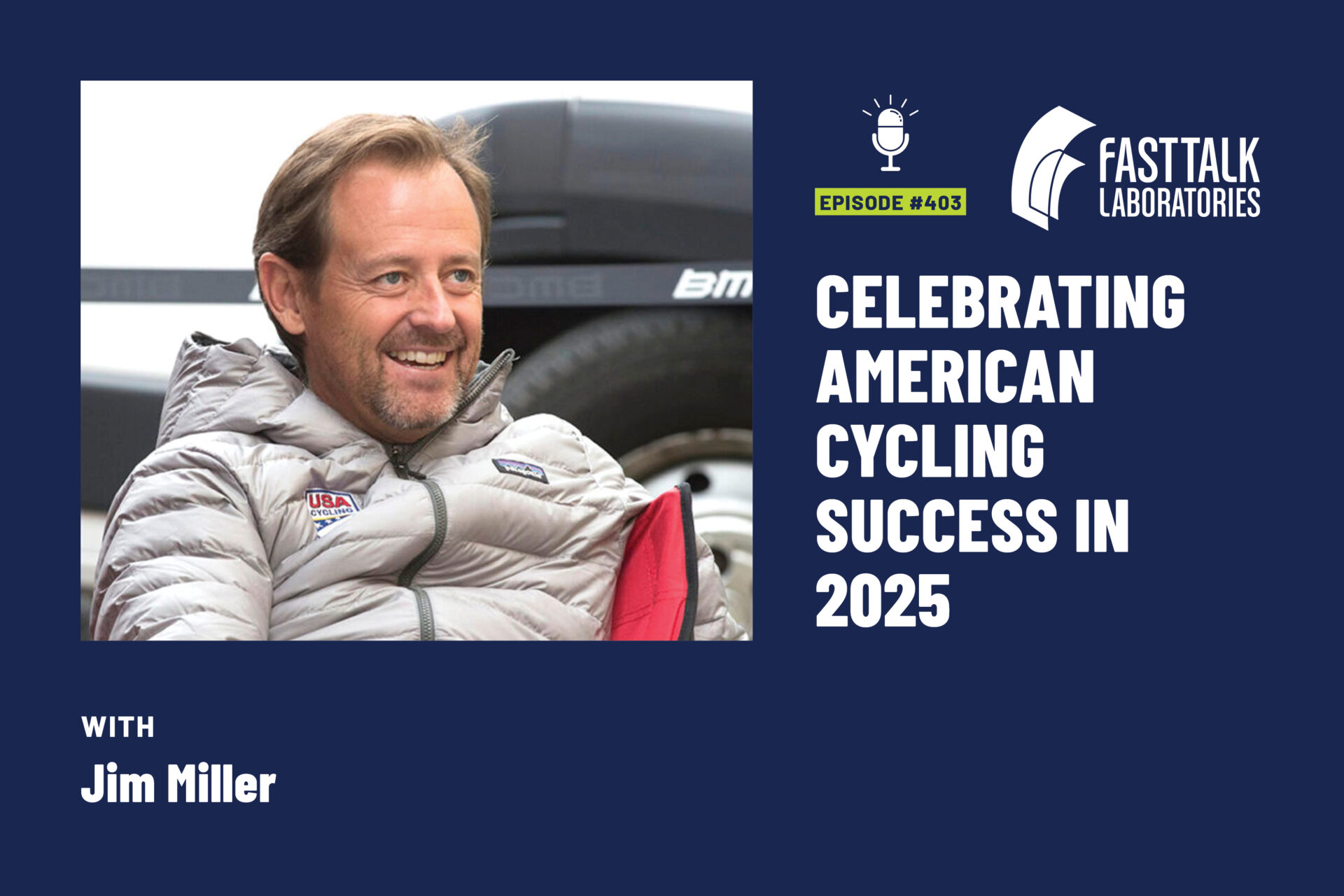






Across cycling disciplines, American riders male and female had exceptional success. USA Cycling’s Chief of Sports Performance details the highlights, addresses.
Episode Transcript
[00:00:00] Chris Case: Hey everyone. Welcome to another episode of Fast Talk, your source for the Science of Endurance performance. I’m your host Chris Case here with Trevor Connor. As a fan of American Cycling, there was much to cheer about in 2025 from the historic season of Christopher Blevins on the men’s World Cup mountain bike circuit, to the incredible performances of American juniors on the world stage.
There were too many highlights to list our guest today. Jim Miller, USA Cycling’s Chief of Sports Performance makes a valiant effort to do so. However, while you may have heard Jim on the show before discussing physiology or training principles today, he wears his team manager hat and discusses both the many successes of American cycling and some of the prevailing headwinds that are disrupting progress for the various cycling disciplines.
We also explore the why on today’s show, what’s driving today’s success, and what is USA cycling doing now to ensure that these successes are sustainable? Finally, Jim brings out his crystal ball to share some of the names he feels we’ll all be hearing about and talking about for the foreseeable future, the next generation of American All Stars.
So cheers to 2025 and here’s to many more good years of American cycling success. Let’s make you fast, Jim Miller. Welcome back to Fast Talk, Chris. Trevor, thanks for having me. You know, we um, got a press release from USA cycling not too long ago talking about all the highlights of the 2025 season across disciplines.
Has this been a banner year for USA cycling, would you say? Is there. More talent now than you can remember in recent years.
[00:01:47] Jim Miller: We have a good collection of talent. I think it’s been a really good year. I don’t think it’s been a banner year, but I think it’s been a really good year. Coming off of Paris year one of a quad.
Can look a lot of different ways, and this year actually looked pretty good. So for year one of a quad, you could say it was banner year.
[00:02:05] Chris Case: So I just wanted to hit you with that question because it’s all relative and you have been on the show before to speak with us more as a physiologist and a coach, but you’re.
The performance director of USA cycling and have been for a really long time, and I feel like today you’re gonna be wearing that hat far more than the other hats that we’ve had you wear, so to speak. And maybe we talk about some highlights, but I also want to have you pull back the curtain a little bit if possible, to help us understand.
What you do, why things are the way they are now, if those are based on decisions you made a decade ago and we’re just seeing the fruits of your labor now, or if it’s chance, look, whole host of reasons. So that’s where I wanna take this conversation
[00:02:54] Trevor Connor: and Jim. You’re the head of high performance, your CEO might be listening.
Your answer was supposed to be, this is the greatest year USA cycling’s ever had.
[00:03:03] Chris Case: He knows,
[00:03:04] Jim Miller: I will say it exactly like it is
[00:03:07] Chris Case: and that’s probably why he keeps you around, right? Yeah. He likes your honesty. Probably. Probably. Well, tell us a little bit more about what. You do? You said before we started recording.
Oh yeah. I get to talk about my day job now. So for people out there that don’t understand what it means to be the director of high performance at USA cycling, just give us a brief glimpse of that role.
[00:03:32] Jim Miller: Easiest way to explain it is it’s like a general manager of. Team or an athletic director at a university.
Not as sexy and as fun as it might look like. It’s a lot of budget spreadsheets. It’s a lot of riding. It’s a lot of managing stakeholders. It’s a lot of doing things that aren’t entirely fun or exciting,
[00:03:51] Chris Case: but you’re also looking for talent and scouting in some way.
[00:03:56] Jim Miller: Yeah, ultimately this job, you create a lot of standards.
You create a lot of operating procedures. You create a lot of processes. You create a lot of way things are done, or way teams or coaches or discipline directors go about their jobs. How we go about athlete selection, how we go about. Developing a budget, how we go about creating programs, investing in programs, dein, investing in programs, all of those things that sucks up probably 90% of my time.
[00:04:26] Trevor Connor: Question I have that I’m quite interested in is how much of the job is about developing new talent versus letting the new talent identify itself and then providing them with opportunities.
[00:04:38] Jim Miller: I would answer that in a couple ways. One, we’re a big company, good sized company in terms of sports or sport performance.
We’re a pretty large sized organization. We oversee five disciplines, road, track, mountain bike Cross, BMX. We actually oversee eSport. We’ve recently taken on para cyclings. Now we oversee para cycling. Any one of those teams alone is pretty robust with talent id, talent integration, juniors, U 20 threes, elite components, and each of ’em are in different states of evolution or development, right?
There’s times where take a track team, you can have a really well developed track team. Performing, create a lot of metals at the elite end, and your requirement for development on that is less. And then there’s times where you don’t have the elite performers and you have to focus on development. So each of these disciplines all function independently and separate based on where they’re at in the process.
But then you also have these metal goals that you agree with. In partnership with U-S-O-P-C, we develop metal goals. We use a metal expectancy algorithm that we developed that. I’ll give you a snapshot at any given time of your probability of metals. And so if you’re chasing a certain metal count and you have an idea how you’re gonna get there, you may be investing in more in that and less than something else.
At the end of the day, there’s not a infinite pool of money. There are resources, which a lot of people would say bad. I of course would always like to spend more money. But at the same time, when you don’t have infinite resources, it forces you to be really laser focused on what you’re trying to accomplish and what you’re trying to do, and actually forces you to be better at what you’re doing because you can’t just take shots in the dark.
You have to have a plan. You have to have a strategy. You have to have way markers, mid points. You have to understand whether or not you’re tracking in the right progress or not. And at every stage you have to make a decision. Do we continue? Do we stop? So I would say that it’s all the above. It’s, you are always gonna have great athletes that percolate up and you can just put ’em on any bike and they’re gonna win.
And then you have athletes that aren’t obvious that you have to develop and 10 years from now they win.
[00:06:41] Chris Case: So if you don’t mind, let me bring it back to where we started a little bit. I maybe erroneously said it could have been a banner year, but I’m looking at it as a fan of the sport and I see Chris Blevins dominate mountain biking like No American has in a long time.
And on the road you’ve got ever and you’ve got. Road cyclists performing week in and week out in different roles. You got good climbers, you got good domestique that are just crushing it. You got people in breakaways all the time. So from a fan point of view, I feel like it was a really good year. You have a different perspective here, so if you wouldn’t mind from your point of view, why was it a good year but not a banner year?
Give us that recap from your point of view of the highlights and maybe where it didn’t meet expectations.
[00:07:31] Jim Miller: Yeah, and I’m definitely looking across the board, right? I’m looking at five different disciplines, and I’m looking from juniors through elites. Did the junior program perform? Did the U 23 program perform?
Did the elite program perform? If not, at least we run good development teams, good developer programs. We’re developing athletes. Are they progressing? Are we on the right trajectory? Are we on the right track? So I don’t look at it across the board and everything, believe it or not. I’m actually a huge fan of this board as well.
I would probably do this job if they didn’t pay me. ’cause I like it so much. I wake up and I watch bike racing.
[00:08:02] Trevor Connor: Again, be careful. Your CEO might be listening,
[00:08:07] Jim Miller: but I would, and I love watching bike racing and not just for in the last 40 k, I’ll watch 250 k of a men’s race. I do not wake up at 3:00 AM to start with 250 K men’s race.
And I’ll tell you that. I’m happy that I catch it at a hundred K. But yeah, to all those things, I think like the men had a really great year. Men’s Road had a really great year. Nielsen Palace, McNulty, Mateo, Ello Simmons, all really good, right? Somebody was constantly performing. That was awesome. It was super fun to watch the women’s side, like got really worried about women’s road racing right now for America.
But I also would put a star against that in it. This is where I developed, and this is where I came up to, the sport, was Women’s Road. And so my expectations of what we can do, where we’re at, what we can win is always gonna be really high. And right now I think we just have a handful of women in the world tour.
It’s really hard to find opportunities for ’em domestically. There’s not great options, just the racing scene alone. You have teams that certainly provide great options for them, but you don’t have the racing that exists like it did 10 years ago. So I always worry about that. Are junior men. Junior women in Europe did a great job on the road.
You would never hear that. You’d almost never find junior race results, but a really, really good crop of junior men and a really good crop of junior women coming up on the mountain bike. I mean, Blevins had, I think, probably arguably the best. US men is bound by year, ever. Mm-hmm. This is absolutely phenomenal.
It was incredible to see him at the front of the group every single week. And short track is one thing that’s very tactical. It was very short. It’s high power. His one minute power is beyond world class, so he’s always gonna be good there. And he’s tactically very smart, but he was doing it XCO too. So it wasn’t like this was.
Just through XCC, you have RI Amos and Bjorn Ri, who’s first year elites, and you know, by all standards, they had a typical first year elite sort of results. Doesn’t mean they’re not good, it’s just that it’s a top progression from U 23 to Elite Mound bike racing. It’s a big leap. It’s a big leap. They were really good.
You have some juniors in U 20 threes coming up underneath them that are really strong. The women’s side, you had really good mound bike race results. The IL Haley didn’t race as much this year as she had, but you throw Haley back into the group with SAF and you’ve got pretty good combo. Gwen is generally really good.
Didn’t have a great year. Made some changes that didn’t work out but corrected those. I would expect her to be racing the front of the group. And Mattman Road is a first year elite, I thought made exceptional progress every single week. She was a little bit better, a little bit better, a little bit better, a little bit better.
But at the end of the year, you could say, well, you know, her best result was somewhere around 15th. I don’t remember exactly what it was, but her progression for race, to race to race was better and better and better. And you love to see that. Kelsey Urban was super rock solid. So yeah, like in that regard, it was really good.
Talk about track for a second. For a physiologist in cycling track is the ultimate laboratory. You have so many controls that you can control. You basically know what you can do before the race starts and it’s just about executing. So in terms of like just a physiologist sort of perspective, you would fall in love with track.
We’ve put a lot of work and effort into track. Our women’s endurance program has always been pretty good. We’ve also done a pretty good job of crossing over athletes and talent transfer on that, and it’s just, you know, sometimes it’s good old fashioned college recruiting, but it’s been really hard on the Ben side.
They’ve got big contracts, they’ve got world tour teams that just are resistant to anything outside of their ecosystem. Not a lot of incentive first man to come ride men’s track unless they really are just diehard crazy about Olympic medals. So that recruiting has been much more difficult. We have a group of guys right now that have broken into the top four teams of the world, which is super, super hard and are legit like legit contenders.
None of ’em came from the road. Well, you could say Grant cos has, but domestic road. The other guys were a ski racer. A mountain bike racer, a foreigner with passport, et cetera. That’s legal. That’s fair play. But they have developed over like the last two and a half years to it. Point where they’re absolutely contenders in this arena now, and that’s really exciting.
Women’s Team Sprint, which you probably didn’t hear about, nobody would hear about they race so few times every year. Sprint Track is just a totally different beast. Heavy weight training sessions, heavy track training sessions. Their building blocks are just long and arguous, and they race two, three times a year.
That’s what they do. So when they come out and they have a good day, or they can come out and have a bad day, they may not get to correct that for 6, 7, 8, 9 months. Yeah. Down the road. Again, that would be tough. We started developing a sprint program with LA in mind in the fall of 2021, knowing it takes roughly seven years to develop a sprinter to be world class.
You just have to start. And this year they have their breakout ride. They won PanAm championships. Almost everything at PanAm Championships, A qualified fourth. The World Championships in Team Sprint, which is really awesome. They ended up finishing seventh or eighth, but probably the fact that they qualified fourth.
They were in shock. We were in shock. It probably didn’t lead to a great second ride, albeit their second ride and their third ride weren’t bad. So just how it goes. Mm-hmm. But yeah, like then we had a banner year. I probably just see the places where we missed that aren’t obvious. Didn’t do a great job and for me, this was between a good year and great years.
You were great across the board.
[00:13:23] Jared Berg: Mm-hmm. Fair enough. What if you could optimize your nutrition to perform even better in your sport? Well, you can. I’m Jared Berg and I’m a registered dietician and exercise physiologist With Fast Talk Labs, I can help you with your personal sports nutrition or you can take control of your own nutrition through my new eight week sports nutrition course.
Learn more@fasttalklabs.com. Look for athlete Services and Sports Nutrition.
[00:13:50] Trevor Connor: So the thing I’m interested in, ’cause I, I agree with Chris, you did have a ton of success here with a lot of really good athletes. How are you handling the challenge of discovering them, of developing them now? Because you said yourself, the US racing is not what it used to be.
We actually recently did an episode with Levi on that, and I’ll put that in the show notes for anybody who wants to hear our take on that. But you as high performance director, it feels like that takes a lot of tools away from you when you don’t have. A big domestic race scene to take these athletes to and to observe them and even to discover new talent.
[00:14:27] Jim Miller: Yeah, talent ID on the road right now is really hard. Talent ID on the mountain bike is great. Lots of juniors racing, mountain bike, lots of U 20 threes. Racing mountain bikes, that’s pretty easy, pretty straightforward, but the road is difficult. There aren’t that many races in America and there definitely aren’t that many stage races.
There aren’t that many road races. There aren’t that many UCI races. It’s become increasingly. More and more difficult.
[00:14:51] Chris Case: In your opinion, is it not the best approach to look at the aspect of the sport in the US that is thriving gravel and say, oh, they’re great on gravel, they ought to be great on the road.
Do you look there? No, absolutely. We look
[00:15:08] Jim Miller: there.
[00:15:08] Chris Case: Do they race
[00:15:09] Jim Miller: enough? Do they get enough racecraft? That’s a whole nother story. Right? Right, right. Mm-hmm. Do they have the skill set from racing gravel that transfers to road racing? You could say they have good skill sets. I could also say that descending at 70 80 K, 90 K an hour down a mountain is not the same as going around a left hand turn in Kansas.
[00:15:29] Chris Case: That’s right. I think that’s fair to say, not to criticize those riders because they are talented, but it’s not the same thing. You could definitely say it’s not the same. The same thing.
[00:15:38] Jim Miller: Yep. And we do look right. I mean, we hunt gravel races, we look at grand fonder results. We’ll look anywhere and everywhere there’s a race and generally if we.
Spine is 17, 16, 15, 16, 17, 18-year-old, under 23 rider. That is even remotely. Forward in the results, then we will dig a little bit further into their history and what they’ve done and where they’re at. I mean, you have to now, you just, you don’t have a choice. That’s just, you have to go where the racers are and where the racers are at and find them,
[00:16:06] Trevor Connor: which is getting increasingly tough, I have to believe.
[00:16:09] Jim Miller: Yeah. You know, road racing’s just not a US problem. This is not just a domestic problem. This is in Europe as well, and the scary thing for the sport is. That it is in Europe, right. If Europeans are starting to struggle with road racing and that goes into decline, then you can only imagine what that’s gonna do for the rest of the world.
[00:16:26] Chris Case: Right? Right.
[00:16:27] Jim Miller: It’s not in a great spot. The amount of races we used to have access to in Europe as a national team for U 23 for women for juniors would say it’s 50% less. There was a time where we actually raced three different programs at the U 23 level, and now we’d be hard pressed to get enough races.
Through the course of the year just for one team.
[00:16:46] Trevor Connor: Why do you think it’s declining? In Europe?
[00:16:48] Jim Miller: It’s the same problem. It’s just population density, lots of competition for roads, lots of competition for municipality resources, lots of competition. For local government support. It’s really the same challenges we have.
It’s, it is no different. Look at your own hometown and on any given weekend, there’s four or five events that you could go to, whether it’s beer festivals, art shows, triathlons, five Ks. Criterion or bike race, what you know, whatever it may be. There’s just a lot of competition or pressure for a little bit of amount of time to do your sport.
[00:17:19] Trevor Connor: Mm-hmm. Does that change your calculus? You said you have five disciplines, you’re not always focused on all five. My guess is 20 years ago they would’ve said, yeah, there’s five, but road is number one, is ro. Just being brought down a few pegs and saying, we really need to focus on the other disciplines.
’cause this might be where the future’s at.
[00:17:38] Jim Miller: Yeah, there’s some, there’s a couple changes with road, right? One, we look at it as a development discipline. So our role in this sport is juniors U 20 threes. I always refer to analysis or comparison. We’ll say junior program is like a, an honors program in high school.
Your U 23 program is a bachelor’s degree, and the whole point of going to college, get a bachelor’s degree is to learn enough that you can go a good professional job and continue developing. And you become who you do in your career. Bike racing is the same once they graduate from a national team and at the U 23 level, they’re looking for a professional job and there’s so much development that has to take place past their U 23 years.
That happens at a professional team. So our role on this is really just preparing them for that transition to the professional team. That has never changed. How we’ve gone about that and done that now has changed now with world tour teams. They’re grabbing juniors at 17, 18, signing ’em to contracts, 5, 6, 7 year contracts if you’re not identified as junior, it’s not to say that you can’t make your way into a world tour team after your year 23 years, but it’s not like it was 10 years ago where they would wait for you to go through your year 23 years before they signed you.
So it’s a little bit different calculus there. I would say with the Women’s World Tour as a national team, you can’t get into Women’s World tour races, so it eliminated 75% of the available races for a national team to compete in. So could you create a trade team? Could you create a national team? Can you get into the other 25% races?
That’s your best option. And if half of those say no, now you’re down to, you know, 12, 15% of braces are available to you, which is basically what it is. So I think how we approach that is, is changed based on what’s available and what we can do, what we can get into, or just the changing landscape of road racing in general.
[00:19:20] Trevor Connor: How do you feel about that with this kinda youth opening of the sport? And look, I was somebody who got into it at 26, and I was told as, as soon as I got into it, you’re over the hill and passed your time. Never got over that. I always said you can’t train age, but there have been a lot of great talents who got into the sport later.
Is there a risk of losing some of that talent? ’cause we’re so focused now on getting them young.
[00:19:45] Jim Miller: Yeah, most definitely. Right. I mean, that happens. I would even use a guy like Matthew, Rick Ello is a modern day example. Good junior. Did good races, had good results, made world’s teams. He was part of Quinn Simmons, Magnus, Sheffield era.
You knew their names five years ago. Most people probably didn’t know Matthew’s name until this year, but he’s a kid that just got better and better each year. You know that two to 3% growth. But if he didn’t have the opportunity, he would’ve never seen who he could become. Another great example, Mike Woods coming up through Rally, right?
Came as a runner after college. He was probably 24, 25 when he got on the bike. Absolute world class motor. But his advantage was there were domestic pro teams, there was domestic series. He could learn his craft, he could learn how to race, and there was an opportunity for him that doesn’t exist right now.
So is it the same opportunity now as it was? Definitely not.
[00:20:33] Chris Case: Do you think that to revisit the topic of the talent that’s out there now, and let’s focus mostly on Men’s Road for a second, just because there seems to be a crop of four or five, six, maybe more Americans right now who are all performing really well?
Are they performing really well because of something that USA cycling helped them do a decade ago? Is it hard to even pin down? Why? Is it case by case basis? Is it they’ve each taken a different path? Do you have any insight there?
[00:21:05] Jim Miller: Yeah, well, the one common denominator is they all. Came from the last generation of big development programs, both us and our national teams in Europe.
All of those guys raced with us as 15, 16 year olds in Europe. All of them raced as 17, 18 year olds. All of ’em raced as U 23 until we got into COVID. That was a deal breaker. COVID was a deal breaker for a lot of them. So I think this current group, they were the beneficiaries of the last. Great development program.
What we run now with this really good junior program, we still run 15 sixteens. We still run a really good junior 17, 18. It’s not as big as it was in terms of race days or numbers coming through the program. Unique numbers. But it’s still good. And then the U 23 program is really pared down to almost nothing right now, and that’s primarily because out of the juniors they’re signing with the world tour teams.
And really the only opportunity we have to race a lot of U 20 threes would be Nation’s cups, which are now open to world tour teams or world championships. So for the most part, they’ve taken over that U 23 development space.
[00:22:06] Trevor Connor: We came into this episode with this very positive mindset of. All the success that you’re seeing, and we’re talking about all the challenges instead and the state of the cycling scene right now.
So I guess my big question to you that I’m really interested in is how did you see this success? Despite everything, despite the
[00:22:27] Jim Miller: landscape, success always starts at the top right, and we have really good leadership, and Brenda knows this, I will not blow smoke up his butt, but he’s probably the best.
C-E-O-U-S-A Cycl act.
[00:22:38] Trevor Connor: You’re definitely aware that he might be listening to this episode. Yeah, exactly. Before he didn’t wanna get paid.
[00:22:44] Chris Case: Now he wants to
[00:22:44] Jim Miller: raise. Yeah. But he, he, he is put together a great executive team across the board. Her marketing, CMOC. She’s COO, now COO launch, the CMO, the best we’ve had by far.
Super engaged, super involved. East Breeze Leaps, thinks about membership, how to grow it, how to provide more value, how to create opportunity. She’s got a great team underneath her. We have a new foundation director that came on this year. She’s super good professional fundraiser, very capable. We just have a really good executive staff and they care about this sport and they want to see it grow and be better.
I think he’s done a great job with that. Consequently, each of us wanna be really, really. Good at what we do. We wanna be great. Like I didn’t do this just to pay bills, pay a mortgage. I work way too hard for that. And there’s easier ways to make money than this. I really wanna be great at this. I wanna be great at developing athletes.
I wanna be great at running teams. I wanna be great at my day job, which is sports administration. And when the U-S-O-P-C looks at their entire portfolio of NGBs, I literally want them to say the best high performance director in all of our portfolio is Jim. I mean that, that’s what I want them to say and recognize.
So I think Brenda’s done a great job of allowing us to be who we are and make decisions, but also because of it, we want to be successful. We wanna work hard to do right by the sport.
[00:24:02] Chris Case: I’m curious to know, based on the answer you just gave, we recently had a conversation with you about tools, AI specifically.
[00:24:11] Jim Miller: Mm-hmm.
[00:24:12] Chris Case: How is that making Jim Miller a better high performance director? How are you using ai?
[00:24:17] Jim Miller: Yeah,
[00:24:17] Chris Case: AI’s gonna be crazy.
[00:24:19] Jim Miller: It’s not right now. I had to give a talk in Silicon Valley a month ago titled AI in Sport, and I started off with number one. I don’t know how in the hell I got invited to talk about AI in Silicon Valley.
And number two, after talking to a ton of people about this, what I realized is AI in sport is. Basically like high school sex. Everybody’s talking about it and nobody’s really doing it.
[00:24:43] Trevor Connor: That’s the first I’ve heard that
[00:24:45] Jim Miller: one. So, I mean, we’re all trying. We’re all trying to figure out how to use it, how to learn it, what to do with it.
We actually have initiative that we call USAC ai, and we’re developing a chat engine open. AI helped us get going on it. They provided some engineers to teach us how to do it. A bunch of API integrations. Now that is pulling a lot of data from everywhere, from races go on and on about it, but we’re creating the database.
AI really is a database, right? If you don’t have the database, it’s not really ai, it’s just reading something and we’re starting to challenge it to do things. For us to function, what we have done is has it to create, and we’re not using it, but we’ve asked it on the side to create selection criteria. For example, here’s a course.
Here’s the requirements, here’s the outcome we’re after. Create a selection criteria for this. At the same time, we’ve asked it to make selections. We’re not using them live, but we just wanna see how they compare to the actual living human beings. Make a selection for this event. Here’s the selection criteria.
Here’s the race results. Here’s, you know, a bunch of inputs, and we’ll spit out the selection of the nominations. Plus the data set to support those nominations, and it does it in about three minutes. Vice versa, the human we’ll spend first selection of the better part of the week or more, putting together the appropriate data to make an argument for a set of nominations.
And it’s a significant amount of work. So if you can take, let’s say seven days. To 10 days of work off somebody’s plate and you can do it in three minutes. That’s just a force multiplier of what that person can do. So we’re working within that fashion. We do create a lot of performance models. I think a lot of people would say that is ai, but it’s not AI performance models.
We develop. It’s more machine learning. You create all the inputs, you create all the coding language you need to, for it to function the way you want it to. And then you can run a ton of scenarios.
[00:26:37] Chris Case: When do you project that AI will be used more heavily or do you have a goal in mind of when you’ll use it?
I think
[00:26:45] Jim Miller: when we’re uber
[00:26:46] Chris Case: confident.
[00:26:48] Jim Miller: Gotcha. That it function works the way we want to, and it’s not a Waymo that just makes a right hand turn for no reason. Right.
[00:26:55] Trevor Connor: That was exactly the question I wanna ask you is you can certainly get it to give you recommendations. How does it compare? Like I look at somebody like you who’s been doing this a while, you must have a very good sense when you work with an athlete of, yeah, this guy’s gonna go all the way, or he probably won’t.
She’s gonna be a world champion. I’m sure you just have built this sense for seeing these different athletes. Can the AI compare to that? Do you look at the air and go, yeah, no, it’s got it better than me. Well, it’s
[00:27:22] Jim Miller: going to be eventually. I don’t think it can do all of that now, but it certainly can save you a lot of time, a lot of research, a lot of data crunching right now.
I think as a tool that saves time. You know, at some point it’s gonna be. A good analogy is a fighter pilot in a next generation plane, right? The player’s probably doing the majority of the piloting, but you put that tool in the hands of a very skilled fighter pilot and you’ve got a very capable combo. I would think that AI gets to the point where you put AI in the hands of a very capable coach, and now rather than monitoring seven metrics, maybe you can monitor.
67 metrics and get warning signs that, or suggestions on what you do, et cetera, et cetera. And it’s probably doing that a little bit now. People are probably figuring out how to do that now. Mm-hmm. Fair enough.
[00:28:14] Suzy Sanchez: Hi listeners. This is Susie Sanchez from USA Cycling For over a Decade Fast Talk podcast has brought the most interesting experts from the world of endurance sports into a conversation about your training.
If you like what you hear on Fast Talk, what about becoming a certified coach? USA Cycling offers courses for new coaches produced with expert help from Fast Talk labs. Learn about becoming a certified coach at usa cycling.org/coaches.
[00:28:40] Chris Case: At the top of the episode, I sort of hoped that you might pull back the curtain a little bit on what you do.
In this role of yours. Can you tell us what new programs, new strategies that USAC has employed or will employ that’s going to continue to move talent development forward?
[00:29:00] Jim Miller: So recently? I guess beginning of this year, end of last year, we’ve started to develop a team, what I call performance services. And this is a three vertical approach, medical, sports, sciences and tech and Inno, and we’re really going down this road.
Primarily because we used to lean on the U-S-O-P-C for your sport sciences. They’d really just provided a lot of services to NGBs for medical or techno. But as they sort of transitioned through their various phases of existence, the performance service provider or the sport science teams, they just got a smaller, smaller in there.
It got to the point where, look, you can’t. Win at this elite level without a pretty robust set of performance service providers, not having physiologists, not having nutritionists, not having psychologists, performance analysts, these type of roles. It is just, it’s almost impossible to win anymore without those.
So we have gone down the road of just starting to create our own team. On the medical side, we have a really great medical director, CMO, and Michael Rohan. He’s done a great job of building this medical advisory team around the country. We have discipline doctors and we have doctors in every discipline that are on call for that discipline at all times.
We have great injury management protocol. When somebody gets hurt, how they’re handed off, who’s taking care of them, who’s seeing next steps, who’s. Making sure that their recovery timeline is as expedited as possible. And then we’re starting to become very proactive on the medicine front rather than just reactive.
So doing blood work, monitoring blood work, making sure it’s happening every quarter, raising flags when necessary, talking to coaches, talking to directors about an athlete’s current status. It’s been a really big program to get up and running, but it’s really, I think, a good program and will be an asset going forward.
On the sports science side, we’ve used a lot of U-S-O-P-C practitioners. There are fewer and fewer. We’ve done a lot of contract work, but it’s always just project based. Somebody who’s embedded in teams and you need these people embedded in teams. So we’re building that out. We have a really talented leader of that team, PhD physiologist from Lees Beckett in the uk, guy named Hayden Allen Young, very energetic, has spent time in the GB program, but also is like very keen about learning BMX, mountain bike, road track, et cetera.
And then he’s, you know, collectively putting the right. Components into each team for those teams to be successful. And then at this tech and annual project is turned out to be really great. We had a data analyst who just recently left Budda wt, but brilliant upon brilliant. Started developing all the performance models for our track programs and time trials began, build databases around metal expectancy, USAC ai.
Things of this nature. And we’re able to parlay that into partnership in Silicon Valley with a bunch of tech leaders. And we’re talking like chief level, senior VP level of companies, you know, exist. Mm-hmm. And we literally cold called like nine of the biggest tech names you could imagine. Asked ’em if they wanted to have breakfast and they showed up at a eight o’clock breakfast on a Thursday morning and we’re like, how can we help?
And number one, I couldn’t believe they replied. Number two, I couldn’t believe they showed up. And number three, I couldn’t imagine that they would stay engaged. But we have a really incredible community out there now that is, we basically give them a problem and then they go to work trying to solve it.
So that’s been really cool within our tech and Inno vertical that I throw in aerodynamics into that equipment optimization or innovation. And we run a really big aerodynamics program. It was directly responsible at five of the six medals in Paris. We put a lot of effort into it from athletes positioning, equipment choices, equipment innovation to prototyping, skin suits, textiles, everything that you could possibly think of.
I would be willing to bet that we’re probably doing this at least as well as half or more of the world tour teams. I don’t think there are very many people doing it better than we are. And then we started to include women’s female. Physiology, female sport science women have won majority of our Olympic medals.
They’ve carried the water force for the six Olympics I’ve been at, and probably longer than that. If you go back to Sydney, Atlanta, Barcelona in 92, they win a majority of all the medals and most physiology, or most coaches, everything they understand about the sport is based. On male physiology and male testing and male research.
So we started working with this Stanford Faster group to bring them into our performance service team and to provide a resource to our women through that team. That’s been really cool under the covers, but could we have a lot of really great projects happening and going that will directly benefit elite athletes?
It’ll directly benefit developing athletes development programs and hopefully make us better all the way across the board in all the disciplines.
[00:33:53] Chris Case: We drifted into a bit of a concerning conversation in the middle, but those are pretty damn exciting aspects programmatically to USA cycling. I’m also curious to hear, because you’ve mentioned the juniors that are up and coming.
In the sports across the sports. I’m hoping you could just shed some light on the top five, 10 names that people should be looking for in the results in the next 10 years, if you will. Five years
[00:34:20] Jim Miller: at the top of the list. I would put Ashland Barry. If he’s not beating really good guys next year, he will most definitely be doing it in two years.
[00:34:27] Chris Case: And for those who don’t know, what discipline is he riding in?
[00:34:30] Jim Miller: Ashlyn Berry is a road racer and a track racer. He’s the son of Michael Berry and Deedee Berry. So, you know, rule number one, choose your parents wisely. Can’t
[00:34:40] Trevor Connor: do much better than that.
[00:34:41] Jim Miller: You can’t do much better than that Enzo Hin cap. There’s just a really good group of junior men coming through right now.
On the junior women’s side. I think a really exciting writer that probably nobody heard of is Girl by the name Emma Jimenez Paolos. She had a French passport, Spanish passport, and a US passport. And chose to race under the US passport. Fortunately for us, but I also think that had to do with the junior programming we had available.
It wasn’t as if she just chose the passport. She certainly interviewed each country to determine where she was going to race under really talented rider, she was, if I remember correctly, second in the individual pursuit at Junior Track Worlds. I think she won the scratch and was probably fourth in the Omni or something.
She’s 18 years old. Maybe she’s 17 this year. She’ll be 18 next year. But I would. But she has a good crack at making Olympic team in 28. Mm-hmm. I think Vita Lopez, San Ramon is really talented and really good. She could probably race three bikes. She could probably race, road, mountain, bike, and Cyclecross and choose which one she wanted to be successful at.
She was second this year in U 23 Worlds as the first year, which is exceptional performance. I think it ended up maybe third in the overall World Cup. So that’s really exciting, especially if you consider the elite riders above her that exist. And you put another great mountain bike rider in the pool.
That’s really exciting. That’s such a tough question ’cause the names just are flooding and then I can’t remember all the names. We have a couple junior women on the BMX. Race bike that are going to be world beaters. I would give them five years before they’re really world beaters at the elite level, but they’re really good, really talented.
[00:36:15] Trevor Connor: I’m sorry, Chris, you didn’t make the list, but I’m still watching you. Yeah. Passed my prime
[00:36:20] Chris Case: I think, at this point.
[00:36:21] Trevor Connor: Yeah. Well, that kinda leads to the question I want to ask for any of these younger writers who are listening and have been wondering, and I’ll tell you, I. Do this group ride every week here in Boulder and there’s a bunch of these young 20 somethings on that ride.
We every week go and hit some big climb and these guys are beating Suses records up these climbs, and I know Strava records don’t make you a world tour rider, but when you can do times like that, you should be at least a cat one, cat two racing the domestic scene and seeing if you have that potential.
When I talk to them about it, they’re always like, oh, I don’t have a race license. I, I don’t even know where to start. Are there local races? And it’s kind of painful to see guys this strong that they’ve never done a race. So since, as we said, there isn’t as much of a race scene here, what are your recommendations to those young riders to get noticed and hopefully get into this great system you’re building?
[00:37:18] Jim Miller: Yeah. Well, first thing I’m would say is always go to the website, right? Go to usa cycling.org. There’s a menu tab called Team USA that has a dropdown that lists every discipline. Click on the discipline you’re interested in, and there’ll be a a event selection dropdown that comes from there, and that will tell you how to get invited to anything from a training camp, to a trip to Europe, to 1516 program to 1718, et cetera, et cetera, et cetera.
How do you qualify for ’em? Continental Championships, how do you qualify for world championships? How do you qualify for Olympic games? So every single discipline will have that listed out within their discipline underneath Team USA on how that happens. I would say for coaches that listen to this, ’cause there’s a lot of coaches, you should also go there and read this.
You should be able to advise your riders on how this happens and how this works. It’s not big of a mystery as sometimes people like to make it sound like. A lot of times they just have not done the research themselves either. So always go there. Second, if you’re racing domestically, there are limited spots, right?
It’s not like we’re taking 70 riders to Europe. We’re taking sometimes less than 10 in a discipline through the course of a year. Other disciplines may be a bit more 15, 20, but the unique numbers aren’t high. So performing domestically is the first step, period, and it is discipline specific. So how you get into a track program is totally different how you get into a road program.
[00:38:34] Trevor Connor: So do your research.
[00:38:36] Jim Miller: Yeah, absolutely.
[00:38:37] Trevor Connor: So Jim, you’ve been on the show before. You know the way this works. We finish out with the one minute take homes where you have approximately a minute to give the most salient point that you want the listeners to take away from this episode. So let’s let you go first.
[00:38:52] Jim Miller: Oh man. Where does American cycling go from here? I’m really confident in speaking for our team, for my team, for my colleagues, that we really have an exceptional team that is working really hard at USA cycling. When I say they eat, breathe, sleep, obsess over how to make this better. They literally do.
Nobody’s asleep at the wheel. Nobody’s asleep at the helm. Everybody is striving to be the very best they can in the portion of the company they represent. And that if things aren’t getting done or things aren’t happening the way somebody would like them to, it’s not because they’re not trying or we’re not trying.
We’re absolutely trying, but some of these problems are very complex and very difficult to figure out.
[00:39:30] Chris Case: Fair enough. I think that both the. Programmatic side of things and the talent side of things is exciting. And honestly, not to stroke your ego too much, Jim, but I have a lot of faith that you are the man for the job in a way.
Like you wake up thinking about this and you go to sleep thinking about this, and you’ve been doing it a long time, but you still have the enthusiasm. So I. I mean, no pressure, but I expect great things from you and the rest of the team, and I trust that your opinion of these other folks that I do not know is sound.
So I’m excited to see where we can take all of this enthusiasm and run with it.
[00:40:08] Trevor Connor: I’ll start with, since we’ve established that Brendan might be listening to this episode, Brendan, Jim’s doing a great job. Yeah. Moving around. There you go. But actually, that’s not too far off of my take home. What I found really interesting in this conversation is.
Chris and I created this outline and it was this very positive outline about all the success that we’ve been seeing at USA cycling this year, and I was kind of surprised in the episode that what we really ended up talking about is all the challenges, you know, the decline in the cycling scene, particularly with Road, which, you know.
We’ve avoided saying it, but you kind of said it. It’s dying. That that might be the word that we have to use now. But despite all this, we’re seeing the success and I think that’s a, and I know you’re gonna say it’s an entire team and there’s probably a lot of truth to that, but just kind of credit to working in a very tough landscape.
Building the sort of success that you are. The great job the team has done. And to Chris’s point, yeah, I’m sure athletes out there are saying, well, I got overlooked and why aren’t you paying attention to me? But just think about all the challenges they have to face and go to the website, do your research, and get yourself noticed.
They’re doing a lot with, not a lot to work with.
[00:41:23] Chris Case: Mm-hmm.
[00:41:24] Trevor Connor: So Jim. Thanks for being on the show. Thanks for having me, guys. Good takeaways.
[00:41:29] Chris Case: That was another episode of Fast Talk. The thoughts and opinions expressed on Fast Talk are those of the individual. Subscribe to Fast Talk wherever you prefer to find your favorite podcasts.
And don’t forget, we’re now on YouTube. As always, be sure to leave us a rating and a review. To learn more about this episode from show notes to references, visit us@fastdoglabs.com and to join the conversation on our forum, go to forums.fast. Do labs.com for Jim Miller and Trevor Connor. I’m Chris Case.
Thanks for listening.
I.