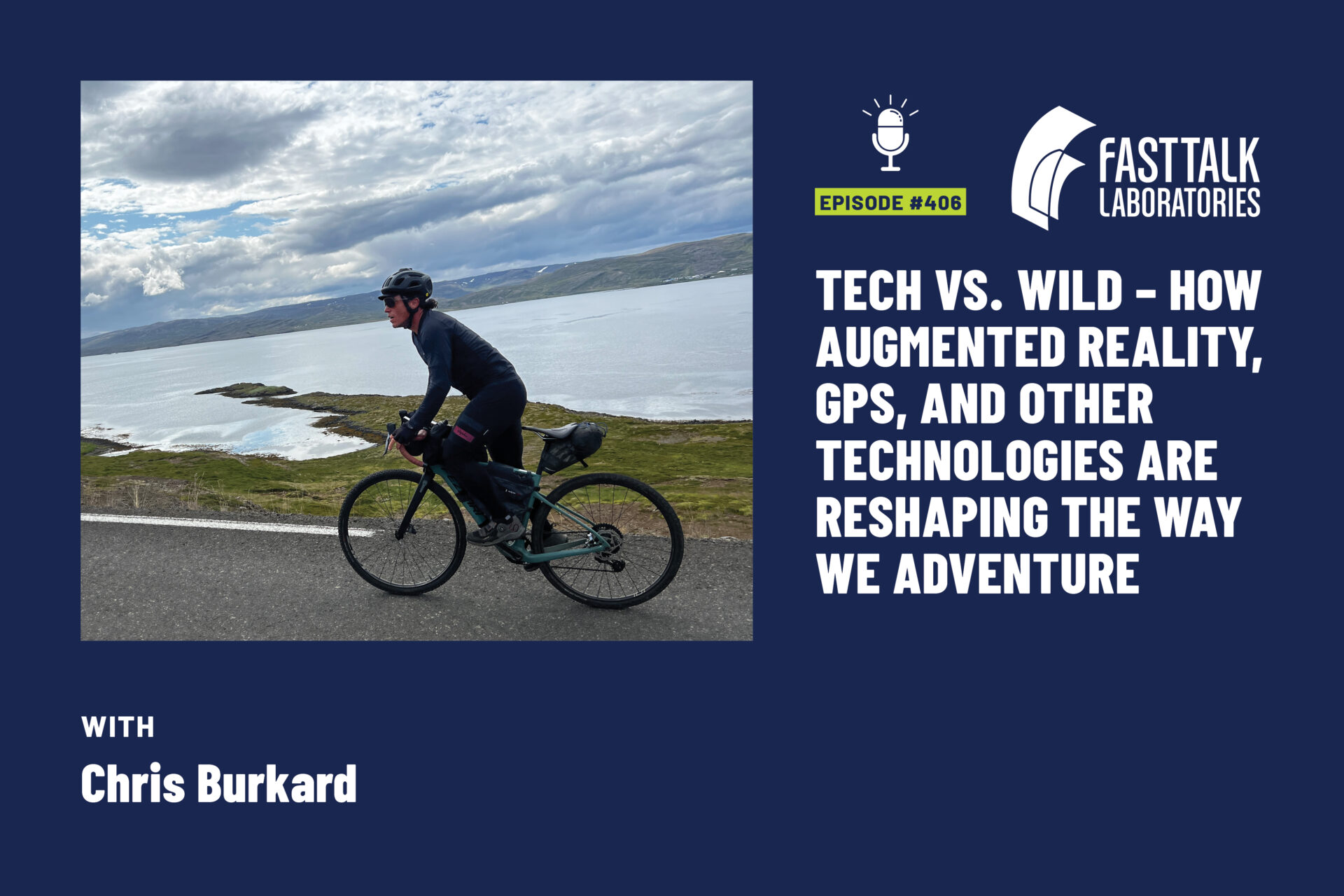






Technology has penetrated deep into the wilds of the world, be it with GPS, satellite communications, drones, or other forms of gadgetry. Adventure photographer and endurance athlete Chris Burkard breaks down how tech is impacting our wild sides.
Episode Transcript
[00:00:00] Chris Case: Hey everyone. Welcome to another episode of Fast Talk, your source for the Science of Endurance performance. I’m your host, Chris Case here with Dr. Griffin McMath. Emerging technologies, things like augmented reality or AR mapping apps. GPS tracking drones are changing. What it means to explore, take risks, and stay safe in the wild.
What are we gaining and what are we losing? Those are the questions we try to answer in today’s episode with the help of adventure photographer, filmmaker, bike packer, and endurance athlete, Chris Burkhard, known for pushing physical limits to tell compelling stories of wild places. Chris is someone I think is perfectly placed to help us understand where and when technology has a place in the wild and when we might be better off setting it aside.
I’ve ridden with Chris in his adopted home of Iceland, and I’ve seen him in his preferred element. The more raw it is, the bigger the smile on his face. So you might think that Chris is a minimalist when it comes to tech gadgetry outdoors. Not true. At least not always is ar turning us into smarter adventures or just passive consumers.
Has GPS made us overly reliant or given us a dangerous sense of false confidence? Are drones a performance tool or just a disruption? We’ll tackle all of these questions and many more, and then Chris will share his must have list of gear that he won’t leave home without the kit he takes when traveling with family to the slightly more robust setup that weighs him down on the most arduous of expeditions.
Some tech is just too good to give up. Speaking of technology and tools at our disposal. Today’s episode is sponsored by Met Pro, and in this episode we’re gonna talk about all sorts of different technologies and tools, and emphasize the fact that nutrition is often one of those neglected things where we don’t take advantage of some of the technologies.
But when we’re talking about big adventures, big days on foot, on the bike, out there in the wild, nutrition is extremely important, and planning ahead is extremely important. Trevor, what do you think about that? Would you agree?
[00:02:09] Trevor Connor: Yeah. I’ve said this before on the show. If I’m going to a crit and I forget my nutrition, who cares?
I’ll get through the race. Right? When you’re doing an adventure event like this where you’re often riding, running whatever it is for 10 plus hours a day, and you’re in the middle of nowhere, if you don’t have that nutrition dialed in, you’re not getting outta there. Mm-hmm. As a matter of fact, we had an episode while back now with Dee Grease Power.
[00:02:33] Chris Case: Yes. Episode 2 47,
[00:02:35] Trevor Connor: where she talked about winning the Ultra Ironman World Championships. And I remember on that episode she said that if she didn’t have her nutrition dialed in every single day, she wasn’t finishing the event, let alone winning it.
[00:02:47] Chris Case: Right. And that’s where Met Pro comes in. Yep. Helps you plan.
[00:02:51] Trevor Connor: This is what I like about Met Pro, and this is why we’ve brought them on as a sponsor of the show. I don’t think that generally counting calories works for people because it is reactive. You kind of eat through the day, and then at the end of the day you see what calories you ate, but it doesn’t prep you.
It isn’t planning, it’s reactive. What Met Pro does is take nutrition and turn it into a training plan. Which is something that we’re all very familiar with. So you map out your nutrition ahead, you prep your meals ahead of time, it sets you up for success. And for something like an adventure tech ride or race, it’s absolutely essential to have that all mapped out.
All planned out, know exactly what you’re gonna be doing, and this is the sort of thing that Met Pro helps you with.
[00:03:34] Griffin McMath: Mm-hmm.
[00:03:35] Trevor Connor: And remember, met Pro isn’t just the tech, it isn’t just an app. They have actual nutrition coaches there. So if you’re preparing for a big event, they’re gonna spend time with you, talking with you, and helping you figure out what is the perfect nutrition for that event for you.
Excellent.
[00:03:51] Chris Case: Well, right now Fast Talk listeners can get a complimentary metabolic Profiling assessment and a one-on-one consultation with a Met Pro coach. To build that perfect performance plan, go to met pro.co/fast Talk. That’s M-E-T-P-R o.co/ FAST. TALK and see what your metabolism is really capable of.
So let’s step back and assess how technology has reshaped what it means to be an explorer. Time to check the tech. Let’s make you fast.
[00:04:26] Chris Burkard: Hey, hey, we are here.
[00:04:28] Griffin McMath: Yes, we are here. And so excited to welcome one of the most special guests I could imagine having on Fast Talk. I am particularly geeked and stoked today and Rare.
We actually are able to talk to this guest when he is on US soil, which I feel like is not typical. Let’s do a brief intro from someone who got to ride with him recently in the flesh.
[00:04:54] Chris Case: Yeah. Excited to have Chris on the show as well. You know, a lot of people know him or think they know him because they’ve seen photos of his, they’ve seen movies of his, they’ve seen his very active social media posts, but I got to ride with him and maybe people are saying, why is this guy on your show?
Well, dude’s an athlete too, you know, he’s done Tour divide, he’s done Silk Mountain Race. He’s ridden across. Iceland in winter. You’ve done some stuff with Kurt Ref Snyder, some legends of bike packing. Yeah. I mean, you are an athlete, I would assume you think of yourself as not just a photographer, but an athlete, an outdoor adventure athlete.
And so we’re super excited to have a conversation with you about that aspect of your life, but also how tech integrates into your life as an athlete, photographer, and adventurer.
[00:05:47] Chris Burkard: So welcome, welcome to the show. Yeah, I’m stoked to be here. Honestly, it’s, for me, it’s like a real refresher and a reprieve to be able to have a chat, you know, specifically a podcast that’s not about photography, that’s not about kind of that part of my life, which is super fun and I love it to death, you know, making films and, and working on commercial assignments, but it’s that timeout in nature with friends, usually through sport.
I think that’s like where my passions lie. So I love geeking out on all aspects of what makes it possible and like stoked to be here.
[00:06:17] Griffin McMath: I think one of the things that made you an especially compelling guest for me, when we come to the topic of adventure athletes and tech and what that kind of intersection looks like, you are someone who has access to some of the most amazing gear possible for some of the most remote destinations and some of the most rugged conditions.
You also have one of the best attitudes and maintain an amazing level of stoke no matter what, but known for pushing physical environmental limits, telling compelling stories. Regardless, we figured that if anyone had great insight to how tech is starting to impact those who are adventure athletes and what that looks like, it’d probably be you.
[00:06:59] Chris Burkard: Absolutely. Yeah, that is an interesting intersection because it really does combine both parts of my life, right? And there’s the conversation around documentation, like media within the adventure athlete space, and that certainly we all know that’s been hugely impacted by tech. You look at what’s possible on an action camera or a phone or a tiny little point and shoot camera these days, and how feasible it is to document your own experience, tell a story from those environments.
That alone to me is super significant. And it’s actually changed the way that I’ve been able to do my job too, because in the past, if I wanted to go make a cycling film that was an adventure film, you’d really need to have proper cameras, bigger, larger cameras with you at all times. And that’s just gonna slow down the process, make it quite a bit more challenging.
But now with the capabilities we have in such small packages, most of. The experiences I’ve had way out in the boonies wherever, and I’m filming it or I’m documenting it, it’s with something really tiny. It’s with something micro, you know, a Sony RX 100, this point and shoot camera that you would, you know, 10 years ago you would’ve needed something massive to do that.
So I am constantly blown away. So there’s kind of that portion of it to answer that question. But then there’s also sort of the side of things where you know, that we’re maybe more aware of the monitoring of basically everything we do, right? Whether it’s the whoop, or whether it’s the chorus, or whether it’s our steps or our heart rate.
And then when you think about the fact that at the end of the day it can spit out a score for you is really fascinating. And. I would say when you couple that with the constant glucose monitors, that’s the most exciting place I can start to see the advances. Because as someone who has been on these long, longer expeditions or places that are, you know, they’re asking a lot of your body in your mind, whether it’s cold or whether it’s really hot.
A lot of times where I always feel the most intrigued is how I’m fueling. For this trip, really efficient. So what I’m getting at here, this whole full circle thing, is that I’m really excited for tech to be able to inform us in real time if what we’re eating is actually fueling us, is actually helping, right?
So when you think about having a constant glucose monitor and you think about having all this documentation, whether it’s a phone or whether it’s an app that’s connected, you’re out there doing some, you know, 16 day bike packing trip or race or whatever it is, and you always start to wonder like, wow, is what I’m reaching for at the gas station?
Or the thing is this, are these the best options? Obviously not right, but if you can get some real time data, that’s super exciting.
[00:09:28] Chris Case: I wanna hit you with another question. This is probably jumping ahead a little bit, but I feel like it’s the place to ask. I can tell that you are a fan of technology, you use it constantly in your job being as a photographer, filmmaker, content maker.
Do you ever just put it down? Do you ever put down the technology and say, I don’t need to take this photo, I just need to take in this view because the technology is distracting me from the experience.
[00:09:56] Chris Burkard: You know what’s interesting is I think that, you know, we are all. A byproduct of how much time we spend with that equipment.
Right. And I realized that for some people having a phone with them or on them or like documenting with their phone, that is almost like abrasive to the experience for me. Being used to going places with a backpack that’s like 60 pounds full of heavy metal and lenses and everything and film cameras.
When I don’t have that, this is like, this feels like nothing. You know what I mean? So, right. I guess what I’m pointing out is like I really appreciate the times that I get to put my camera down. I really appreciate the times I get to put technology down and I actually find that that trans mutes, you know, all experiences, if every time you go and ride your bike or you go for a run and you are constantly interpreting.
How well you performed by looking at numbers. I really think that people are setting themselves up to have a slightly unhealthy relationship with that experience. That’s just my personal opinion, because if it’s always calculated and calibrated and there’s always a finish line or a goal, you really truly miss out on the fact that in the beginning it wasn’t about that.
It was about just fun. It was about joy. It was about escape. It was whatever, health, I don’t know. But for me, it’s the same thing with photography, right? Like I’m speaking from that experience where having technology around me all the time. When I get the chance to strip that away and pause or reflect a little deeper on what is in front of me, it gives way to something really important, which is experiencing what is happening and not just clicking the shutter or documenting it or looking at it with a critical eye, which people kind of forget about that.
When you get to look and appreciate something for just what it is, and you’re not trying to think about how you can best filter it or experience it or document it or this and that. Like it’s a challenging thing. You know, I go to a concert, my favorite musician of all time, and if I’m shooting a photo, my whole focus is shooting this photo.
It’s almost hard to take in the other auditory experience because you’re too focused on the visual experience, right? So all I’m saying is like, that’s the difference, right? It’s like sitting there in a seat enjoying it or working, and I. Feel like yes, learning to actually put the camera down and experience something has been probably the most important lesson that I’ve had to learn in the last 10 years.
By doing so, it’s really informed my ability to, I think, tell more meaningful stories because I’m experiencing that. But I also think what happens, and I’m just speaking to photographers here mostly, which is that in the beginning you don’t feel safe putting it down because you wanna make sure you’re getting the moment that you need.
[00:12:37] Chris Case: You don’t wanna miss it.
[00:12:38] Chris Burkard: Yeah, exactly. And then as time goes on, your, your experience builds and you kind of know, and it’s the same thing. You know, you go on a hard bike ride, you don’t always need a watch to tell you that it was hard. Sometimes you can just know it’s actually maybe. Cooler to do that because it informs something different, reminds you that you are in tune with that experience.
So yeah, that’s kind of how I look at it. It’s critically important to what I do, for sure. Hmm.
[00:13:01] Griffin McMath: I love this question because to me, nothing better symbolizes this, and to me, I see you in this exact scene. It’s the Sean Penn scene in the movie Walter Mitty and Sean Penn is this adventure photographer, and he sees the thing he’s been looking for and the magical shot that he is waiting for happens and his character’s.
So in awe of it, Ben Stiller’s character goes, why are you gonna take the picture? And he goes, sometimes that actually ruins the moment. And he puts this mega camera down and he says, just appreciate it. And also it’s like one of the best soundtracks ever, in case you like Jose Gonzalez. But going back to this, I think before we dive into the future of tech and what’s rolling out right now, because you’ve had such a.
Beautiful career speckled with all of these different tech advances, some of the ones you’ve already mentioned. I’m kind of curious to see if we can just do a quick, are there any tech advances in the last couple of decades that you can say, I remember when this came out and this is the change it made?
[00:14:00] Chris Burkard: Yeah, absolutely. I mean, the GoPro twice, specifically the action camera, the birth of the action camera, I remember that pretty vividly, only because it was a really interesting time in photography because prior to that moment. You really had to have a waterproof housing and a camera to go in the water to shoot anything or, or to be able to shoot in kind of those harsh environments, whether it’s snow, whether it’s water, whether it’s like dirt and grime.
So the birth of the action camera changed everything. I mean, it was wild. And every company had one. Sony had one and dj I had one, and, and yada, yada yada. And so that now is its own category. That was never even a, a category before, never even a business. Now it’s like there’s like thousands and thousands of jobs, right, that are dedicated just to that space and millions and billions of dollars.
So interesting to me ’cause that they didn’t just like change photography, but it changed the whole media market and filmmaking and everything, and the far reaching effects of that. We’re probably the most significant in the last 50 years in photography. That’s significant. And then I would say like with that slowly came the phone and what that’s able to do.
Right? So the phone kind of started to morph into that as well. And what’s unique is that I remember vividly that experience where you’re realizing, well, every person has a camera on them, so technically everybody’s a photographer. Mm-hmm. Because what’s the distinction? What becomes a distinction? And I guess that’s where I started to question things a little bit personally and feel like, well, what am I personally, am I just a photographer?
Is this just like my tool of choice and I pull it up and I use it? Or am I trying to do something deeper, tell a story and the medium can be. Anything, and I’m just sharing with you the evolution of that thought and how it affected me personally and that personal growth looked like this. It looked like me starting to recognize that if I wanted to last in this industry, I would need to learn some other skills and I would need to learn how to direct and I need to learn how to write.
And so, yeah, I started to make books and do a lot of other things. So it affected me a lot, at least in the way that I thought about things.
[00:16:00] Griffin McMath: I love how you’ve talked about everything from film to CGM and today we’ll talk a little bit about augmented reality GPS. We’ll talk about drones, which I can only imagine for both of you.
That one’s a big one. But first, maybe let’s just dive into one of those, and I think one of those that makes adventure possible and then in some ways, some would argue, can instill false confidence. Not so experienced adventure athletes is GPS. It’s great to know, but sometimes the more we think we know, the more we actually don’t.
And so can we start with GPS, especially you two, you’ve been on expeditions.
[00:16:40] Chris Burkard: Yeah. Are we thinking like specifically more of the S-O-S-G-P-S devices? Like the Garmin inReach?
[00:16:46] Griffin McMath: Yeah.
[00:16:46] Chris Burkard: I can click the button and I can get rescued. Is that kind of the thought?
[00:16:50] Griffin McMath: I have that plan in my Garmin too. I was, the first purchase I made, I was like, beam me up Scotty.
I want out.
[00:16:56] Chris Burkard: Yeah, they’re awesome. I mean, I genuinely think that that has been probably alongside the go put. It’s funny ’cause that was the second thing I was gonna mention was, was basically personal tracker and or a satellite communication that has really allowed. For so many more people to feel confident or competent taking on those things.
And it is a bit dangerous, right? I always relate it to like, it’s, for me, coming from the surf world, it’s sort of like a sup in the lineup, like a standup paddle in in the surf lineup, which is, there’s no problem with that. Like standup paddles are rad, but what it does is sometimes it allows somebody with less experience to be out in a place where they shouldn’t be putting everybody else at risk, which is basically the exact same thing, right?
So you have this larger device you can get out there and you can take off on the wave before anybody else because you have all this volume. Now I think about that and folks who have maybe chosen to bite off an adventure with. Yeah, with maybe a little less regard for like what it might. Required to safely get outta there.
And I’ve definitely, certainly traveled with a lot of people that I feel like maybe they, they, you know, they take more risks than I would, and I kind of love that. I kinda love thinking about how that affects certain people’s mentality. You know, I, I definitely find myself to be very conservative when it comes to how I approach like expedition type of experiences.
And I definitely don’t ever like the idea that the GPS could make me feel more confident.
[00:18:27] Chris Case: Is there anything, is there a trip, an expedition, a crossing of a glacier perhaps? That you’ve done now because of the existence of technology that you wouldn’t have done prior to its existence?
[00:18:42] Chris Burkard: Oh, absolutely. A hundred thousand percent.
Yeah. I would never have crossed Iceland’s glaciers any of them without it. I mean, I just, I just would not have done that. You know, and I, and it’s funny because since I’ve been around alive or in this field, this has almost always been an option. You know, and I, and I don’t mean like GPS has not been there for like 40 years in this format, but for me, at the peak window of when I have been experiencing places like this, it’s always been an option.
And I, I think a lot about the fact that, you know, the first year that they did the tour divide, there wasn’t anything like this. And in fact, smartphones weren’t even a thing. I, you know what, I think I, I feel almost more worried about not having a smartphone with me. If I had to choose between the two. I think I’d rather have a smartphone than I would a GPS, just like a GPS device, only because the amount of map data that I usually have on my phone is.
Way more valuable to me.
[00:19:38] Griffin McMath: Mm.
[00:19:39] Chris Burkard: Right. Because I can look at the shading and, you know, there’s trips that I’ve done in Iceland where you’re going in and out of valleys skiing across, you know, a pretty popular hiking trail in the summer, but in the winter it’s super gnarly and there’s geothermal vents. And I’m like, where am I exactly on this trail?
You know, I know that the little inReach screen is great, but like, when you really wanna know and you’re cross-referencing with multiple maps, I don’t know about you, but that’s the level of, of anxiousness I find myself in. You know, so I’m cross-referencing Gaia and I’m looking at, you know, topple this and, and blah, blah.
And so that’s just kind of how I operate. And I feel like this is a, to me, a more of a safety device. Capacity.
[00:20:17] Chris Case: Is there an uptick in a place like Iceland that you know of in terms of people getting into dangerous situations above their heads because they have a false sense of confidence because they have a phone or they have a device and they think they can push the button and get evacuated quickly or.
You know how to use this technology. You have multiple sources so you can cross reference, where’s that geothermal vent? I need to know where it is to avoid it. Whereas others might just say, oh, it’s not on my Google map, so I think I’m good. Like, have you seen the negative repercussions of having this technology in the hands?
[00:20:54] Chris Burkard: Absolutely. I mean, way more, way more so than ever. I mean, you also have to consider that. It’s interesting ’cause this kind of bleeds into something else, which is social media, right? Social media. Given that when you post your Strava activity or you post your anything, you know, you, it’s on your, your chorus thing, it’s on your ride with GPS, it’s on your whatever.
It doesn’t really matter where it ends up, but all of these things are still, they’re, they’re basically social media. It’s a way for us to socially engage with other people’s content, whether that’s a bike ride or whether that’s an Instagram post or whatever,
[00:21:25] Chris Case: right?
[00:21:25] Chris Burkard: It doesn’t matter if you’re the, you know, most superior athlete in the world, you’re still using this thing, right?
And so what I’m saying is that now. Somebody could look at my trail or my route or my whatever, and it’s posted publicly and be like, oh, cool, I’m gonna go do that too. You know what I mean? Yep. And without all the disclaimers and like, unless I write an actual like, you know, dictionary size novel about the training and the preparation and the this and the that, nobody will really understand that, Hey, this is super freaking dangerous.
Right. Yeah. And I’ve purposefully not published a lot of routes that I’ve ridden because they’re serious river crossings. And it’s not something that I would want someone to go do unless they had like swift water rescue understanding, or like they were with a friend or they knew how to cross it safely.
Because you’re out in the middle of nowhere and rescue is, yeah, maybe it’s a phone call away, but like that would be way too late. So ultimately there’s droughts that I’ve. Kept offline, and I think that, like what’s interesting about it is that basically what I’m getting at is people can now see these options that in the past they might not have and without any understanding of what it might take to be there or just simply with no information.
You know of like what gear do you even need? It kind of creates a lot of gray area.
[00:22:40] Griffin McMath: I love this point that you’re mentioning. First off, so much respect for you for having a sense of stewardship and responsibility of, I could share it, but would this increase the liability or risk for others and not recognize, and it brings up this conversation about people confusing visibility with accessibility, right?
Like just ’cause I can see it means I can do it. And in a different scale. If you were to use something like Google Maps, they’ve started to, like in the summer, if it’s you’re in an urban area, sometimes you’ll get an alert when it detects you’re in a certain location and says, don’t leave animals or kids in cars.
That they’ve started to assess some safety things. And sometimes I wonder as GPS gets better in these more remote areas, if it identifies that you’re in these areas. Are you skilled enough? These are hazardous areas. These conditions. I think there’s an opportunity for platforms like All Trails, Gaia, Strava, to be doing.
Like you might be following this trail, but are you sure that you have the expertise?
[00:23:39] Chris Burkard: I think that that actually is a beautiful foray into this concept that a lot of these apps, they become or are becoming, without naming names, virtual training guides. Right? And so to your point, Griff, it’s like, how does that virtual training guide help you to be aware that now you’re ready for that next step, whatever that might be.
Oh, like you’ve ticked these off your list. Well, like, yeah, this is the next evolution and you’re perfectly primed as an athlete for this thing, which I think is super cool. I, I like that. That is kind of the direction it seems to be taking, you know, I mean, you at least know like, well, my sleep score is this and my performance rating is this and my, you know, all of the other data.
So how would we, you know, be able to, I don’t know, use it as a gauge?
[00:24:19] Griffin McMath: And to your earlier point, having it as a balance between peace of mind. Then not getting to the point where you’re constantly monitoring and you’re losing yourself in tech rather than losing yourself in the moment or the adventure.
[00:24:31] Chris Burkard: That’s the tricky part because it truly is like you have to thread this line. You know? ’cause we’re all, we’re talking about all these accessibility points that it gives us, right? But the question really becomes, what does it take away and or just because we can, should we, you know what I mean? Like just, yeah.
We can wear all this stuff when you go out and ride, should you? Absolutely.
[00:24:52] Chris Case: One of the points I was gonna make when you were discussing this, Chris, was the kind of irony, it’s not a good thing, it’s not a bad thing, but it’s kind of ironic that. These tools allow us to do more, and in some ways they allow certain people to do more than maybe they should.
And then those same technologies are then being asked to almost give us warnings like, Hey, are you sure you’re capable of this? I guess the major point I would make is there’s still a human responsibility to interpret whatever it is that you’re getting as feedback data coordinates this, that there’s decision making that has to go into it based on the information you’re being fed.
So you can’t just take Google Maps directions and say, oh, the trail. Says I have to go this way, and it’s leading you off a cliff. I must go that way. Like the famous scene in the office where they drive into the lake because the GPS told ’em to drive into the lake. You know, like you have to use your brains sometimes to make decisions.
[00:25:53] Chris Burkard: I couldn’t agree with you more. In fact, my personal hot take is that I think we’re asking too much of technology.
[00:25:59] Griffin McMath: Hmm.
[00:25:59] Chris Burkard: And again, I don’t wanna like, you know, derail the conversation at all. But I did this darkness retreat a year ago where I just went into a cave and was in the total darkness up in Oregon for three days.
And one of the things that was the most significant about it was that I woke up on the first day, you know, utter darkness, no sound. I’m underground, I have no lights at all. And you can’t like see your hand in front of your face. So the first night I went to bed, shut off the light, and then I didn’t turn on the light for 72 hours or whatever.
So the first morning when I woke up, the thing that was so interesting to me was that I basically like had no idea what time it was ’cause I didn’t have a clock or my phone and I had no clue of the, the time of day or anything like that. And I felt like it was such a shocking experience because I didn’t have anything to tell me if I was late or if I had woken up on time.
And because of that, I didn’t know how long I slept. And so, you know, you ever woke up in the middle of the night and. Wondered if it’s the middle of the night or if it’s the morning, or if it’s middle of
[00:26:59] Chris Case: the day every night. That happens to me. Yeah.
[00:27:02] Chris Burkard: So what I’m saying is like, you kind of forget about the fact that like you have an internal clock and the goal is to check in with yourself.
And the first thing I thought about when I was sitting there was like, oh, well how do I feel? How do I feel? Not what does the watch tell me I’m feeling? What does the score tell me was like, how do I feel? Because at that point I had to decide, am I gonna go back to bed or am I gonna start doing my routine?
Which in the total darkness is not much, but it’s still life. You know, you’re gonna eat and you’re gonna use the bathroom and you’re gonna take a bath or whatever you’re gonna do meditate. But the point is, is like that experience, what it taught me was, was that I don’t check in with myself and I don’t ask myself how I feel because I’m so used to waking up and deciding if I’m um, late and at the end of the day I have to do this.
So everything I do has to go backwards from that first. Cup of coffee or the whatever. So I just thought that was significant and I think that in many ways I have really tried to think about how I’m, maybe what I’m asking of technology to do that I should be able to do.
[00:28:04] Griffin McMath: This is the perfect segue to talking about our concept of reality in the cues we take from our environment and the tech that’s rolling out an augmented reality, right?
All of this information that gets brought back to us and the decisions we make, especially as adventure athletes and those of us who are going on expeditions or weekend trips. And so I think I’m curious, maybe the first question is, do you have any gut reflexive reactions to the concept of augmented reality being brought into adventure tech?
[00:28:36] Chris Burkard: I mean, I, I don’t even know what it would look like, to be honest, I’ve never put on a VR headset. I don’t really, I mean, I understand the theory and I guarantee you there’s probably ways in which that would actually be super helpful. You know, I can, I’m sure I can, you know, conjure up an idea, but the question is like.
We’ve been doing fine for, you know, a couple hundred years now as a human race. Without it, we need it, you know, because all I can think about is where the, are we gonna charge this thing? You know, like there’s just one more thing to make your backpack heavier or your car busier and like, I’m in the process of life where I just wanna simplify everything.
[00:29:13] Griffin McMath: Yeah.
[00:29:14] Chris Burkard: All of it. You know? So I actually think what’s beautiful is you, you start to come to terms with the bits of tech that you really care about, the ones you really like and you just want to like support those brands, right? Or those pieces. And I think what’s gonna happen is all of it’s gonna kind of become congealed.
Like let’s be real there. It’s not gonna be long until your phone is your Garmin in reach too.
[00:29:36] Chris Case: Yeah. I was gonna play devil’s advocate a little bit and say I have no interest in wearing goggles to overlay anatural landscape with data or things.
[00:29:48] Griffin McMath: Yeah, it does.
[00:29:48] Chris Case: It seems. Horrendous to me. Yeah. However, as Chris pointed out earlier, like he feels more safe and more productive maybe is the word with a phone than he does with an inReach when he’s in the backcountry because of all the technology on it.
Hmm. And that’s not augmented reality, but it’s augmented information. Like we used to have a paper map before that we used to have use a compass. Like we have become very comfortable having a tool that we never had before.
[00:30:18] Griffin McMath: Yeah.
[00:30:19] Chris Case: So I’m not suggesting you’re wrong, Chris, in any way. I’m with you on the AR business, but slowly but surely, we get used to some of these things and then we do have to check ourselves and say, do I need to bring out this stupid phone and look at what my elevation is right now, or what time it is?
I think that the dream is really to not have
[00:30:39] Chris Burkard: to have any of it person. I mean that’s, that’s if you want my hot, my real, you know, personal view. I think that, you know, the earlier question being like. I gave myself was like, would I prefer to have that GPS, that safety button or would I prefer to have all the information?
And I think that for me, all the information is epic. I look at this as a bunch of paper maps and a book or something like that, you know, that I could have in my backpack that I could read. And I think to me, when technology is just a reflection of something that was in the past, like a tangible tool, like a book or a compass or whatever, it’s great, you know, it, it allows me to have a lighter backpack and like, that’s the pro.
But the con is like, you’re connected in some way. You know, you have something to keep you busy. And I, I think that those are the more subtle effects of it that I get more worried about is like, what is it taking away that you might see or hear or smell or have to like, you know, be in touch with, in nature and experience without it, you know?
[00:31:38] Griffin McMath: I think the idea too of you’re holding up your smartphone and you’re saying books, maps, that’s what this represents to me. Books and maps have to be appreciated prior to your adventure. They cannot be whipped out on the trail partway through to dive through this section of experts, da da da, which is where that real time info in any of these apps or augmented reality would pop out ahead, right?
Like, uh, trail under construction, 50 yards or something. And I think one of the things we have to consider, especially when it comes to augmented reality and even the slow way that that could start to creep into adventure tech, is what happens when real time info through something like augmented reality starts to replace people’s preparation, their intuition or their experience that you would do beforehand.
Collaborate with your group. Make sure everyone’s on the same page. ’cause they say, oh, well it’s okay because I have my X, Y, Z device.
[00:32:34] Chris Burkard: Yeah. Yeah, that’s a good observation. I mean, I don’t, I don’t really know what to say about that other than, I mean, I know that, you know, me and Chris, you and me, you know, we kind of bonded over the fact that we just love looking at old roads on maps.
Like, I, like love the preparation part. Mm-hmm. Like, that’s the exciting, you know? Mm-hmm. The time spent pouring over a computer screen or a map or talking to somebody, or, you know, you, you travel to an area and you, you wonder what’s up there, and then you look at it when you get back home. That’s like. All that preparation that then you couple with like the physical training is like super exciting to me.
You know, it’s the same idea of like, I save really good podcasts for those really long rides. ’cause I want to have something to look forward to. Like, to me, the prep work is kind of, you know, instead of making it a task, I really try to make it fun. And I think that that’s a, just something you kind of have to enjoy.
But I think that universally, some people will just never want to do the prep. You know, like they just, that’s just not what they are, I guess. So I don’t know that I relate. To that a lot like those personality types are ones that I don’t know that I see eye to eye with sometimes. You mentioned Kurt Snyder, who is such a talented cyclist and adventure cyclist and one of the legend of legends for kind of pioneering new trails on mountain bike and advocating for bike packing routes.
But one of the things that he had told me, ’cause I had, I had worked with him a little bit to do some coaching, you know, it’s the same thought process when it comes to coaching is like, if it’s not fun, you’re not gonna do it. And if every workout is just this grueling thing, you know, that’s okay if you’re gonna be an Olympian, but you know, I, if you’re not, then maybe consider just making it more fun and enjoying what you’re doing.
And if that looks like riding some other bike or doing some other sport, you know, that’s okay. And I, I really took that approach this year. Into my training for Silk Road and other things, and that was something that I just thought a lot about, so I just, yeah, to your point, it was kind of trying to think of new ways to reimagine the prep work, being fun, making it interesting, like save your favorite music and listen to it when you’re doing it, and save your favorite TV show when you’re training on the indoor trainer, when it’s snowing outside or whatever it is.
I just try to make it be something I can look forward to.
[00:34:42] Chris Case: Mm-hmm. It’s really interesting knowing lots of different people who go on lots of different types of trips, big, small, medium backpacking, bike packing, et cetera. The style that people bring to it. Some people are. Mega preppers.
[00:34:58] Griffin McMath: Are we talking about the apocalypse or are we talking about bike packing?
I mean, they
[00:35:01] Chris Case: treat it like it is the apocalypse. They are mega preppers. They know exactly the distance. Yeah. How many calories per day? And then my guess is you and I, Chris, are in the boat where it’s a balance between being prepared enough to know that we’re gonna be safe, but also leaving some mystery out there.
Because that’s part of the joy of it, is discovering stuff that you didn’t know was there because you didn’t read all the blog posts about all the things. The beauty of Iceland is that you have done some of the firsts, like you’ve done the first this and or the first that, and it feels more remote.
There’s not a lot of use in some of these areas, which is great. Not everybody gets that opportunity. But I just love the fact that in this conversation you can understand that there’s different approaches and no one approach is right or wrong. People bring their own style to every aspect of it. The preparation part, the amount of technology they bring, how hard they go, or how much they just sit and enjoy the views, et cetera, et cetera.
So that’s really cool.
[00:36:04] Chris Burkard: I love what you’re saying. ’cause this is like speaking to my language, I truly feel like that is the magic is I’m a big prepper, not a, not a max prepper, but like a Sure.
[00:36:13] Griffin McMath: I’m the cool, kind. Yeah. Yeah. And
[00:36:15] Chris Burkard: I like to prepare, but like my job has sort of forced me to prepare and, and when I’m researching a location where I’m going, if I’m bringing a crew, et cetera, et cetera.
So I, I have to be like fairly over prepped in some ways. But I really appreciate trying to leave some space for when I’m there for the magic to happen. And if every hour and minute of every day is planned and booked and this and that, then you never leave room for the unexpected.
[00:36:39] Griffin McMath: Mm-hmm.
[00:36:40] Chris Burkard: And the unexpected is like the spice of life.
Like when you’re a kid and you’re surprised, like that’s the best feeling. Like, you wanna be surprised? I don’t know why we don’t like seek that out anymore. You know, like to me that’s quintessential with joy and all the great iconic feelings is like surprise and awe is what I’m after. And we rode the STR coastline, which was so sick.
It’s one of my favorite rides I have done all year, and I’ve been to some rad places. But that trip with you was awesome. Yeah, I’m like, like, oh, let’s just go up this road, see what’s there. Ah. Like we’re surprised. Let’s go over here. Like, oh, there’s a market. Oh, like that is at the core of me. What I love more than anything.
And I think that I agree. I, I aim to really give people permission through social media or the work that I do to like try to seek that out. Go into situations a little unprepared in some ways, just so that you can maybe find it. And I think that that sort of relates to how I approach. Also some of my sport and aspects of that, like I.
You know, I would never wanna wear, you know, necessarily like a, a band with all the data while I’m racing something like the, the tour divide, because it’s, it’s, it’s about being in it. And I think sometimes I get a little too obsessed with the numbers and with the data. And I thought about this like a couple months ago because, or maybe a year ago, because, you know, I remember wanting to go out on a training ride and there was too many, like, I didn’t have a battery for this thing, and I didn’t, this wasn’t charged and I decided not to go.
And I was like, that is so lame that I decided to not go and ride my bike or whatever it was, because I wouldn’t have all the tools to record the things. And I’m like, that’s just not what it’s about. Right.
[00:38:28] Chris Case: Yes.
[00:38:29] Chris Burkard: So to get to your point, it’s like there has to be some mystery, you know? Mm-hmm. There has to be some of that, and you have to leave a little room for like what could happen.
[00:38:35] Griffin McMath: I think what you also just touched on is what can happen with technology is this performative nature of the recap. Right. I messaged Chris maybe like a year ago at this point, and I’d had my longest ever continuous ride. Mm-hmm. And it was all cast, and I was like, guys, I just broke so many VR and my phone died in the sun.
What am I like? And Chris’s only response to my frantic moment was like. Strava didn’t get it. It didn’t happen. Griffin. Yeah. The
[00:39:02] Chris Case: ironic comment that people make. Yes, yes, yes. You know,
[00:39:05] Griffin McMath: and you talked about this a little bit earlier of people posting the Strava rides, and there’s so many creative ways to post your stats or your route, right?
Put your phone in the fridge, all the things that people are kind of doing, but that can impact. The impetus for experiencing adventure or for what you actually seek? Are you seeking that wonder? Are you seeking that awe, are you seeking a connection with nature, physical health, or are you seeking digital external validation and approval?
And so I think that can be especially potent and adventure athletes as well, because there’s always a summit to be explored.
[00:39:43] Chris Burkard: Completely agree. For what it’s worth, that’s like the trickiest part, right? We in our psyche as human beings, like we, we want to, we want to compare ourselves, right? And how we, uh, equate value to what we do.
And I think that’s really what it comes down to for me, is like trying to kind of get away from that. Like not evaluating my last this or that because of how. If I got a pr, if I was, you know, faster than this person or whatever, it’s, but like, did I enjoy it? And did I have fun? What did I find out about myself?
And I think what’s cool is like those longer rides, those longer experiences, which I think we’re all very fascinated by. Where the mind goes, the mind drifts far from those things. You know, there is a point in every race I’ve ever done where I’m like, why am I racing? This is so stupid. This is, you know, the antithesis of what I want right now.
And you reflect back and you have, you know, moments of joy and all the experiences. But I love where the mind drifts to, and it usually drifts far from looking at the data.
[00:40:37] Griffin McMath: I think that’s one of the best parts of apps like Strava. When they let you leave notes or how did you feel about the ride afterwards?
I love watching people just diary the weird thoughts that they’ve had or like the weird experiences. I don’t wanna know what new gear you had. Did you have an existential crisis halfway through this trail? Tell me all about it. Let’s get into it.
[00:40:58] Chris Burkard: Seriously? Yeah. Like, where did you go? Because that’s what I am intrigued by.
I mean, for me, sport is an expression of the human experience and I think that it’s a beautiful one, especially when it requires you to like do it internally, you know? And yeah, I’m huge fan of that. I wish that there was more. Tech geared towards that. Yeah. On a more serious note, I will say the thing about technology is that people always ask me like, what’s the next social media platform gonna be?
Or whatever it is. And I’ve, I’ve always said it’s about ease of use. That’s all it’s about. It’s gonna be about ease of use. And right now the ease of use is these two appendages, right? Our thumbs and our fingers, right? So what is gonna happen, in my opinion, is when this becomes obsolete because it’s implanted or it’s in a pair of glasses, right?
You’re gonna have all of those options, augmented reality built in your phone and all this stuff. And it’s, you’re not gonna be using this, you’re gonna be using line of sight and where your eyes drift and whatnot, right? And ultimately. Social media will have to catch up to that. And what I mean by that is that right now the apps that we engage with the most, they’re driven by this.
They’re limited by this by scrolling. Does that make sense? Scroll scrolling. Yeah. Yeah. So when this appendage is no longer the tool to use it, then it will evolve. And that’s what I’m saying. I think that people need to always realize we are humans. We’re gonna take the path of least resistance, always like fish, like any other animal on earth, right?
So we. Are looking for the easiest way to get done what we want to get done and ease of use has driven everything we do. Right. That’s, that’s really kind of what it comes down to. I think of that and I mean obviously there are cases in which it maybe maybe does it, but I think when it comes to like doing something hard sport, right?
That’s my thought is like I think the augmented reality will be built into our experience when it can be integrated into a way that we can use it whilst, you know, doing our thing, our sport, whatever that might be.
[00:42:52] Griffin McMath: I think that the tech that I foresee potentially having somewhat of an impact, you know, we’ve had a rise in adventure athletes and especially since the pandemic people going outdoors and who have really recognized the benefit of that.
There is a women’s health article out today about the rise of the everyday athlete, more like the elite athlete I think. Then you see apps like soa, which is the AI video generator that kind of infuses real video and does all this and you see it a little bit in. At home exercise equipment where you can have a different reality in front of you and you’re working out to an adventure scene.
You never have to leave the comforts of your own home. Or you have an increased number of kids who access the world only through their phones, but then if you ask them where have they ever actually been, it’s a different impact. And so my curiosity kind of last thing, rounding out augmented reality is are people going to kind of continuously lose a little bit of wonder and awe because they’re becoming visually numb to what they can access real or not?
In their hands or on their phones because we have constantly this wild reality put in front of us. Why would I now hike and sweat and work really hard to go see it when I can see it from my phone?
[00:44:09] Chris Burkard: Well, we’re talking about vision, right? There are quite a few other senses. So I, I will say that the truth of the matter is that there will be a time when you don’t need to do that.
In fact, what you can experience in VR will be so intense and so real that it will be real life. I mean, and this is the bigger, more challenging question is if you’re watching something and it elicits the same feeling and experience as being outside than what is the difference, right? That’s just the matrix, right?
That’s that’s the question. Yeah. Like it doesn’t actually make a difference, you know, if somebody can find the meaning of life watching augmented reality goggles versus somebody who found it in wherever, if they got to the same place, what’s the point? It doesn’t matter. Ugh. So,
[00:44:52] Griffin McMath: yeah,
[00:44:53] Chris Burkard: I know, and it’s a little sickening, but it’s the truth.
And I think that the gap. Right now that we’re in is that you’re talking about visual, which is great, but there are a lot of other senses. There are, you know, sight and sound and, and touch and all those things. And so until those can be as good, then we will still seek out other experiences. And that’s what you’re seeking out.
That’s why you ride outside and not on a trainer because you wanna feel the wind mm-hmm. Against your sweaty skin. That’s not a feeling that you’re gonna get, you know, on the trainer. So I think there are certain aspects, but I’m also very aware that’s gonna change and that’s gonna be something that we’re gonna have to come to terms with.
[00:45:33] Griffin McMath: Until then, we’re traveling with you on your next bike packing trip. That to get the real deal.
[00:45:41] Trevor Connor: Fast Talk listeners. During a recent listener survey, you told us you wanna be able to listen to Fast Talk at work on workouts, and during housework and YouTube, you talked, we listened. The Fast Talk podcast is now available on YouTube.
We’ve added more than 100 of our best episodes of more releasing every day. And soon we’ll offer video summaries and other featured content that you won’t be able to hear on the audio only podcast. Search for Fast Talk labs on YouTube and be sure to subscribe.
[00:46:10] Griffin McMath: I’m really curious on the opinions you’re gonna have about all things drones.
And now, before we dive too much into this, we have to be mindful that drones serve a variety of purposes, depending on the person who has one, right? And now they’ve become so accessible. That you could have a drone for a child who wants to videotape from the rooftops of buildings. The drone technology has become so pervasive that certain areas have instilled buffer zones.
Like when I lived in Hawaii, if you had a drone and it got anywhere near the airport, it automatically, regardless of whether you wanted to or not, started to descend even if it was over the ocean. So this technology has been around long enough where it’s become accessible to the everyday person who has a couple hundred bucks and to the point where some of the technology is scary.
Good. And the drones possess many other technological advances. So when it comes to adventure, athleticism, and being out on expeditions, I don’t wanna paint this dystopian picture of tons of drones in the area that you can’t even see the sky. But can you give us an overview of kind of your thoughts on the state of drums when it comes to adventure athletes?
[00:47:25] Chris Burkard: I don’t know. You know, that’s a question that’s interesting because when technology gets to a place where everybody, and when I say everybody can afford it, what I’m talking about is if you can afford to buy an iPhone or whatever, you can afford to buy a drone. So my thought is like anybody at this point who wants to have a drone could afford a drone.
I would imagine that it’s met its max capacity at this point. Like I’m talking about the sales of that. I don’t think there’s gonna be this boom where all of a sudden in the next two years, there’s gonna be drones everywhere. First of all, as you mentioned, there’s buffer zones everywhere, all over Iceland, national Parks, et cetera, et cetera.
The fines are pretty expensive and, and I think people really appreciate the fact that they aren’t allowed there. In my mind, when it comes to like the professional athlete, I’m always thinking, well, that person is typically doing something that is not. Where other people would be in a more impacted area, right?
If you are a professional skier, you’re probably gonna be, you know, skiing in some cool LA in some remote area, or on, you know, inhouse you’re, I don’t know that you’re gonna be as close to other people experiencing it where it might disturb them. I think it’s an amazing tool personally for people to be able to document what they’re doing and be able to scout places.
I actually feel like in my mind, outside of just. Pure visual documentation. The biggest value of drones that I’ve had has been when we’ve taken it skiing in Iceland, we’re looking for an exit off of like a glacier visually. And that has saved my s multiple times. Um, this is funny ’cause this is like stretching the whole other direction where you’re like, you have a lot of technology and you’re like, you might as well use it.
Not that that’s needed. You could look at, you know, on your phone, the shaded relief maps and figure out a route. This just made the experience more enjoyable because we found the patch of snow that led all the way down. So I find that actually for a scouting tool and for, you know, a lot of kayakers will use it.
A lot of people will kind of look downstream and see what they’re heading into. Climbers use it quite a bit as well, like. I see that as an awesome tool for those things. Now I definitely also think that drone regulations will increase quite a bit and it’s requiring people like myself to have like a license to operate it if you’re doing it commercially.
So I just see it as becoming more managed. And I actually think that maybe five, six years ago I saw way more drone. In places. ’cause prior to things getting banned or stopped, like you would go to Iceland, they would be everywhere, all over all the time. And now I hardly hear them, to be honest. So I actually think it’s on a downward spiral in terms of privacy and whatnot, you know?
And I agree, a lot of places that we fly, like they can put up an airport, can put up like a no fly zone where you can’t even fly into that area. So I would imagine seeing that maybe in neighborhoods, I’d imagine seeing that other places. I don’t think that that technology is too challenging. It’s just basically places registering with, with the drone companies where no fly zones are right, and the drone has to be on GPS or it can’t work.
So I actually see them being more restricted quite
[00:50:25] Chris Case: a
[00:50:25] Chris Burkard: bit.
[00:50:25] Chris Case: What would you say, personally, do you feel like you are more prepared than you used to be when you set out on an expedition? Based on the technology that’s available to you now, do you feel. No difference because it’s all relative to the sort of context of what you’re willing to do.
What kind of impact has it had on you personally?
[00:50:50] Chris Burkard: That’s such a funny question because it’s kind of like the scale, like these two scales that you would, you would expect to be evenly weighted. But I think what ends up happening is that your tolerance for risk on one side is here and your preparation is here.
And so if your tolerance for risk is high and your preparation is low, you know, sometimes we find ourselves there. Sometimes it’s the opposite. Your preparation is high and your tolerance for risk is, is very low or whatever it is. So ultimately. I guess what I’m getting at is that I find myself occupying both spaces sometimes, and I think that technology has played a role in that for sure.
It’s allowed me to feel confident in situations that maybe in the past would be a little bit more scary. I don’t know that it would affect, obviously, the outcome thus far. ’cause I haven’t had to push that button ever, luckily. But I know a lot of people who have, and I know a lot of people who have been caught off guard.
For example, there was an Italian group trying to cross the botany, Okal Glacier on skis. And you know, they went to put their tent in the ground, their, their glacier tent. And normally you have kind of like a little wedge that you’d cover with snow and pack it down and let it freeze overnight. But they went down and there was just pure ice.
It was just a sheet of ice. And the glacier, like in that spot where they were the, the snow had drifted away because of the wind. And so they didn’t bring ice screws. So I’m just thinking through like, they had to get a rescue.
[00:52:12] Griffin McMath: Mm-hmm.
[00:52:12] Chris Burkard: Unexpected things can happen, you know, if you. Bring everything with you to prepare for every potential threat that could happen, that that in and of itself kind of strips away some of the experience too.
So it’s that balance of like, well, how much risk am I willing to take? And I’ve done trips with friends where, you know, I envy their ignorance because they have no idea how bad something could go. And I’m sure you both, you both relate to that. Yeah. You’re like, wow. Mm-hmm. You know, this experience for you was like.
It’s so unrealistic and you’re so, you know, I, I hope you can revel in this ’cause it was epic. But, but yeah. I also find that those scales shift and sometimes as you develop maybe a little bit more, a thicker skin and you feel like you can endure a little bit more, maybe you’re not as scared or don’t feel like you need to pack all your fears on that trip.
Right. So I find myself kind of asking that question and judging that every time I go out, I filter this experience based upon a few things and my filter usually looks like how trained am I? You know, is my fitness gonna make up for some of my lack of preparedness? Is my awareness of the terrain or, or is my food or whatever, you know what I’m saying?
Mm-hmm. Like one of these things, are they gonna help my lack of whatever, knowledge preparedness, I’ve never been to this country. I’m just trusting somebody. I’m, you know, I start to kind weigh it out like that. And I just have my own personal, I guess you could say arithmetic as to how I weigh those things out.
[00:53:33] Griffin McMath: That was so beautifully said. The balance between being prepared and then you said the phrase, or am I packing my fears?
Right. And
that’s such a poignant way to describe that. Am I being responsible where I’m not outsourcing my accountability to the chance of emergency services or local responders? Or am I going overboard and I’m actually just packing my fears along with me?
[00:53:58] Chris Burkard: I love that though. I think that that’s the truth. Like I’ve often thought about how many trips have I done where I’ve just barely skirted by. You know, like sometimes your confidence and experience can be very just, you know, inflated arrogance. ’cause you really just don’t know how lucky you’ve been. And I, every couple times that I’m doing any trip or any experience, I kind of try to reevaluate that.
You know, I try to refresh in my mind what it actually looks like to be prepared. So, I don’t know, I, I’m a little more hard on myself about it, I think, and maybe I shouldn’t be, but I also think you can find a level of preparedness in your partner that you’re traveling with as well. And sometimes you put a little bit more responsibility onto them, which is not my favorite thing either, you know?
But that happens.
[00:54:39] Chris Case: Hmm.
[00:54:39] Chris Burkard: Big
[00:54:40] Chris Case: question, and maybe this was the question to even start with, but we’ll sort of finish with it here. Do you think wildness is at jeopardy because of advances in what humans can bring to wild places? Or are we not at jeopardy of losing that?
[00:55:00] Chris Burkard: Oh, absolutely. I think that we are for sure at jeopardy of potentially, theoretically destroying a lot of wild places, but not in the way that maybe the listener might think.
I mean, in my interpretation of it is that I wish that there was like a no phone rule in the national parks, not because the wildness of the park is gonna be ruined, but because our experience in that place becomes ruined by the fact that it’s like another Pokemon card to collect. You know? Like we, we went there, here’s the selfie, let’s go.
You know what I mean? Like I, yes. I guess what I’m saying is how significant, this is just for a thought experiment, but how significant would it be if you like walked to the edge of the Grand Canyon and there was just like a, a chair there with, you know, another tourist who’s never been there and you’re, you have to like talk to them for two minutes or something like that and get their interpretation right.
What I’m saying is that for some one, they’re going there and their jaws on the floor and they’re experiencing awe and beauty and everything. And for somebody else they’re walking up and taking a photo and then going back on their device or you know, their kid playing with their toy or whatever, you know, and it’s not necessarily a bad thing.
It’s okay. I am an advocate for the fact that if people are at least going there to see it, that’s a good thing as opposed to sitting at home and never seeing it or seeing it through ar. Right. So. With that. There are some exceptions being made, but I, I guess my bigger fear is not so much, is the wildness on Earth gonna be gone because I, I feel like I see a lot of it, and there is more of it than I could ever even imagine to experience out there.
It just usually requires. A bit more effort. And I hope that people don’t lose the concept that like, through effort we can really experience a lot of beauty. And with that, my personal biggest fear is like, I just don’t want the wildness inside of people to start to evaporate, you know? And I think sometimes spending a decent amount of time outside and offline together is like a truly invigorating and beautiful experience, and not necessarily one that needs to be examined as like a, a badge of honor, but just something that should be a part of our life, like our daily life in some capacity.
Pursuing the feeling of awe. I also try to pursue that feeling of like, when was the last time that I asked for help? I question that every year. And I do that because that level of vulnerability when you’re traveling or when you’re experiencing a place, although, you know, you could interpret that as like, oh, this person’s not prepared.
But for me, when every answer, every question you could ever ask is right here. Why would you ever need to interact with another human being? And what I’m getting at here is, that’s what’s important is like interacting with human beings. When I was in China for 30 days and Kirstan for 30 days, just like two months ago, it had been a minute since I’d been in a third world country.
You know? And you realize that like, yeah, just because I can get every answer on this device, am I, am I losing this part of myself that has kind of forgotten how to communicate with people even if non-verbally? ’cause I can’t speak the language. So I guess that’s what I fear is our lack of connecting with other humans because of technology and what it feels like to have to like, not beg, but just like have a little bit of humility in your life to like ask somebody for help or ask somebody how to get here.
Can I sleep in your back, you know, room? Or can you help me buy this food or tell, you know, whatever. Like those are really raw experiences that I still love and look for. Hmm,
[00:58:26] Griffin McMath: this might be the first episode. I’ve like welled up with tears. That was so beautifully said.
[00:58:30] Chris Case: Thank you. I couldn’t agree more what you said that last point.
The crutch that technology can become for people that they rely on it to replace human interaction is kind of sad actually. You know, like that detracts from the immersive experience they could otherwise have. The friends they might make, the connections they might make with humans that are literally.
On the other side of the earth where they feel like, you know what? Humans aren’t that different. No matter where they live, they still have the same desires, they still have the same sense of what beauty is and adventure is, and you could make that connection. But if you rely on Google Translate to help you understand what you need to buy at the little market in Kyrgyzstan, instead of trying to have a conversation with your hands and gestures and your heart, maybe to some degree, then that’s lost.
[00:59:26] Griffin McMath: I think a great way to close out is something actionable that people can gain from this collective wisdom. And maybe we kind of run through a mock tech check for adventurers. So let’s see if we can together give some tools, tips, tricks to find their balance between tech, peace of mind, safety, responsibility, and that true exploration.
Awe. Wildness. So maybe we could just kind of soundboard here.
[00:59:59] Chris Case: Yeah, go for it. Chris, I’d love to hear what are the essentials that you feel like are great tools and then maybe the habits that you’ve formed over the years to say like, now’s the time to use it appropriately. Now’s the time to put it down.
[01:00:13] Chris Burkard: Yeah. I always frame it like this. Whatever’s gonna get between me and my subject. My subject might be the Redwoods, my subject might be these actual people. You know, I remember as a young photographer being in the Middle East, and I always, every experience I was pulling a camera up ’cause I was really uncomfortable interacting with people.
And so I guess all I’m getting at is that I try to evaluate what tech I’m bringing based upon like, okay. Is this something I’m gonna need to be constantly checking? Is that critical or not? Okay, so could I bring something else? Is the phone necessary? Usually it’s always coming. And how many things can it take place of?
So for me it’s usually I really enjoy or appreciate having a good watch that helps me to understand at least a baseline of the calories I’m burning. Because I think at the end of the day, if you’re doing a big day, that’s pretty important for me. And obviously this changes based upon what sport you’re pursuing, but like the things I usually never leave home without and or are nice to have are usually like my phone, my watch, and some type of SOS tracking device.
And that’s usually based upon if I’m going out of service. For me it doesn’t necessarily mean that I’m going off the map in the middle of nowhere and need to have a rescue. It’s more like am I gonna be outta cell range so that I need to send like an emergency text through. And I would say that the number one reason that I’m using those kind of inReach is for communication.
It’s a nice to have, it’s not a necessity, but it’s a nice to have now. If I’m going somewhere that’s kind of more like, you know, there’s two different sides. There’s like the family vacation, there’s like the personal day mission or whatever. Then there’s like the expedition, this range things shift. And usually I will include to that kit, you know, a small camera if I wanna document it.
Usually like the RX 100 because it’s tiny, it’s point and shoot, it fits in a pocket. It doesn’t create a lot of distance between me and my experience. Or if I want to go more analog, I’ll bring a film camera, a little point and shoot film camera even better because I’m not even looking at it. So what I’m saying is like there’s levels to this, the level of which you wanna experience the place.
And I like to pool all my electronics together before any trip. And I really try to evaluate how much is it gonna take to charge all this stuff. And that will be the final determining factor of like, can I bring it? Is it gonna die on the second day of the trip? Is it gonna last the whole time? If I have to bring 20,000, 40,000, you know, milliamp hour chargers to to charge this, that’s not worth it.
So I have to maybe choose, pick and choose, and that will determine. A lot of times what I’m bringing, if everything I have is on one plug, that’s important, right? Because you’ve gotta also bring the stuff to charge that and the cables. And so I really try to separate all my electronics in kind of a pool.
Even my bike, you know, bike batteries, this and that. ’cause I always like to evaluate how much energy I’m needing to make this trip possible and is it necessary, right? And then I question that. Usually I try to filter that experience. But if I’m like with that kit, the only thing I’d probably add to that, if I’m going even on like a personal work trip, just flying somewhere in Europe, is I’ll just bring noise canceling headphones.
And that’s like my, like if I had to have one, I’m not like a, you know, I need an electric toothbrush kind of guy. Like I like to have those at home, but if I’m traveling, I don’t need that. But noise canceling headphones. Are pretty important for me ’cause I’m fairly like sensitive. I’m a sensitive sleeper and I’m also just like airplanes.
I can’t really get into the zone and I really like to kind of zone out and write and, and listen to some music and it really helps me to, in a chaotic environment, find a little sense of reprieve. So, um, that’s my, maybe like my excess piece of kit that I, I bring.
[01:03:40] Griffin McMath: That’s a solid list. I echo you on the noise canceling headphones.
Those are a gem for more reasons than one.
Yeah,
I think to add a few of those on, I really liked the idea of assessing the pool of tech and then reverse engineering what it’s gonna take to sustain them. That kind of maintenance concept. I think in addition, and some of these are, you think you do always test tech in a controlled environment before you take it out.
Not just testing the battery.
[01:04:09] Chris Burkard: Always The cables too. Like double check ’em. Yes,
[01:04:11] Griffin McMath: yes, yes. Also, pack some duct tape. Listen, the first technology that ever it does was clutch. It never fails you. I think also kind of going back to tech is not a substitute for adequate preparation or wilderness skills or fitness.
To that point, what you talked about earlier,
[01:04:28] Chris Burkard: one rule for me is you have to go into those map apps, whatever mapping app you’re using on your phone and make sure they are offline. Before I get on a plane, I make sure everything that I need, you know, say I’m going from the states to Iceland and I’m gonna do some crossing, or I’m flying over to UTMB and I’m gonna, I’m just imagining what some athlete might do is like, I download everything that’s essential beforehand.
Yeah, yeah. Like on my phone, my home screen of my phone, I take all my apps when I’m doing a race or I’m doing a, a long hike or whatever’s, and I, I take all my apps and I put it into one folder and I only have the apps out that are like important, like the camera or the map. And because I, and I usually change the background just to be like gray ’cause.
Even at night, you know, sometimes you’re in a tent, you’ll be like on your phone, you’re like, I don’t want this to be like a, a thing to play on. You know, I want it to be a tool and I’m pulling it out and you know, I’ll go so far as to delete some apps, but I just find that even if they’re just hidden and they’re harder to get to, like ones that are pointless, then I won’t use it.
Mm-hmm. Right.
[01:05:25] Griffin McMath: Chris? So I told a listener based out of San Diego, named Taylor that I would ask a question to you and it has more to do with your mindset as an adventure athlete than your tech. And so here is the question and the relevance as to why. This is the first person who took me on adventure trips in my early twenties and, and comes from a long line of adventure athletes.
And so when I thought of one listener that I wanted to ask, this was the particular person. So he said he was recently backpacking the Ray Lay’s Loop and Sequoia King’s Canyon. While he did have perfect weather, it got him thinking of this question for you, how do you maintain your level of stoke even amidst some of the most brutal conditions on earth, like most of the insane bike rides you do across Iceland’s glaciers, for example.
The alternate question is, do you ever question whether the suffering type two fun is worth it?
[01:06:25] Chris Burkard: I love that. You know what’s interesting is like I find myself drawn to those experiences for various reasons. One of them being that I really appreciate. Stripping away all the superfluous aspects of life that are just irrelevant and really seeing what’s important to me.
And a lot of times you, you whittle away at all the masks and you kind of get down to what you feel and what’s important. And that moment of reflection for me is what it’s all about. Like I really appreciate that internal space Now for sure. I, I can be a negative Nancy all the time, like I get super bummed.
I mean, but that in and of itself informs you of kind of what. You maybe need to think about or ponder or work on or whatever it is, you know, like, what is this irritants that I have with this thing? You know, why am I feeling so bothered by whatever it is? And I, I honestly feel like that teaches me more than I could have ever imagined.
And I, I seek it out because of that. Mm. Yes. I’m an optimist for sure. I’m a glass is half full person. And sometimes you also just wanna test that, you know, like maybe what does it feel like to be a glass is half empty kind of person for a moment. And I appreciate that too. You know, there’s, there’s aspects of personality and that, you know, you get to put to the test.
And I think that’s what those experiences do for me and I really appreciate that. Thank
[01:07:42] Griffin McMath: you so much. He pumped to hear the answer.
[01:07:44] Chris Case: Nice. Chris, we always like to end our episodes with one minute take homes. We put you on the clock of figurative clock, not literal. You got one minute to give the listener out there the most compelling nugget of knowledge from your mind about this subject matter that we’ve just discussed.
What’s the essence here?
[01:08:06] Chris Burkard: I think that the essence really is, you know, the more that we can learn to intimately share our experiences, the better. And as a storyteller and somebody who cares deeply about people connecting over story, doing podcasts, sitting around a proverbial or real campfire and just, you know, talking about life, that’s what I.
Hope more people do, and I, I’d actually say that social media and books and films and all these types of things that we consume, this is how we usually experience it. And I would just advocate for people to open their mouth and share their experience of places and. Tell the world why the outside world, the natural world is so special for those who want to do that as a career.
My only piece of wisdom is to put your own voice there. You know, don’t go out and have the best epic day of your life or the best bike ride or whatever it is, and just simply go online and say, you know, the mountains are calling and I must go because that’s somebody else’s quote. You know, that’s not yours.
And, and you felt this experience. You rode your bike through the snow and the wind hit the back of your neck and you know, you, you saw the volcano erupt or you, you know, whatever it is that you documented, you, you know, saw sunrise in the Sierra. I don’t know. You know, you saw Duckling walk across the road.
Tell me about that experience. ’cause you are the author of your own story and I think that people need to actually think about that. You know, what does it mean to share something intimate or real or vulnerable with intention every day? We have an opportunity to do that. For those of us that engage in social media or media of any kind.
We have the ability to do that, and I would urge people to do it more.
[01:09:37] Chris Case: I’m tempted to read something I wrote about our trip on the Strand coast. Can I can read, I think because
[01:09:43] Griffin McMath: the phone is armed and ready, I think he absolutely should.
[01:09:47] Chris Case: Well, and it has something to do with Iceland specifically. It has something to do with me, but it really, I think, in captures what it is to me to be outside in nature.
And although this episode was about technology, I feel like I don’t really have a problem setting it down to immerse myself in these experiences and whether they’re collective or individual. Be present so I don’t always feel like I belong in this world, which explains why I feel so content on the edges of the earth.
Iceland is an edge where I feel I can fall into eternity and never have to explain my whereabouts. In the bucolic. I time traveled just by witnessing a way of life in the wild. I come to understand that time is irrelevant. When space is so vast, I work hard. There are no easy miles here, which means I feel at home.
Human movement is the pinnacle of will and action. I have a chance to become who I was intended to be through my own effort. It’s the expression of my truth. Exertion, determination and devotion yield the actualization of confidence, resilience, and athleticism, and thus I fulfill a potential, my potential, my passion, my purpose.
I’m an instrument. I alone can play out there on the edge. I
[01:11:06] Chris Burkard: was sick. That was really nice.
[01:11:09] Chris Case: I get worked up. I used to do a lot of, I still do some amount of storytelling, but I used to have an outlet for bigger stories, and I don’t do that so much anymore because I don’t work for Vela News and I don’t write for Adventure Cycling Magazine or whatever the case may be.
That just came out of me after we did our three day little trip in Iceland. But that place, as you know, better than anybody else, Chris, any non Icelandic person, maybe that place is so incredible and it brings out the best in people if you embrace what it is, right? And so. I mean, there’s no better place in my mind where you can go set aside the technology and just learn so much about yourself, the world, and just embrace what it is to be in a wild place and a raw place and learn from it.
[01:11:58] Chris Burkard: Well, that was a beautiful example of, you know, sharing that story. I appreciate it. Thank you.
[01:12:02] Griffin McMath: I’m really moved by both of the things that you two have shared just now in your take homes. I think what rains most sharp for me right now and what I’m thinking about relevant to my life, this is my bias, is that I have been more hesitant or outright scared of the outdoors for the last year and a half or so.
And though I’ve been building up my exposure more and more over time and going more deeply into nature, I think after you’ve had something. Scary happen where you could have lost it all. The rawness that you remember when you go into the wild can be packing your fears, whether tangible or intangible.
And I think to have a conversation like we just had is bringing up all of these other somatic experiences of experiencing awe and wonder and beauty and just the vivid experiences you have in nature. That you could try to mimic elsewhere and would never be the same. I could eat a peanut butter and jelly on the couch of my house and it’s gonna be some that tastes like Smuckers.
I have that thing overlooking a summit on a day where I can’t feel my fingers it you’ve ever had. And I tell you what Michelin Star doesn’t have on this PB and j. It is fantastic, right? And so I think when you pull that across the experience, if you’ve had one of these experiences where you’re like, yeah, I’m an adventure athlete and I’ve done and gotten dusted by one of these experiences, I do wanna bring all of this tech and I do wanna overshoot because of that.
I think there’s a difference between being accountable for your own safety and not relying on emergency services and others, and then not having faith in yourself and your deep experiences that lightning doesn’t always strike twice Ric in the same place, the same person. So I think my takeaway for this is.
Yes, be accountable. Yes. Do the preparation. Yes. See the beauty in the preparation and talking with others who are older than you or more experienced, or the books, dust ’em off. Make that part of the adventure itself. And then also really check your fears. At the door before you pack and say, what will continue to make this experience beautiful, accountable, responsible, and meaningful?
Because if you do pack your fears, you’re gonna think about them the entire time you’re there too. It was more than one minute, but let have it. Okay. Mine
[01:14:30] Chris Case: might’ve been to you, so No,
[01:14:31] Chris Burkard: you
[01:14:31] Chris Case: nailed
[01:14:31] Chris Burkard: it
[01:14:32] Chris Case: and you got, uh, beautiful souls. Thank you. Thank you.
[01:14:34] Griffin McMath: Thank you,
[01:14:35] Chris Case: Chris. Yeah, a pleasure to have you on. Thank you for joining us.
That was another episode of Fast Talk. Subscribe to Fast Talk wherever you prefer to find your favorite podcast. Be sure to leave us a rating and a review. And don’t forget, we’re now on YouTube, so give us a like and subscribe there too and help us reach a new audience. As always, remember that the thoughts and opinions expressed on Fast Talk are those of the individual.
We love your feedback. Join the conversation@forums.fast talk labs.com or join us on social media at at Fast Talk Labs. For access to our endurance sports knowledge base, continuing education for coaches as well as our in-person and remote athlete services. Head to Fast talk labs.com for Chris Burkhardt and Griffin McMath.
I’m Chris Case. Thanks for listening.