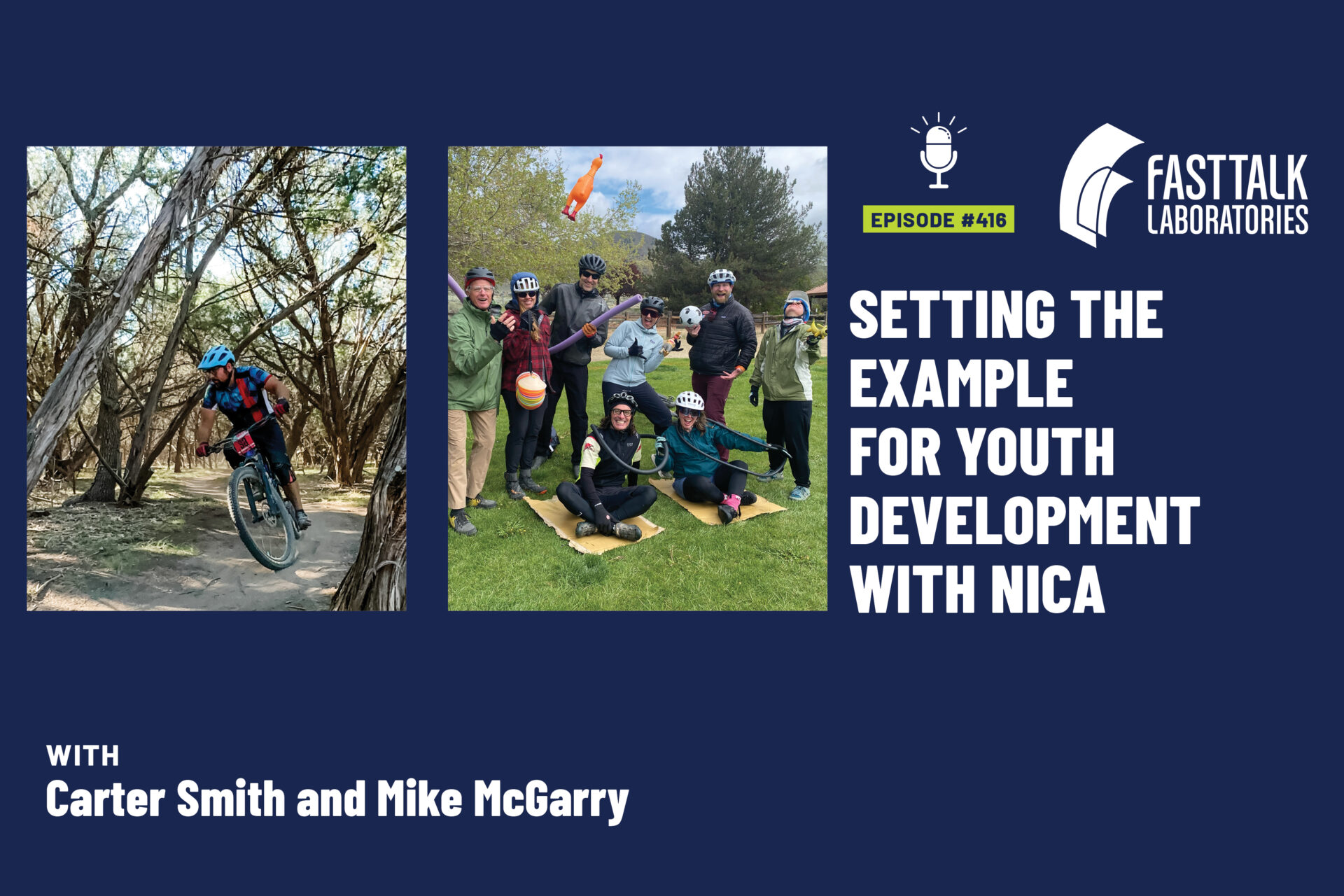






NICA serves all juniors, from future Olympians to kids borrowing their neighbor’s bike. We talk with two leaders at NICA about how they balance serving riders of all levels.
Episode Transcript
[00:00:00] Trevor Connor: Hello and welcome to Fast Talk your source for the signs of endurance performance. I’m your host, Trevor Connor, here with Chris Case. Sadly, over the last decade, north American cycling has seen a decline in just about every discipline with one notable exception. Mountain biking has, in many ways experience a resurgence, and a lot of that can be attributed to nica, the National Interscholastic Cycling Association, a high school program, which introduced mountain biking as a school activity at high schools throughout the country.
While skills work on the bike, training and racing are all key parts of their program, much of their CES can be attributed to their core philosophy of developing people. First cycling is just the vehicle, literally and figuratively. The fact that they have a long history of developing lifelong cyclists, some of whom have reached the highest levels of the sport, is in many ways a bonus, not the target.
The biggest challenge that NCA coaches face is the enormous diversity of their athletes. On the one side of the continuum are kids who show up to the rides on a borrowed bike, just looking to hang out with friends. Well, on the other side, they have cyclists focus on developing into elite athletes, and of course, there’s kids on all points of the continuum.
In between the coaches have to figure out how to balance the knees of all these different athletes, often on the same ride. Joining us today to talk about these challenges are Nica, coach Carter Smith and NCA’s, director of Coaching and Education, Mike McGarry. They’ll talk to us about NCA’s history and the underlying philosophies that had driven the program from the start.
When NICA started, there was little signs on the best ways to develop young athletes. They had to figure it out. The recent science is showing they got it right and have been setting the example. We’ll dive into the four biggest challenges they frequently face with NCA athletes. First, how to create a training plan for the rides when there’s such divergent skills among the kids.
Second, how to make sure the kids train in an injury-free environment. Third. We’ll talk about addressing the nutrition needs in kids who often don’t know much about healthy nutrition. And finally, we’ll talk about the challenge of equipment along with our two NICA coaches. We’ll hear from several coaches who have had a lot of experience working with junior athletes.
Tim Cusick, the owner and head coach of Base Camp. We’ll talk about the importance of programs like Nica. Neil Henderson, founder of Apex Coaching will talk about his hope that the model is applied to other sports. While USA Cycling’s Chief of Sports Performance, Jim Miller will address the challenges of balancing performance oriented juniors with kids.
Just looking to have fun. Finally, Dr. Stacey Brixham, founder of Draft Responsibly Coaching. We’ll talk about the challenges for coaches of working with kids. So put on your kids’ gloves and hope you can keep up and let’s make you fast.
[00:02:45] Chris Case: Carter, Mike, welcome to Fast Talk. It’s your first time here. Thanks for joining us.
[00:02:49] Carter Smith: Thank you. I appreciate it.
[00:02:50] Mike McGarry: Yeah, great to be here. Thanks for having me.
[00:02:52] Chris Case: So Trevor has worked with all types of athletes. I know Julie, she’s worked with a lot of Nike teams, mountain bike athletes. We wanna talk about NCA’s Place in this world of cycling and also youth development. I think one of the things to set things straight right from the top is getting a sense of what NICA considers itself and what it doesn’t consider itself.
[00:03:18] Mike McGarry: Yeah, I think I’ll take that one. So NCA really sees itself as youth development using cycling as a tool to do that. So helping kids develop and grow in athletics and in themselves and figuring out who they are and using the mountain bike as a tool to do that. And I think the real long-term goal with this is that we bring as many people into the sport of cycling and mountain biking, help them find their place in it and what they love in it, and then hope that they go and be mountain bikers for the rest of their life or cyclists, or find whatever discipline works for them.
[00:03:52] Trevor Connor: So when you’re saying youth development, you’re not so much saying, we’re trying to develop elite athletes here. Take ’em to that pro level. This is, we’re trying to develop them as people, as youth.
[00:04:03] Mike McGarry: Yeah. I mean, my real goal is to bring kids into the best environment as possible for as long as possible to make ’em feel supported and nurtured in that.
And some kids will find that they love cycling and that they have the ability to be elite. They have the drive to be elite and you’ll have some kids that they have no interest in that. And the goal with Nica is that both kids feel honored in their NICA programs that like trying to be the top step of a podium be in a world cup.
Being a professional athlete is no better goal than loving riding bikes with your friends. And that’s what can make being like a coach awesome. And also difficult to like cater to that wide of a variety of goals. But I think that’s also what makes us really special.
[00:04:45] Trevor Connor: To that point, when we were getting ready for this episode, you kind of broke the athletes you work with down into four categories.
You had brand new riders, intermediate riders, intermediate riders who are trying to figure out if this is their sport, and then those experienced riders who are probably trying to do something with the sport. So tell us a little bit about that and the challenge of working with all these divergent interests.
[00:05:10] Carter Smith: Yeah, so that was kind of the impetus for reaching out. Nike does a spectacular job of training us brand new coaches. So I’ve been with the league for about five years, but even as a first year, I felt. Very well trained to show up and the riders who it was their first year, I could get ’em on the bike. I could use a language that we were using across the NCO organization.
I could teach ’em how to ride safely. At the other end of the spectrum, the riders who have been in the league for six, eight years, they know this is their sport. They’ve got private coaches, they’ve got trainer road subscriptions or whatever they’re doing in order to train. And then kids who are there just for fun, we can support them very easily.
But there is this subclass of students who think they might wanna be fast, who think this might be their sport. They’re starting to think about specialization and I’m not a professional coach, but I have to fill that role a little bit for those kids until they figure that step out. And it seemed like an area that you guys would have a lot of expertise in because of what you do.
[00:06:17] Chris Case: I wanna take a step back just for a second and understand if this is always sort of been the case with Nica or if this is a new phenomenon. NCA’s got a pretty long history at this point. How has this emerged over time? How have you identified these four groups?
[00:06:36] Carter Smith: So again, I’ve only been with the league for five years and for me most poignantly, I watched my oldest son go through all four of these categories.
My daughter is exactly where I’m talking about in that category where she has been riding for fun with her friends for two years and is now starting to explore whether she wants to be riding five days a week like her brother. And then I have a 10-year-old, this is his first year, and he’s just out putting time on the bike and hanging out with his friends.
So to me it doesn’t seem like a new phenomenon, just looking at the athletes that I’ve had access to. But I don’t have a long history with NACA to draw on.
[00:07:14] Mike McGarry: And I can give a little bit of context. I’ve been a a NICA coach since 2014 in Wisconsin, but I’ve been with the national organization since 2020.
And when Nica started in Northern California at Berkeley High, it was ’cause they wanted to start a road cycling team. And everybody showed up with mountain bikes. So they decided, ah, we’re gonna do mountain biking instead. And that’s what started the Berkeley High team. And then eventually the NorCal Nika League, well it wasn’t Nika then, and then it was really race focused.
It was Northern California high school mountain bike racing. So I think NCA started with a very race focused goal, right? How do we get kids into competition? And then as NICA evolved into a national organization, taking more and more leagues and seeing. Kind of a gap in youth sports for cycling and youth development.
It really kind of shifted to make sure that it was focusing on whole athlete, right? Really good skill development. And Carter talked about equipping coaches with how to create great programs for kids and predominantly like equipping coaches for those new to the sport athletes and great skills development.
What we maybe have missed out on is those kids that Carter’s talking about that don’t know they’re seeing themselves as potentially loving the sport and wanting to move on to, but Micah started very race heavy and has evolved into kind of still having races as very much a part of what we do. We throw amazing races.
They’re highly competitive. Kids that perform well across the country in their NACA leagues, go on to perform well outside of naca, but it’s not the only focus anymore. And so I think that’s kind of been the shift with NACA in general, the training in NACA, and I think how teams and leagues also see themselves.
[00:08:57] Trevor Connor: Let’s pause for a moment and hear from Elite coach Jim Miller with his answers on the challenges of coaching such a diverse group of kids.
[00:09:06] Jim Miller: That’s a tough problem, and I respect their take on what their organization is. I think they avoid the word racer or racing at all costs. Their goal is to get kids on bikes, riding bikes.
It happens to be that there are races at the end of the week, but that’s not the most important thing. And so I think how they go about it and how they get as many kids on bikes as they do, I think is great. On the other end of that spectrum, if somebody does have ambition and they do want to be a bike racer and they do want to aspire to more, then that’s the point where I think local clubs, local certified coaches, I think that’s where they had a role and that’s where they add to what exists through NACA now.
I mean, you have to tip the hat to the amount of kids they’ve put on a bike in the last 15 years.
[00:09:53] Trevor Connor: So Carter going back to your question saying, Hey, we probably know all this and have a lot of experience with this. I’d actually counter that getting ready for this episode. I went back and looked at the research on working with junior cyclists, and one that really caught my attention was this 2022 study that had some big names on it.
Dr. Inga Maka was on it, and they said right at the start of this, no, studies have reported training characteristics of junior cyclists yet. And they try in this study to show here’s how we see junior athletes training. But then their conclusions are, this is just what we’re seeing. We’re not making any statement on whether this is the best training for them.
Then another study that I found really interesting and was happy to remind myself of was one that looked at sports specializations in youth. And by the way, I’m sure all of it, what I’m saying right now, you guys are saying, well, duh, we know all this. That’s the reason we’re talking with you. ’cause I think you actually have more experience with this, but it’s just called sports specialization part one.
But it was actually written more by medical doctors, but showing that there is a lot more specialization in youth sports, particularly in solo sports and highly technical sports. And I think mountain biking checks both of those boxes. And they said that sort of specialization has a very high correlation with more injuries with burnout and dropping out of the sport.
I’m sure that’s a challenge that you face all the time.
[00:11:25] Chris Case: And was that study looking at kids in the US
[00:11:28] Trevor Connor: specifically? Yeah. So it was looking at all sports.
[00:11:30] Chris Case: Yeah.
[00:11:31] Trevor Connor: And so they, they brought in bits from different sports and I love they talked about that tennis has been trying to address this and has now made eligibility requirements based on age.
So basically kids can’t specialize too soon.
[00:11:43] Carter Smith: Last year I did my level three NCA training and one of the big tidbits I took away is that they actually presented some data that showed that a substantial number, I think it was 80 plus percent of Olympic competitors specialized the late. And that has changed how I approach the kid on the team who also plays soccer and needs accommodations.
Not that we weren’t accommodating before, but now we go out of our way to accommodate those kids who are in multiple sports. Because as you say, it seems like the data shows late specialization is better, not only for burnout prevention, but maybe for performance as well. Absolutely.
[00:12:24] Mike McGarry: One of the things that we try to focus on when we’re training our night good coaches is that so they can translate it to kids and to parents.
’cause I think parents have kind of been sold through other sports and a lot of the kind of the American sports system that you need to specialize early if you ever want to be a successful athlete in anything, right? Like you gotta play baseball all year round, you gotta do soccer all the time. If you’re not getting all these touches, you’re never gonna get that scholarship.
And what we want our kids, our coaches and our parents to focus on is we want well-rounded athletes to come out of this. And if you’re doing these other things, it keeps the cycling then fun and engaging. And I think that’s something I wish there were studies on it, like how do we work with junior athletes in all sports to help them remain fun and engaging even at that high performance training level because.
We don’t want kids to burn out. It’s not about throwing some eggs against the wall and hoping some of them don’t break to get there. We want to really help them love their sport, perform at a high level, and then continue to love their sport and do it forever. I mean, the great thing about cycling is that it doesn’t stop when you’re done performing at a high level, right?
I played football at the collegiate level and I loved football. It was a huge part of my life, but I haven’t hit somebody in full pads since I stopped playing collegiate football. But I am gonna keep, hopefully, riding my bike for the rest of my life, and I learned how to do that when I was four years old.
So I think that’s the goal with this, is to help a pathway and a continuum of loving the sport, thinking about performance, performing at a high level, but then also coming out of it, still loving cycling even if you’re not performing at that high level.
[00:14:03] Julie Young: I’ve probably been working with Nica, Mike, as long as you have, I’m in Northern California, so know Vanessa and.
Julia Veitch and all those the usual suspects. So work with a lot of individual NICA teams, like providing training plans for the coaches and consulting with the coaches, and just have so much all the respect in the world for the coaches because they really are. Dealing with such a wide range of interests and abilities and kind of hurting those that are just there to participate and just jump around on your bikes.
And then those, as you said in that, that intermediate and then those that are very passionate and more competitively inclined. But I think like. In terms of the burnout situation, what I’ve realized with working with athletes, it’s so individual and understanding like each individual has such a different tolerance in terms of mentally and physically and just being really in tuned with that.
And I know as Nica coaches, that’s tough because you are dealing with such a wide range of athletes, whereas for me, dealing with individual athletes, it’s far easier. But that’s like any piece of training. It is so individual in that respect. And I think the hard part about this is in terms of that specialization, is now we are seeing these athletes succeed at such young ages.
And I don’t know if y’all know Katina Nash, but I was actually skiing with her yesterday and we were having this conversation about, it’s hard for these young juniors like Fen Van Ple, she’s offered this contract and how do you turn that down? But then on the other side, you see kids in Nike and they look up to people like that, or Puck Peters, and they’re thinking to themselves, gosh, I have to be at my top of my game by 18.
So it’s hard to convince some of these kids it’s okay to go cross country skiing during the winter trail running, or do some different things.
[00:15:52] Mike McGarry: And I think it’s also hard, I think especially for some of us as coaches and parents too, when we see those very young high performing juniors to not praise them for that too.
Right? I think sometimes it’s really easy to praise early physical development, right? And then it can change those things. And when we see those young juniors that are performing at a really high level, it’s difficult for us to now show that to our student athletes and be like, look at this 18, 19-year-old that’s like doing amazing things.
So it’s just something we need to be aware of that everybody. Develops at their own level. Right. And their own thing. And I, and when you talked about knowing your athletes, that’s so key. And being able to cater a plan to them is really important. And it’s something that like we’re not training our Nike coaches to do, so we really rely on great kind of performance coaches that understand juniors or understand kind of that long-term athlete development and help them not get to that burnout spot.
Mm-hmm.
[00:16:48] Julie Young: Speaking of. The different athletes, Mike, and just the development. I think that is something also to be really mindful of is in terms of puberty. You know, I see the young boys that I train, and like puberty is such a performance enhancer for them, but for the girls it’s really tough, you know? And they’re having to adapt and adjust to their bodies.
And there’s actually a really good paper Trent Ellingworth wrote, it’s called Patience During Puberty. I’d suggest you have the opportunity to share that with your coaches, but it’s just really providing perspective and context for like all the people around the athletes as they’re going through this period, just to be patient with it and not read too much into it.
[00:17:30] Trevor Connor: Let’s hear from Coach Tim Cusick on how the balance is tough, but Nike has found it by avoiding too much structure.
[00:17:38] Tim Cusick: For me, I would say, look, one, let’s say thank you to start, it’s great that we are bringing these underserved athletes, these high school students, the ability to compete, to learn about training, and to kind of get into the cycling world in a different format that’s been available even five years ago.
That up and coming, how do we find those high school students and things like that was a challenge. Two, I think you see a great philosophy outta that group. I mean, they get the one thing, these are young adults, these are kids, and making this fun is so, so important in that phase, and I think you see coaches with a real commitment in Nike get to just making sure that’s at the core of their philosophy, bringing them together, enjoying the positive sides of the sport, not over structure, not too much push for performance.
I think they’ve done an awesome job balancing that approach and it’s why they’re being successful.
[00:18:36] Chris Case: Before we move on, could you Carter Mike, give us a glimpse inside a NA team. I’m curious if there’s a typical student to coach ratio across the nation, or if it depends. Team to team. I’m just thinking to myself, this group of athletes who may need a little bit more of a communication, a dialogue.
How are you feeling about this word? Where do you wanna take it? If the ratio is closer to one-to-one, you have the ability and time to have those types of conversations. If you are one coach and there’s 50 students, athletes. That conversation becomes probably very secondary or tertiary to what are they gonna do today?
How do we need to get ready for this race? Like those kinds of conversations take a while, and the rapport that you need to have those conversations takes a while to build. So just give me a glimpse or give us a glimpse inside the teams that are out there and if there’s any consistency at all between them.
[00:19:36] Mike McGarry: So the things that are solid and set is the coach of student athlete ratio for our groups and our trail rides. So for eight student athletes, you need to have at least two coaches, and one of those needs to be our level two or three coach. So kind of a more trained coach on that. You can also do six to one, so six athletes to one.
Those are those max ratios. So you can have more and it can be better. I think what we say is a best practice across the country is it’s great to keep kind of the group leaders as consistent and your sweeps as consistent so they can build relationships with student athletes. But again, all of our coaches are volunteers, so you do have to adapt and be able to adjust and make sure that you’re still meeting those ratios depending on who shows up for that.
So if someone can’t make it to practice, you might have to adjust those ride leaders, but not huge ratios. And I think it kind of varies team to team across the country, how those are set up and the consistency of those.
[00:20:31] Carter Smith: I do think there is a lot of variability. State to state. We just participated, actually saw Mike down in Arkansas recently, our regional race, and got an opportunity to connect with coaches across multiple states.
And the participation rate in Texas is substantially different than the participation rate in Utah. And so I think there’s gonna be a lot of regional variation as well. But what I will say is, so our team has fluctuated between 35 and 50 student athletes for the five years that I’ve been involved. We generally have somewhere around the neighborhood of 25 coaches.
However, I think that’s a little bit misleading because as Mike was talking about, we have different levels and I started out as a level one coach. We have a substantial percentage of our coaches that are starting out as level one coaches and as a level one coach. Your first year, your second year in.
You’re just trying to keep up with the kids on the back of the trail group, make sure that nobody gets lost. Right, right. That kind of stuff. You’re not doing development either competitive development or student athlete development at that stage, typically. And so it’s the level in two, three coaches, the ride leaders that are doing that.
And really the level three coaches are the ones that are meeting offline and talking about specific student athletes and what might we be struggling with. And so the ratio of coaches to students may be one to two, but the ratio of level three coaches who are interested in developing all of these athletes, two students may be in the neighborhood more of that six to one or even eight to one, depending on the team.
And so. As I stepped up into kind of my level three role, there’s four of us on the team that are level three coaches with about 40 students. And so 10 to one ish when we’re talking about that kind of stuff.
[00:22:16] Mike McGarry: Mm-hmm.
[00:22:17] Carter Smith: So I think it’s a little bit more in line, Chris, with what you were talking about, where on race day we’re worried about logistics, but we do have time offline where, and we interview our kids at the beginning of the season and talk about what are their goals.
’cause certainly if we have kids that just wanna ride with their friends, we’re not talking to them about extra practices and things like that. But if we have kids that are really focused on performance, we may be talking about different things with those kids, but I think it’s a bigger ratio and that’s one of the problems.
[00:22:46] Mike McGarry: I think Carter’s a hundred percent on that one. I think what ends up happening is that the amount of student athletes that are wanting to push into that performance side usually is not as big, right? So I’ve coached teams that have been in the 150 plus range of athletes, and then you maybe have two or three groups of that 150 that are really kind of like pushing and loving that performance side, wanting to fight for those top tens, wanting to fight for those performance spaces.
So it’s like catering your coaching to those groups of athletes. And it’s almost as the team grows, it may seem more difficult to manage them, but it actually becomes easier because you have larger cohorts of kids that have similar goals, similar talent and fitness levels. So you can group them together and really help them focus because like Julie said earlier, it’s really hard to cater a training plan to a broad team.
’cause everybody’s so individual, we can’t show up and do intervals. At Aika practice with eight kids. ’cause everybody’s at a different spot unless it’s like a super short sprint interval and the rest of it’s zone two. So the bigger the team, you can kind of bring that group and get a little tighter as we go into those spaces.
[00:23:58] Trevor Connor: So let’s go in that direction and talk about some of those challenges that you face, particularly when you’re dealing with such a diversity of athletes. And I’ll say, Carter, you sent us a list of some of the challenges you face and said, Hey, let’s pick one of these and talk about it. And our response to you was, well, these are all so interesting, let’s try to get through every single one.
So I’ve got them all listed here and really just want to hear your answers of how you address this. But the first one, which you’re kind of talking to now, is how do you address the challenges of stepping up the training with the athletes where you have some that are just there to have fun and when they’re out in the trails, they’re probably enjoying looking at the trees as much as they are the mountain biking.
Versus others who are like, I’ve gotta do better than the last time I’ve gotta race to win. I mean, do you have that huge diversity? So with those athletes who are starting to step up their game, wanting to improve, how do you manage all that balance?
[00:24:55] Carter Smith: So typically the first thing we do is if we have athletes that are interested in being more competitive, we sit down with them first.
’cause one of the things that my son learned early on is he would see these kids that were very fast, very race focused and think, golly, they show up at practice twice a week and they’re so fast. And he didn’t understand that they were riding five other days a week and their group ride was their fun, easy ride.
[00:25:21] Trevor Connor: Mm. Yeah.
[00:25:23] Carter Smith: And so one of the things we do is we introduce them to the fact that, hey, it takes more work than just showing up to practice. The struggle is, and it’s almost individualized for each kid, is when you have a middle schooler who can’t go out on a ride by themselves, isn’t really safe to send out on the road and may not have access to a trainer, is how do we get them those extra miles, those extra practice sessions.
I can give you kind of a smattering of things we’ve done, we usually off season in the summer, do some road rides where we introduce them to road riding in a group setting where it’s a lot safer. That is outside of the Nica umbrella, so we’re not covered by their insurance. And that’s fine for most of us.
But there are some kids who don’t have access to ride if they’re not covered by the NICA insurance. Some kids have access to trainers and so we can set them up with indoor trainers. That’s a whole can of worms as far as then what do we have them do on the indoor trainers?
[00:26:22] Trevor Connor: Yep.
[00:26:22] Carter Smith: And then cross training.
So one of the big ones is if we have kids who want to get faster and don’t have a whole lot of other resources, is we will encourage them to run cross country. With their schools because we have found that that is incredible cross training. It builds great cardiovascular fitness. It’s usually accessible to all students.
Track and field is usually a tryout based where if you’re not fast, you’re probably not competing. But most of the schools around here, if you wanna run cross country, especially in middle school, you show up, you get to run. And so they may not be fast, but at least they’re running multiple times a week and competing a couple of times.
So those are some of the things we use to try to augment, but that’s where we really struggle is how do we get them. Those other 2, 3, 4. Workouts per week without burning them out, without going too hard from the beginning and without the oversight of an experienced one-on-one coach. Mm-hmm.
[00:27:15] Trevor Connor: You just kind of broke it into four levels with that fourth level being the athlete that is serious, this is their sport.
It sounds like when you’re dealing with that sort of athlete, really they need to have their own coach.
[00:27:27] Carter Smith: Yeah. I think we’re pretty much in agreement across the board that when those kids are talking about going into national development teams, when they’re talking about trying to race at a collegiate level, when they’re serious in their varsity competition, and usually these are juniors and seniors, right?
So I, I don’t know that I would encourage young athletes to do this just because of the risk of burnout. But our juniors and seniors that really want to be serious, we encourage them to get their own personal coach. Some of them have used AI coaches because it’s more accessible, but something personalized.
[00:28:00] Trevor Connor: So I bet I used to coach the CSU cycling team, and this is university level students, but it was a similar sort of thing where we had that huge diversity of some people who were just there, really just have some fun and see what this was about. And then there were athletes there who were trying to go pro.
And as the coach, I actually put very little time into developing training plans. ’cause the way I looked at it is the one group, they just wanna have fun. I’ll give ’em basic training, but they’re not looking for a sophisticated training plan. And the serious cyclists on the team who are trying to go somewhere, they all had a coach.
They didn’t need me to build a training plan for ’em. So it sounds like that’s kind of what you’re dealing with as well, or the landscape for you.
[00:28:39] Mike McGarry: And I would say that’s kind of like. The model that we want NICA teams to go on for this one too, is that like create like a season scope and sequence that starts with really great skill building, team bonding starts to build some endurance, then starts to build some speed and then peak, right?
And not individual spaces. Because when the kids really want to perform when they’re at that varsity level, especially in our bigger leagues, Texas, Utah, Wisconsin, like they’re gonna need to train outside of nca. Most NCA teams do about two days a week, maybe a third day a week. And that’s awesome for like building a nice base fitness, but it’s not gonna be what puts you at the pointy end of races.
So when we have kids that love that, our goal, I think as NCA coaches is to find one-on-one performance coaches that understand young athletes and don’t just try to put an adult model of performance on them. So I typically try to support. Families and athletes with some questions to talk to those performance coaches on.
’cause I think one thing I see with the burnout is that our younger athletes often don’t know how to ask the questions or to adapt their plan when they don’t think it’s working for them. A lot of young athletes are very adult dependent, even when they’re getting into teenage years of, coach told me to do this and I have to do it, or if they miss a workout because of school or something happens, they internalize it.
Really quickly. And I think adults are much better at being like, life came up and I had to do something. I had to miss that workout. I gotta reach out to my coach and change it. Where I’ve seen athletes really get in their head and lose a bunch of confidence and make it not fun because they felt like they were letting down their coach.
[00:30:26] Trevor Connor: So I love that you say that. ’cause that study I told you about before that was looking at specialization in youth, talked about that burnout aspect of literally reading out of the study right here. It says professionalized adult style practices are likely not optimal for fostering talent development.
The psychological risk of burnout, depression and increased risk of injury may be a reason to withdraw from sport and young athletes who took part in early specialized training. That’s basically what you’re saying. It’s the same thing.
[00:30:56] Mike McGarry: It’s so tempting to look at Kate Courtney’s Instagram or these professional athletes’ Instagram and be like, well, that’s what Kate Courtney’s doing, so we should make our sixth graders do that.
Right? Because it’s gonna make them professional athletes. But again, like that’s where in the Nika training, it’s trying to be like, Hey, like this is what we do. This is what we specialize in. Stay in our lane for that. And then support our athletes if they want to go to that next level.
[00:31:20] Julie Young: So Mike, it’s a couple things came up and when you said about Kate Courtney’s training plan I just saw on Instagram, I think Cole Patton put his like, this is what my week looks like.
And I was just like, oh no. Like the athletes that I coach and was like, oh no, they’re gonna be wanting to do these multiple five hour day rides. I was just like dying.
[00:31:40] Mike McGarry: Again, I think NICUs goal is to bring as many people into the sport. We’re the mouth of the funnel, right? We want as many people to come in and find cycling and mountain biking as possible.
And then. They get to figure out what their love is, right? We talk about challenge by choice a lot in Naica, and that’s what’s great. Like we’re giving them this opportunity to find whatever challenges of them and whatever excites them. And a lot of these kids that are doing naica would’ve never found a mountain biking or cycling without naca, without a NA team in their community.
And many of them will not go to a collegiate, a professional, super high level, but some of them will, that never would’ve participated in cycling. And they are gonna be the next U US Olympians World Cup winners and World Championships cyclists. So they’re coming out of NCA and these youth development teams, because NA teams are in communities across the country, they’re accessible to spaces and they’re really inclusive.
They’re welcoming to everybody in that realm. You don’t have to want to be a, an elite cyclist to join your NICA team, but you could find out that you’re good at it and could become an elite cyclist from joining your NA.
[00:32:50] Trevor Connor: Making the training accessible to all athletes is critical, but here’s Dr. Stacy Brixham on the additional challenges of coaching juniors.
[00:32:58] Stacey Brickson: My experience with juniors is pretty limited. I did volunteer as a NICA coach for one year, mostly just to help out a friend, but I don’t have any athletes currently outside of that experience with Nika that our juniors, I do have a daughter who’s just recently broken into the pro gravel scene, and I don’t coach her directly, but I am very in awe of the coaches who do coach junior athletes, and even in young adults like my daughter.
It’s a whole. I think different animal than adults like I work with, you just have so many, not just physically developmental things going on, but their bandwidth emotionally is in a hundred different places. And I think it takes a special kind of coach to really respect all of those different things that are mostly in disarray or at least in a state of chaos and flux that aren’t so for adults.
So I think it’s a really special kind of coach that does it, and maybe I should do more of it and be that special person.
[00:34:02] Trevor Connor: So something you brought up in your list that I’m really interested in hearing your thoughts on is injury prevention, because as we’ve been saying, a big part of your mission is creating this good experience for young athletes, expose ’em to the sport. I would say at that age, getting injured is one of the quickest ways to get them to say, I don’t like the sport.
So that, that’s an important thing to avoid. And often at that age, they don’t have the skills to necessarily really know how to avoid injuries or deal with injuries when they get them. So. So what are your strategies here?
[00:34:35] Carter Smith: So again, this is a subcategory of our students. I did training and trauma surgery and we always joke that trauma is a chronic disease.
It’s always the same student athletes that seem to come up with the serious injuries. And so the question, the reason I pose the question is, are there things that we can look for and or train are student athletes for. That are very specific. For instance, one of the strategies that I will try to use, which is very blunt, is just not riding riders up to their aerobic capacity, but riding them to their bike handling skill capacity.
And sometimes that’s frustrating for them because they feel like they’re the fastest one in their group and they wanna move up to the next one. But we have found that if you take a rider without bike handling skills and allow them to push their speed, those are the riders that tend to get injured. I also have seen that the NICA National presented some data that a lot of our injuries, a lot of our crashes are due to front wheel washout, which is a bike control problem.
And so are there strategies we can employ? I think one of the things I would love to see is some NICA partnerships with industry where we say, Hey, you know what? These are tires that we think are good and these are pressures that we think are good because especially when you have kids that are not as financially advantaged.
They may be riding on tires that don’t have good traction, they may not have good pumps to set pressure, and I think there are technical aspects where we can try to prevent injury as well.
[00:36:08] Trevor Connor: Yeah,
[00:36:08] Carter Smith: I think number one is looking at the athlete and trying very hard not to put them in situations where they’re overriding their skills.
And number two is making sure that we set them up in a way that their equipment is safe. So that is not leading to injury. But again, both of those are fairly blunt tools.
[00:36:26] Chris Case: I think this also goes back to the diversification of skillset that develops when you have kids off of bikes. Strangely enough, I think better athletes are more spatially aware, more aware of their limitations, what they’re comfortable with, and when you put them on a vehicle, a bike, it’s.
Easier for them to understand where those limits are for them and what their capacity is, even though they may not have developed it on the bike. But in the end, I think we all know that the more you ride, the more you get comfortable with the edge of where whatever tire you’re riding can go and that breaking point.
So there’s a balance there of you need time on the bike, but having time off the bike doing other things helps you ride the bike.
[00:37:17] Mike McGarry: I think one thing that Nica is really good at is teaching student athletes foundational and fundamental mountain bike skills. It’s one of the things we excel at doing. We support turning somebody that knows how to ride a bike into a mountain biker, into a good beginner or intermediate mountain biker.
We started in, I think 2017 requiring an on the bike skills training for our coaches, for all our level two and three coaches. So everybody that’s gonna like lead rides, they have to come to an in-person training where they learn how to teach foundational fundamental mountain bike skills to student athletes where we can turn anybody.
Into a pretty good foundational mountain bike skills instructor. And since that implementation, we’ve reduced student athlete injuries by 32%. By requiring that of our coaches, it’s actually reduced coach injuries by 20, I think 3% as well. So like intentional skills instruction is our best injury prevention.
[00:38:14] Carter Smith: Sure.
[00:38:14] Mike McGarry: And to help coaches understand that and to build that into their seasons is key. ’cause I think sometimes, right, we get coaches that are like, you know how to become a better mountain biker, put as many miles in as possible and that can be great if you’ve got great skills. But there’s a lot of kids out there that have an awesome engine but not great by handling skills and learning how to corner better is gonna help them.
Probably exponentially more than a couple more watts. ’cause if they can save energy and time on every single corner, it’s gonna pay off for them in the end. So I think our big thing as Nick is to help them slow down, right? Slow to go fast, intentionally work on skills, do it every year, and not just be like, all right, you gotta put miles on.
[00:39:00] Carter Smith: So the class he’s talking about, we call OTV on the bike 1 0 1. And that was something I participated in my second year on the team and thought, Hey, I’m checking a box. And it was the most effective training I have gotten from Nica. It was way more beneficial to me as a rider and to me as a coach than I could have ever anticipated.
And the Texas League is working really hard at making that a lot more accessible because we see how beneficial it is. As a coach, I did not know how beneficial it was in injury prevention. And so that’s actually strategy number one that I’m gonna take away from this session. Is making sure all of the coaches on our team understand that those skills not only help us teach better, but also help us keep everybody safer.
So that’s really helpful. As far as the tire pressure, and I know I’m getting a little off in the weeds on this one, but I think figuring out what the tire pressure should be is almost trivial with the tire pressure calculators. The problem is when you have 45 students that show up to practice, we get ’em around checking, making sure they have water, and everyone does exactly the same thing.
How’s your tire pressure? Everyone squeezes the tire and says, that’s good, seems reasonable. And half of the kids are sixth and seventh graders. Who have never ridden a bike before, squeezing their tire, saying, yeah, my pressure’s good. And so I’ve been struggling with, I don’t have time unfortunately, to check the pressure on every single tire for all 45 riders.
And at the same token, make sure that their brakes are working. You know, we depend on the student athletes to be able to check their own bike, but it’s really hard to train them to check for those things that really can prevent injuries, such as making sure they have adequate tire pressure.
[00:40:41] Trevor Connor: I used to coach a cycling club, a road cycling club, and one of the things I would do in some of our sessions is I’d have two wheels, one with the tire inflated to 125 PSI, the other one inflated to 70 PSI.
And then tell everybody to squeeze them, and then I would ask them to guess which is the one that’s inflated to 125 and it would be a 50 50 split. They just had no idea.
[00:41:08] Mike McGarry: I think you just inspiring ideas is having a bike check station at an early practice where you’ve got a digital gauge. I mean, I think your example, it makes sense, but I think you can really tell between like 15 and 25 in a mountain bike tire and a lot of our kids need.
Probably 12 to 15 PSI, whereas I need probably about 26 to 28.
[00:41:32] Trevor Connor: That’s fair.
[00:41:32] Mike McGarry: Yeah. A big human and intentional skills instruction is important, but it sounds boring. So yes, we’re gonna do it. We’re gonna do intentional skills instruction, but Micah coaches are also like, we wanna quickly get them to playing games on bikes.
Right. Make it fun, make it so you have to perform the skill correctly to have fun in the game and to perform well in the game. But it’s also very low risk. Right? One of my absolute favorite games to play at practice is bike soccer.
[00:42:01] Trevor Connor: Love it.
[00:42:02] Mike McGarry: Right. Bike. Soccer is wild. It’s a little crazy. You make it very tight.
You’ve got one foot off the pedals. You’re in this tight situation. You’re learning all these bike handling, this bike body separation, this awareness skills in a very controlled environment. If we can teach our kids how to work on those bike handling skills in a controlled environment, then when we get them out on the trail, they’re having fun, right?
’cause they’re not nervous about their skills. They’ve, they know how to move their bodies. I don’t know how many crashes I’ve saved myself from because I love playing bike soccer. And that’s really the goal. Make it fun. Play games. Get them ready to be riding the trails before you take them on trail.
[00:42:43] Trevor Connor: Yep.
[00:42:43] Mike McGarry: The example I often give when I’m talking about this with new Nica coaches is that trail riding is NCA’s game-like situation, right? A trail ride is what our races are like, right? So in football, I was a football coach for a long time. 11 on 11, full contact, full pads is game-like situation. If I showed up at the first day of practice and said, all right guys, we’re gonna set up and we’re gonna do 11 on 11 full contact game, we’re gonna have injuries all over the place and I’m probably gonna lose my job.
But as mountain bike coaches are cycling coaches, that’s often what we do. The first thing we do is say, all right, let’s go for a ride. And that’s taking kids that we haven’t assessed and putting them in a game-like situation. So we need to do skills, we need to play games, and we need to assess their abilities so when we get to the trail, they’re having fun, not scared of mountain biking.
’cause the quickest way to ruin someone’s experience with mountain biking is to put them on a trail that they’re not ready for. And we don’t wanna do that.
[00:43:40] Chris Case: Mm-hmm.
[00:43:41] Trevor Connor: A great way to look at it.
[00:43:44] Chris Case: If you’re training consistently for endurance sports, you’re putting your body under a lot of physiological stress.
And while that stress is necessary for adaptation, it also temporarily suppresses the immune system. Something exercise scientists often refer to as the open window of immune vulnerability that can occur after hard training sessions or races for endurance athletes, that’s when illnesses often show up right When you’re building fitness.
Sune MD from Samira MD is a physician formulated immune support supplement that can be especially helpful during periods of physical stress, including heavy training. One of its key ingredients is well immune beta-glucan. A clinically studied 1 3 1 6 beta-glucan shown to support immune defenses and help maintain a healthy inflammatory response during periods of physical stress.
The formula also includes buffered vitamin C, chelated zinc, B vitamins, and a botanical blend, including kinesia, astragalus, and andrographis, all selected to support immune cell activity and recovery during demanding training blocks. The goal is simple, stay healthy so you can keep training. UNE MD is physician formulated, made in the United States with clinically researched ingredients and produced in FDA inspected CGMP certified facilities.
If you want to learn more about supporting your immune system during heavy training and competition, visit md.com/fast talk and use code S-T-T-A-L-K 15 for 15% off your first order.
[00:45:19] Trevor Connor: So shifting gears, the other topic that you sent us that I think is a really interesting one is nutrition in junior athletes.
And again, did take a look at some research leading into this. And something I found really interesting was a study that looked at low energy availability in junior cyclists and showed that by the season, at least in the group of junior cyclists they were looking at, which was just high school athletes, every single one of them.
Was in low energy availability. And their explanation for this was that they just didn’t have the nutrition knowledge. They didn’t know any better. They didn’t know how to eat for their sport. So I’m interested in what you’ve seen and what you teach the Nike athletes
[00:46:07] Chris Case: and low energy availability is like a chronic under consumption of the nutrients you need because there’s daily life and then there’s their activity and they’re not meeting those needs.
So it’s a chronic condition that they’re in.
[00:46:20] Trevor Connor: Right. And to the point, the intervention they did was nutritional counseling and found that when they taught the kids nutrition effective nutrition, effective sports nutrition, most of them came out of LEA. Mm-hmm. So low energy availability and were able to better manage their food.
Yes.
[00:46:38] Carter Smith: So I would put the kids kind of in similar categories that we talked about earlier, right? Those kids that are at the top of their game, either because of their coach or because of their family by necessity, have to learn nutrition. It can’t do six day a week workouts without adequate nutrition. At the other end of the spectrum, the kids who are just there to ride for fun, we usually don’t struggle with those kids.
But the intermediate kids, the kids who are pushing it hard twice a week, but don’t yet know how to eat, we really struggle with those kids. And school lunch makes it worse. When they’re young, there’s a lot of decisions made for them. But as they get into the ages, we’re talking about seventh, eighth, ninth, 10th grade, they’re making a lot of their own decisions about what they eat at lunch.
They don’t necessarily make good decisions as far as how to fuel themselves. Trevor in particular, I kind of know where your biases lie, and I’ve parroted you a lot. For the first couple of seasons, we really pushed race day nutrition kind of being available at all practices, right? We’re always carrying chews and GOs and things like that in our pocket, and I do think they have their place, especially day when you’re having a kid that’s having a mentally tough day.
Some sugar in the mouth really goes a long way, but. I have been more recently touting that race day nutrition is for race day. And when we’re competing and we have to, we can eat that straight sugar, but otherwise we really need to be eating real food and a good snack before practice consisting of real whole foods is probably going to fuel you better.
But again, I as a novice have to then train these students and their parents, what do they need to show up to practice with? What do they need to eat before practice so that they can be prepared for a hard effort? And that’s where I struggle.
[00:48:26] Mike McGarry: Yeah, I think it’s really tough with our, like our high school athletes, especially our high school.
Girls to get them to eat. And I think changing, trying to change the relationship with food and thinking of food as fuel. All of our NACA athletes from the youngest to the oldest, no matter how competitive they are, are endurance athletes and they need that fuel to perform and they like just be safe right out there.
They need to be eating and drinking to be safe on their bike. It’s another injury prevention for us. So I think we partner with experts at Nica, so the feed is one of our partners and them just helping with that, like you talked about. Real food, right? Real food. Having a good diet during the day, a good snack beforehand, topping up with grams of carbs, something during your ride, whatever that is for you.
And then having some nice recovery afterwards. But like stressing that with your student athletes is key. And modeling it for student athletes is key. Our kids are always watching us. So if we’re saying, Hey, bring a snack to practice, make sure you eat a snack during practice, make sure you’re drinking a bottle or two during practice.
And we as coaches aren’t doing it. It doesn’t matter what we say, so we have to model it, we have to talk about it. Anything like Carter talked about, we also need to help parents understand that too, is make sure your kids get a snack before practice. Make sure they’re carrying a snack in a jersey pocket or a hydration pack so when we stop, they’ve got something to snack on.
And that’s information that we want to share with. Teams, parents, kids at those information meetings and when they’re showing up have that be a requirement really for them. They have hydration and they have food with them.
[00:50:05] Trevor Connor: I love seeing that you’re doing this and you’re helping the athletes with this. I mean, going back to that study, which is the 2024 study title, assessing energy availability and glucose dynamics and adolescent cyclists, one of the points they make in the introduction, which I can agree a hundred percent with, is these kids are just getting inundated with marketing and social media that’s telling them all these things they, they need to have, and they get this belief that, oh, I’m an athlete, therefore I should be getting everything in powder form and pill form.
And actually it pushes them away from healthy nutrition. So it’s good to have something like what you’re doing, say no. Healthy whole foods, you need to be eating them as an athlete and giving them that training and that counseling.
[00:50:48] Julie Young: Mike, I think another important thing that you brought up, I’ve done some talks for teams, the Nike teams in the Bay Area on nutrition, and I think your point of the consistency of messaging among coaches, parents, and athletes, and to Trevor’s point, I think no matter our age, nutrition can be extremely confusing and seem conflicting.
And so not to say one person’s way is the only way, but I think just having some sound science and it doesn’t necessarily have to be complicated, I think it’s more about nailing the basics. Mike, as you pointed out, I think a lot of times these kids just forget to eat, has been my experience. But I do think it’s that consistency of messaging among all the kind of stakeholders and just continuing to repeat that even though sometimes the kids seem glazed over and doesn’t seem like it’s getting in.
Just keep saying the same things.
[00:51:38] Mike McGarry: Yeah, I think it’s important to like have. Times during practice where if you have a regroup or a stop or depending on your venue, if you’ve done a lap, it’s like, all right, we’re gonna have a snack because they need to get used to eating while they’re riding. And then as they’re riding, it’s more intense and longer maybe something like, I have athletes that are like, oh, I don’t like eating while I’m riding.
Like, it upsets my stomach, or I just don’t, I don’t enjoy it. I’m like, we don’t have that option. If we wanna keep riding that even at a moderate level, we have to eat ’cause we’re burning so many carbs or burning so much of it. And I think when I teach. Nica coaches, I really like to stress talking about carbs and grams of carbs and avoid the use of calories.
’cause we want to really avoid any of our young athletes thinking about calorie counting and starting any disordered eating. So the messaging that we’re going for is really, food is fuel, and if you’re thinking about kind of that race day stuff, it’s carbs grams, carbs, which is also tough because we’ve got these road cyclists now that are having astronomically high grams of carbs an hour, which I also don’t want our young kids to follow.
[00:52:40] Chris Case: I’m curious, I make a lot of courses here at Fast Talk Labs for coaches, so nutrition is. Amazing. And it’s also really a frustrating subject to speak about and to teach because it’s almost like religion. Mm-hmm. And people have a really strong beliefs about it. There’s also a ton of misinformation everywhere about it.
And like Trevor said, marketing is sending messages this way and that at all of us. I’m curious, Mike, to your point about getting a consistent message out and helping parents understand like when a kid signs up to be on a team, a NA team. Do parents receive a, here’s a welcome video that explains what your kid is going to go through in the next year on this NICA team.
And it talks about what practice is like and injuries prevention should be look like and what nutrition should look like.
[00:53:36] Mike McGarry: We don’t have a welcome video yet. It is something that we want to do. Like part of what makes Nike awesome is that there’s 32, 33 leagues across the country and they all kind of have a little bit of their own flavor.
And we’ve also got teams, thousands of teams across the country that. Do things semi autonomously. We do have good kind of templates and welcome messages for families and teams to use, but it is something we’ve looked at is like, Hey, when a kid gets signed up, here’s your kind of welcome to NICA and what you’re getting into.
But nutrition has not been a part of that. So I like that idea of nutrition. Morally we’re saying, Hey, you need to make sure you have water and a snack at practice, but not kinda like that I, that idea of nutrition in there. And just to riff a little bit, like I think parents are heavily involved with NICA athletes.
I think about 80% of our coaches are parents. So kind of a fun thing that happens with our sport that doesn’t happen with a lot of other sports is that the parents and the coaches are riding along with the athlete. So they’re getting a lot of those same demands, right? If they’re out there doing practices with athletes a couple days a week.
They’re also riding for 90 minutes, two hours out there. So we gotta teach coaches just as much like you need to eat and drink to feel good on the bike so they can hopefully influence their athletes the same way.
[00:54:56] Carter Smith: Yeah. Our riders get that, not in a video, but in an early season meeting where our head coach will sit down with all of the new parents and go over many of those things.
And if, if you’ll bear with me, I’ll give you an analogy that may illustrate some of the struggle there. So one of the things that we tell parents early in the season, right, is your kid needs a bike and your kid needs a helmet. And then we say, and your kid needs a flat kit. And I remember being a first year parent and they set a flat kit and I ride bikes.
I still have no idea what needs to go in a flat kit. And I will tell you that we have 45 riders on our team and not one of them carries the same thing.
[00:55:34] Chris Case: Yeah.
[00:55:34] Carter Smith: And most of our competitive riders. Don’t carry one at all.
[00:55:38] Chris Case: Well, they’re immune to punctures. Elites are always immune to problems.
[00:55:43] Carter Smith: Totally. But the problem that I had was, it was just too nebulous.
Now, of course, I’ve been in it for five years and I can talk for an hour and a half about what needs to be in a flat kit and what each person should carry. And so one of the things I’ve actually pushed our current team to do is to put together our own starter flat kit. And when kids join, we say, here’s a multi-tool.
Here’s a CO2 head. Here’s a way to carry them. That’s the basic flat kit you’ll learn over the next two years what you like. You can buy what you want, but with nutrition, I have the same pragmatic problem where we tell parents, make sure your kid has something to eat. And they show up and they have a thing of fruit snacks with five grams of carbs in it and no protein or fat.
And so pragmatic advice is a little tougher as far as, okay, but what race weekend? Right? We have these big race weekends where we have to pack all of our food and carry it with us and telling parents. What are good race weekend foods? Obviously when riders get experience, they’ll figure out what settles well with their stomach and our, our high school athletes, by the time they’ve been doing it, they know exactly what they like to eat two hours before the race and six hours before the race, before our brand new riders.
Giving them not just very nebulous, they need grams of carbs, but hey, this is a really good example, right? A banana is a great example of something that’s portable. It’s easy, it has good carbs in it, but giving them those practical pieces of advice is tough because you need a lot of ’em. Because not every kid’s gonna eat the same thing.
[00:57:12] Trevor Connor: Good advice. So you’ll laugh at this. I was thinking about your flat kid. I was just talking to a friend not that long ago, who is a professional cyclist and she was over in Europe and she went out for a ride with a bunch of world tour athletes. One of ’em got a flat tire and they all looked at her. ’cause not a single one of them knew how to repair it.
[00:57:34] Chris Case: And did she change the
[00:57:35] Trevor Connor: Oh yeah, she did it for ’em.
[00:57:36] Chris Case: Yeah. We’ll see. Like she took advantage of her skills.
[00:57:38] Trevor Connor: I, I’m 24 and I felt like the mom.
[00:57:41] Chris Case: Nice.
[00:57:43] Trevor Connor: So last thing that you had brought up was bikes. And I think we’re gonna surprise some people when we hear about the challenges here. But I get this, I had a personal experience where a college buddy of mine reached out to me because his son is in the NCA program.
His son is 12, and he wanted to buy a bike for his son. So I immediately connected him with a friend and said, you should talk to this friend of mine, he can get you a really nice bike for about 12, 1500. And then I could reply back, my friend’s like, yeah, no, $300 is my max here. So you have this issue that you’re gonna have sub athletes who are showing up on the $5,000 top mountain bike.
There are other kids who are gonna be showing up and need to borrow a bike. So how do you address all this?
[00:58:28] Carter Smith: So we’re fortunate that we do have several team bikes. I know because I maintain and store them. And so when we have kids that come onto the team, especially when they don’t know if they’re gonna like it and they just wanna try it out for a year, we do have a system where we can loan them a bike.
The tough step becomes that if they do like it, eventually they’re not happy on that loaner bike anymore and they want, you know, that next bike. And I struggle with how to counsel the rider and the parents, which are the important things they need to look for. I’ll tell you my personal experience. My son started riding, I put him on a giant talon.
The giant talon has an axle that is not supported in the middle. It’s only supported on the very ends, and then the load is in the middle. And even as a sixth grader, he bent that axle, that hollow QR axle at every practice. And so every practice I was taking apart the rear axle, reb bending it, trying to make it last.
I had several spares until I finally gave up and wouldn’t spend a thousand dollars on a bike. And so that’s where I struggle is I don’t want to tell parents like, well, this is a reasonable bike. And then it’s just not up to the challenge of what we do on Nica because what we have, even our youngest, most inexperienced athletes doing is pretty rigorous compared to what most people would do on a mountain bike.
So things that I have focused on is upgradeability, right? If you can find a bike that has through axles that has a tapered head tube, even if it’s a blow end, even if it’s a used bike, even if it’s an older frame, those are all things that can be upgraded later when the kid wants to. But the question still stands, what are those?
Most important things to look for when we’re trying to navigate the used bike market or even buying a new bike. What are the non-negotiables that those new riders need to be looking for on a bike?
[01:00:26] Chris Case: This makes me think of, this is a terrible idea in a way, but World Bicycle Relief decided we wanted to get bikes out to the world to help them get medical supplies to towns and get kids to school that are in villages far from where they live.
And so they built the Buffalo bike. NCA needs to approach Trek and have them build the NCA bike for the masses. The elite kids can bring their super calibers and their whatevers. But the rest of the team can get a really nice trek bike or fill in another brand. But you’re in Madison. So I figured I’d mention them.
And that could be the Nike bike.
[01:01:04] Mike McGarry: I’ve had those conversations with them before. They’re very receptive. Right. And I think for them, and for any bike brand is getting it at a price point that works for people that are new to our sport. Right, but then also has the things that are necessary to make a bike that is gonna be fun and safe on the kind of terrain that we ride.
Oftentimes when I’m working with new families and trying to help them understand what kind of bike to look for. One of mine with it is hydraulic disc brakes. If a bike has got hydraulic disc brakes and you’ve got a younger rider, we can typically make it so those brakes work for small hands. Mechanical disc brakes don’t usually work for small hands, and then if you can’t break mountain biking becomes scary.
So that’s one of my keys for them and helping them. I’m often say that I’m a resource for them if they’re looking at used bikes. ’cause if you don’t know the sport and you’re like, Hey, is this an alright used bike for this amount of money? You don’t know. It’d be like me looking at great downhill skis. I have no idea what I’m looking at.
I love skiing, but I live in Madison, Wisconsin and I don’t get to do it that much. So I need to go to someone that’s an expert and if we can be kind of that expert on what’s a good safe bike. And I think that’s the key. Oftentimes a used bike that costs less than a new entry level bike is gonna be safer, more capable, and better for that athlete.
But if you don’t know what you’re looking for, you don’t know what you’re looking for. And then a lot of our leagues also have loaner fleets, just like Carter’s team has some, my team has some loaner bikes as well. But the struggle as a team is you’ve gotta maintain and store those bikes, which is, it’s a difficult, it’s an extra thing.
And if they’re not getting used, they become obsolete. Pretty quickly. And they’re like, oh, now we gotta sell these and get new ones. So one thing that I’ve found just kind of almost universally across the country, if we have kids that want to be on a N team and that community reaches out to their cycling community, it’s like, Hey, I’m looking for a mountain bike that’s about this size that is still safe and functional.
You can usually find one. And that’s kinda the great thing about the mountain bike community across the country.
[01:03:09] Julie Young: Chris, I like your idea of the Nika bike.
[01:03:11] Chris Case: Thank you.
[01:03:12] Julie Young: Yeah, so my, one of my first experiences with NCA was attending a race at Granite Bay in Northern California. And so we have different demographics, of course, like everybody, but we have the Marin kids that are showing up on their specialized S works that are 22 pounds.
And then we have the kids from the Central Valley showing up on target specials that are probably 34 pounds. And I guess the one thing that ran through my mind is, it’s a shame because the field isn’t level just. By virtue of the equipment and then also considering the different resources these kids have, we’re missing talent.
And so I think it would be so cool if we could have more standardized bikes. And I know some, obviously some kids wouldn’t give up their specialized s escorts, but it’d be neat to have that level playing field.
[01:03:57] Mike McGarry: I think what’s great about Texas, NorCal, Wisconsin, all these places that are having it, there’s a lot of good used mountain bikes out there that kind of stay within the community as well, which is great.
So like I know when my son, who’s now a, a ninth grader or gonna be a 10th grader for this next race season, when he was coming into sixth grade, it was like we were able to find a really nice older trek pro caliber. That fit him, right? He had been through two other Nika athletes, was still in good shape and it didn’t cost us that much.
And when we were done with it, we were able to give it to his younger sibling, right? And so the nice thing is if you could help parents be like, O, maybe don’t get that $500 bike, but maybe go for that little bit higher up one that’s got what you need and there’s a market to sell it to somebody else on the team or somebody in the community afterwards.
So like. The amount of kids that are riding bikes, the amount of families that are in there. There actually is a bit of a resale that happens with these communities that have Big N teams too. So it’s one of the benefits, but we’re always gonna be looking for bikes. And Trek does a Pathfinder scholarship across the country for athletes that are looking for bike.
This is only for students that self-identify as Bipoc, but they give 250 bikes out a year and full scholarships for all their fees and they give them equipment and stuff. So the kids that really can’t afford it, there’s that scholarship and a lot of leagues also have some space to help with some of that financial.
But yeah, we wanna lower that barrier to entry as much as possible. But we are an equipment heavy sport and the super caliber and the S works is gonna be lighter and it’s gonna give you an advantage over an entry level bike. For sure.
[01:05:34] Trevor Connor: Before we move to our take homes, let’s give a final word to coach Neil Henderson and why he thinks Naica is a model that should be emulated by other disciplines.
[01:05:44] Neal Henderson: I love what is happening in the high school mountain biking across the us. The growth has been fantastic, and so extending the reach beyond who is currently being, I’d say exposed to cycling to a huge degree is really important, and the way they approach it and having the breakdown for the different.
Stage levels even within the high school so that you’re not just in against everyone. From the start, I’ve noticed some really positive things in how they do the coaching in terms of smaller number of athlete for a group rider or coach. One of those things that allows there to be better feedback for developing skills and teaching and keeping everyone safe and having fun and that comradery.
Going to a high school mountain bike race, if you’ve, if you haven’t been to one, I would encourage you to get out there and watch and just see how that happens. I’ve been to a couple events and it is just awesome. The energy level is fantastic. It is really fun. I’d say in some cases it’s really a model that should and could be replicated in other cycling disciplines, and I’m very glad that they are leading the way and excited to see them continue to grow.
[01:06:58] Trevor Connor: All right, well I think it’s time for us to wrap things up and move into our take homes and we have five of us, so could take a couple minutes.
[01:07:08] Chris Case: It will.
[01:07:09] Trevor Connor: So both of you’re new to the show. We often finish our episodes with one Minute take Homes where each of us has one minute to say the thing that we think is the most important message for the listeners to take away from the group.
And I will ask Mike and Carter, I’ll let one of you go first. Who would like to start?
[01:07:30] Carter Smith: I’ll be happy to go first.
[01:07:32] Trevor Connor: Alright.
[01:07:32] Carter Smith: Obviously we covered a lot of stuff, but hopefully a significant portion of the audience for this is Nica coaches. And the take home that I think I was convinced of before, but now I am doubly convinced of is the importance of our OTB 1 0 1 training for all coaches.
It is not required for level one, but I think it should be encouraged for all level one coaches. I think it makes us better coaches, but now that I know that it also has data on injury prevention, I think if I can stand on a soapbox, that’s the soapbox I’m gonna stand on, is that we need to be, obviously we need to be doing dedicated skills training for the athletes, but we need to be doing dedicated skills training for the coaches, even those of us who think we already know how to ride a bike, because I think it has so many benefits.
And then I’ll quick put my own vote in as well to support the Nica bike.
[01:08:24] Trevor Connor: Nice.
[01:08:24] Chris Case: I’ll keep mine short.
[01:08:25] Trevor Connor: Go ahead, Chris.
[01:08:27] Chris Case: I wish that Nica existed when I was a kid because I was that cross country runner and then I turned into a three all year round runner. I burnt myself out by the time I was done with high school, but I wish I could balance the cross country with the mountain biking.
And I say that because what you’re doing is creating happier, hopefully happier, healthier adult humans, I should say. And all the things that we spoke about today go towards that. Being safe. You can’t have fun and if you’re not being safe, you can’t have fun. If you’re hangry and you haven’t had any food all day, I know what that feels like and and, and on and on.
So I love the fact that you have this emphasis on fun and building skills to make people better humans.
[01:09:14] Trevor Connor: Fantastic. Julia, want to go next?
[01:09:16] Julie Young: Sure. We’ll kind of piggyback on what Chris said. I wish there was Nika when I was grown up too. No, I love Nika. Like I said, the first races I’ve gone to like just this enthusiasm and energy and it really is this family affair.
And Mike, I think you had said about like, you know, you’re getting more people on bikes and it’s true because I see the kid starts riding the bike and then that trickles up and the family starts riding the bike. And what I think about is we know probably what maybe 1% of these kids might do something in sport, but you really are teaching them.
So much about themselves. And I think there’s no better place than sport to learn about yourself and to develop that confidence and that self-esteem. And you’re really planting these seeds of healthy lifestyles. And again, I know sometimes the kids may look at you glazed over and just like, oh no, not this again.
But you’re planting these seeds and I really think creating this foundation for really healthy lifestyles moving forward, and I know this is not intentional, but you really are. Nica really is such a huge part of, again, exposing more kids to the sport of cycling. And really there is a correlation with the advent of NCA and what we’re seeing now at the World Cup in terms of more US riders vying for those podium spots.
So I know unintentional, I know it’s all about just getting more kids on sport, but great job.
[01:10:39] Trevor Connor: Well thanks. We kind of have two types of episodes that I prepare for here. Some that are really science heavy. I get excited about those. Mm-hmm. Because I show up with my 2030 research studies, and That’s
[01:10:50] Chris Case: right.
[01:10:50] Trevor Connor: I’m in my wheelhouse. And then we have others that I see as kind of more humanistic experiential episodes, and I don’t really bring a lot of research to those and getting ready for this one, I really put in that second category, but a few days ago said, well, let’s take a look at the research and what it’s saying.
And what I was actually shocked to see is how much research there is. It’s recent research. So really what I’ve seen is I think you developed the program at NACA from a, probably a lot of trial and error, a lot of experience. But now the research is coming out and what we saw just with the few studies that I mentioned, the science is now really backing what you’re doing.
That you shouldn’t be training juniors the way you train adult cyclists, that you should be having it fun, that they should not be over specializing. All these things that you have found and are doing in, in a lot of ways, you’re leading and the science is catching up, but saying, yeah, this is the way to do it.
And as Julie said, I think this is probably why you see a lot of the different disciplines and cycling struggling right now. But mountain biking still doing really well. I think we can really tip our hat to NACA for being a major part of that. So Mike, take us out.
[01:12:08] Mike McGarry: Well, yeah. First of all, I just wanna say thank you to all of our Nike coaches ’cause they would do it.
At the team level, right? So from the national level, we can set up the training, we can talk about the philosophy, we can get excited about it, but every single coach in every community is what really makes this happen. And that’s what makes cycling better. If we as Nike organization and just when we’re working with juniors, no matter where they’re at, we make it fun for them.
We make it engaging for them, no matter what level of competition they want. And we keep it focused on our athletes. They’re gonna be cyclists for life. And that’s really the goal with Micah. Make it fun, make sure it’s engaging for them, and to set them up for a lifelong of cycling.
[01:12:48] Chris Case: Excellent.
[01:12:49] Trevor Connor: Fantastic.
Well everyone thank you. That was a fun episode.
[01:12:52] Carter Smith: Thank you. I appreciate it.
[01:12:53] Mike McGarry: Yeah, great to be here.
[01:12:55] Trevor Connor: That was another episode of Fast Talk. Subscribe to Fast Talk wherever you prefer to find your favorite podcast. Be sure to leave us a Radian review. Don’t forget, we’re now on YouTube. Give us a like and subscribe there too and help us reach new audiences.
As always, remember that the thoughts Independence Express on Fast Talk are those are the individual. We love your feedback. Join the conversation at forums. Do Fast talk labs.com or join us on social media at at Fast Talk Labs for access to our endurance sports knowledge base. Continuing education for coaches as well as our in-person or remote athletes services.
Head to Fast Talk labs.com. For Mike McGarry, Carter Smith, Tim Cusick, Neil Henderson, Jim Miller, Dr. Stacy Brixham, and Chris Case, I’m Trevor Connor. Thanks for listening.