



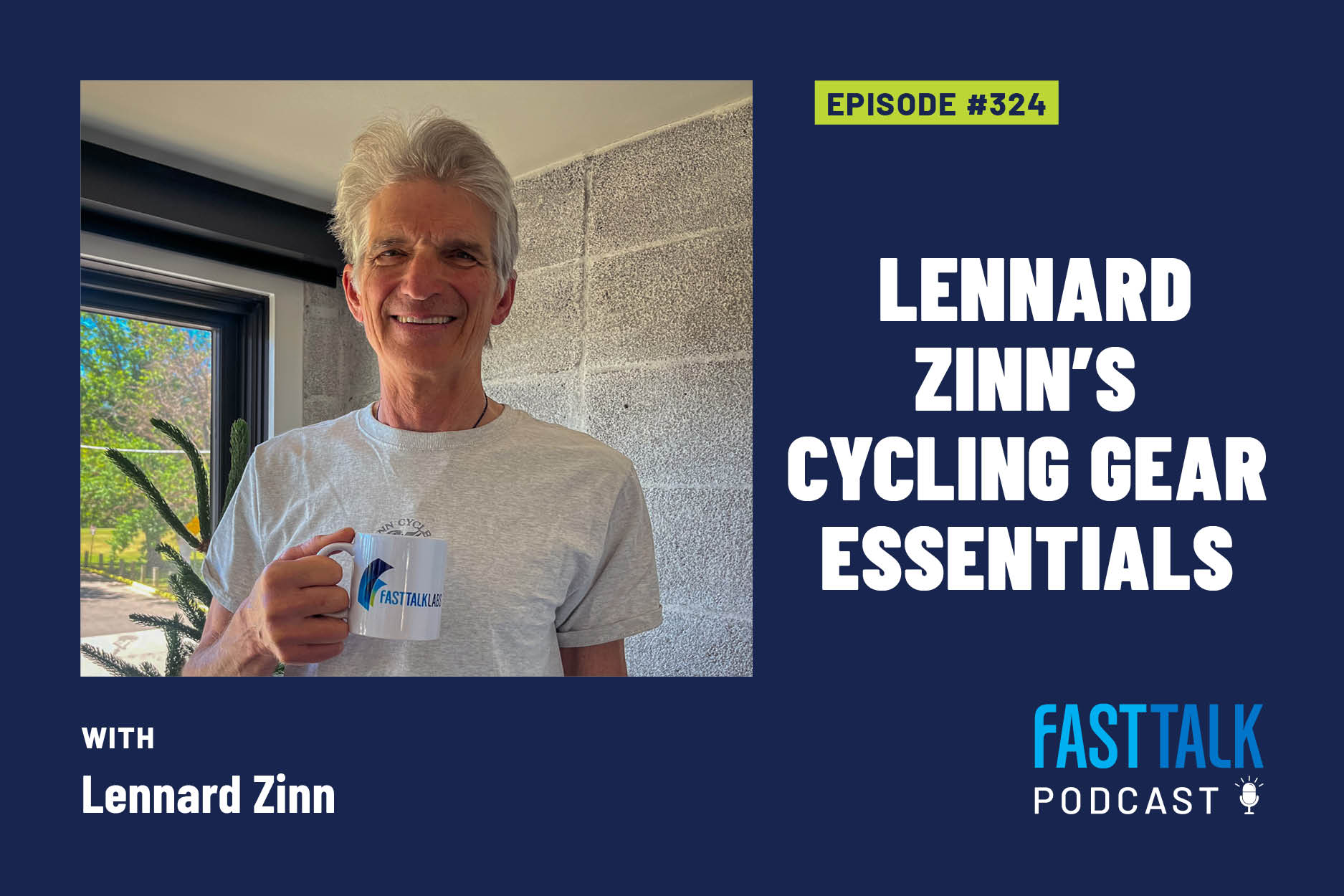
Lennard Zinn shares his decades of experience to help cyclists of all levels navigate what gear they do and don’t need when starting a new cycling discipline.
Episode Transcript
Introduction: Beginner Gear Questions and Why This Episode Matters
Trevor Connor 00:00
Well, Leonard, welcome back to the show. It’s been a little bit since we had you, how long has it been?
Lennard Zinn 00:04
Long enough that I couldn’t remember exactly which building it was.
Trevor Connor 00:07
Fair enough.
Griffin McMath 00:10
Well, we’re really glad to have you.
Trevor Connor 00:12
I appreciate you reaching out. And this is an episode that actually, I think Griffin in particular is going to be really excited about, because Griffin is just starting to get into cycling. She’s got a big event coming this summer, and she has been hitting us with lots of equipment questions. So let’s get the best expert out there. And I’m sure you’re gonna have a whole lot of wisdom to share with us.
Lennard Zinn 00:34
Oh that sounds great.
Griffin McMath 00:36
I’m particularly excited because as Trevor said, I have a race coming up, and I am new to endurance cycling completely. And so Rob, as you may know, Rob Pickels is my coach. And immediately after my first ride, I messaged him about something about being a female and sitting in a saddle that long and just my body’s not used to it. And so I was looking at different parts of this bike. And before I invest in a bike that I really want to enjoy and spend money on, I have this kind of rinky dink, you know, $400 bike that just feels like it’s falling apart. So I’m really excited about this conversation, I have my computer out to take some notes. I know we’re going to talk about different disciplines as well, but really excited to learn about your expertise, because as I’m writing, inherently, to this position to there’s so many questions that come up that I’m trying to figure out. While I’m writing it, I’m supposed to be training. So this is gonna be really exciting. And I appreciate you taking the time.
Lennard Zinn 01:33
Yeah, my pleasure.
Trevor Connor 01:35
So one thing I do want to say, this is not an episode about how to save money. You know, if you’re a beginner and you really want to get into this and you want to spend the money. Absolutely. This is more about as a beginner cyclists, what do you need? What don’t you need? Where’s your money best spent? Certainly the suggestions we’re gonna give are going to help you save some money and go in the right direction. But this is really more about, you’re getting into cycling, what do you need? What do you truly need and what do you not need? So Lennard, I’m just gonna go straight there and ask the big question, when you’re talking about a beginner cyclists, what do you feel, so, they’re just getting into this, they don’t have a bike, they don’t have any of the gear. What’s most important?
What Every Beginner Actually Needs
Lennard Zinn 02:18
Well, obviously, having a bike, and a helmet. Can’t do anything without those. But then I would say that really, really high on the list is bike fit and particularly the correct saddle, that there won’t be much to discourage a new rider quicker than having, being uncomfortable on the bike. So those are the first things and then after that, it’s the kind of details that also discourage cyclists are things breaking, tires going flat, all that sort of stuff, and then them not knowing how to deal with it and feeling either dependent on other people, or incompetent about how to handle those problems.
Griffin McMath 02:59
I think the saddle part is especially huge I just have to account for that. The number of times I’ve talked to Trevor about this and we’ve talked about the actual you know pants that I’m wearing having padding, and where’s the padding supposed to be, where is it actually supposed to be most firm, and I can’t support enough what you’re saying the first thing that I want to spend money on is what I’m sitting on.
Lennard Zinn 03:18
Yeah I’m including with the saddle is also the Shami that you know the padded shorts or padded tights that you’re wearing. So yeah, exactly.
Trevor Connor 03:26
And I will throw in there a lot of beginners think you want something that’s super padded, like those banana seats that’s got four inches of foam in them. My experience is those are really comfortable for 10 minutes, but if you start writing longer, they are remarkably uncomfortable.
Lennard Zinn 03:41
Yeah, no, I, I’d be happy to start riffing about saddles right now. I mean, it’s been a focus for me for decades. And I think that that’s an appropriate place to start if that works for you guys.
Saddle Fit, Anatomy, and Why Comfort Comes First
Trevor Connor 03:53
Yeah, no, let’s go there.
Griffin McMath 03:54
Can we talk too about the difference in saddle needs between men and women?
Lennard Zinn 03:58
Absolutely, yeah. So saddles, just like most things in life, were first designed for men and women were an afterthought. And saddle design originally came from horses and horses are curved, saddles were curved, saddles were made out of leather because everything was made out of leather that you use on horses. Even the fact that you get on the bike from the left side and all the drive systems on the right side had to do with how to deal with horses, that that’s how you mount a horse because you have your sword on the left sides. You can’t mount from the right side of the horse because the swords in the way. So anyway, saddles you know, when I was on national cycling team in the early 80s saddles were always curved, there wasn’t really choice of width, and most cyclists were young. I mean, we baby boomers are sort of the first generation that’s really continued to do high level of athletic activity and to, now I’m 65 and you know, I’m on the latter side of baby boomers, there’s a lot of baby boomers in their, you know, 80s, who are still ridding a lot. And when you’re 22, you can sit on a two by four and you probably survive it okay, but the older you get, the less able you’re able to handle that sort of thing. You know, on a brief thing about how saddle design has changed over time, saddles now are flatter in the back, they come in different widths, and they have a groove or a slot or an opening generally down the middle. That largely was driven by there was a pretty well known writer for Bicycling Magazine who had a divorce what in dealing with his angst and anxiety over over his divorce, he just rode his bike a ton, like 800 miles a week and sort of like Race Across America type of stuff. And he kind of worked through the agony and got to the point where he was dating again, then when he dating again, he discovered that he was impotent. And then he went to a urologist and this urologist became very famous in the bike industry for making the statement that man should never ride bicycles, because that soft tissue in the perineum was never meant to support weight. And, you know, obviously, the bike industry did not take that lightly and got very concerned and, and specialized was one of the first to jump on the bandwagon of trying to make a saddle that would not cut off the blood supply to the genitals. And so that’s when the grooves started happening and saddles, and the saddle became flatter in the back so that the sit bones would sit on the saddle, the blood vessels and nerves that go to the genitals go in between the sit bones, so the sit bones are the bottom of the pelvis. And these bones called the pubic rami that extend out toward the front, those taper in toward the center. And so do these nerves and blood vessels run just inside of those bones. And then as you roll forward, more on the saddle, the contact point, because the pubic rami angle inward, the contact point on the saddle becomes narrower or narrower. So that’s why a triathlete that’s rotated way forward on their saddle, finds comfort on a saddle that’s much narrower than somebody who’s sitting up on the saddle, because they’re sitting on the narrower part of the pubic rami, as opposed to the person who’s sitting up more upright, they’re sitting on what we call ischial tuberosities, the sit bones which are wider than that’s the farthest outboard point of where those pubic rami might go. And so the idea was to support those bones and to prevent anything from compressing those nerves and blood vessels. And so, one of the things that Trevor mentioned early on is too soft of a saddle that somebody would go, oh, my butt hurts, I need a softer saddle, they get progressively softer saddles, but it doesn’t take away the numbness. That’s because the soft stuff then just squishes up in between the ischial tuberosities and compresses the nerves and blood vessels. Same with a curved saddle, it jams up in between. And then this thing of saddle width became important where specialized really premiered this technology of measuring the width of people sit bones, and they made this thing called an Ass-O-Meter which is this-
Griffin McMath 08:25
An unfortunate name.
Lennard Zinn 08:26
Yeah. Which at the time was this memory foam, so you’d sit on this pad, and then it would leave these depressions where your to sit bones were, you’d measure the distance between those. Now it’s become sort of more like an iPad screen that you sit on and it senses the pressure on the computer screen. I’m not sure exactly how that one works. But in any case, once you’ve established the width of the sit bones, then you make sure that there’s more saddle to the outside of that point. So say your sit bones are 13 centimeters apart, then you want your saddle to be, for normal ridding position, at least 15 centimeters wide and fairly flat in the back so that, that sit bones are sitting on the saddle. If that person with a 13 centimeter width sit bones had a saddle that’s 12 or 13 centimeters wide, so 13 centimeters was 130 millimeters, that was pretty much the standard width for saddles, back in the 70s and 80s. The Selle Italia Turbo, the Selle San Marco Concor, all those saddles, not only where they curve, but they also were about that width. So that means that if somebody, there’s plenty of people with sit bones 13 centimeters or wider apart, that means that they’re basically the entire saddle is jammed up in between their sit bones, cutting off blood supply and nerve function. So that was really the first thing to get the sit bones on the saddle, then creating this channel to relieve pressure on the prostate and on the perineum is the next part of that. Then the next part, this is all still talking about men, the next part was how to get pro riders riding these saddles because they’re the people that people emulate. So if they’re riding a particular saddle the reason to sell the Selle San Marco Concor was such a popular saddle was because Greg LeMond and Bernardino rode on it. And so specialized and other companies like that knew that they got to get these guys on the saddles, and they’re all traditionalists, I’ve been riding this jolla turbo, this turbo saddle forever, I’m not changing. And they’d even, you know, some of them like Miguel Indurain would travel with his saddle, separate from his bike, because he was if everything else, the bike got lost, he didn’t care, but the saddle was like, that was it for him, you know, his first point of contact with the bike, and he had to be that saddle for the Tour de France, for instance. And the way that specialized managed to get these guys to use the saddles, was to have them ride on the saddles, versus on their own on a stationary trainer, with a cuff on their penis that measured the blood flow to their penis.
Griffin McMath 11:09
Boys will be boys. I mean, my goodness, ok.
Lennard Zinn 11:13
And so, and so if you got Tom Boonen to see that his blood flow dropped by 85% when he’s riding on his turbo saddle, versus only dropping by 20% on the specialized saddle, that’s it. He switched. And that’s how these guys switched. But then the assumption, the broad assumption that, of course, is almost always made with everything is that well, if it works for men, it’s going to work for women, maybe we need it to be pink or, or light blue or something. But otherwise, it’ll probably work for women. Other than that, there was also this belief, there was a brief period and in the early 80s, where, where saddle manufacturers said, oh, well all women because of childbearing, they have really wide pelvises. So they need these really, really wide saddles in the back, and I was sponsoring women’s racing team at the time. So I’d follow behind them in races in the van and watch them pedal. And there was, there were a couple of women on the team that definitely, you could just see it, their hips were hooked on quite wide, you know, and there’s, this was before we were measuring the distance between sit bones, but you could just see that they were wide there and, and that these really wide saddles in the back worked okay for them. But all the rest of the women, if they were on one of those saddles, and they started spinning at a high rate, pedaling at a high cadence, they’d just be bouncing all over the place because their sit bones were much narrower. And then every time their leg came down their hamstring muscles, were just hitting this like broad beam, leveraging up one bun, and then the other, just bouncing all over the place. So that was obvious that didn’t work and they tended to just, oh, forget this and go back to men’s saddles, which at the time didn’t have any of the features that, that we’re talking about. But they certainly complained about saddle pressure, and most people just shrugged it off. Oh, well, you’re gonna get used to it. Now that we now have the saddles that support the sit bones properly, we measure the sit bone width, we have this pressure relief area, that’s got to work for women, right? That was the assumption. So, but then, you started having these events, like unbound gravel, you know, where women would be riding 200 miles on gravel, and they’d be on these saddles discovering that, no, this does not work. And most women didn’t want to talk about it. So literally, there were a lot of women who are top pro racers who were getting labile reconstruction surgery because their labia would be getting, very hardened and stiff. And it was super uncomfortable to sit on a saddle. And Andy Pruitt, who’s sort of the guru of bike fit and worked for specialized for decades, and started the fitting system that became retool that specialized then bought, he’s a below the knee amputee. And it was really his understanding of that problem. And how he deals with it in cycling and in walking that made the breakthrough on the women’s saddles, and that is that when men sit on a saddle and get ischemia was where, is where, you know, you press into an area, like press into your palm your hand and your hand turns white there for a moment, that’s ischemia where the bloods pushed out of the way. When men get pressure in that area, sitting on the saddle and have ischemia, it causes their genitals to shrink. That’s pretty well known and guys are embarrassed about it. But when that happens with women, that assumption was that the same thing would happen however, it was Andy’s realization that when his stump of his lower leg is sitting in the, in his prosthesis, that the two bones, the tibia and the fibula, the ends of those bones are pressing into that cup, and you get ischemia at those two places. But if you had only those two places supported, and the area around there is like a void, it would be incredibly painful because the surrounding tissues become engorged with blood, they become super swollen. And so he needs to have some sort of, it can’t be too hard. But it also has to be, give some gentle pressure back to prevent those areas from swelling and getting filled with blood. And so he was wondering, well, maybe that’s what happens with women, too. So he had a number of pro women, this is when the specialized experience center was out here in Boulder near the, near the airport. And he got specialized to make a bunch of different models of saddles that he wanted to try out different technologies on, and the saddles were clear. And these women would come in at night into specialized experience, center ride for hours on these trainers, with no pants on, on the saddles with a video camera looking from underneath to see what would happen. And you know, obviously, this takes a big leap of faith from the women to be willing to do this, and also some level of desperation that they understood that we got to do something. So Alison Tetrick was probably the most famous of those. And if you look up specialized ads about this subject, you’ll find these incredible ads from Alison Tetrick, talking about this exact thing and talking about parts of anatomy that keep getting bleeped in ad. But they discovered that indeed, that was what was happening. The labia were becoming engorged when they ride for hours and hours. And that’s what the pain was. And then this thickening and all this long term effect happens because of that, because of the damage to those tissues. And so that’s when the, what’s called a specialized mimic, it’s like a flexible, soft hammock in that area that was just an opening in the void in the middle of the saddle is now like this gentle foam and stretchy material, this hammock that’s just sort of pushing back on those tissues. And it made all the difference for these women. But yes, these women tended to be on the pro road teams, for instance, in Europe, Andy would start to do these interviews with women and talking to them about this. And he talked to their coaches and their team managers, hey do any of your women have problems with the saddles, oh, no, no, they’re all tough, they don’t have problems. They need actually talk to the women themselves, and discover this incredibly high percentage, and I don’t remember what he quoted the number of them, who had had labile reconstruction surgery, and that they were miserable. And that this was something that nobody had addressed. And the combination of, you know, our society being the way it is, and women not being wanting to talk about this area, led to decades and decades of agony for women. And so that would be my first suggestion for a woman as a beginner getting into this. And then there’s specialized now as another technology that the next generation of mimic is called Mirror, which is another thing where it’s, I think that’s supposed to indicate mimicking and mirroring that physiology there. So that’d be the first thing, get your sit bone width measured. So you get the proper width saddle and get one with mirror or mimic in the center of the saddle.
Why a Professional Bike Fit Is Worth It Early
Griffin McMath 18:35
I’m going tonight.
Trevor Connor 18:36
If I’m hearing you right, basically, you’re saying even a beginner should be investing the money in a proper saddle and making sure they’re getting one that, that’s right for their anatomy.
Lennard Zinn 18:47
Exactly, that if, if they are a beginner wanting to get more into cycling, that means they’re wanting to spend more time on the bike, and there’s nothing that’s going to stop them from spending more time on the bike more than being uncomfortable sitting on what they’re sitting on.
Griffin McMath 19:01
It’s interesting what you’re talking about, actually online, right now there’s kind of a surge of people saying, why aren’t we talking about this more as female cyclists, and kind of a call for this needs to improve. And I remember hearing about the hypersensitivity. I heard about the hypertrophy, if you will. And I remember on my first long, longer for me, ride of my training plan, I started feeling a strong discomfort and I’d read about this like two days ago. And I just looked like the biggest weirdo because I was freaking out and my heart rate was like too high on the ride because all I could think about were these things and how I knew I was on a really bad saddle. So I was riding down the road like trying to almost not sit on my saddle because I was so afraid of this and it because it hurt. And so I love what the two things you’re talking about. We’ll have to link out to those more details on what you’re talking about in the show notes. But just the importance of saying kind of what Trevor said, saddle first. Especially for you know, for females, there’s a lot to consider there and then to go get measured and to really make this a comfortable experience for you if you want to do this for a long time.
Trevor Connor 20:09
Yeah, you kind of expressed the importance of this when you brought up Eddy Merckx, the fact that he had ride any bike, but he had to carry a saddle around with him. But what would you say is next, what would be the next most important gear for a beginner to consider? Is it the bike? Do they need a great bike? Or is it just making sure you’re comfortable and can ride the bike as you’re saying.
Lennard Zinn 20:32
They need a good fitting bike. So that would be, I would say, the first most important thing to invest some money into is a professional bike fit. You can ride a heavy, crappy bike. You know, there were guys who just, I don’t know if you saw that, there were some guys who did the unbound gravel, this time who guys that have done it a number of times in the past, but they did it on Walmart bikes where they spent, I can’t remember it was like $400 Walmart bikes, or maybe it was even cheaper than that. Maybe even $75 Walmart bikes, these are, these are bikes that, straight bars, you know, just super cheap.
Griffin McMath 21:11
Break with the pedals.
Lennard Zinn 21:11
Yeah, they had, exactly, they had coaster brakes. And by the end of the ride, you know, they, the tires were plenty tough, they didn’t have any of the tire problems. But he was having these big, thick, heavy tires. And, you know, they were out there a very long time, they could physically do this event on a really cheap crappy bike. And they wanted to show that that was possible. However, then once you actually have a bike, the next most important thing, saddle first next thing is getting fit on it properly. And I want to also emphasize that the older you are, the more important all of these things are. That you have a lot more adaptability to, to stuff that doesn’t fit and doesn’t work right the younger you are. The older you are, you can end up with permanent problems very quickly by ignoring this advice.
Trevor Connor 22:08
So let’s flip the question around a little bit. What are, in your opinion, the most common mistakes you see beginners make when they’re purchasing their gear?
Lennard Zinn 22:17
Most common mistakes beginners make when they’re out riding a bike is not bringing enough food and water. So that sort of does fall into gear, you have to have water bottle cages on your bike, you have to have water bottles in them, that have water in them. And you have to have a way to carry food either in pockets in a jersey, or little bento box on the top tube of the bike, something like that. And then rain gear, particularly but also bringing, you know like your first time, oh, let’s go ride up in the mountains and they ride up in the mountains in shorts and short sleeves. And then don’t take into account that, oh, when you coming back down, it’s 20 degrees lower temperature, and you’re moving much faster through the air. And when you are sweating like crazy going up, you’re gonna be freezing going down. So extra clothes that are specific to cycling, that are lightweight and easy to carry along, and easy to put back on when you need them.
Trevor Connor 23:14
So is there any gear, like when a beginner comes to you they’re, they show up with their bike and all their gear, is there anything that you look at and go, why did you purchase that? You just didn’t- you don’t need that.
Griffin McMath 23:25
Because it is fun to go shopping. And there’s so many things available to me online, Lennard. Stop me from impulse spending. Do I not need-
Trevor Connor 23:33
And look, I will tell you when I was brand new to road cycling and bought my first real road bike. I bought this really expensive set of aero bars for it, even though I wasn’t doing any time trial. And I wasn’t a triathlete. And it was finally, I was out for a ride with someone and they were like, why do you have those? Why do you need those? So I can tell you from experience, sometimes you just purchase things where if you had known better, you could have saved yourself some money.
Lennard Zinn 24:00
That’s a very good example. You know, an example for me is you know, my business has for many decades been focused on really big and tall people. And making bikes for people that bikes and bike shops don’t generally fit. And you know, one example was big John Platt, he’s, he’s now head of Sony Music. He wanted to ride a bike, he went to a bike shop in Vail. They sold him a Gary Fisher mountain bike and he’s out riding on the road with that and a buddy of mine came up along who just happened to be talking to him and said, well, are you enjoying the trails around here? What trails? I don’t want to ride trails. Well, why do you have a mountain bike? Well, this is a mountain bike? I mean literally, that’s how much beginner it was that he just wanted a bicycle, he was only going to ride it on the road, and they sold him a mountain bike because that was the only bike that they could make the seat height high enough for him you know he’s six foot seven, 300 pound guy. And, and that they needed a bike that would support him and fortunately my buddy said you need to go see Lennard Zinn. So having a bike appropriate to what you’re going to be using it for, that’s probably the first thing. Like, you know, you don’t bring a knife to a gunfight kind of thing. Like a- the probably the most universal bike, I suppose that you could use for everything would be a fat bike, right, you can ride a fat bike on snow, you can ride it on dirt, you can ride it on pavement, you can ride it on anything. That said, it’s going to be pretty dang slow on pavement. And it’s still pretty slow on smooth dirt trails, and even bumpy ones, that it’s really meant for one particular thing, just like your aero bars are meant for aerodynamic advantage when you’re riding solo at high speed and other wind at any, any other purpose for it doesn’t exist. So those are really good examples of having equipment appropriate to the type of riding you’re doing.
Trevor Connor 26:00
So know what’s the right bike? Yeah, I mean, I actually I saw a poor soul who suffer from that he was fairly new to cycling. And this is right when fat tire bikes were invented. So you know, he’d heard about all the craze and figured that was the bike to buy and I saw this poor guy trying to climb up this tough local climb in Boulder called Flagstaff. Going about two miles an hour wondering why he was so slow. He didn’t understand the purpose of the bike.
Lennard Zinn 26:27
Yeah, didn’t understand it when he comes downhill why it’s making so much noise, because that- all that sound energy is the auditory expression of energy loss.
Trevor Connor 26:39
Yep. So here’s my next question for you. Because when you’re a beginner, you’re going to make your investment. And likely over time, you’re gonna to do upgrades, you’re gonna replace some of the things that you initially purchased as you learn what you’re interested in, see your, your level, the level you ultimately want to get to. I think we already partially answered this question that you should invest the money right from the beginning in a good saddle and a good bike fit. But what are things that beginners can, with their first investment, go cheaper, knowing they can upgrade it later. Versus things that even from the beginning, you should probably invest the money in from the start. So I put the saddle in the category of invest the money right from the beginning, is there anything else?
Why Tires Matter More Than Most Beginners Realize
Lennard Zinn 27:27
Well, I would say tires, tires are not a huge investment. But to understand that there’s a very big difference. You know, we did years of, of rolling resistance testing when I was writing technical articles for VeloNews. And it is astounding how much difference in rolling resistance there can be between tires that look pretty similar, maybe even are priced fairly similar. So some tires, actually, for the tire designed for the same purpose we discovered, used 40 Watts more to turn it at 30 miles an hour than the best tire in the category. 40 Watts out, you multiply that by two, because there’s two tires 80 Watts, given that a that a beginner cyclist will be lucky to turn out more than say 100, well, depends on the size of the rider of course, but, but 150 to 200 Watts, for an extended period of time for beginning cyclists, that’s pretty good. If you now are absorbing 80 watts of that in the tires, that means that you’re not going to be able to keep up with very many people at all. And tire pressure. That’s another thing that’s a common mistake is inflation pressure that obviously people have the experience if their tires are way too low, that they can just feel that there’s a lot of rolling resistance, and that if they hit a train track or something they can dent or crack their rim and pinch flat, the tire. Pinch flat is when the tire pinches down against the rim, so that means there was a bubble of the of the inner tube, outward that ends up getting pinched from the top and bottom. So you get caught what’s called a snake bite where you got a hole at the top and hole at the bottom, two holes above and below each other on the, in the, in the inner tube. So people can kind of understand that easily. But the other end of it, they don’t tend to understand about inflation pressure. And they assume like they pump it up really high, and the bike feels fast to them, because it’s like real bouncy and lively. Well it’s bouncy and lively because every bounce that it’s taking is absorbing energy that you put into the bike to make it go forward. So every up down movement of the entire bike and rider is, needs to be looked at as energy lost. That if you instead have the tire inflated to a pressure where when you roll over the regular type of bumps that you’re going to expect on the surface you’re on. So obviously this is dependent on how smooth the surface is that if you’re, if you’re riding on smooth glass, yeah, there’s nothing faster than pumping your tires up to 200 psi. But the reality of even a smooth asphalt road is that they’re little, little imperfections, little stones in it, that make the tire go up and down. And running that tire at much lower pressure, will allow those to be absorbed in it. And then when you get on gravel, you know, and you’ve got little stones in there that, that if you can just absorb the full height of the bump in the tire, and not require the bike and the body to move up and down. You’re gonna be faster, even though you’re like, how is this possible this tire feels so soft? Well, you know, if I could take back all those years of, of pumping up my tires to 135 psi when I was racing, and the number of exploded tires that I had, you know, losing races that way. I mean, it’s just, it’s sad to think about.
Griffin McMath 30:56
So, when we’re navigating this, I mean, when I look at this, and I look at okay, saddle first, and then tires, the thing that keeps coming into my mind, especially having searched this, is this big tube versus tubeless. Debate versus whatever the third type, what is it clinch…
Tubed vs Tubeless vs Tubular: What to Choose
Lennard Zinn 31:11
Tubular.
Griffin McMath 31:12
And does that matter, depending on the discipline of ridding that you’re going to be doing?
Lennard Zinn 31:17
Yes. So, let’s just start at the extreme end, the extreme end being fat bike, so fat bike with four, four and a half, five inch wide tires, if you want to roll with lowest resistance on snow, you want the tire to spread out, like a foot of animal would spread out when they’re walking in snow. And so the tire pressure needs to be really low, and I’m talking like two psi, well, the problem is two to four psi, that’s gonna leave a really flat track on the snow, which the other users are going to appreciate. Because it’s not putting a groove in the snow, you’re gonna roll better because you’re on top of the snow as opposed to pushing down through it and having the resistance of breaking through snow continually. But it doesn’t give much ability of if you’re running that tubeless. And then you come into a hard corner, it’ll easily burp air out of it. So the tire is so, so soft, that the sideward pressure can release the tire bead away from the rim and allow air to poof out there. And there’s nothing more miserable than I can imagine, especially in northern, far, in the far north, where it’s pretty dark in the winter too, to be out in the dark at 10 below zero dealing with a flat tire. So in that case, where there’s also very few sharp things, glass, sharp rocks, anything, you’re riding on snow, it makes sense, unless you’re gonna- there are some crazy things you can do to make tubeless work under those conditions. But, but otherwise, I would use an inner tube in that, in that circumstance that, that the downside of having a flat and that condition is so much higher than the upside of little lower weight and, and little lower rolling resistance of not having a tube inside. But then as you go to mountain bikes, then you now have enough pressure in the tire to hold the tire fairly well against the rim. And the difference between tubed and tubeless, is gonna to be enormous in the potential hassles you’re going to run into because there’s all sorts of hazards that you can get punctures, riding a mountain bike with, with thorns if you have an inner tube. So a tubeless tire is basically the same type of a tire as a tube tire similar to your car tire, it’s a clincher, meaning it clinches into the rim. And if you have a tubeless tire on a bike, you generally run sealant in it. So it’s usually latex based, and it hardens when air moves fast past it. So.
Griffin McMath 33:57
Is that that liquid I see explode on people sometimes, okay.
Lennard Zinn 34:00
Yeah, that’s the liquid and so. So the idea is that if you get a little hole in the tire, then air is going to be shooting out toward that hole carrying sealant with it, toward that hole and the sealant, the fast movement of the air past it will harden that and fill the hole. And so that’s a wonderful thing. And it means that if you’re ridding a tubeless tire with sealant in it, over a field of goat’s head thorns, you might not even notice that you’re riding through thorns until you look down and you see them all sitting there on the outside of the tire because you won’t have lost basically any air. But if you do that with a tube tire, all of us are familiar with what a thorn is like in a tire that has an inner tube in it. And then similarly, you’ll hit rocks hard on a mountain bike that can pinch flat a tube. Well if there’s no tube in it, you can’t pinch flat the tube, so, so tubeless is just like a no brainer for mountain bikes. That a properly fit tire with sealant in it run at the proper tire pressure, the other thing is that the inner tube moving inside of the tire absorbs energy, there’s this chafing motion that happens as the tire is flexed constantly as it rolls, and that’s costing you energy. So the rolling resistance is also lower, when you eliminate the two, there’s usually not a weight advantage because a tubeless tire, usually a tubeless, ready tire has an extra amount of rubber in it so that it can hold air without an inner tube. So that ends up being about the same weight as the tube would have been. But the main things are, you just end up being able to ride more and not be fixing tires as much if you use tubeless, or mountain bike.
Trevor Connor 35:47
So one thing I want to throw in here though, just talking from the the beginners perspective is be aware, there is some maintenance you have to do. If you’re doing tubeless, that sealant will dry up, you need to be putting that sealant back in and I was on a group ride where a woman got a flat tire. She was tubeless. She’d been riding these wheels with tubeless for like a year and a half, two years, and never put in more sealant. And when I checked it, I mean it was completely dried out and going brittle. You need to be using the tires regularly. And I’m sure you’ll talk to this Lennard, but you do need a special pump that actually builds up pressure and then forces pressure in really quickly. So there is a bit of knowledge and understanding that’s required to use tubeless effectively.
Griffin McMath 36:33
Is this kind of like so many miles on your car need an oil change, the thing with the sealant.
Lennard Zinn 36:39
Similar-
Griffin McMath 36:39
And is there a standard formula because I’m notorious for waiting at least 5000 miles more before I get an oil change. I need explicit instructions.
Lennard Zinn 36:48
Yeah, and like with a car, it’s kind of condition dependent on the type of maintenance and the type of driving you do with your car, that if you, if you drive your car on dirt roads a lot, that there will be some dirt getting in pass through the air filter and into the into the cylinders and getting, making your oil dirty faster. And it needs to be changed sooner than if you thrive in very pristine conditions. And a thing that really needs to be understood with tubeless. If you just leave the bike sit over the winter, like you just you have tubeless tires on your bike. And then winter time comes and you don’t ride at all. And the bike doesn’t move, what you can pretty much be certain will happen is that all of the sealants in it will pool up at the bottom of those tires, and it will harden up. And that will mean that you now have this heavier spot on your tire that is doing no good for you other than throwing the wheel out of balance. And so to take that into account is important. Like really, ideally, you move the bike some, you know, you ride it every couple of weeks or something a little bit to keep that moving around. Otherwise, when you start the season, you actually take the tires off, clean out that one dried up pool of sealant and put it back on. And yes, as Trevor said, if you’re installing tubeless yourself the initial burst of air to get the beads to move up from the valley of the rim up onto the ledge is where they, where they then seal with a tire bead, which is the thick edge of the tire. You can’t do that with a hand pump. With a regular hand pump. You either need an air compressor, you can use like a CO2 cartridge, but CO2 tends to dry sealant quicker than normal air does. But the other thing is a pump that’s like basically got a second chamber like it’s sort of a piggyback style thing, it looks like it’s got a backpack next to the pump body that’s bigger than the pump itself. And so and that’s got a separate gauge on it. So with the tire pump, you first pump up this auxiliary volume of air, and then when you put it on the tire, then you release that from that chamber, and it blows the tire rapidly up onto the rim. And then, the next thing is to cover the tire with soapy water and then look for air coming out of it and then keep rotating the wheel. If you see bubbles coming out of one part of the tire, then rotate the wheel so that the sealant flows to that area and go around and seal everything using bubbly water or holding it down if you got a koi pond, hold it down in your koi pond and and look at where the air is coming out and and keep moving around. But I guess I didn’t kind of complete this continuum going from fat bikes to road bikes with tubeless the sort of the next thing after mountain bikes is kind of halfway inbetween mountain bikes and gravel bikes is cyclocross, which is the discipline where, in order to be efficient at it, you really need to have your tires generally at super low pressure. At the kind of pressures that a tubeless tire would get burped on, because now you got a skinnier tires 33 millimeter tire at really low pressure, like 15 or 20 psi, maybe 25 psi. That’s not enough to come into a corner at 20 miles an hour hard and do 180 degree turn which there are lots of in cyclocross and not loose air. So that’s where a tubular tire that’s, as far as I’m concerned anymore, that’s the only application for tubular tires is for cyclocross, where it’s absolutely an advantage because the tire is like a garden hose, it’s a cylinder now sewed on the bottom, so the tube is sewed into the tire itself, and the tire is glued on to the rim. So you can run it at really low pressure, and it’ll fold over side beside, but it’ll stay on the rim. It’ll also run flat, because it’s glued onto the rim, if you get a flat, it won’t come off the rim if you keep riding on it. And you’ll have to ride. There’s usually two pit zones on every cyclocross course where you can, where you can come in and get a bike change or a wheel change. And so in order to get to that on the flat tire, you need to not have the tire come off while you’re riding. So a tubular is great for that. Then for gravel, you’re once again, sort of in a similar situation as with a mountain bike, where you can hit bumps, you can hit sharp things, you can hit stuff, that would be a problem with a tube, and you want the lower rolling resistance, and you want to be able to run fairly low pressure, and not get pinched flats, and that tubeless is absolutely the way to go. Then when you get to road tires, now you’re running at high pressure, and you got a very small tire. And we had a really long period where the tire manufacturers and the rim manufacturers weren’t on the same page in terms of specifications, there was something called ETRTO, which is the European Tyre and Rim Technical Organisation. And there was not a unified standard that both the tire companies and the rim companies worked on. And one in particular, this country was stands making, where they were making their the rim sidewall above the ledge that the tire sits on, A they were making this- the ledge a little bit bigger diameter than everybody else was making their rims and they were making the sidewall a little bit lower, in order to try and make the tire rounder when it was mounted on the rim. But then that meant if tire manufacturers would start changing their spec a little bit in order that they’d be easier to mount on those on those rims that were bigger. But that meant that the fit wasn’t as tight on a different rim. And now you’re pumping these tires up to really high pressure, you have people going really high speeds on them. And they come wailing into a corner. And if you have a tire at 100 or 90 or 100 psi, that’s only 25 millimeters wide, and you come screaming into a corner. And the traction is so good on this, on asphalt, that you burp air, when you burp air, unlike with a mountain bike, you’re burping a small percentage of the pressure out. You say you burp the tire from 25 to 22 psi, that you do that on a 90 psi, 100 Psi road tire, you’re gonna go from 100 to 20 right away, and there’s no way you’re going to stay on the road, you’re going to fly off the road and the injury is going to be extreme because you’re going very fast. So now as of January 2023 was when it’s now ISO, now does the standards for this and not ETRTO is- and ISO now established a universal standard for tires and rims that all the tire and rim manufacturers agree on. So presumably, one can feel safer with a road tubeless tire. But still, if you think of lots of tubeless mounting systems, where people just take a standard rim and they put air proof tape that tends to be quite slippery onto the rim, that, then, combined with the slipperiness of the sealant, can really allow the bead to slide inward and burp air, compared to a rim that’s specifically made for tubeless that has a little raised lip on the inner edge of the of the bead, just like a car rim would have, where it takes much more force to dislodge the tire bead to the inside. And so with road tubeless I’m just saying that one needs to really have much more secure- they make sure that the rim that they’re using is absolutely, this is a tubeless specific rim, and this is a tubeless specific tire, and that they’re made recently within, within the last year or two to make sure that everything is, is going to be in specification and you don’t have to worry about blowing that tire off. And, and it can be done. I mean, Tadej Pogačar’s winning everything apparently on tubeless tires these days. And it’s still yes, there’s the same advantages, rolling resistance has improved and everything. If you do go to tubeless.
Tubeless Setup, Flats, and What to Carry
Trevor Connor 45:26
I can tell you from experience, my race wheels are tubeless. And you know, I was putting tubeless tires on them. And I was experiencing exactly what you’re talking about. I was having races where by the end of the race, I was down to 20 psi. So I’ve actually just gotten some lightweight tubes and put tubes back in there, despite the benefits of tubeless.
Lennard Zinn 45:46
Yep, yep. And if you use like a latex inner tube, or one of these polyurethane inner tubes, those actually are quite low rolling resistance and quite resistant to flatting when pinch flatted, unlike a butyl tube, which is the standard black tube that you have.
Trevor Connor 46:01
So, I’ll give you my hot take on this, thinking about beginners. I don’t think a beginner should get within 10 feet of tubular, it’s just too complicated. I’m talking about the beginner who’s just still learning how to change a flat. But I would also say for them, I think they’re better on a clincher with a tube, despite the benefits, just because of everything that’s involved in maintaining and setting up tubeless, right. The other issue is if you’re out for a ride, and you’re on tubeless, and you get a flat, and the sealant isn’t good enough, and you have to put a tube in there to get home, you’re gonna get yourself coated in this sticky liquid. And let me tell, you getting a tubeless tire off, getting a tube in there, and then putting it back on. You got to be really good at changing tires to be able to do that because those tires are tight.
Lennard Zinn 46:51
Yeah, they’re hard to get on and off. There is one thing though, that I would put on this gear list, mandatory gear list for beginner cyclists, and that’s something called the Vittoria Pit Stop. Carry along, there’s also Hutchinson Fast’Air. So this is the equivalent of things that you can get for for a car tire, which is like an aerosol can that’s got high pressure gas, along with sealant in it where you can, you can fix a flat on a car tire. People are maybe familiar with that. So the Vittoria Pit Stop or the Hutchinson Fast’Air is bigger than a CO2 cartridge inflator, but whether you got an inner tube or tubeless, especially for tubeless, it’s awesome. But for inner tube too, you just stick the nozzle onto the tire, and it blows the tire back up and puts sealant in it, all in one go, no removing the tire. And you know, if you get a cut in the tire, yeah, this is not going to fix the problem. But if you get a cut in a tire, neither is replacing the tube because the tube will stick out the cut, you got to boot the tire from the inside, and bunch of other stuff. But if you just have a small leak, this will fix it, then you fill it with this sealant filled and it’s actually propane, usually inside of this thing, as opposed to CO2 or anything. And then you see where the air is coming out, you rotate that to the bottom. And again, just like with tubeless sealant, you just allow it to stop flowing when it seals the hole. And then, or else you just jump on the bike and start riding. And few years ago I did the L’Eroica, which is this very famous, retro giant group race in Italy in the Chianti region on the Strade Bianche the white roads of Chianti. And you’re supposed to have a bike that was made before 1975. And that’s, you can’t enter if it’s more recent than that. And some people are on ones from 1910. You know, it’s, it’s a really amazing event. But you know, I was over there with my normal bike. So I had to rent a bike and I’m so tall, there was only one bike in the entire area that I could rent that would fit me for this event. And it had 19 millimeter tires on it. These are gravel roads, really long race on gravel roads, and I’m on 19 millimeter road tires.
Trevor Connor 49:17
Oh, oh.
Lennard Zinn 49:17
So it didn’t take too long before I got a flat, but the thing that I did have was two Vittoria Pit Stops and I just blew that tire back up. And now I had, this is my rear tire, now I rotated it to the bottom, got the got it to seal, and now I had sealant in it, and I wrote the whole rest of the event on these little 19 millimeter tires. And those things can completely save your day and it doesn’t matter if it’s tubed or tubeless.
Trevor Connor 49:46
That’s a good hot take and I’m going to throw out another quick hot take for anybody who’s fairly new to this and you don’t know what he means by booting. So, Lennard, you were just talking about a slice in the tire, not the tube, but a slice in the tire. As you said, the issue is, you can put a new tube in there and it’s just going to push out through the tire and you’ll get another flat. So always carry $1 bill with you because you can fold up that dollar bill. You put it between the tube and the tire, and it prevents the tube from ballooning out. You don’t want to leave it like that. That’s just to get you home, and then you throw out the tire, but it can be a lifesaver.
Lennard Zinn 50:24
I think Canadian dollars work too. I know euros work.
Trevor Connor 50:27
Yep.
Lennard Zinn 50:27
As well.
Griffin McMath 50:28
Immediately my generation is going dammit. We only do tap pay now. Now I have to carry-
Lennard Zinn 50:33
You can’t, can’t stick your cell phone in.
Griffin McMath 50:37
Yeah, I can’t shove an iPhone in the tube, okay.
Lennard Zinn 50:40
Yeah, no, but yeah, an energy bar wrapper will work.
Griffin McMath 50:42
There we go.
Advertisement 50:43
The world of endurance sports is full of stories of accidental athletes like traveling champion, Chrissie Wellington, was a government bureaucrat before she became one of the greatest Ironman triathletes of all time, or ultra runner Dean Karnazes, who bet that he could run across America if a friend quit smoking, or Fabian Cancellara, who started riding bikes as parental punishment for bad behavior. Well, however they got here, we at Fast Talk Labs are glad to welcome them. Got a friend who is new to endurance sports, send them to fasttalklabs.com and look for our beginner friendly guide to sports nutrition, cyclocross, gravel cycling, and much more.
Do Beginners Need an Expensive Bike?
Trevor Connor 51:21
So Lennard, something I find really interesting, we’ve had this great conversation about what people would think of as the extras, not the really important things, tire, saddles, all that sort of stuff. We talked a little bit about the bike, but really all you said is pick the appropriate bike. So here’s my question to you, a beginner cyclists just getting into this, do they need to buy the $2,000, $3,000 bike? Or as long as they’re picking the right bike for the job, are they fine on the to $200, $300 Walmart bike? Is there a certain level that even as a beginner, you should purchase?
Griffin McMath 51:54
I want to piggyback off of that and kind of add from my own words here in that, we’re talking about all these really great pieces. And so now I’m wondering, you know, to his point, do I keep my $400 bike and just get a really nice saddle, I would like to not keep the one on my bike, but do I, you know, do I piecemeal this concept of a bike build? Or do I just, you know, go out and buy the pre, everything’s set to go, $3,000 bike? There’s this mentality now, we’re giving people so much information about these different pieces, they should really pay a lot of attention to.
When to Upgrade vs When to Replace
Lennard Zinn 52:28
Well, if you can afford it. Sure, great. Get the $3,000 bike from the beginning. But I will say first of all, A there’s used bikes, and we have more access to used bikes than we ever did before. With online ability to buy used bikes online, you’re not just dependent on your local area for, you know, want ads in the newspaper or something. And in buying a used bike, you want to make sure that you have somebody assisting you to make sure you get the right size, because you won’t have somebody in a shop to help you with that. But you can get a very good bike for less money than getting a used bike, getting a new bike, like $200 or $300 bike, I don’t see the point at all. I think probably you got to be over $800 or maybe $1,000 on a new bike, before you get a bike that would then make any sense to upgrade later. Like you could get a $200 or $300 bike with the expectation that I’m not going to upgrade anything except maybe the saddle and the pedals. And then when it’s time to make an improvement, I’m getting rid of this bike and I’m getting an entire different bike. Once you get up over $1,000 I think then you can, you can say okay, I can get a bike with a pretty decent frame for that, I’m going to have downgraded wheels, tires, components, and that it can be worth my while to upgrade those things. In the first, you know, beyond the stuff that we talked about, that I think is critical, saddles, bringing the right stuff along with you, having shoes that work well, and pedals that work well with the shoes, and proper cycling shorts, then we talked about tires, then the next thing would be, would be wheels. You know, we bicycle literally means two wheels. And that’s the most important part of the bike is the two wheels. And then you can make a huge difference on a cheap bike. Because the wheels will be cheap on the cheap bike and you can make a big difference spending as much money on the wheels as you spend on the whole bike, and aerodynamically, and weight wise, and efficiency, that sort of a great thing. And then, and then if you’re, you know, if you’re shifting basically works, okay, you know, and you’re breaking works okay, another thing that bikes all generally now have disc brakes. It’s just, you know, over a certain price point you’re gonna get disc breaks. Well, and there’s a very big difference between a cable-actuated disc brake and a hydraulic disc brake. That’s-
Trevor Connor 55:06
Tell me about it.
Lennard Zinn 55:07
Yeah.
Trevor Connor 55:08
So my gravel bike is not hydraulic. And I had a nice crash a couple of winters ago because of it.
Lennard Zinn 55:16
Yeah, there’s just no comparison. So, to upgrade your disk brakes to hydraulic ones, that’s kind of the next thing.
Frame Materials: Carbon, Aluminum, and Titanium
Griffin McMath 55:23
What I’m not hearing at all in this conversation, you know, we’re talking for an hour now, and I’ve never heard anyone talk about the frame, like the different materials of the frame. And I feel like that gets so much attention. Is there a reason why we’re not as concerned about the frame at least for, I guess like a beginner?
Trevor Connor 55:41
One thing I’m gonna say is, carbon fiber is cool. People don’t think aluminum is as cool. I will say there are plenty of aluminum bikes out there that are much cheaper. And unless you’re racing, the Tour de France, is going to perform just as well for you. So you don’t have to go to the carbon fiber bike. Griff, another thing I’ll point out, because I do remember putting together your bike, you’ll get a laugh out of this. I did in college, make some extra cash, assembling the Walmart type bikes, and a big difference between that type of bike and even just a low level decent bike, is a low level decent bike or all bikes, have quick really saddles, quick release wheels, all those sorts of things. When you’re dealing with the $200 Walmart bike, it’s all nuts and bolts, you have to sit there with the big monkey wrench, putting everything on including the wheels. And that’s become, and, Lennard, please laugh at this, that’s kind of become my standard. If you got the monkey wrench bike, you spent too little. But Lennard, please give the real opinion here.
Griffin McMath 56:42
I will just say that it was, when I bought it, it was a $500 or $600 bike, we will not mention the name. It was not Walmart. But it’s a company that just wants to get people out there in an affordable way. But Trevor tried to help fix my, or like put this thing together. And it took multiple of us to go what is this thing actually asking us to do in the front office, here with this bike?
Lennard Zinn 57:04
Wow.
Griffin McMath 57:04
What a day.
Lennard Zinn 57:05
Well, so the question was really about frames, you know, I’ve been a frame builder for 43 years now. And we first started building frames out of steel, and then went to titanium, and basically never stopped. We do aluminum full suspension bikes, and we do some carbon bikes to carbon frames, too. I believe absolutely in titanium, it’s the longest lasting, it’s bikes gonna go great forever, there’s a huge advantage to a carbon bike in the sense that the labor required to make it is low skill. So you know, any welded bike requires skilled labor. And so that means even though carbon bikes are more expensive than aluminum bikes, generally, that doesn’t mean that the cost to produce it was higher, it means that they can get that for it. And so the advantages to the industry of going to carbon are obvious that, you know, you invest a lot in the tooling upfront. But then people putting carbon into molds, doesn’t require skilled labor. Like there’s a problem with counterfeit carbon bikes in the world. That there are manufacturers with very low moral standards who are willing to make a bike that looks just like a brand name bike, and sell it for that on Alibaba or whatever. And people think, oh, carbon is carbon. Well, it’s not, you can’t see what’s inside. And you have no idea the quality of the carbon fibers, how tightly they’re compressed, and how they’re laid up, any of that stuff. Your only choice is to look at it from the outside and to put it on a scale. And if it weighs the same, and it looks the same, then it’s easy to think that it is the same. As opposed to a welded bike, whether it’s aluminum, steel, magnesium, titanium, whatever. You can look at the welds, you can see how it’s put together. And if you’re economizing, is what I’m saying, if you’re not going to a high end shop and buying a high end carbon bike that you can be sure is from the manufacturer, you can limit your potential to screw things up betting an inexpensive bike by getting an aluminum bike. But I still feel that the most important part about the frame is that it fits properly, and not what it’s made out of, provided it’s strong enough to support you. And that also depends on your weight. You know, like if you’re a big heavy person, you can’t be using the same wheels in the same frame as lighter- but you can’t expect things to hold up the same for you. And whereas a light person can kind of get away with anything, but does not need to have the overkill of a heavy bike. A heavy duty bike because they’re not going to put as much stress on it.
Trevor Connor 59:53
Lennard, I know there are a few things that you really want to talk about in this episode, but I think we would be remiss if we didn’t take two minutes and talk about shoes and pedals. What should a beginner think about there?
Road vs Mountain Shoes and Pedals
Lennard Zinn 1:00:06
Well, I think the first thing they should decide about is how much they intend to walk in the shoes. Like if they’re not going to be walking around in it, so walking around what I mean is like if you’re going on a gravel road ride, and you want to kind of, you see an overlook, you know, you want to get off the bike and wander over to it or you’re going to, you’re going to go meet people at the coffee shop and or especially one that has stairs, you know, where you got to walk down or up stairs. That makes a broad distinction between basically, quote, mountain bike shoes and road bike shoes. So mountain bike shoes, they’re meant for pedaling, but they’re also meant for walking they have tread on the bottom and they have a recessed cleat, whereas a road shoe has a cleat that sticking out on the bottom. So it means that the front of it is going to be sticking up high, you’re going to be walking around on your heels, and the bottom of it is really slippery, and you can’t expect to be walking around, climbing stairs, and things like that with it.
Griffin McMath 1:01:02
Sounds like tap dancing.
Lennard Zinn 1:01:03
Exactly. Or, or wading through a stream. You know, if you wade through a stream with the road shoes, you’re gonna get crap in the cleats that are going to prevent you from clipping into the pedals. So mountain bike pedals, and the cleats that go with them were meant for getting in sand, mud, dirt, water, snow, ice, and still being able to clip into the pedals. So that’s the first broad thing. Yes, with a road shoe and pedal, you are saving some weight because you don’t have the rubber knobs and rubber lugs on the shoes, and the pedals can be smaller and more reduced. And you can get better cornering clearance because it’ll only clip in on one side and it’ll be low to, low to the ground on the other side. And it’ll just be more efficient. But if for any kind of mountain biking, gravel riding, and I say for a lot of road riding where you’re just, you know, yeah, you want to be able to stop and have a, stop at a coffee shop, you want to be able to, there’s not a big downside to having mountain bike shoes and pedals. And then if you have fit problems like if you have really huge feet or you know that your knees or hips need to be aligned in a certain way, then there is that sort of steers you have with road pedals towards speedplay pedals which have more ability to shim the cleats, to camp the cleats, to tip your foot one way or the other. If you’re somebody that needs to go to pedorthist or a podiatrist about your foot problems well this is kind of, that gravitates you toward a speed play pedal because they come in all different spindle lengths, and they’re really the favorite of bike fitters. Shimano has some pedals that do come in some different spindle lengths. So that’s, and if you need a different spindle length and you’re getting a mountain bike pedal, then Shimano would be the one that you’d look for for that. That has a variation of spindle length. And generally, a lighter shoe and a stiffer shoe is going to be more efficient for pedaling. So where the price difference tends to happen in shoes is between carbon soles and just plastic soles that are more flexible. So as long as it’s something that feels pretty stiff to you. And this stiffness again is going to be function of, if people with very small feet don’t need to worry about shoe stiffness very much because it’s hard to have anything but a really stiff shoe when it’s really small, but somebody with a really big feet, shoe stiffness is going to be a big deal. Same with cleat position, that cleat position, the bigger your foot is, the cleat needs to be much further back on the shoe. Because that lever arm that you’re trying, trying to control with your calf muscles of the length of the foot between where the tibia reaches your ankle, and your, where your cleat is mounted is much bigger thing to control. And you can imagine if, you know, those shoes that Ronald McDonald’s wears, that if you had the cleat out at the end of that, super inefficient to be trying to control that giant long thing with your calf muscle. It’d be much more efficient to have the cleat much closer to where your ankle is. So those are all considerations.
Trevor Connor 1:04:10
And I’ll throw in there you brought up the importance of, even as a beginner, getting a good bike fit, just my personal opinion, but I think if you show up with a great saddle, your new bike, and running shoes, you can’t get a truly a proper fit. You know, I don’t think you need expensive shoes. I mean my mountain bike shoes which I love and what I train in all winter, I got it in the bargain bin there at Shimano’s for 45 bucks, and I’ve used them for years and love them. But, you know, that’d be my recommendation to beginners is if you’re just gonna have one set of shoes and pedals, I, like you, probably recommend go with versatility get a mountain bike shoe, get the pedals, and make sure that’s part of the fit as well.
Lennard Zinn 1:04:49
Yeah and then if you have multiple bikes, then you only need one set of shoes that will work on all the bikes, as opposed to your road bike needs these shoes and your mountain bike needs these shoes and now they they call gravel shoes, now. Well, I don’t think there’s any differnce between a gravel shoe and a mountain shoe. But it’s another way to sell people another pair of shoes. And I don’t think it makes sense.
Griffin McMath 1:05:10
I think as a beginner, there’s some type of mountain bike shoes. And I like them because first off, they also look really cool. And I would wear them with jeans if I want, you know, but they’re not clip in, like the, just the idea of clipping into a bike. Where I’m at, like there, people will call themselves beginners, but like I am a true beginner. And the idea of clipping myself into any vehicle where me and the vehicle are going down, because I can’t balance sounds really intimidating. So these other shoes, right where you lace up and there’s nothing in the bottom besides, you know, the grips, that that feels so much more doable than the idea of tap dancing. I’m not, I’m not ready to be a tap dancer just yet. But I do look forward to the day where I can tap dance into a coffee shop with Trevor with all the other Boulders cyclists. That’d be fun. I’ll feel like I’ve graduated.
Trevor Connor 1:05:59
That is a good hot tip. If you’re a new cyclists and you just bought your first set of clipless do not go out in a busy road, find somewhere with no cars to practice with them. Because man, first time I rode them, I actually fell completely over I was going such a slow speed it didn’t hurt at all. But it’s going to be a little difficult unclipping until you get the hang of it. So just don’t be on a major road beside a bunch of cars the first time you do it.
Clip-In Pedals and Beginner Confidence
Griffin McMath 1:06:23
Not clipless, clip-
Trevor Connor 1:06:24
Clipless.
Griffin McMath 1:06:25
Oh, they’re called clipless?
Trevor Connor 1:06:26
So the ones that you actually clip in are called clipless.
Griffin McMath 1:06:29
Oh, okay. Guys, lets-
Lennard Zinn 1:06:30
So this is something I’ve tried to combat like, I’ve written out these maintenance books in the art of mountain bike maintenance, NAR to road bike maintenance. And I’m hoping that they get disseminated enough because I talk about a clip in pedal, versus a flat pedal. So a clip in pedal is one that you clip into. The reason clipless started is because we all, road racing bikes had toe clips, which was this like basket thing, that went around a cage, that went around the front of the foot, and then had a strap, and you tighten the strap around your foot. So that, so then clipless pedals meant that they didn’t have a toe clip. It didn’t mean that they didn’t clip in. So then we all went through… Yeah, clipless pedals, clipless pedals, but obviously to a complete beginner who’s now, it’s like, I guess kids now with cell phones, they still dial numbers on their phone. But dialing a number on a phone makes no sense anymore, any more than clipless makes sense, because you have to understand about.
Trevor Connor 1:07:29
History.
Lennard Zinn 1:07:29
Dials on phones, and toe clips on pedals. It’s a relic of the past, that doesn’t clarify anything. So yes, I just try and get people to talk about clip in pedals.
Griffin McMath 1:07:42
Yeah.
Lennard Zinn 1:07:42
And flat pedals.
Griffin McMath 1:07:43
I’m gonna help you start that revolution. We’ll take it on. It just doesn’t make sense. So all of this in mind, I feel so much more equipped, no pun intended, talking about shoes, and pedals, and a frame, and the saddle, tires, the wheel. But inevitably, something is going to go wrong. And I don’t like to just look at this from the attitude of something breaks, how do I fix it? But, as we’ve heard about my history, with oil changes, I would like to go into cycling, with better preventative maintenance as well. So do you have any tips as far as just maintenance as an overall category for the beginner, things they should know, things that should have?
Basic Maintenance Every Rider Should Know
Lennard Zinn 1:08:23
Yes. So, the most important thing, I think, is to get in the habit of before you get on your bike, to check your tires. So I’m, we’ve talked about tire pressure, I do mean checking your tire pressure, but then also inspecting the tire. Like, you can avoid flat tires, if you, many of them, if you notice that your tire has a little piece of glass sticking in the top of it, you know, and you pull that out before you roll out on your bike. So just inspect the tires. And then if you see that, hey, they’re pretty worn, like your tire’s kind of round in cross section. But if you feel the top of the tire and it’s flat on the top, that means it’s kind of worn through most of the tread. You should replace your tires. So that’s sort of the first thing.
Trevor Connor 1:09:08
When you check your tires, look to see if there’s a bunch of little tiny slices and holes, because that means that the rubber is breaking down and getting soft. And when you run over rocks and things like that, they can now slice the tire a little bit. And the issue is, you can pick up little pebbles or pieces of glass, and they’ll stick in the tire and as it rotates, it will push that glass or the rocks in. When the tire gets to that point, you’re done with it. You’re gonna start getting flats.
How to Remove and Reinstall a Rear Wheel
Lennard Zinn 1:09:36
Yeah, and along that same line, if you’re somebody that leaves the bike, sit for a while before riding it. And you look at the sidewalls of the tire, and they look really dried out, and especially a different color from what they looked at before. There’s always you know, rubber breaks down from sun and from ozone. And both of those things, you know, you’re gonna, you’re much more likely to have an exploded tire if your tire casing has just been degraded by sitting around for a long time. You know, it’s the same thing with car tires, you know, a car that’s been sitting for 50 years that it looks like the tires are great, you start driving that and it’s gonna blow up because the tire has degraded so much. Another thing that I think is really critical is knowing how to get your wheels on and off of your bike, the most likely thing that’s going to happen to you that’s going to stop your ride is a flat tire. And if you can’t get your wheel off, you can’t change a tire. I mean, that tip I gave you about the Vittoria Pit Stop, yeah, you don’t have to take your wheels off in order to fix a flat with that. But anything beyond that requires taking the wheel off. And with a disc brake, and the type of derailleurs that we now have, that is harder than it maybe ever been to get the rear wheel on and off, because all the rim brakes, you could release the brake and allow the wheel to go up in between the brakes. And older derailleurs, on a derailleur there’s what’s called a jockey wheel cage, the two wheels, to jockey wheels pulleys, that the chain goes over. Derailleurs used to have that jockey wheel cage pivoted somewhere near the middle of that cage. And the e-range of the bikes was much narrower. So if you look at a road bike from the 70s, the little, the little cassette, the rear cogs, it looks like a corn cob or something because there’s very little difference in size between the various teeth. But as baby boomers have aged and asked to, you know, keep ridding, and ridding, and plus pushing the limits with riding on dirt, and riding on all these other conditions, and riding on snow, they’ve constantly demanded a bigger gear range from the manufacturers. Well, in answering that, the derailleurs have become quite a bit different. And also the derailleurs have become stiffer with these clutches on them so that the chain we have now, the all this extra chain length, because the chain has to be able to go from a very small cog in the rear, to a really big one. So you need a much more chain length, and you have to have the derailleur that controls all that chain legnth. So then if you’re hitting bumps, the chain is tending to slap around and, and jump off and stuff. So they, so they’ve made the derailleur springs stiffer and put clutches in them and stuff to prevent the chain from bouncing so much. And they’ve now made all the derailleur so that the pivot of the jockey wheel cage instead of being sort of more of the center of the jockey wheel cage is at the upper jockey wheel. That means that before, when you used to be able to get the wheel in and out, all you do is is pull forward on the bottom jockey wheel pull down and forward. And that moved the upper jockey wheel out of the way of the chain so that you could pull the cog past the jockey wheel, and move the wheel in and out of the bike. Now when you do that, it doesn’t move that upper jockey wheel at all, because that jockey wheel is pivoting on that end of the derailleur. Well, if you then now have to pull the derailleur back, you’re fighting against a super stiff spring, you’re fighting against the clutch, and as you pull the rear derailleur back, it moves it inward. So that means it’s now harder to get it free of the chain. And then at the same time, you have to make the, when you’re putting the wheel back in, you have to get the rotor to go up in between the pads inside the brake caliper which are very close together. And everything is working against you to make that happen easily. And especially somebody that’s new to it, and doesn’t really want to get their fingers greasy on the chain, and grabbing the derailleur and all this dirty stuff back there. It takes some practice and you know, this is much better done in a video. But if you can’t get your wheels, on and off, and what I’m really talking about is the rear wheel, you’re going to be in much bigger trouble, you can have all the spare tires, and pumps, and CO2 cartridges, and inner tubes, and tire levers, and everything you want in your, in your bag with you that you were recommended to carry along with you. But you can’t do anything with any of those tools if you can’t get your rear wheel off and on.
Griffin McMath 1:14:20
We’re gonna have to have you back in the office to give us a DIY video here.
Lennard Zinn 1:14:23
Yeah.
Trevor Connor 1:14:23
Yeah.
Griffin McMath 1:14:24
I think that’s gonna have to happen.
Trevor Connor 1:14:25
Well, Griffin, any other things you want to know?
Preparing Your Bike for Bikepacking
Griffin McMath 1:14:28
Yeah, I think I’m going to pair this to someone else’s question too. I tend to be the person who dives headfirst into things before I’m fully aware of what I’m doing. And so I like to be able to, I don’t know, to push myself outside that comfort zone. There are hazards that come with that lifestyle. As you can imagine, one of the things that you just mentioned I was kind of thinking there going okay, what would I do right now with where I’m taking this $400 bike, I have no business taking it there because if something happened, I don’t know what I’m doing. And then I’m just hauling this bike back to, you know, my car. So outside of this, I think about the beginner, especially in today’s kind of changing adventure climate, a lot of people, they don’t just want to start on a bike and learn some of the skills. A lot of people are trying to go straight for gravel or straight for mountain bike, kind of bypass the skills parks, even. And people are really excited about bikepacking specifically, I think a lot of the things that we already talked about will apply to beginning bike packers. But for those people who are like me, are a little bit more skilled on a bike to begin with, I think it would be a great time to ask a question of what now? Like, okay, now I’m gonna go bikepacking, what are the considerations for my bike? So do you have maybe like, a quick three ideas of what we can do to our bikes to prepare for bikepacking if we’re a beginner?
Lennard Zinn 1:15:52
Yes. So, of course, the first thing is the packs. You have to be able to carry stuff. And generally for bikepacking anymore, we’ve gone away from racks and panniers. So that used to be the way, you know, for two road touring that’s absolutely what you have. Racks, front and rear rack, panniers, that are bags that attach to those racks. For bikepacking, gravel and mountain bike, you don’t, especially because the rear suspension on a mountain bike would mean that you can’t possibly mount a rack on it. Same with front suspension. But also, that even if you could, it would be the rear suspension would come up and bang the rack into other parts of the bike. And so there are these sort of cone shaped rear bags that you can put under your saddle that you know, you just really want to do some, some research on the bags. And that would be something, that would have been an area to invest some time and also some research into to make sure that the bags that you’re getting will hold the things that you want. And also to understand how to limit yourself, the amount of stuff that you bring along. Bikepacking is no better place to discover that. Yeah, no, I did not need that carry this along on all these five days dread, you know, that- it’s better to make that decision beforehand, than later. And then I do think that tires, still, tires are critical. And the more weight you have on the bike, the more stress it puts on the tire. And so thinking about knobs also, you know, how knobby of tires do I need based on the kind of, what I expect to find on these trails that I’ll be on. Can I have a really fast rolling center section and just little knobs on the side? Or am I going to need traction going straight up over, over loose things are wet things or roots and stuff like that.
Griffin McMath 1:15:55
Yeah. That’s great. Thank you.
Final Takeaways and Closing Thoughts
Trevor Connor 1:17:54
I hate to say it guys, we’re only halfway through the outline. But we’re an hour and a half in. So I think we need to call this one even though there’s plenty more to to hopefully talk with you in the future about, Lennard. But you know the routine, we always finish out with our one minute take homes. So Lennard, let’s throw it to you, what is the most salient, important message for a beginner cyclists to take from this episode?
Lennard Zinn 1:18:18
Attend to your saddle first.
Trevor Connor 1:18:20
That was the shortest one minute we’ve ever gotten. Had a good one.
Griffin McMath 1:18:25
Oh, so good.
Trevor Connor 1:18:26
Griffin.
Griffin McMath 1:18:27
Yeah, my first takeaway was that just the history, I didn’t realize the history of how horses, to bikes and the way were they were engineered. So, Trevor’s birthday is coming up later on.
Trevor Connor 1:18:39
Oh boy.
Griffin McMath 1:18:39
And I feel like I have to get him a sword now, so that when he comes into the office, he can dismount from the bike, and then also take out, you know, a sword as like our fearless leader.
Trevor Connor 1:18:50
I actually kind of like the tone that sets around the office.
Griffin McMath 1:18:54
I’ll see how it’s received. But yeah, I think the other takeaway was, I was really, really moved by you talking about the female athletes who, was specialized who came in and sat on clear seats with, you know, nothing on, with video cameras straight up, you know, at them. And honestly, it made me well up a little bit at just what a beautiful thing. That is that those humans put themselves in such a vulnerable place for the benefit of every female ever thereafter, who would be able to cycle and that is a very vulnerable thing to talk about and to witness those types of changes in your body, and then talk to other people, let alone talk to a company who wants to put a video camera on that is a really big deal. And so, you know, if you’re listening out there, the people who have put that together. I’m so grateful. And I’m once again so wowed by women and thankful to Andy for the role that he played. That was a really neat story. And I think my last takeaway was just really having an appreciation overall for the order of what I want to do, and certain things that I can just kind of scroll past online and feel like eh, that’s a flashy thing that I just don’t need to worry about right now and feel a bit more confident navigating that conversation at a store. So I really am so glad that you came. And we’re gonna, I think after this episode wraps too we have some questions from some listeners that we’re going to have you answer really quickly, and we’ll post on social media. Before we do, Trevor, what are your takeaways besides accepting a sword later at the end of the month?
Trevor Connor 1:20:34
Oh, I love the sword. I kind of want to leave it there. But, I have one.
Lennard Zinn 1:20:37
You are right handed, right? That’s, that’s why the sword was on the left, because assumed males with right, right handed males.
Trevor Connor 1:20:38
I am right handed.
Griffin McMath 1:20:46
There we go.
Trevor Connor 1:20:47
There we go. The next will be the suit of armor. But that’ll slow me down on the climb. My take home, we asked the question early on, what are the biggest mistakes we see beginners make? And my answer to that question is my take home, which is, I see a lot of beginners obsess the bike. And feel they need to buy that $3,000 bike and you could see that’s just not where we went here. Lennard, you made a great point that which type of bike do you want, you could go and spend the $3,000 on a road bike ride for a few months, and realize I’m really more a mountain biker. Now what are you going to do with that $3,000 bike? So to me, the lesson here is it takes surprisingly little money to get a well enough performing frame for any beginner. Don’t spend a ton of money on the frame, spend it on the, as you said the wheels, the tires, the saddle, getting the bike fit, all those things are going to make a big difference. And later on. As you advance, you might want to get the nicer frame, but you really don’t need it from the start. It’s the other things that actually make the biggest difference. Now all right, Lennard, great having you on the show. As always.
Lennard Zinn 1:21:58
Thank you very much. I appreciate it.
Griffin McMath 1:22:00
Thank you.