
- Listen On...
-
Apple
-
Soundcloud
-
Spotify
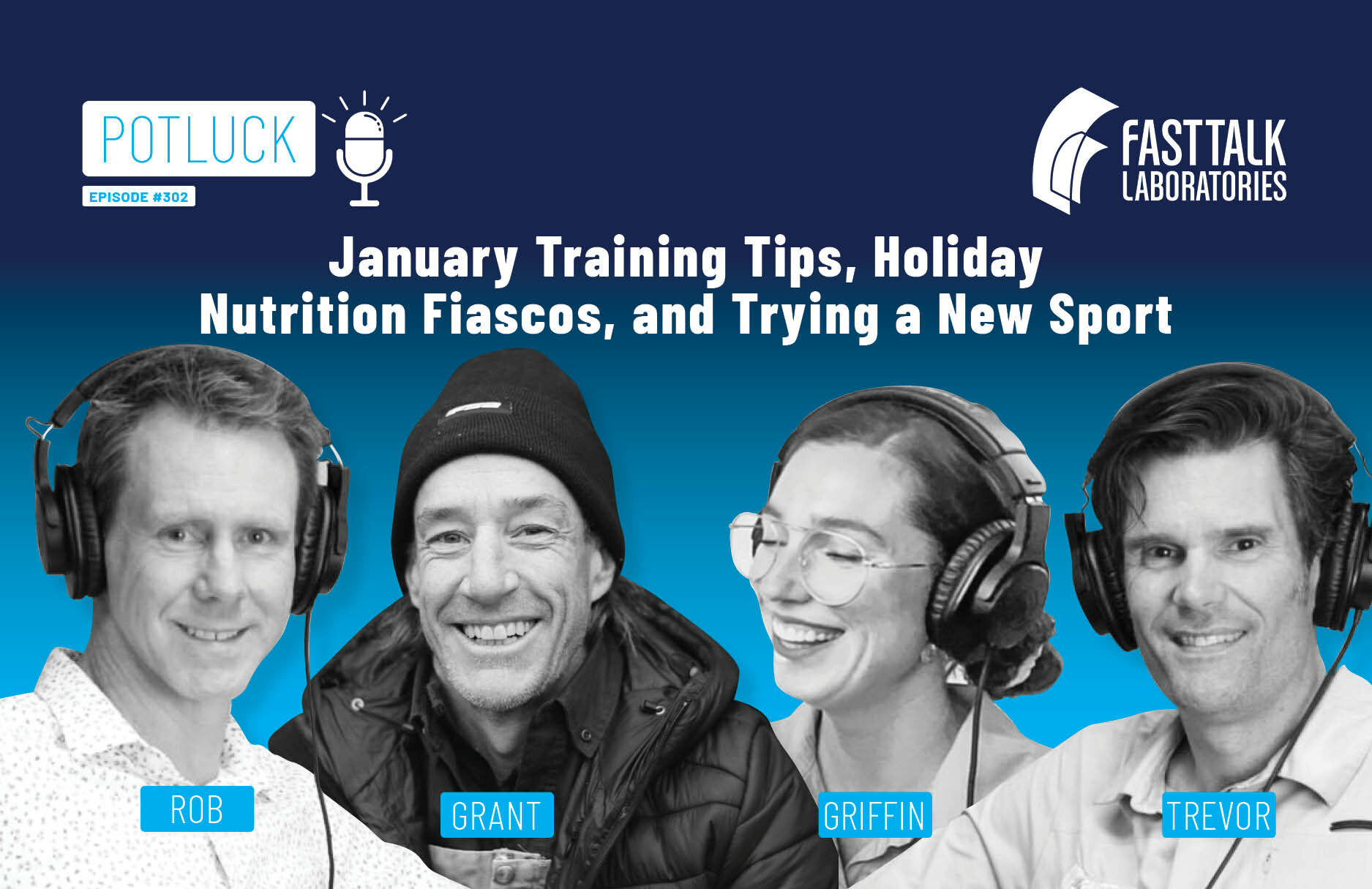
In this week’s potluck, we discuss our favorite ways to approach training in January, practical weight management tips after the holidays, and what to consider when trying a new endurance sport.
Episode Transcript
Intro, Banter & Cyclocross Nationals Recap
Trevor Connor 00:04
Well, welcome everybody to another episode of Fast Talk, your source for the science of endurance sports training.
Rob Pickels 00:11
It’s not right, but I’m gonna let you say it. I never know what it is.
Trevor Connor 00:14
I’ve only started just doing it.
Rob Pickels 00:16
It’s your source for the science of endurance sports performance.
Griffin McMath 00:19
Oh my god.
Trevor Connor 00:20
Okay.
Rob Pickels 00:21
Hey, I know, I know we want to talk about the podcast, but you know what I want to talk about? I want to talk about that guy.
Trevor Connor 00:27
I want to go there too. We got a surly Grant.
Rob Pickels 00:29
Grant, we have a Grant Holicky. Not only is he a surly Grant Holicky this morning wearing slippers, 17 degrees outside. Proud of you, buddy. He is also once again the coach of current cyclocross national champion, or I shouldn’t say that you’ve always been Eric’s coach. But Eric, that came out, wrong. Yeah, no. But hey, Eric Bruner who is somebody near and dear to my life all the way back Boulder Junior Cycling, Grant you’ve been coaching him for the years since and he is once again cross national champion.
Grant Holicky 00:58
Yeah, yeah. It was pretty fun to watch.
Rob Pickels 01:00
It was a super great race.
Grant Holicky 01:01
Yeah, if you haven’t seen that race that is one to go watch, Cyclocross Nationals from this year.
Rob Pickels 01:06
It had drama, it had performance.
Grant Holicky 01:08
It had physicality.
Rob Pickels 01:10
It did in fact, have physicality.
Grant Holicky 01:11
Yeah, it was like a hockey.
Rob Pickels 01:13
Yeah.
Grant Holicky 01:14
Trevor, you would love it.
Rob Pickels 01:15
You too. It was the Canadian version of cyclocross. Yeah it was.
Trevor Connor 01:18
Am I wrong here? Are you also a national champion now?
Grant Holicky 01:21
No.
Trevor Connor 01:21
I thought you you did the Masters?
Grant Holicky 01:23
I did back at 10th.
Trevor Connor 01:25
Oh, okay.
Rob Pickels 01:26
There’s a one in that.
Griffin McMath 01:27
Yeah, yeah.
Grant Holicky 01:30
And I did not win, but uh.
Trevor Connor 01:32
Wait a minute, he’s right. There’s a one that. There’s a 0 and 0 is nothing, so you we’re first.
Grant Holicky 01:37
Yeah, yeah, one times zero. Actually the one of the guys I coach one my age group, Justin Morgan.
Rob Pickels 01:44
Nice.
Grant Holicky 01:45
So that was-
Trevor Connor 01:46
So you have two national champions.
Rob Pickels 01:47
Well and also, and I feel bad for leaving him out, but Scott Funston was second in the elite race who Grant also coaches.
Grant Holicky 01:55
I don’t coach him directly Chris McGovern coaches him, but I work with him on the team.
Rob Pickels 01:59
Oh, god screw that guy.
Trevor Connor 02:00
So wait a minute, is Grant actually a good coach?
Rob Pickels 02:02
Grant is a good coach and if people are looking for coaching then they can hit up either Grant or myself at foreverendurance.com, just a little little plug.
Grant Holicky 02:10
I like it, well done.
Trevor Connor 02:11
I am gonna say, you know, the showing up and flip flops always wearing a hat you look like a coach.
Rob Pickels 02:16
If you want the seat of the pants coach you can go with Grant, if you want the well put together coach you can go with me. You get all of your options at Forever Endurance.
Grant Holicky 02:23
Rob, Rob and I may be the yin and yang here. Rob walks in and his overcoat and his nice Burberry looking scarf, and his- he looks put together, I look like I always look.
Rob Pickels 02:35
This is balanced. We are the balance in the universe.
Grant Holicky 02:38
In the force?
Rob Pickels 02:39
In the force.
Trevor Connor 02:40
That is a good point because Rob is stylish. I’m not I was just saying that I have no fashion sense whatsoever. I just, I have figured out how to wear clothing that doesn’t embarrass… works out well.
Rob Pickels 02:51
The other side of the table- It’s just like garbage chic. Or, it’s true. It’d be funny if this this is an off white on it then you would be really fashionable.
Grant Holicky 03:01
I would be, you’re right.
Rob Pickels 03:02
Right?
Grant Holicky 03:02
You’re right.
Rob Pickels 03:03
Trevor’s like off white, what is-
Trevor Connor 03:04
So all of you have a style. My style is if I was standing beside a wall, you would notice the wall.
Rob Pickels 03:05
Your style is the shirts that you get gifted for Christmas.
Trevor Connor 03:13
That is exactly.
Grant Holicky 03:14
That’s true.
Griffin McMath 03:14
No, I like the polka dots. Let’s not, let’s not diss the polka dot.
Trevor Connor 03:17
But, I will say I improve this year, I was Christmas shopping. I was in the bay which is the Canadian Macy’s and they had button down shirts for $25 they were like 75% off.
Grant Holicky 03:31
They’re all flannel and fleece line.
Trevor Connor 03:33
Yeah, so they were the ones that nobody else wanted, but I bought a bunch of them. 25 bucks you can’t go wrong.
Rob Pickels 03:39
Why not?
Grant Holicky 03:39
That is basically the core of any good fashion style. What’s the cheapest? Isn’t, isn’t that what we go for usually? How old are those jeans, Trevor? I feel like they’re older than Griffin.
Trevor Connor 03:50
Scarily I think I bought these like years ago.
Griffin McMath 03:51
I don’t know whether that’s an insult or a compliment to me actually.
Grant Holicky 03:56
It wasn’t about you, Griffin. It was about-
Rob Pickels 04:00
Not everything is about you.
Griffin McMath 04:01
Oh my god.
Grant Holicky 04:01
I was just going with the youngest person in the room.
Griffin McMath 04:01
So then that’s a compliment.
Trevor Connor 04:01
They are older than Griffin, younger than me.
Grant Holicky 04:05
Perfect.
Rob Pickels 04:06
Older than Griffin…
Trevor Connor 04:07
Somewhere in between.
Rob Pickels 04:09
So they’re, so they’re retro they-
Griffin McMath 04:11
So if anyone’s doing the math.
Grant Holicky 04:12
They’re Rob’s age.
Rob Pickels 04:14
They’re my age, perfect!
Trevor Connor 04:16
Okay, shall we actually talk about something here?
Grant Holicky 04:20
Um, yeah, let’s-
Rob Pickels 04:21
Podcasting is fun. Let’s talk about training because this is the source.
Trevor Connor 04:27
Oh, Grant is stripping.
Griffin McMath 04:29
I know you were-
Rob Pickels 04:31
Wa…what?
Griffin McMath 04:32
Your outfit, but I mean.
Grant Holicky 04:35
She can’t even speak
Griffin McMath 04:36
I know, speechless.
Holiday Habits & Setting the January Training Theme
Trevor Connor 04:38
To try to get this train back on the tracks, which is how we always start the Potluck. We have a theme it’s January. It’s relatively early January when this is going live. I think this goes live around January 12. Most people just took the holidays. We all did the same thing. I’m not even going to tell you guys what I ate on Sunday.
Rob Pickels 04:58
I holidated so hard this year, holiday the crap out of it.
Trevor Connor 05:02
Yeah, so did I.
Grant Holicky 05:04
I won that national championship.
Trevor Connor 05:06
I drove home for the airport on Sunday, I stopped at a gas station, when I got to my house. I looked at the wrappers and things sitting on my passenger seat and I was just like, I become everything I hate.
Rob Pickels 05:18
For the guy who is really against like sugary foods, he really loves candy.
Trevor Connor 05:23
Oh I- this is like growing up. I was a candy fanatic. That’s always my issue. It’s like, when I say sugar is bad for you don’t eat it. It’s not like I’m going well, that’s great, because I hate sugar. I’m saying that going, I love sugar. I could, when I was a kid, I’d like three bags of Skittles and eat them in one sitting, so, it’s a sacrifice.
Grant Holicky 05:45
Skittles are the best.
Rob Pickels 05:46
Well, yeah, you know, depending on your point of view.
Grant Holicky 05:49
You don’t like Skittles?
Griffin McMath 05:50
I’m not one to talk. I’m hiding a box of peanut butter captain crunch in my front seat. I didn’t bring it in the office today. Sometimes you just need it.
Rob Pickels 06:00
I made good choices today. I stopped at Whole Foods and I got a banana and an apple because I forgot them at home.
Trevor Connor 06:05
Yeah.
Grant Holicky 06:06
So you went to Whole Foods to get your banana and your apple?
Rob Pickels 06:09
I did, it was the most convenient on the way here.
Griffin McMath 06:11
You’re really living into that pea coat reputation right now.
Rob Pickels 06:14
My shadow, as I was walking into that store was so on point.
Grant Holicky 06:18
You look good!
Trevor Connor 06:20
So worst part of when I go home is my dad is invested in a small chocolate company. So he doesn’t make any money off of it. But what they said-
Rob Pickels 06:28
It’s called Hersheys.
Trevor Connor 06:29
It’s a Canadian company.
Grant Holicky 06:32
Good chocolate company.
Trevor Connor 06:33
But they sent him free chocolate. So whatever I’m home, he has the stack of boxes that he gets for free. He’s like here, Trevor have chocolates.
Grant Holicky 06:42
They’re free. Hey, free and chocolate.
Rob Pickels 06:44
I was gonna say say the only- okay. Hey, let’s talk about training.
Grant Holicky 06:50
Let’s talk about trianing.
Trevor Connor 06:51
What’s your question?
Grant Holicky 06:51
No, I don’t want to do my- I think Trevor’s question should go first.
Rob Pickels 06:53
Always.
Grant Holicky 06:54
Well, I don’t have a question.
Rob Pickels 06:55
No, no, no, you had a question. We voted your question off the island.
Grant Holicky 06:59
That’s right. That’s why I no longer have a question.
Trevor Connor 07:01
Grant is very bitter.
Grant Holicky 07:02
I’m not bitter, necessarily. I thought all of your questions we’re better.
Trevor Connor 07:05
I was, I started the countdown to start the show and I had to pause cause you needed to get out a few F bombs before we started.
Grant Holicky 07:13
I did, I did. That doesn’t mean I’m upset, necessarily. Cause there’s things that I need to get out.
Trevor Connor 07:23
What does that mean otherwise?
Griffin McMath 07:23
Listen, that word depending on how you say it can meet a lot of different things.
Grant Holicky 07:24
It could, I could have been exuberant.
Trevor Connor 07:24
Rob was actually did a great comedy skit about all the things that word can mean. It’s worth watching.
Rob Pickels 07:28
Samuel Jackson narrated book called Go the **** to Sleep.
Griffin McMath 07:31
Ah, yes, so good.
What Should Training Look Like in January?
Trevor Connor 07:35
Fast Talk Laboratories offers deep dives into your favorite training topics like intervals, polarized training, data analysis, and sports nutrition. Take a look now at our cycling based training pathway, now’s the perfect time to see how to lay the perfect foundation for an awesome season. In our new guide to cycling based training experts Joe Friel, Dr. Steven Siler, Brian Kohler, Dr. Andy Pruitt, and I show why good base training isn’t just about writing endless miles. We share how to plan and structure your bass season, how to monitor your efforts, and how to track your fitness gain so you start your next training phase with a strong aerobic engine. See more at fasttalklabs.com/pathways. All right. My question. I’m going to read it. A lot of athletes let training slip over the holidays. I always personally consider January the start of true training for the season. What’s your favorite workout approach to January and this is for athletes that race or their season is kind of that March to September. So I know, Grant talking about cross athletes, the answer is keep resting. So talking more about people involved in that road season. So who wants to answer this question first? I definitely have my thoughts.
Grant Holicky 08:49
Well, I think it’s a little bit hard because people seasons are starting earlier, and earlier, and earlier now. And even masters racers in Colorado, they’re traveling down Arizona and doing Valley of the Sun or Tucson Cycling Classic or these races that are like February, mid February. For my athletes, I tend to kind of suggest that you leave those races to the Californians and the Arizonans and like they’re gonna come in fit and they’re going to come in flying.
Rob Pickels 09:17
Super fast.
Grant Holicky 09:18
Yeah, if you start your season in January here, I tend to advise a little mix of different things, maybe a little running, definitely get your strength work in, do those things, because it’s really hard to get in a ton of volume in Colorado, in January.
Rob Pickels 09:34
I agree.
Grant Holicky 09:35
And in a lot of the country, it’s hard to do that. I mean, there’s places that it works really, really well but if it works really, really well that’s people that I would advise take their break back in November. Crank back up in December. But for a lot of us yeah, we let it go, I let it go big time. And maybe not quite as well as Rob, this is why I’m wearing all baggy clothes to work today. Couldn’t fit- nothing else fit Griffin.
Rob Pickels 09:57
No, no, this is why I had to get an apple in me this morning.
Grant Holicky 10:00
This is all that fits me right now. So yeah, like, I tend to approach it with a little bit of a training mix that maybe include some running, maybe includes some lifting, maybe includes some cross country skiing, maybe even some downhill skiing, just a little bit of everything, keeps things light, keeps things fresh. And then as we move into those longer days of February, we start cranking back up a little bit more hours on the bike and try to take advantage of the sun.
Rob Pickels 10:28
Yeah, for me January is oftentimes that rebirth, right. And the hope is that people don’t let themselves slip too bad in December, so that you’re not crawling out too deep of a hole. But I think that a lot of individuals, you know, they come into January, and one of two things happen, or maybe both at the same time. They assume that their fitness is what it was six weeks ago, when they kind of weren’t last training hard. And they just dive right back into training, trying to do the exact same workloads. And ultimately, I think that that can be detrimental, right. Because that’s so tiring when you’re trying to do things that are now too hard, because your FTP has has dropped by, I don’t know, 5%, maybe more. So I think that starting out with testing is always really important in January. And if that’s lactate testing, awesome, if that’s some sort of FTP performance test and that’s great, too. Which leads me to my second point, I think that people can be in January, and they can say my fitness is so bad, they can almost be afraid to train. Because they don’t want to see these numbers, they don’t want to see these numbers that are lower than they should be, than are lower than they were before. And so I oftentimes write some workouts that are maybe a little bit lower intensity for people, maybe what I do is I’ll shorten the rest a little bit so that they’re still getting a good workout. But I won’t do it as a high percent of their FTP as I normally would. Let’s help build some confidence back, let’s get back in the consistency of training. I think January is a great month to be kicking things off. But races aren’t necessarily won in January, right. So the perfect workout might not be as important.
Building Fitness: Consistency vs. Intensity Debate
Trevor Connor 12:02
So I gotta give a different answer. What I love about that winter season, you know, we talked about some people do start racing in February. So really what we’re talking about is, you’re a couple months away from when you consider your season starting, what do you do? And to me, the biggest thing is now about getting consistent. Particularly if you are on that start racing in March or April, you just had the holidays, you typically lose that consistency, you’re gonna have weeks where you’re not training it at all. And I think the biggest gains come from when you can just say, I’m going to do a couple of good three, four week blocks, where all I have to focus on is my training. Even in the season, you’re going to have races and events where you go, training has to take second wheel to getting ready for the events, you can’t always be consistent about your training in season. So I love you hit January, we’re now going to do two or three of these four week blocks and do this nice build. I do agree with you that the intensity can really hurt. So I personally don’t, well there’s two reasons for this. But I don’t like hitting athletes with the really high intensity in January. One of the reason’s is-
Grant Holicky 13:10
Oh I love it.
Trevor Connor 13:11
I know you do.
Griffin McMath 13:12
Brutal.
Trevor Connor 13:12
So I’ll give my explanation for why I do more thresholdy work. One is the high intensity hurts. Second, as goes back to we talked about this on the show and you’ll look at the research. The higher the intensity the work, the quicker you see the adaptations and the plateau. Like you do sprint work. you see the adaptations in a couple of weeks, and after like three, four weeks, you just don’t see much after that. You do like Tabata type work, you see most of the gains in about six weeks, when you’re doing work around your anaerobic threshold MLSs, whatever term you want to use, it’s 10 to 14 weeks to see the gains. So I see a real benefit of doing that work in this phase where we got a couple of months of training. And we can build that. And yeah, there is that argument that we’ve had on the show of is it different systems? Or is all this work hitting the same system as one system you just hit yet slightly different. That’s a different conversation.
Grant Holicky 14:07
Well, it is all the same system. But I agree with you and I’ll tend to do- and I’m sorry to cut you off Griffin, I know you have something that put in this, but I really want to get back at Trevor.
Griffin McMath 14:19
I don’t want to get between that.
Grant Holicky 14:21
No, I agree with Trevor and definitely I will do more tempo and threshold type work this time of year because you do need that time to build it in. The reason I like doing intensity year round is that it’s not just physical. V02 max is a gigantic zone. I will say this on repeat and people on the show will get sick of it. But that zone goes from 110% of threshold to max effort and it’s all purple on your computer. That’s ridiculous there’s so much nuance in that zone. And there’s so many different places to play around in that zone and things you feel in that zone. So I like that it’s hard.
Trevor Connor 14:58
Yes.
Grant Holicky 14:58
I like that you can do something in January, that’s short, that’s intense. And you get off the bike. And people feel like they did something. People really felt like they, you know, I got something done today. And I think sometimes those base workouts, especially when they’re on the trainer, and they’re a little bit shorter, sometimes you get off, you don’t really feel like you did that much. So that’s kind of why I like that intensity. But I won’t argue with the fact that this is the time of year to get some of that LT and tempo work in and it works really, really well.
Why Race Seasons Are Starting Earlier
Griffin McMath 15:26
I would love to take us back, you said something a little bit ago about how the season is starting to creep earlier and earlier. And so my question is A why is that even happening? And B, does that change the whole premise of the question of what to do in January?
Rob Pickels 15:43
I think that it’s really hard. I face this a lot. It just seems like a lot of the races that I like to do are in April. And then I have like this dearth of event through the middle of the summer.
Grant Holicky 15:53
Dearth.
Rob Pickels 15:54
How do you like that, huh?
Griffin McMath 15:55
Mmm, no. Actually after that, I don’t, like.
Grant Holicky 15:59
It’s just one of those words that you don’t like?
Griffin McMath 16:01
Mm mm.
Rob Pickels 16:01
So yeah, I think it is hard, right? For the athlete, they’re at the whim of the calendar, right, in some regard. And I think that there’s different types of athletes, right. There are athletes that are going to race the series that is local to them. And then there are athletes that kind of cherry pick, maybe more marquee events, right. And ultimately, I think the question is of the race promoters, like why the heck are these events happening so early in the year now? The athlete is at the whim of the race.
Grant Holicky 16:29
Well around here, you do see it. There’s not a whole lot in summer because it’s hot, right? And people don’t want to put on races when it’s super hot. But you’re right. The super fun races around here are April, or May.
Trevor Connor 16:39
It’s not just the heat. Another reason is-
Grant Holicky 16:42
People aren’t around.
Trevor Connor 16:43
The people you make the money on masters riders and they vacation.
Grant Holicky 16:46
Yeah, they’re not around. That’s a good point. I have always missed that a little bit. But I think you’re right. And I don’t know. I mean, that does bring us to a whole nother question is, you know, are we talking about that in January? Are we talking about that December? And there’s these big picture arguments about the calendar. I mean, this is why we moved cyclocross nationals to December because everybody complained, oh, I can’t train through the holidays, which to me, I won’t get on my high horse. But it’s ridiculous. You’re preparing for a single one hour or 50 minute long masters race, how much you really need to be doing? Like, give me a break and enjoy yourselves, it’s not the end of the world to have a beer.
Rob Pickels 17:21
This is, as we said, the coach of current cyclocross national champion.
Grant Holicky 17:26
But I want to come back to something that I think Trevor said, the streak. And I’m a big believer from a mental performance standpoint about the streak. That the whole point of a resolution or the whole point of getting back to something is getting back to the rhythm and back to the streak. Give yourself the three days in a row, the four days in a row, whatever that is. So creating a way that allows you to still be interested, or if you’re coming off our super hard offseason, like Rob did. And by hard I mean, he like offseasoned hard.
Rob Pickels 18:00
I did.
Grant Holicky 18:01
He was all in on his-
Rob Pickels 18:03
December was, yeah.
Grant Holicky 18:04
And I did too. I weighed myself at the gym yesterday, and I don’t care too much about my weight. And it was little, you know, oh, crud muffins, I gotta get going here a little bit. And to me, that becomes about the streak, okay, I did a run today. And I’m gonna do this tomorrow, and I’m gonna ski hard on Saturday, it doesn’t matter what those things are. It matters that you get something done on a regular basis, because for most athletes, as soon as you’re back in that streak, you’re back in it, you’re gonna get excited about it again. You’re gonna see this movement toward and I think that’s really where we need to get back to is instead of this rest running away from, let’s get this movement toward.
The “Streak” Mentality & Getting Back Into Routine
Trevor Connor 18:44
It’s something that I want to quickly address to Griffin’s question, I think it’s really important for people to understand. I see people all the time that go to Valley of the Sun or go to these February races and go, I’m getting a leg up on the season. You’re not. All you’re doing is moving your season, you’re starting out sooner, and you’re gonna start feeling stretched sooner. I remember when I was managing team Rio Grande, we had this rider on the team who will lived down in California. And he went to those early January races and he was killing it. And he sent me this really excited email, go look how well I’m racing right now, I’m going to be crushing it this season. And I sent him an email back that he didn’t understand saying, I’m really concerned. And sure enough, he crushed it in January and February by the time team Rio Grande went to their first race in March he was already overtrained. And he barely went to a race that season.
Rob Pickels 19:38
And I think that that’s what you have to be considerate of, right. If you have an early season, it’s okay to start your season early. Just understand that a traditional leader season probably isn’t going to work out well for you. And as long as everything works together. I’m okay with people starting in February, but just don’t expect to be good in the middle of the summer.
Grant Holicky 19:59
Or you can expect to be good, but you have to split this up into three separate seasons, you’re going to be taking a week off in late May or early May, if they’re training in January. So, you know, we’ve talked about this a little bit more about how the athletes and we talked about it with Joe Friel, about how athletes are having to peak over, and over, and over again or hold these peaks and how did they do it? This is one of the ways they’re going to do it. Yeah, they’re starting earlier. Yeah, maybe they’re even ending later. But there’s these breaks that are built in, so that it’s hard to do that super traditional long, build up periodization piece. Instead, you’re hitting it, I’m really good here and then I’m gonna back off and I’m gonna take some rest. And I will scream from the rooftops that three, four, even six days to one week rests man, they do not hurt you. They only help you and people just don’t want to take them. So yeah, you can get cranking now. But just look for that week off somewhere down the road.
Griffin McMath 20:59
So unless someone splits up multiple seasons, the actual landscape of the competition could change if people are front loading.
Grant Holicky 21:06
Yeah.
Griffin McMath 21:06
Their season.
Grant Holicky 21:07
And you can do that, listen, like you can know if you’re from California or Arizona that like I’m going to target value this on or I’m going to target one of these things because I have an opportunity to come in a leg up. So I’m going to do really well. And sometimes it’s-
Trevor Connor 21:21
Target Valley of the Sun.
Grant Holicky 21:24
For a variety of reasons.
Trevor Connor 21:25
I’ve got a bias here. Yeah, I apologize. The organizers of the Valley of the Sun are gonna hear this and hate me, but I just don’t like that race because everybody’s like, I gotta get a leg up. I’m gonna show up. I have spent particularly cat twos and I’m gonna get my upgrade and be a cat one by March.
Grant Holicky 21:41
Yeah.
Trevor Connor 21:42
Everybody shows up, nobody’s been on a peloton for six months.
Grant Holicky 21:46
It’s sketchy.
Trevor Connor 21:46
It’s a crash fest.
Grant Holicky 21:48
Yeah, it’s sketchy and it’s nobody’s fault. But when you look at your season, you may decide to target an early race because it suits you, or it’s good for you. Understand that then build in a break somewhere so that you can go to the next race that suits you. You can’t hold an April peak. You can’t hold a March peak. You sure can’t hold a February peak for eight months.
Peaking Too Early & Structuring Your Season
Trevor Connor 22:12
No, you can’t. Last thing I will say to that and then we’ll move on to Rob’s question, people when we say this to people, they look at the pros and go, well how the pros do- they race February to October. Couple answers to that. One is they’re pros, they’ve been doing this a long time, and they have a stamina and resistance that most people don’t have. B, there’s two types of pros. There’s the Domestique Pro, who really never peaks. They’re just kind of 80%, 85% all the time. And they’re 85% is good enough to do some damage in a pro race. And they’re just able to go to race to race to race, but they’re never on top form. If you look at the the guys that are trying to win the Tour de France or the big events, like Tadej, you don’t see Tadej in the March races or February, or if he is, he’s not doing much.
Grant Holicky 23:01
Right, he’s bundled up.
Rob Pickels 23:02
Well, and I think that that’s a great point, right? Oftentimes, people will look at somebody faster than them and assume that that person is always on their peak form and fitness because they’re beating you. Here’s the thing, they’re just faster than you. And oftentimes they are not trying that hard. They are not on their peak. I think what Izonhoven was this weekend, I saw a quote from Vanderpool and he demolished everyone in that race. And his quote was something like I tried not to expend too much energy, this race.
Grant Holicky 23:29
Yeah.
Rob Pickels 23:30
He’s just that much better he is, trust me, he is not racing 100%.
Grant Holicky 23:33
Right, but one of the things that I will definitely say is that I know we tend to look at this and go, I’m out of shape, I’m behind the eight ball, and all those things. And all those things may be true. But in my mind, it’s not very hard to get an athlete to 90%, it’s very hard to go from 90% to 100%. You can be very good at 90%. You can be competitive at 90%. You can use racecraft at 90%.
Rob Pickels 24:01
And 90% is better than 110%.
Grant Holicky 24:03
Absolutely. So remember that it doesn’t take that long to get to 90%. I would argue you can get there in six weeks, you can get there in two months, no problem. It’s that next leg up, that takes us this long time or this period to get there. So you can look at yourself in January and go I’m out- I’m out of shape. I’m in this weird place where I’m like, I’m actually in decent shape, but I’m a little overweight. That’s fine. It’ll come off. I know how to get it off. I know how to do those things. But I’m not panicked, I don’t get into a panic mode. I’ve got athletes that got sick, everybody’s getting sick this year. The respiratory stuff that’s going around, you will get sick and you’ll get knocked out for a week or two. Don’t stress about it. It’s gonna be okay, we can get that back. You’re not as far behind as you think you are. And it comes back very quickly. The top end might take a little longer. That’s okay. But we can get there too.
Trevor Connor 25:01
That’s always my goal with the bases.
Grant Holicky 25:03
Yeah.
Trevor Connor 25:03
When you come out of a successful base season, you should be able to hang to the end of the race with the people that you want to be competing with. It’s just when the attack start, you’re gonna have nothing to respond to that. And then we build the top end, and then you’re winning races. Yeah.
Best January Workouts: Threshold, VO2, and Sprints
Rob Pickels 25:18
Can we do this? Can we end this segment out on if you could only do one workout in January, what would it be?
Trevor Connor 25:25
I can’t have one workout because again, I’m, I believe in the polarize approach. So it’s a lot of long, slow, and then the threshold workout.
Rob Pickels 25:33
The underlying assumption is that there is a majority of of base zones two level work.
Trevor Connor 25:38
That, at, for me, it’s the five by fives, or the four by eights threshold work.
Rob Pickels 25:42
And for everybody listening to describe that, Trevor’s five by fives are like 90, 95% of FTP.
Grant Holicky 25:50
Though, right around 100%, 95 to 100.
Rob Pickels 25:52
And then a short rest, five minutes on one minute off, five minutes on. So as opposed to a five by five you could also do on a V02 level where you’re at 120%.
Trevor Connor 26:01
I don’t touch that in the winter.
Rob Pickels 26:03
Yeah.
Grant Holicky 26:03
What would you do?
Rob Pickels 26:04
I, like you, and more of a max, aerobic power type of person. But I will say this very much depends on, on the athlete you’re working with. And this is not a universal suggestion. But I will say long max, aerobic power, long V02 stuff is really hard and painful in January. So I skip the five minutes, the eight minutes stuff, and I’m a 30, 30 kind of guy. I think that that gets you up to that workload, it gets your legs used to dealing with that, but it doesn’t have the stress on the system that holding that power straight for five or eight minutes will.
Grant Holicky 26:37
Yeah, I love that. And I love 40, 20s, for that same reason. One of the things, and this will sound kind of odd that I don’t want to ever get rid of in January is peak sprints. And we’re not talking V02 max work, I’m talking like, all out.
Rob Pickels 26:51
Out of the saddle.
Grant Holicky 26:51
5, 10 second sprints. Spread them out through a ride, do 5, 6, 7 of them, end a ride with them. And part of the reason I love them in January is your legs are actually kind of fresh, you’re going to see some sweet numbers in there. And that, that excites people that’ll get you going even if you’re not seeing those other and all of a sudden you pop 1100 Watts, and you’re like, I’m a golden god, you get excited about the rest of the training. And there’s a huge technical component to top end sprinting. And if you can start working on it, now, you have a better chance to get to that place with that really high cadence and that really, really 120, 130 sprinting out of the saddle. And that, you can hold that. Because you’re not necessarily going to be able to hold the top end power, but you can hold the technical things that you’ve learned about producing top end power.
Trevor Connor 27:37
And by the way, you want to hit your best sprint power ever? Do it in like November and December when you’re out of shape.
Grant Holicky 27:44
When you’re barely riding the bike. It feels great, though you feel good about yourself.
Trevor Connor 27:48
Yep.
Griffin McMath 27:49
Griffin is cued up over here. I know.
Rob Pickels 27:57
She want to.
Griffin McMath 27:57
We just skipped over to me, because I’m not a pro endurance athlete.
Grant Holicky 27:58
I didn’t ignore you. I looked right-
Griffin McMath 27:59
You look at this and you’re like, I want to know what workout she’s doing?
Griffin McMath 27:59
Squats. Are my January goal.
Rob Pickels 28:00
Let’s go girl.
Rob Pickels 28:00
Wow, she in the gym. I like, I like this.
Griffin McMath 28:03
It’s a primal functional movement, it benefits so many aspects of your physical health. And I now follow all of you on Strava. So I’m going to be watching you and mimicking what you’re doing, but my endurance goals are for September.
Grant Holicky 28:18
I did squats this morning.
Trevor Connor 28:19
I gotta say, you look at this and you go, what doughnuts is he eating?
Rob Pickels 28:24
Which leads me to my question.
Grant Holicky 28:26
Oh, it does.
Griffin McMath 28:26
It does.
Grant Holicky 28:27
It’s a beautiful segue.
Rob Pickels 28:28
It does, doesn’t it.
Trevor Connor 28:29
I laid you up, laid you up on that one.
Rob Pickels 28:31
I don’t know that that’s the word that you’re looking for.
Grant Holicky 28:35
Teed you up.
Griffin McMath 28:35
Teed you up.
Trevor Connor 28:36
You know, I get my expressions-
Post-Holiday Weight Gain & Nutrition Reset
Rob Pickels 28:37
Funny, funny expressions. I will say as as a quick aside, you know, we had family over our house for Christmas. And it’s been a long time since we’ve had like babies in the house. My kids are 11 at this point. And my brother in law was like, I’m gonna go put Olivia down. And we you know what she means like to put her down for a nap. But it’s just such an odd phrase of word that we all use, because in a different context, it has a very different meaning. Anyway, it was just like a little family inside-
Grant Holicky 28:59
Talking about putting the baby down.
Trevor Connor 29:00
Exactly.
Grant Holicky 29:00
It’s about time.
Trevor Connor 29:12
Listeners, this is a great time of year to expand your training knowledge join Fast Talk Laboratories now for the best knowledge base of training signs on topics like polarized training, intervals, data analysis, sports nutrition, physiology, and more. Join Fast Talk Labs today and push your thinking, and your training, to all new heights. See more fasttalklabs.com/join.
Rob Pickels 29:39
Let’s see, whew, holidays. I got on the scale, much like everybody else, and I looked at the number and I gasped, much like everybody else. And this isn’t, I don’t want to have a discussion- a deep discussion about the philosophy of weight loss whether or not people need to lose weight. I am at a point right now where I believe that I am slightly above a healthy optimal weight for me, to tell you the truth. This is not about becoming a skeleton to win the Tour de France, right. I need to put that caveat out there. But what I’m actually interested in because everybody is different. And for me, nutrition stuff is so individualized for people, I don’t always think that there’s one optimal thing. I want to hear from everybody. What practical tips, or what practical actions do you include in your daily life, to improve your nutrition, to improve your body composition? And why do you do those things for yourself? And my hope is that the listener can identify with somebody and say, oh, God, I feel exactly the same way. Maybe that will work for me.
Trevor Connor 30:42
Shall we have the contest? I left at 162 pounds, 172 this morning.
Rob Pickels 30:47
Wow. Okay.
Grant Holicky 30:48
I’m about 10.
Rob Pickels 30:49
10 over?
Grant Holicky 30:49
I’m about 10.
Rob Pickels 30:51
That’s better- I mean, I’m like six over.
Grant Holicky 30:53
No, I’m about 10 and 10’s pretty normal for me. I think some of it for whatever it’s worth think some of its that I was doing 20 push ups a day all through-
Rob Pickels 31:01
Yeah, dude, you’re swoll.
Grant Holicky 31:02
I don’t know about that, but I do put on weight, muscle fairly easy.
Rob Pickels 31:06
Yeah, no, no, no.
Griffin McMath 31:08
I’m significantly under, we’re very different, no. When I went home I was like, darn it, like, I have been trying, yeah.
Rob Pickels 31:15
Okay. So yeah, let’s expand my question.
Grant Holicky 31:16
I didn’t want to go first for this-
Rob Pickels 31:18
You can talk from the other side.
Grant Holicky 31:19
I didn’t want to go first on this, but I will lay something out there. The key to everybody in this room, whether you’re underweight or overweight, is we got out of our routine. Right, you can just leave it very simply as routine. Somebody like Griffin who has to pay attention to what she eats to make sure she stays where she wants to stay. Because she’s always anxious and she’s like, you know, scared little bird and Trevor terrifies her.
Griffin McMath 31:45
Take it back.
Grant Holicky 31:45
And anytime she’s in the office just like tweaking, you know.
Trevor Connor 31:49
That’s the way it goes.
Griffin McMath 31:51
It’s more like you walk in, and I’m found giggling in a corner somewhere.
Grant Holicky 31:55
Whatever it is- metabolism, metabolic rate, that’s nice and high. Getting back on point, that routine, if Griffin has to focus on the right amount of food at the right times, in order to stay the weight she wants to stay at. That’s just as much routine as myself making sure that I am eating oatmeal in the morning, or not having a beer at night, or whatever those things are, as much to me is they’re not choices as they are habit and routine. And January is a time that we can get back to habit and routine. So for me, the kids are out of school, I don’t even try anymore. No, I seriously, I don’t try to hold my routine, when everybody else around-
Rob Pickels 32:41
Can’t do it man.
Grant Holicky 32:41
Is off it.
Rob Pickels 32:42
Hard.
Grant Holicky 32:42
This is the time that I get to enjoy that and not have any guilt over that. So I can go and have a couple of beers a night, or go and do those things or eat differently in the morning or eat dessert. Because those things are social, you know, those aspects of what we do are social and they connect us to the people around us. And usually for me, I’m with family, and I’m with those people that I really want to be with. Those are connecting pieces to those things. So I’m gonna lean into, I’m gonna I’m gonna enjoy them. But then I get back to January and I look at things and I go, okay, kids are back in school, I can fall back into what is my routine. And that routine, I know, will drop the weight off that I need to get off, it will get me back to health, and I can move forward.
Rob Pickels 33:26
That was more insightful than I expected.
Griffin McMath 33:28
Yeah, it was great.
Nutrition Deep Dive: Habits, Hunger, and Routine
Trevor Connor 33:29
That’s very good.
Grant Holicky 33:31
This is why I don’t ask questions anymore. I’ll just sit here and give input on yours.
Trevor Connor 33:35
I was expecting a much psoralea Grant today.
Grant Holicky 33:37
I never really surly.
Griffin McMath 33:39
I think the habits is a great point. As long as there are no other underlying conditions that are-
Grant Holicky 33:44
Absolutely.
Griffin McMath 33:45
Right like that’s, that’s the caveat.
Grant Holicky 33:46
Well, you’re the one that’s going to think that way, obviously.
Griffin McMath 33:50
Yeah.
Grant Holicky 33:50
As well you should, right, what are the underlying-
Griffin McMath 33:52
Right.
Grant Holicky 33:53
You know, what are the medical pieces, what are the health pieces and, and you’re absolutely right, and I’m fortunate right I’m in a place where I don’t have any underlying issues. I don’t, there’s a history of high blood pressure in the family. So I don’t drink caffeine anymore unless it’s a race day and there’s little things like that that I’ll focus on but I don’t have to worry about these other pieces of the puzzle so I can go and eat more sugar. For me it’s sugar, right.
Trevor Connor 34:20
That’s it for me too.
Grant Holicky 34:20
It’s added sugar. I made a shift years ago, I remember, this that I went to natural peanut butter instead of all the sugar that’s added in typical peanut butter and I lost two pounds. Like it’s, it’s noticeable. Stop drinking Coke and I lost weight. And for me, I have these little promises to myself and they’re not necessarily the healthiest things but on this day when I know I’ve worked really really hard I have a bowl of ice cream, you know, and it’s it’s that kind of stuff that’s part of my routine. My routine is not living like a monk. It’s hardly that, it’s just knowing I don’t drink on a night before my kids have school. Because I gotta get up early and I got to do those things and I need to sleep well. And so they don’t have school, I have a beer, maybe I’ll have two, you know, I had to go chase Eric Brunner around for three hours on the bike, I’m gonna have a bowl ice cream because I’m probably under calorie anyway. But that all of those things and even those little treats, even those little pieces are part of my routine, I figured out a way to work them into my routine. So my routine feels good. It’s not abstinence, it’s not like I’m starving myself. It’s just part of life. And it rolls.
Rob Pickels 34:21
Yeah.
Grant Holicky 34:40
So I absolutely love this question to the point that as, you know, we’re working on a book right now. And there’s gonna be multiple chapters in this book addressing this exact question. I absolutely love reading the research and thinking about this. And to your point about routine, I’ll give you a little physiology behind this because I’m the same thing. That part of my routine when I’m not just at the weight I want to be at but eating healthy, which is really important to me. To me they go hand in hand, if you are eating healthy, your body is going to find a good weight. Yeah.
Trevor Connor 35:00
So part of my routine is eating a low glycemic load diet. So I’ve never really spiking insulin. And when I’m eating a low glycemic load diet, and I’m in a routine, you know, I have my cheat days, I might go over to Pearl Street and they got this great ice cream shop there. I’ll have some ice cream, spike my insides a little bit. But I go, hey, you know, I really enjoy that tomorrow I can get back to the routine. It’s when you get out of the routine. So when I go home, I don’t want to offend my mom, I eat a lot of her cooking. I am eating high glycemic load day after day. And there’s a certain point and there is research on this. So here’s the issue. Insulin is it’s kind of a this catch 22 thing, where eating a lot of sugar, eating a lot of high glycemic index or high glycemic load foods, spikes insulin, but insulin increases hunger signals. So you’re eating and you’re getting hungrier and hungrier as you’re eating. And there’s further research showing that at a certain point, it impacts the part of your brain that is basically your control center, your willpower. And they have done research show and it literally shuts off your willpower. So I go home, trying to eat healthy, but I’m getting these insulin spikes, I’m getting these insulin spikes. And there’s just a certain point, it’s four or five days in where I go to the cupboard. There’s all my dad’s free chocolates. And I’m sitting there going, I shouldn’t eat these. I’m saying to myself- You’re saying it between bites. Like I will put down 10 chocolates.
Grant Holicky 37:44
Yeah.
Rob Pickels 37:44
Yeah.
Trevor Connor 37:45
And go to bed with my heart race and everything else going, why did I do that?
Grant Holicky 37:49
And there’s an endorphin spike when you get sugar too. And that’s something that you want, you crave, and you want it over, and over, and over again. So there are these negative or positive feedback loops, however you want to word them. And like I said, and I hear what you’re saying about ice cream every once in a while those things. That’s why I’ve worked it into my routine, like I can get to Friday and know I get to have a beer or I can get to Tuesday night, I’m gonna have ice cream with sprinkles and I’m gonna really enjoy it. And to me, that means that I’ve worked those endorphin rushes or those, you know, pleasure seeking moments into what I’ve done. And that way I can continue in perpetuity with it. And it feels good. But at the same time, I know that when I go home, much like you’re saying, Trevor, I’m just gonna lean into it. I just know this is where it’s going to be and it’s going to be okay, I go back up to upsate New York. I’m eating chicken wings, I’m eating pizza, I’m eating really good Burn dairy ice cream. I’m gonna go down those roads, because they’re fun.
Trevor Connor 38:48
And it’s okay, here’s my counter, to here’s my concern, because I used to be the same thing. And it’s the holidays. Let’s let it go a little bit, I’ll put on some weight, I know I’m going to lose it in January. I’m not worried. But as you know, I’ve got AFib.
Grant Holicky 38:59
Yeah, yeah, and this is back to what Griffin was saying.
Trevor Connor 39:02
Getting those insulin spikes down. So I do not eat simple sugars anymore.
Grant Holicky 39:08
Yeah.
Trevor Connor 39:08
And my AFib was pretty much gone all fall. And that was my issue, I wasn’t concerned about gaining the weight over the holidays. But I noticed a couple of weeks into the holiday, sure enough, AFib was coming back.
Grant Holicky 39:22
Right.
Trevor Connor 39:23
That’s my concern.
Grant Holicky 39:24
And this is, this is what exactly what Griffin was saying about the underlying issues. And I don’t have that many so I don’t need to worry about it, but many people do. And so you have to work that into how you make these choices.
Griffin McMath 39:37
Well, and even some of those choices that you make with sugars, you know ,if you can have healthy fats and fibers at the same time to just slow down, you know. Exactly, so.
Rob Pickels 39:48
Grant something you said before, you don’t do a program of abstinence, right. And that, and that really resonated with me and you know, the example that I gave when I proposed this question was this, I am of very hungry person, I’m pretty much hungry all the time. I make it home from bike rides by thinking about what I’m going to eat as soon as I walk in the door, I’m just hungry all the time. And for me when I was trying to do more of an absence, eat the same stuff, but just eat less.
Grant Holicky 40:19
Yeah.
Rob Pickels 40:20
I was always hungry. And that was a really bad place to be, right. Because then you’re not enjoying your day to day, then you’re dieting, then it’s all the negative things that come across with dieting, and weight loss, and all of those words. And so, you know, for me, what it became was how do I eat as much as possible, right, but of lower caloric density foods. And so almost every night for dinner, I’ll make an entire bag of frozen vegetables, maybe it’s broccoli one night, maybe it’s something you know, another night, and I’ll eat that entire bag of vegetables prior to eating like the main more, you know, because we’re cooking for the family who knows what it could be, it could be pasta, it could be anything like that. But by eating a large density of I shouldn’t say a large density, a large volume of food like that, I’m able to eat less of the things that tastes really good, less of the things that are just filled with cheese, and carbs and everything else. But still walk away from that meal, feeling satiated, as opposed to just being like, I’m just going to eat a half a cup of pasta and one meatball and be hungry within 30 seconds of walking away from the table.
Grant Holicky 41:36
Yeah, and I also think there’s a piece to this, that eat what you really like last, leave the meal with that taste in your mouth with the really, really good stuff. I mean this is straight psychology, right? Like one of the things that you’re doing, and you don’t even know that you’re doing is like, I do this all the time with vegetables, I get them out of the way. And I’ll eat all of them first, same idea, right. And then I can go and eat that alfredo sauce that I made the other night that’s really rich, but I’m leaving that meal going oh, that was amazing. I ate so well tonight. And maybe I didn’t eat nearly as much of it as before. One last little thing that I do want to throw into this too is just very quickly about weight. And what we see as our ideal individual weight, we really have to approach this the way you would approach any goal in life, they have to be realistic. And I think far too often, I remember when I was like this when I was racing triathlon, I wanted to be 172 pounds, I’m never going to be 172 pounds. If I’m 180 to 182, I’m perfect for me. As soon as I went under 180, I was in 176, 175, I couldn’t do the things that I needed to do. So maybe I could go uphill faster, I couldn’t train, I couldn’t perform. And dude, I can train like an animal at 188. Because I have all that excess and obviously I don’t want that down the road. But make good choices about what you’re establishing has a healthy weight for you and understand that, and the last thing I will say, I’ve done this with athletes for years, and years, and years, and years, the more you pay attention to it, the harder it’s going to be.
Griffin McMath 43:21
From a different perspective, you know, I am significantly underweight for myself at this point. And we did all the labs and tried to figure with found like- a couple of things that might have been contributing to it. But I feel like if you’ve seen some of those hot ones episodes where people are really struggling, they’re just like, really trying to pack down those wings. That’s me trying to get in my protein count everyday we’re at the point where it is such a mental, like the mental burden or load of trying to calculate, okay, how can I try to increase calories, you get sick after certain point and you can do protein shakes, you can, you have to pair it with carbs, and fats, and all at the same time there’s a real science to it. But if you are getting to the point, and this is one of the things for me, I mean, I try I stopped all exercise for a few weeks, I’m gonna get some pity weight, I’m gonna I’m gonna eat like ****, I’m going to stop working out. And nothing it didn’t, didn’t work. And so you know, I tried the other route where I’m just going to do some strength training, I’m going to increase my protein, I’m going to increase my carbs the same time, and I do all this, and the mental load of that, that stress of trying to make sure that I was doing all the time made that worse. So for me, it’s about sneaking things in in addition to whatever I’m doing so that one I’m trying not to stress about food, or calories, and protein because it just makes it worse. So I’ll eat the things that I like, I don’t- I try not to stress about it. I know that I can afford to gain a little bit of if you want to call it unhealthy weight right now. Do strength training as much as possible. I have a big endurance competition goal with some friends in September, but I’m, I don’t want to train for that just yet, because I can’t handle that on my body. So for me it’s strength and resistance training. It’s protein, it’s a lot of carbs, I will eat tons of pasta right now I’m like, carbonara, you want me to throw in some egg yolk.
Grant Holicky 45:16
Yup, yup, yup, yup.
Griffin McMath 45:17
And all this type of meat, I will do it. And my, you know, blood pressure might go up in the interim, but-
Grant Holicky 45:22
It probably won’t.
Griffin McMath 45:23
Like I don’t care.
Grant Holicky 45:23
It probably won’t.
Trevor Connor 45:24
So when I was racing full time, I was doing the calorie count thing. And it was pretty miserable and look, I will say this, you can eat McDonald’s all day. And if you’re counting your calories, you can get down to your target weight, it just can be miserable, and you’re not healthy. So I go back to what I said earlier of best way to get to the right weight is to eat healthy. And Rob talked about eating lower calorie density, I just wanted to flip that around and say, you want to simplify healthy eating down to the absolute basics. It’s eating nutrient density, making sure your foods have your nutrients. So I always love to point this out. There’s studies on pregnant women, they always joke about how pregnant women have these crazy cravings. Well, it looked into this, these different cravings that women would have, whatever they were craving, that food would always be really high in a particular nutrient. And the women just intuitively understood this and so they would crave it, they really needed that nutrient. So you really have to think of hunger signals are not an on off switch. Your body is craving something so let’s say your body’s craving b6, and you go and eat a McDonald’s shake. Your body’s gonna go, that’s great. I’ll store that.
Grant Holicky 46:11
I still want b6.
Trevor Connor 46:12
But you didn’t give me what I need. So I’m not going to turn the hunger signals off.
Grant Holicky 46:27
Right.
Rob Pickels 46:28
What vitamin’s in lasagna?
Trevor Connor 46:30
I was gonna say what’s in the peanut butter Captain Crunch I was craving? You want to turn off the hunger signals, focus on nutrient density. And I’m doing this off memory. So I might get this slightly wrong, but there is actually a table showing the most nutrient dense categories of foods to the least. And I can always remember the top of it, I might get the bottom part a little bit off, but it basically goes most nutrient dense. Vegetables, then seafood, then fruits, then lean meats, then eggs, then legumes, rounding out the bottom three of the list. Now I can’t always quite remember the order is milk or dairy, grain products so you’re pasta’s, your breads, and bottum of the list is nuts and seeds.
Grant Holicky 47:30
Now I’m going to take this back all the way to what I said at the beginning and I think for everybody, everything you guys are saying it all comes back to routine. If Griffin’s gonna get enough of the food in and enough of the calories and she has to plan her meals, plan her snacks, plan what it is and hit the routine and know you’re hitting the routine, it takes so much stress out of the equation. I’m going to prep for this is what my ride is and I’m gonna eaten lunch after this ride, I’m going to eat this snack so that I don’t go into dinner having not eaten for six hours and be starving, and eat a giant meal which our body is going to store. Well, that fat and then I’m going to get done because as Trevor said, you can’t turn off the hunger signals necessarily. And I still want sugar because I’m under calorie. So I’m going to go eat ice cream. Routine is everything. When do you eat? How much do you- and does it, I don’t even think it matters how much you eat, the regularity of eating, whether you’re trying to gain weight or lose weight, can have such an influence on what you’re trying to do. Because you’re not going through these big periods where you’re getting under calorie and you’re gorging yourself. So for me, always gonna come back routine, routine, routine, establish one that feels good. Establish one that you like, that you can hold on to, and move forward with it from that.
Rob Pickels 48:43
I feel like this conversation went a little bit more philosophical and nutrition science than I wanted. So I’m going to throw in a couple more tips that I was thinking of and Grant, you really brought this to the forefront of my mind when you were just speaking. And that is, you pointed out, you have to be on your routine so you don’t end up at the gym starving because you haven’t eaten. This is another one of the sort of tips that I try to follow is even in times where I’m trying to lose weight, I still continue to eat throughout the day. Because what ends up happening is you’re like well, I’m gonna skip lunch and then I’ll have less calories. And you go for that ride and you’re dead tired and you bonk out on that ride. So you get home and you need 1000 calories of peanut butter or peanut butter Captain Crunch and things are now blowing out the window. Because you-
Grant Holicky 49:30
Knocking stuff off the counter into your mouth like Trevor.
Rob Pickels 49:33
Exactly. Because you tried so hard in one direction.
Trevor Connor 49:35
Like Trevor?
Grant Holicky 49:36
No, like you told that story about laying on the floor, knocking things off the counter and eating them. I will always remember that when I come back from a ride bond.
Rob Pickels 49:44
Yeah.
Trevor Connor 49:45
So, yeah, I, that’s why I brought up the nutrient density. So when I was training full time and eating a lot of high glycemic, low nutrient density foods. I was starving all the time. I couldn’t go an hour without eating. When I eat a really nutrient dense meal I can go five, six hours and not even think about eating.
Griffin McMath 50:01
Oh my gosh, what’s that life like? If I don’t eat every half an hour, I turn into that Gremlin from the movie, the trolls, you know.
Rob Pickels 50:08
Oh really? Nice.
Griffin McMath 50:09
Like early 90s.
Rob Pickels 50:10
Yeah, maybe.
Griffin McMath 50:10
The gremlins rising from the sewers midnight.
Practical Eating Strategies & Sustainable Weight Management
Trevor Connor 50:16
Burr, winter, the air is cold. But if you’re getting back to conditioning and looking to rev up your training. If you haven’t already, now is a great time of year to reflect on the past season. Specifically, when it comes to data and recovery. Two very important metrics in endurance sports, visit Fast Talk Labs and take a look at our pathways on recovery and data analysis. These two in depth guides can help you get the most from your offseason. See more at fasttalklabs.com/pathways. All right, well, we are at 55 minutes. This one’s been going long, but we still have a great question from Griffin, and we’re gonna cover it. So Griffin, take it away.
Griffin McMath 50:58
Yes. So my question is, when an athlete is looking to try out a new sport, whether it’s in addition to, or they’re shifting their focus, how does one set realistic expectations and make a proper investment of themselves into this new sport? And that could be a lot of things, right. That could be their mental emotional investment into it, how much are they going to let their self worth as an athlete ride on this new sport, right? Or are they swiping the Amex and getting all of the best gear right away? Are they completely switching their training plan for this? So that’s my question, what’s a good way to approach, I would like to either add in or try a new sport.
Rob Pickels 51:42
I think that when people are trying new things, I love it, because there’s this youthful vigor that takes people over, right, and they are so excited. And that is so commendable. And it’s always something that you want to encourage, you want to ride that wave because that helps build the love of the activity. And for me, I think in the beginning a lot is about being supportive of people in any manner that you can. And I’m okay with having some slightly outsized expectations. If somebody’s like, I’m going to be cross national champion, like Eric Bruner, I’m going to bring his name up as many times as I can, in this episode. He’s coached by Grant Holicky if you didn’t know. Maybe you’re gonna cut that down, but if they say, hey, I want to compete at Nationals this year, it’s like, okay, do you have some endurance background? Okay, we can work toward doing that, if that really is your goal, right. I’m okay with encouraging people, not being like you’re a brand new cyclists, you’re never gonna make it there. That’s 10 years down the line. I don’t know might not be. But one of the biggest things that I see is getting into sports, I think is really hard for people from an equipment standpoint, right. And we are for the most part, cyclists in this room. And I’ve been a cyclist for a really long time. So it’s hard for me to really understand this. But I will, I recently got into this thing online, it’s really nerdy. It’s online car race driving called iRacing. And it’s really equipment intensive as well. And for me, I went in and I bought the less expensive stuff, right, I bought used stuff. I tried to spend as little money as possible until I knew that I was in it for the long run. Because I wasn’t out that much, if I didn’t like it after three months, if I didn’t have time. But I will say when I upgraded from that beginner entry level stuff, I upgraded to end game sort of sort of product, you know, okay, I’m in it. I don’t want to upgrade four times because ultimately, that’s more expensive. I know I want to do this, I’m going straight to the stuff I’m going to be happy with for the next five years. And I think that people ought to do that. With cycling too, start out as cheap as you can.
Grant Holicky 53:52
Yeah.
Rob Pickels 53:53
Rent I shouldn’t- it’s hard to rent a bike, you can rent bikes, borrow bikes, buy used bikes go that direction, you don’t need top of the line equipment to go out there and have fun, make sure you love the sport and then invest your money.
Trevor Connor 54:06
You know, a good example of that. I sometimes work with athletes that say I want to try out time trialing. Time trialing is a very specific sport that you’re either going to love or hate.
Rob Pickels 54:15
And it’s equipment intensive. I hate to say it equipment makes a big difference.
Trevor Connor 54:18
Let’s face it, the difference between slapping some arrow bars on a regular road bike, and a top TT bike. Particularly when you’re, you’re not a top time trial is is pretty small.
Rob Pickels 54:30
Oh hold on. Wait, what? Oh, Andy Pruett, is that you on the phone?
Trevor Connor 54:34
I’ve actually Andy has said this to me. So my suggestion people if you want to try time trialing buy a used bike, put some arrow bars on it, see if you like it before you make the investment in the big arrow frame.
Grant Holicky 54:47
Yeah, you know this is interesting because for me this comes back to the question of mine today that we cut I-
Griffin McMath 54:54
Not bitter.
Grant Holicky 54:55
Not at all.
Rob Pickels 54:56
But he is working it into the episode.
Grant Holicky 54:59
These are wonderful questions. But what I love about people try new things is the risk. And that’s what I love about it for myself, right. I think I’ve seen this happen multiple times over my sporting careers, I’ve gone and taken a risk. And just tried something completely new. The beauty of that risk is that you have this improvement rate that’s super fast. And it’s really, really nice to see that huge improvement very quickly. It can be enthralling, it can be addictive to see that right away. But approaching anything new with realistic expectations is crucial. I’m not going to go from 0 to 100. I’m gonna go from 0 to 20. And I love what you guys are saying about the equipment, just get something that works, just get in the door, just start, and then oh, I can buy this because it’s gonna make me feel even faster. Great, man, I can buy this because it makes me feel even faster. I feel like that’s what triathlon used to be. Triathlon used to be people walking in and going, well, I got a pair of goggles, I got a, you know, a sure hybrid bike, and I got a pair of running shoes, I’m gonna give it a try. Then the next time it went to a 10 speed bike back in the day. Now, you can spend hundreds of dollars on super shoes, if you want to, you can graduate up through these things, as you get more interested or you get more dialed. And that’s great. I love that.
Trying a New Sport: Expectations & Investment
Rob Pickels 56:23
Griffin, something that you mentioned, was defining your self worth as an athlete. And I want to put this Grant, I’m going to tie this with your risk situation. And I’m going to I’m going to say something very clearly, your self worth has absolutely nothing.
Grant Holicky 56:38
Thank you.
Rob Pickels 56:39
To do with how good you are with what event you do. And a lot of people do tie these things together, I’m going to like you no more, no less. If you choose to be a parasailor, if you choose to run 100 miles and fail, I don’t really care.
Grant Holicky 56:55
Yeah.
Rob Pickels 56:55
You know, more than anything, I think you can be proud of people for going through the process, you can be proud for the grit and the determination. But in all honesty, the results in my opinion-
Grant Holicky 57:06
Don’t matter.
Rob Pickels 57:06
They don’t matter. FTP doesn’t matter.
Grant Holicky 57:09
I’m going to jump in on this because this is absolutely crucial at every level of the sport. This is one of the things that we talk about at the highest level of sport, in order to have retention of Olympians, of World Championship, if they are defining themselves as an athlete first, they will not last at the top end of the sport. They may be incredible for two or three years, but you’re going to watch it happen over, and over, and over again. And you are going to see the people that define themselves as athlete first, like Lance Armstrong, make really poor choices in the things that they’re choosing to do for that sport. Your self worth is your self worth, your athletic endeavors are a piece of you and something that you get to express your personality through. They are not the definition of who you are, or your personality.
Trevor Connor 57:59
Well to take that a step further. That’s where I was gonna go with my answer to this, which is you read articles about somebody who is, for example, a really high level triathlete, and then they go and try a mountain bike race and win it you go, oh, wow, you know, look at that. Completely different sport and they’re really high level, we write articles about that, because that’s not the norm. That’s not what generally happens. So if you have been performing in one particular discipline sport at a high level, and you make a switch, expect that you’re not going to be high level in whatever you’re taking on. But that’s part of the fun to me. So for example, when I was at my best with road cycling, there was a certain point where I’m like, I’m not getting any better. So there’s a joy of going and taking something else on and going, I’m not going to be nearly as high level, for example, cyclocross, I completely suck. But then you get that joy, again, of growing, building, improving. And that’s, to me, the biggest reason to make a switch the the growth, the learning is the fun part.
Griffin McMath 59:00
See, this makes me so giddy because I looked at you. And I said that phrase, because your self worth has to be defined internally, it has to be internally sourced. But that that’s one thing. As I’ve, you know, I’ve been here for however many months now. And one thing that I feel like I’ve witnessed as I’ve kind of been exposed to a variety of athletes, and perspectives, and coaching perspectives, not necessarily anyone in the room, but when people have talked about, oh, I want to try this other sport or how people have recovered from defeat in their primary sport, it’s been hard to not notice that some really entangle their self worth with their success or how much they’re investing. Like if they don’t have the best gear right away to start I feel like some feel like they are not worthy then to show up at the start line. And so I’m so happy that all of you picked up on that because I wanted to see if I leave this there will someone touch this?
Grant Holicky 59:53
And it’s incumbent upon those of us who are in the sport to welcome those people that are coming in to set that example. And I think when you’re at a high level in a sport, whether it’s a coach or an athlete, we need to be stewards of that sport, we need to be people that if we can pull anybody into the sport of cycling, we don’t know where the next great athlete is going to come from, and especially on the women’s side, where athletes hit their peak and hit their stride it late 30s 40 years old. Can we please lower the barrier of entry to this for people to allow them to feel like they belong, allow them to feel like it’s a safe space. And we’re going to then enhance every aspect of our sport, from every level all the way up to the very, very top.
Self-Worth, Growth, and Beginner Mindset
Rob Pickels 1:00:39
Griffin, what is your September event that you have alluded to?
Griffin McMath 1:00:42
So and this goes to take risks, but set realistic expectations for yourself, myself and a group of friends, I’d, what’s called the rat race. Are you familiar with these? Yeah, it’s some type of length of an endurance event that happens in a variety of locations all over the world. So it could be a five or six day event that happens in Croatia, or a one to two day event that happens in Scotland, and a variety of other locations, Iceland, they’re at the most majestic views. And they’re typically multi sport so the one that we’re looking at doing is 100 miles, maybe 100 kilometers, I can’t remember how they are measuring it, but there’s cycling, trail running, and then you kayak for a couple miles as well. And you can either go hard and do it all in one day. Or you can split it up into two days. And you can’t in between, there’s all these logistics. And so a group of us were like, well, the two day is something that’s probably achievable for us, because the way they kind of measured out, but I’ve never cycled that long in my life. I mean, after moving here from Hawaii, and then starting with this company, I had to buy a new bike. And I was like, well, I don’t know, if I’m gonna like mountain biking more, or this. I mean, I suspect that I will. So I bought some six $700 hybrid mountain bike, and that’s going to be what I train on, and I can rent when I get over there. So for me, I am setting up a new training for myself, because I never really did endurance sports, I was always a team sport type of person. And so this is great. It’s a different type of relationship with yourself, if you are doing it with a team or a buddy this particular race, you have to stay within a certain distance of them to stay qualified, which I think is really neat. But when you’re training in a different state from someone else, you don’t really know your pace. So that’s what I’m training for, going back to the land with my people.
Rob Pickels 1:02:32
Yeah, I love it. And I think that events like this, they’re almost perfect for this brand new risk taking situation, right? Because your success in events like this does not come from being a specialist in a sport, the best bike rider in the world is not going to do well in this race. And ultimately, here’s the thing, what ends up happening is your teammates, not as good of a bike rider as you are so you end up riding slow, and then you can’t paddle a kayak to save your life, right. And so your success is going to come from dabbling in all sorts of things that is ultimately what’s going to improve your experience, and your performance, and everything else. So I think that it’s really interesting, and I’m excited for you. I can’t wait to hear more about it.
Griffin McMath 1:03:13
Thanks. So that’s where my joy comes in. I love- I grew up on the water, or watersports anyway, so the kayaking part and like getting put more put more miles there, then, you know.
Rob Pickels 1:03:22
And ultimately you can be, you know, I think that the other thing about this too, is that oftentimes these adventure races have teams, right a group of people, and it’s nice when different people are maybe a little bit more of a specialist, more knowledgeable in one area where you can be a mentor, you know, maybe they know more about biking than you do, great. You can learn from them and you know more about kayaking than they do vice versa.
Griffin McMath 1:03:45
So can I hire a cycling coach through your company?
Trevor Connor 1:03:49
Do you guys know any?
Griffin McMath 1:03:50
Do you know any?
Rob Pickels 1:03:51
I know a guy that coaches Eric Burner. But not, not Scott Funston. So I know that guy too-
Grant Holicky 1:03:58
That guy’s in the company too. So we’re sorted there. Yes, you can hire somebody. And as we were talking about earlier, it’s nothing better than beginner athletes. It’s so much fun to coach beginner athletes now.
Griffin McMath 1:04:10
And it sounds like for the female comment you just made I’m about to enter my prime and I’m-
Grant Holicky 1:04:14
You’re gonna hit it. From an endurance point of view, there is so much upside in the late 30s for female athletes.
Griffin McMath 1:04:22
That’s the first time someone has told me recently in my 30s that I have so much ahead of me. Something isn’t expiring, they’re like no, there is so much hope for you now this is when things begin. Oh, great.
Trevor Connor 1:04:35
Look if your aspirations would be a football player, yeah, sorry.
Grant Holicky 1:04:39
Yeah, they might be over or top level sprinter. They may be over.
Griffin McMath 1:04:43
Quarterback.
Trevor Connor 1:04:44
Decades. So on this note, I gotta share a quick story with you from the holidays because I’ve been getting more and more into running. It’s exactly what we’re talking about. Try something different. Grant’s just shaking his head. I’ve actually really started, I used to hate it, I’m really starting to enjoy it.
Grant Holicky 1:05:00
Yeah.
Rob Pickels 1:05:01
And I’ve said I’m a really slow runner. So over the holidays, I was out for a run. I’m like, oh, I’m doing a good pace, like my pace for my best 10k ever, which I got, and I was so excited, and then I got together for dinner with my nephew, who just ran a marathon. And I’m like, dude, I wrap my best 10k ever. Like, how fast did you go? I’m like, 54 minutes that he looks at me goes that’s not fast. But it’s fast for me.
Grant Holicky 1:05:28
Yeah, yep, yep.
Rob Pickels 1:05:30
Similar when I was in Lake Placid, you know, Lake Placid, right, you’ve been to Lake Placid. I was friends with Lowell Bailey, who eventually became biathlon world champion. His sponsor had switched from atomic to Rossignol. So he had a basement full of like World Cup level atomic stuff. And he was like, hey, I can set you up. And so he gave me an amazing pair of skis that had World Championship inspection sticker on it, and I show up at Mount Van Hoevenberg, the Olympic venue, fall on my face trying to put the skis on, you know, because the glide is so good. I get out there and I feel like I am crushing it. The wind is coursing through my hair. And I get back and I brag to Melissa. I was like I just skated 10k in this time, and she just looked at me at deadpan. She’s like you could have run faster than that, and it was like, oh, God, I’m bad at this sport. And that’s okay. Because that makes it fun, right?
Grant Holicky 1:06:22
Oh, man. Yeah, I love that. And I think it’s a great point to end on. We were all beginners at some point. Every single one of us in every sport we’ve ever done or tried. We were all beginners at some point. And we had those people in our lives that supported that. We had those feelings that supported that. And it became something that we moved through and we got to express joy and express fun within. And it’s really important that all of us kind of foster that in other people. I think it’s really cool what you’re doing. And I think it’s cool, what, whatever anybody is out there trying to do because that risk and that chance that you’re taking, you’re just gonna find out so much about yourself by doing it. And that’s, that’s what sports about.
Wrap-Up, Personal Stories & Outro
Griffin McMath 1:07:08
Thanks. I really appreciate that. I’m pumped. Does this mean you supporting me will mean that you’re going to bring me haggis at the next podcast episode?
Grant Holicky 1:07:17
Haggis?
Rob Pickels 1:07:18
Haggis?
Grant Holicky 1:07:19
Oh, this is Scotland. I think, I don’t think haggis is nearly as important as like, people are going to be speaking with a Scottish accent. There needs to be a Duolingo for a Scottish accent. Even though it’s not a second language-
Rob Pickels 1:07:30
It’s a language you can understand if you can understand the accent.
Grant Holicky 1:07:36
Kind of, sort of, maybe. Yeah, you’re screwed. You’re gonna need a Scottish translator.
Griffin McMath 1:07:41
All my family can do the accent because we are Scottish. And that’s the only accent I can’t do. Like I could do with thick Russian accent, I can do all these other accents. My French is even- but you asked me again to give the accent of my own like mother tongue and I can’t do it.
Trevor Connor 1:07:57
I can’t even do a Canadian accent and I was born there.
Rob Pickels 1:08:00
No.
Griffin McMath 1:08:00
No you can.
Grant Holicky 1:08:01
You can do a Canadian accent.
Trevor Connor 1:08:04
I go to Canada everybody’s like, Oh, you’re American, right? Because you have an American accent. It’s so sad.
Grant Holicky 1:08:11
I see that, I can see that. I’m going to Tavar, Czech Republic for World Championships. And this is the home of my people.
Trevor Connor 1:08:19
Are you Czech?
Rob Pickels 1:08:19
Czech?
Grant Holicky 1:08:20
I’m Czech. Yeah.
Griffin McMath 1:08:20
Are you gonna tell them how to pronounce your last name.
Grant Holicky 1:08:24
Well my last-
Rob Pickels 1:08:25
Holicky.
Grant Holicky 1:08:25
Holishky.
Griffin McMath 1:08:26
Holishky.
Rob Pickels 1:08:27
Holishky?
Grant Holicky 1:08:28
Holishky is the correct way to pronounce Holicky.
Rob Pickels 1:08:31
It’s Grant-
Trevor Connor 1:08:32
Holishky.
Grant Holicky 1:08:33
Holishky.
Trevor Connor 1:08:33
I gotta remember this.
Grant Holicky 1:08:34
And just my father is, we’re actually bohemian. So my dad’s entire side of the family is bohemian. If my grandmother was alive she’d be slapping me silly to say that I’m Czech because Bohemia, we can go into the history lesson of-
Rob Pickels 1:08:47
This makes sense.
Grant Holicky 1:08:48
Yeah.
Rob Pickels 1:08:48
Now I get it.
Grant Holicky 1:08:49
Yeah. But I get to go to Czech. I’m really excited.
Rob Pickels 1:08:52
That’s exciting, it’s awesome. Classic venue for cross worlds I will say.
Trevor Connor 1:08:55
My last name is Connor. And the correct way to pronounce it, anytime I order food at a restaurant is apparently O’Connor’s.
Grant Holicky 1:09:04
Is that the restaurant you’re at, O’Connor’s? That’s that’s a great-
Trevor Connor 1:09:06
Whenever I order food and they ask for my name I tell them Trevor Connor and then they start yelling Kevin O’Connor.
Grant Holicky 1:09:12
Kevin O’Connor.
Trevor Connor 1:09:13
How did you get that?
Grant Holicky 1:09:14
You should open a Canadian restaurant-
Rob Pickels 1:09:17
Wait was that the kid in Home Alone?
Griffin McMath 1:09:18
I was just thinking this.
Grant Holicky 1:09:20
Named O’Connor’s and they’ll serve fine Canadian cuisine.
Trevor Connor 1:09:24
What is Canadian-
Grant Holicky 1:09:25
Poutine, just poutine, everywhere, just poutine.
Trevor Connor 1:09:28
I did go to the Canada pavilion at Epcot we went to the restaurant to eat the Canadian foods. We looked at the menu and I’m like, I’ve never had a single one of these things. Ever.
Grant Holicky 1:09:37
I was always wondering what Canadian food is but poutine is high on that list.
Trevor Connor 1:09:42
Basically poutine.
Grant Holicky 1:09:43
Poutine.
Trevor Connor 1:09:43
All right Griffin, you want to take us out? And the rule of the potluck, you can’t read it.
Rob Pickels 1:09:47
Have you been doing it?
Trevor Connor 1:09:49
She has been doing it. Let’s see if she can remember.
Griffin McMath 1:09:51
Guys I don’t know how to close out a potluck. I’ve never closed an episode before.
Trevor Connor 1:09:55
Starts with, that was another episode of Fast Talk. Keep it going.
Griffin McMath 1:09:58
That was another episode of I don’t know what the ****, that was.
Rob Pickels 1:10:01
Kelly will bleep it you can say ****, it’s fine.
Trevor Connor 1:10:06
No, no you can’t.
Griffin McMath 1:10:06
Wait and then what do I say? That was another episode of.
Trevor Connor 1:10:09
The thoughts.
Rob Pickels 1:10:11
And opinions expressed on this episode are those of the individual.
Griffin McMath 1:10:15
Oh my god.
Grant Holicky 1:10:16
Into the mic.
Griffin McMath 1:10:16
Okay, that was another episode of Fast Talk the opinions and perspectives expressed on this episode are that solely of the contributors and not of Fast Talk or Fast Talk Labs.
Trevor Connor 1:10:29
It is really of no value.
Grant Holicky 1:10:32
Please visit our, you’re the socialist person and you’re pushing this.
Griffin McMath 1:10:35
I know I’m excited, but I’m nervous right now guys, you’re all staring at me.
Grant Holicky 1:10:38
Why are you doing this?
Griffin McMath 1:10:39
It’s a- and it’s pouring back here and the lights are making me sweat.
Rob Pickels 1:10:43
Not gonna lie.
Trevor Connor 1:10:44
Be sure to leave a rating and a review.
Griffin McMath 1:10:47
To learn more about Fast Talk and Fast Talk Labs, please check out our website at fasttalklaboratories.com.
Trevor Connor 1:10:54
fasttalklabs.com.
Griffin McMath 1:10:55
Did I just say Fast Talk Laboratories?
Trevor Connor 1:10:57
Yes, you did.
Grant Holicky 1:10:57
I can’t spell laboratory so labs.
Griffin McMath 1:11:00
Yeah. Thank you, fasttalk.labs.com. I don’t want to do this. This is making me nervous.
Grant Holicky 1:11:03
You’re doing it, you’re doing it. Take a risk Griffin, take a risk.
Trevor Connor 1:11:03
Let’s just be clear. If you did it right on the potluck, we would kill that and then make you do it wrong.
Griffin McMath 1:11:03
Oh my god. Kelly don’t let any of this see the light of day, okay?
Rob Pickels 1:11:16
To be coached by the coach of national champion, Eric Turner, you can visit foreverendurance.com.
Griffin McMath 1:11:23
Can I just record this?
Trevor Connor 1:11:24
For Grant Holicky, Griffin McMath,
Rob Pickels 1:11:27
You should just keep going.
Trevor Connor 1:11:28
Rob Pickels, I’m Trevor Connor. Thanks for listening!